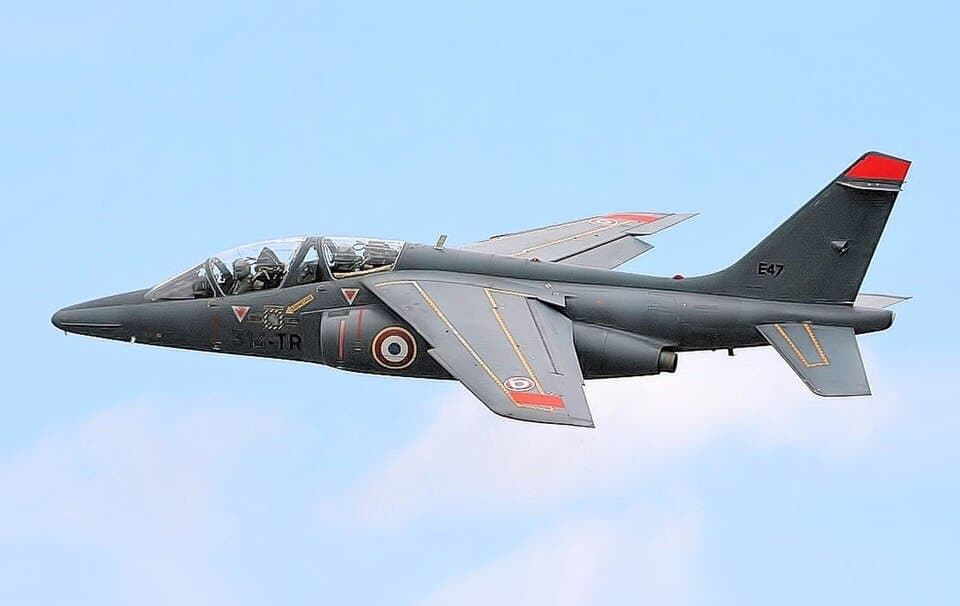
Credit
Tim Felce (Airwolfhound) · CC BY-SA 2.0 · Resized · CC BY-SA 2.0 · Source ↗ · Modified


Preparing your view.

At a glance
Measured figures
Close-support version · Length
Single source13.23 m (43 ft 5 in)[source]
Configuration
| Specification | Dassault/Dornier Alpha Jet | SIAI-Marchetti SF.260 |
|---|---|---|
| Type | Light attack and advanced trainer aircraft[source] | Trainer /Light attack[source] |
| National origin | France / West Germany[source] | Italy[source] |
| Manufacturer | Dassault Aviation / Dornier Flugzeugwerke[source] | SIAI-Marchetti Aermacchi Alenia Aermacchi Leonardo S.p.A.[source] |
| Status | In service[source] |
SF-260M · Length
7.10 m (23 ft 4 in)[source]
Empty; Close-support version · Empty weight
Single sourceGross; Close-support version · Gross weight
Single sourceMaximum take-off; Close-support version · Max takeoff weight
Single source3,515 kg (7,749 lb)[source]
5,000 kg (11,023 lb)[source]
7,500 kg (16,535 lb)[source]
Empty; SF-260M · Empty weight
Single sourceGross; SF-260M · Gross weight
Single sourceMaximum; Close-support version · at sea level
Single source1,000 km/h (620 mph, 540 kn) at sea level[source]
Ferry; Close-support version · with 2x 310 L (82 US gal; 68 imp gal) droptanks
Single source2,940 km (1,830 mi, 1,590 nmi) with 2x 310 L (82 US gal; 68 imp gal) droptanks[source]
SF-260M · 2 crew, with maximum fuel
Single source1,650 km (1,030 mi, 890 nmi) 2 crew, with maximum fuel[source]
Close-support version · lo-lo-lo profile, gun pod, underwing weapons and two drop tanks
Single source610 km (380 mi, 330 nmi) lo-lo-lo profile, gun pod, underwing weapons and two drop tanks[source]
SF-260M · 1 × Textron Lycoming O-540-E4A5 / Textron Lycoming AEIO-540-D4A5 6-cylinder air-cooled horizontally-opposed piston engine
Single source1 × Textron Lycoming O-540-E4A5 / Textron Lycoming AEIO-540-D4A5 6-cylinder air-cooled horizontally-opposed piston engine, 190 kW (260 hp)[source]
Close-support version · 2 × SNECMA Turbomeca Larzac 04-C5 turbofan engines thrust each
Single source2 × SNECMA Turbomeca Larzac 04-C5 turbofan engines, 13.24 kN (2,980 lbf) thrust each[source]
Close-support version · at high altitude
Single sourceClose-support version · internal fuel only at low altitude
Single source(internal fuel only) 2 hours 30 minutes at low altitude; 3 hours 30 minutes at high altitude[source]
Bars compare reported quantities only. A larger figure does not make a system better; configurations and test conditions differ.
In service[source] |
| Primary users | French Air and Space Force Top Aces Egyptian Air Force Royal Thai Air Force[source] | Italian Air Force Libyan Air Force Philippine Air Force Belgian Air Force[source] |
|---|
| Number built | 480[source] | 900 (2012)[source] |
|---|
| Manufactured | 1973–1991[source] | 1964–2017[source] |
|---|
| Introduction date | 4 November 1977[source] | April 1966 (FAA certification)[source] |
|---|
| First flight | 26 October 1973[source] | 15 July 1964[source] |
|---|
| Aspect ratio | 4.8[source] | 6.3:1 excluding tip-tanks[source] |
|---|
| Fuel capacity | 1,520 kg (3,351 lb)[source] | internal: 235 L (62 US gal; 52 imp gal) usable[source] |
|---|
| Stall speed | 167 km/h (104 mph, 90 kn) (flaps and undercarriage down)[source] | 126 km/h (78 mph, 68 kn) flaps and landing gear down[source] |
|---|
| g limits | +12 / -6.4 (ultimate)[source] | +6 -3 at max aerobatic T-O weight[source] |
|---|
| Time to altitude | 9,145 m (30,000 ft) in less than 7 minutes[source] | 1,500 m (4,900 ft) in 4 minutes 2,300 m (7,500 ft) in 6 minutes 50 seconds 3,000 m (9,800 ft) in 10 minutes[source] |
|---|
| Landing speed | 170 km/h (110 mph; 92 kn)[source] | — |
|---|
| Take-off run | 410 m (1,350 ft)[source] | 384 m (1,260 ft)[source] |
|---|
| Landing run | 610 m (2,000 ft)[source] | 345 m (1,132 ft)[source] |
|---|
| Guns | One 27 mm Mauser BK-27 cannon in centreline gun pack with 150 rounds or one 30 mm DEFA cannon in centreline pod with 150 rounds[source] | — |
|---|
| Hardpoints | 5 with a capacity of 2,500 kg (5,512 lb), with provisions to carry combinations of:[source] | — |
|---|
| Rockets | Two Matra rocket pods with eighteen SNEB 68 mm rockets each or two CRV7 rocket pods with nineteen 70 mm rockets each[source] | — |
|---|
| Missiles | Two AIM-9 Sidewinders ; two Matra Magic IIs ; two AGM-65 Mavericks[source] | — |
|---|
| Bombs | a variety of bombs (such as the Hunting BL755 cluster bomb )[source] | — |
|---|
| Other | Two 310 L (82 US gal; 68 imp gal) Drop tanks[source] | — |
|---|
| Role | light attack jet and advanced jet trainer co-manufactured[source] | Italian light aircraft[source] |
|---|
| Source measurement | Manufacture of Alpha Jet sub-assemblies was divided between France (Dassault), Germany (Dornier) and Belgium ( SABCA ), each country performing final assembly and checkout of the type in separate facilities. Dassault hosted the largest of these three assembly lines, typically producing 13 aircraft per month to meet the needs of French and export customers. It was reportedly capable of a maximum output of 15 Alpha Jets per month. The Dornier final assembly line typically maintained a maximum rate of six aircraft per month. In contrast to the final assembly arrangements, none of the three sources duplicated the manufacture of any component: Dassault-Breguet produced the front and center fuselage, Dornier constructed the wing, tail and rear fuselage, while SABCA manufactured the nose and flaps of the aircraft. A total of 4,500 people were employed in the manufacturing of the Alpha Jet in Germany, an equal number in France also worked on the programme.[source]Dassault/Dornier Alpha Jet · Development / Into production; only the objects and conditions stated in this passage The Alpha Jet is a light twin-engine aircraft equipped with an intentionally simple airframe despite the performance delivered. Both the leading edges and air intakes are fixed; while the aerodynamic shape of the aircraft, which was developed with the aid of computer aided design (CAD), conforms with the area rule . Fully powered controls are used, comprising a dual- hydraulic systems and load-factor limited dynamic feel system arrangement attached to conventional flight control surfaces . The cockpit is pressurised for greater comfort during training. The Alpha Jet is designed to accommodate ten-minute turn around times with minimal ground equipment, using features such as pressurised single-point refueling, ladder-less entry/exit of the cockpit, and a ten-hour endurance of the liquid oxygen system.[source]Dassault/Dornier Alpha Jet · Design; only the objects and conditions stated in this passage The Alpha Jet is powered by a pair of SNECMA Turbomeca Larzac turbofan engines. It is a low bypass-ratio, twin-spool engine that uses modular construction methods. The Larzac was a new engine at the time, having only performed its first run a year prior to being selected to power the Alpha Jet. The need for greater thrust to power the aircraft than the original model of the engine could generate led to the development and adoption of the 2,970 lb Larzac 04 in February 1972. This version of the engine initially powered the Alpha Jet.[source]Dassault/Dornier Alpha Jet · Design; only the objects and conditions stated in this passage The Alpha Jet was more complex than competing second generation trainer aircraft, requiring seven man hours of maintenance for every flight hour. Nearly 5,000lb of munitions and equipment can be carried on five hardpoints, four on the wings and one at the centerline on the lower fuselage. In an armed configuration, a gun pod containing a 30 mm DEFA cannon , as installed on French aircraft, or 27 mm Mauser BK-27 cannon , as installed on German aircraft, would typically be installed upon the centerline hard point.[source]Dassault/Dornier Alpha Jet · Design; only the objects and conditions stated in this passage In September 2014, Direction générale de l'armement (DGA) and French Air Force officials were reportedly investigating the Alenia Aermacchi M-346 Master as a replacement for the Alpha Jet. Alenia Aermacchi claimed that France was interested in procuring 35 M-346s in this capacity. In April 2015, the DGA issued an initial pre-solicitation request for a replacement trainer aircraft. Likely candidates for this requirement reportedly include the M-346 Master, Aero L-39 Albatros , Beechcraft T-6 Texan II and Pilatus PC-21 . The PC-21 was introduced in 2018.[source]Dassault/Dornier Alpha Jet · Operational history / France; only the objects and conditions stated in this passage During the early 1980s, an additional 15 aircraft, designated Alpha Jet MS2 , were ordered. The Alpha Jet MS2 bore high levels of similarity to Dassault's proposed Alpha Jet NGEA , featuring a Sagem -built Uliss 81 nav/attack system, a Thomson-CSF -built laser rangefinder and HUD, along with a digital multiplex databus . The Egyptian Air Force Alpha Jets were based at As Salahiya airbase in 308 (Close Air Support) Tactical Wing with 57 Squadron and 58 Squadron. In 2015 the 308 CAS Tactical Wing moved with both squadrons to El Mansoura airbase for ground attack training. The Egyptian Air Force used the Alpha Jet MS1 fleet to replace the Aero L-29 Delfín and Mikoyan-Gurevich MiG-15 in the trainer role, while the later-built MS2 standard aircraft served to replace the Mikoyan-Gurevich MiG-17 in the ground-attack role. In February 2000, Egypt was reportedly seeking to replace their Alpha Jet fleet, and was investigating several options, including the BAE Systems Hawk .[source]Dassault/Dornier Alpha Jet · Operational history / Egypt; only the objects and conditions stated in this passage Nigerian Air Force (Alpha Jet E) – 24 acquired. 4 upgraded in 2011, 9 more reactivated. 11 in service.[source]Dassault/Dornier Alpha Jet · Operators; only the objects and conditions stated in this passage Length: 13.23 m (43 ft 5 in)[source]Dassault/Dornier Alpha Jet · Specifications (Close-support version); only the objects and conditions stated in this passage Wingspan: 9.11 m (29 ft 11 in)[source]Dassault/Dornier Alpha Jet · Specifications (Close-support version); only the objects and conditions stated in this passage Height: 4.19 m (13 ft 9 in)[source]Dassault/Dornier Alpha Jet · Specifications (Close-support version); only the objects and conditions stated in this passage Wing area: 17.5 m 2 (188 sq ft)[source]Dassault/Dornier Alpha Jet · Specifications (Close-support version); only the objects and conditions stated in this passage Empty weight: 3,515 kg (7,749 lb)[source]Dassault/Dornier Alpha Jet · Specifications (Close-support version); only the objects and conditions stated in this passage Gross weight: 5,000 kg (11,023 lb)[source]Dassault/Dornier Alpha Jet · Specifications (Close-support version); only the objects and conditions stated in this passage Max takeoff weight: 7,500 kg (16,535 lb)[source]Dassault/Dornier Alpha Jet · Specifications (Close-support version); only the objects and conditions stated in this passage Fuel capacity: 1,520 kg (3,351 lb)[source]Dassault/Dornier Alpha Jet · Specifications (Close-support version); only the objects and conditions stated in this passage Powerplant: 2 × SNECMA Turbomeca Larzac 04-C5 turbofan engines, 13.24 kN (2,980 lbf) thrust each[source]Dassault/Dornier Alpha Jet · Specifications (Close-support version); only the objects and conditions stated in this passage Maximum speed: 1,000 km/h (620 mph, 540 kn) at sea level[source]Dassault/Dornier Alpha Jet · Specifications (Close-support version); only the objects and conditions stated in this passage Stall speed: 167 km/h (104 mph, 90 kn) (flaps and undercarriage down)[source]Dassault/Dornier Alpha Jet · Specifications (Close-support version); only the objects and conditions stated in this passage 216 km/h (134 mph; 117 kn) (flaps and undercarriage up)[source]Dassault/Dornier Alpha Jet · Specifications (Close-support version); only the objects and conditions stated in this passage Combat range: 610 km (380 mi, 330 nmi) lo-lo-lo profile, gun pod, underwing weapons and two drop tanks[source]Dassault/Dornier Alpha Jet · Specifications (Close-support version); only the objects and conditions stated in this passage 1,095 km (680 mi; 591 nmi) hi-lo-hi profile, gun pod, underwing weapons and two drop tanks[source]Dassault/Dornier Alpha Jet · Specifications (Close-support version); only the objects and conditions stated in this passage Ferry range: 2,940 km (1,830 mi, 1,590 nmi) with 2x 310 L (82 US gal; 68 imp gal) droptanks[source]Dassault/Dornier Alpha Jet · Specifications (Close-support version); only the objects and conditions stated in this passage Endurance: (internal fuel only) 2 hours 30 minutes at low altitude; 3 hours 30 minutes at high altitude[source]Dassault/Dornier Alpha Jet · Specifications (Close-support version); only the objects and conditions stated in this passage Service ceiling: 14,630 m (48,000 ft)[source]Dassault/Dornier Alpha Jet · Specifications (Close-support version); only the objects and conditions stated in this passage Rate of climb: 57 m/s (11,200 ft/min) max[source]Dassault/Dornier Alpha Jet · Specifications (Close-support version); only the objects and conditions stated in this passage Time to altitude: 9,145 m (30,000 ft) in less than 7 minutes[source]Dassault/Dornier Alpha Jet · Specifications (Close-support version); only the objects and conditions stated in this passage Landing speed: 170 km/h (110 mph; 92 kn)[source]Dassault/Dornier Alpha Jet · Specifications (Close-support version); only the objects and conditions stated in this passage Take-off run: 410 m (1,350 ft)[source]Dassault/Dornier Alpha Jet · Specifications (Close-support version); only the objects and conditions stated in this passage Landing run: 610 m (2,000 ft)[source]Dassault/Dornier Alpha Jet · Specifications (Close-support version); only the objects and conditions stated in this passage Guns: One 27 mm Mauser BK-27 cannon in centreline gun pack with 150 rounds or one 30 mm DEFA cannon in centreline pod with 150 rounds[source]Dassault/Dornier Alpha Jet · Specifications (Close-support version); only the objects and conditions stated in this passage Hardpoints: 5 with a capacity of 2,500 kg (5,512 lb), with provisions to carry combinations of: Rockets: Two Matra rocket pods with eighteen SNEB 68 mm rockets each or two CRV7 rocket pods with nineteen 70 mm rockets each Missiles: Two AIM-9 Sidewinders ; two Matra Magic IIs ; two AGM-65 Mavericks Bombs: a variety of bombs (such as the Hunting BL755 cluster bomb ) Other: Two 310 L (82 US gal; 68 imp gal) Drop tanks[source]Dassault/Dornier Alpha Jet · Specifications (Close-support version); only the objects and conditions stated in this passage | The original model of the SF.260 was powered by a single Lycoming O-540 engine, capable of providing 260 hp. The standard engine made use of a carburetor , while a fuel injected engine was available as an optional extra. The SF.260 has been described as having the power to be immune to the gyration-like effects of turbulence and possessing a high rate of climb. During the 1980s, aerospace publication Flying stated the SF.260 to be: "the fastest normally aspirated piston single in production". The SF.260 holds the airspeed records for aircraft in its class over the 100 km (62 mi) and 1,000 km (620 mi) closed circuits. Later-built models often made use of turboprop engines; the initial model to be equipped as such, designated as the SF.260TP , was powered by a single Allison Model 250 engine, flat-rated at 350 shp.[source]SIAI-Marchetti SF.260 · Design; only the objects and conditions stated in this passage The pilot and up to two passengers (or pilot and one student in trainer versions) are accommodated under a broad, extensively glazed canopy . The pilot, who accesses the aircraft via purpose-built walkways along the wing, would be typically seated on the right-hand side of the cockpit; military pilots are trained to control the aircraft using their right hand on the stick and their left on the throttle.[source]SIAI-Marchetti SF.260 · Design; only the objects and conditions stated in this passage The SF.260WL was intended for pilot training, but was also used for ground support during the war in Chad . Dozens of Italian pilots served as instructors for Libyan cadets from 1977. Their number decreased in 1982, as they were supplemented by a group of 15 Libyan instructors, who had been trained at SIAI Marchetti's facilities in Italy. Libyan SF.260s played an important role during the country's involvement in Chad. They were used as light ground attack aircraft, using machine gun pods, rockets and bombs. Their first known actions took place in February 1978, when they participated in air strikes on the Chadian army garrison of Faya-Largeau together with Mil Mi-25 helicopters. As a result of the sustained bombardment, the majority of the 5,000 troops deployed there fled, and around 1,500 of them were taken prisoners on February 18.[source] |
|---|
| Designer | — | Stelio Frati[source] |
|---|
| Capacity | — | 1 passenger[source] |
|---|
| Airfoil | — | root: NACA 641 1 -212 (modified); tip: NACA 641 1 -210 (modified)[source] |
|---|
| Propellers | — | 2-bladed Hartzell HC-C2YK-1BF/8477-8R constant-speed propeller , 1.93 m (6 ft 4 in) diameter[source] |
|---|
| Never exceed speed | — | 436 km/h (271 mph, 235 kn)[source] |
|---|
| Take-off run to 15 m (50 ft) | — | 606 m (1,988 ft)[source] |
|---|
| Landing run from 15 m (50 ft) | — | 606 m (1,988 ft)[source] |
|---|
Maximum take-off; SF-260M · Max takeoff weight
Single sourceAfter continuing the advance towards the south, by late November, pro-Libyan units had reached Dougia, only 60 kilometres north of N'Djamena. Libyan SF.260s were forward-deployed there, together with Mi-25s. On 8 December, these aircraft, joined on 12 December by Tu-22 bombers, D-30 howitzers , and M-46 field guns , started attacking N'Djamena. The week-long bombing caused a huge amount of destruction in the Chadian capital, and a number of civilian casualties that remains unknown today. After Habré fled to Cameroon , resistance collapsed and his surviving fighters escaped to Sudan .[source]SIAI-Marchetti SF.260 · Operational history / Libya; only the objects and conditions stated in this passage
F.250 – first prototype powered by 187 kW (250 hp) Lycoming O-540 -AID. The prototype, regn. I-ZUAR, was destroyed in a crash at Sestri Ponente , Genoa on 7 November 1965.[source]SIAI-Marchetti SF.260 · Variants / Aviamilano; only the objects and conditions stated in this passage
F.260 – two prototypes powered by 194 kW (260 hp) Lycoming O-540-E4A5[source]SIAI-Marchetti SF.260 · Variants / Aviamilano; only the objects and conditions stated in this passage
Royal Thai Air Force , 18 SF-260M (1973–1999)[source]SIAI-Marchetti SF.260 · Operators / Former military operators; only the objects and conditions stated in this passage
Length: 7.10 m (23 ft 4 in)[source]SIAI-Marchetti SF.260 · Specifications (SF-260M); only the objects and conditions stated in this passage
Wingspan: 8.35 m (27 ft 5 in) over tip-tanks[source]SIAI-Marchetti SF.260 · Specifications (SF-260M); only the objects and conditions stated in this passage
Height: 2.41 m (7 ft 11 in)[source]SIAI-Marchetti SF.260 · Specifications (SF-260M); only the objects and conditions stated in this passage
Wing area: 10.10 m 2 (108.7 sq ft)[source]SIAI-Marchetti SF.260 · Specifications (SF-260M); only the objects and conditions stated in this passage
Empty weight: 755 kg (1,664 lb)[source]SIAI-Marchetti SF.260 · Specifications (SF-260M); only the objects and conditions stated in this passage
Gross weight: 1,140 kg (2,513 lb)[source]SIAI-Marchetti SF.260 · Specifications (SF-260M); only the objects and conditions stated in this passage
Max takeoff weight: 1,200 kg (2,646 lb)[source]SIAI-Marchetti SF.260 · Specifications (SF-260M); only the objects and conditions stated in this passage
Powerplant: 1 × Textron Lycoming O-540-E4A5 / Textron Lycoming AEIO-540-D4A5 6-cylinder air-cooled horizontally-opposed piston engine, 190 kW (260 hp)[source]SIAI-Marchetti SF.260 · Specifications (SF-260M); only the objects and conditions stated in this passage
Propellers: 2-bladed Hartzell HC-C2YK-1BF/8477-8R constant-speed propeller , 1.93 m (6 ft 4 in) diameter[source]SIAI-Marchetti SF.260 · Specifications (SF-260M); only the objects and conditions stated in this passage
Maximum speed: 333 km/h (207 mph, 180 kn) at sea level[source]SIAI-Marchetti SF.260 · Specifications (SF-260M); only the objects and conditions stated in this passage
Cruise speed: 300 km/h (190 mph, 160 kn) at 75% power at 1,500 m (4,900 ft)[source]SIAI-Marchetti SF.260 · Specifications (SF-260M); only the objects and conditions stated in this passage
Stall speed: 126 km/h (78 mph, 68 kn) flaps and landing gear down[source]SIAI-Marchetti SF.260 · Specifications (SF-260M); only the objects and conditions stated in this passage
Never exceed speed : 436 km/h (271 mph, 235 kn)[source]SIAI-Marchetti SF.260 · Specifications (SF-260M); only the objects and conditions stated in this passage
Range: 1,650 km (1,030 mi, 890 nmi) 2 crew, with maximum fuel[source]SIAI-Marchetti SF.260 · Specifications (SF-260M); only the objects and conditions stated in this passage
Service ceiling: 4,700 m (15,300 ft)[source]SIAI-Marchetti SF.260 · Specifications (SF-260M); only the objects and conditions stated in this passage
Rate of climb: 7.6 m/s (1,500 ft/min)[source]SIAI-Marchetti SF.260 · Specifications (SF-260M); only the objects and conditions stated in this passage
Take-off run: 384 m (1,260 ft)[source]SIAI-Marchetti SF.260 · Specifications (SF-260M); only the objects and conditions stated in this passage
Landing run: 345 m (1,132 ft)[source]SIAI-Marchetti SF.260 · Specifications (SF-260M); only the objects and conditions stated in this passage
Take-off run to 15 m (50 ft): 606 m (1,988 ft)[source]SIAI-Marchetti SF.260 · Specifications (SF-260M); only the objects and conditions stated in this passage
Landing run from 15 m (50 ft): 606 m (1,988 ft)[source]SIAI-Marchetti SF.260 · Specifications (SF-260M); only the objects and conditions stated in this passage