
FORCETALLY
Loading the evidence…
Preparing your view.


Preparing your view.
At a glance
D-74 122 mm field gunlarger figure on 5 of 5
Measured figures
Length
Single source9.875 m (30 ft)[source]
Length
Single sourceConfiguration
| Specification | D-74 122 mm field gun | SPG-9 |
|---|---|---|
| Type | Field gun[source] | Recoilless gun Anti-tank gun[source] |
| Place of origin | Soviet Union[source] | Soviet Union[source] |
| Used by | Various[source] | — |
| Wars | Vietnam War Sino-Vietnamese War Sino-Soviet border conflict Indo-Pakistani War of 1965 Sino-Indian War Yom Kippur War Iran–Iraq War Lebanese Civil War South African Border War Russo-Ukrainian War[source] | Vietnam War Iran–Iraq War Salvadoran Civil War Lord's Resistance Army insurgency Gulf War Lebanese Civil War Iraq War Second Sudanese Civil War Third Sudanese Civil War Libyan Civil Wars Northern Mali conflict Syrian Civil War War in Iraq (2013-2017) War in Donbas Yemeni Civil War (2014–present) Saudi Arabian-led intervention in Yemen 2022 Kyrgyzstan–Tajikistan clashes Russo-Ukraine War Gaza war |
Counts only measures both sources give with the same scope. A larger figure is not a better system.
2.11 m (6 ft 11 in)[source]
Maximum; Maximum firing range
Single sourceEffective; Direct
Single sourceEffective; Indirect
Single sourceIndirect: 23.9 km (15 mi) Direct: 1.08 km (.67 mi)[source]
24 km (15 mi)[source]
Maximum; Maximum firing range
Single sourceEffective; Effective firing range
Single sourceBars compare reported quantities only. A larger figure does not make a system better; configurations and test conditions differ.
| Designed | 1944[source] | — |
|---|
| Produced | 1955[source] | — |
|---|
| Shell | Separate loading charge and projectile[source] | — |
|---|
| Breech | Semi-automatic vertical sliding-wedge[source] | Interrupted screw[source] |
|---|
| Recoil | Hydro-pneumatic[source] | None[source] |
|---|
| Carriage | Split-trail[source] | Tripod[source] |
|---|
| Elevation | +45/−5 degree[source] | +7°/−3°[source] |
|---|
| Traverse | 45 degree[source] | 30° total[source] |
|---|
| Former operator · Democratic Republic of Afghanistan | Democratic Republic of Afghanistan[source] | — |
|---|
| Former operator · Burkina Faso | Burkina Faso[source] | — |
|---|
| Former operator · Cambodia | Cambodia[source] | — |
|---|
| Former operator · Cuba | Cuba[source] | — |
|---|
| Former operator · Egypt | Egypt[source] | — |
|---|
| Former operator · Islamic State | Islamic State[source] | — |
|---|
| Former operator · Pakistan | Pakistan[source] | — |
|---|
| Former operator · Soviet Union | Soviet Union[source] | — |
|---|
| Role | Soviet field gun[source] | tripod-mounted man-portable, 73mm caliber recoilless gun[source] |
|---|
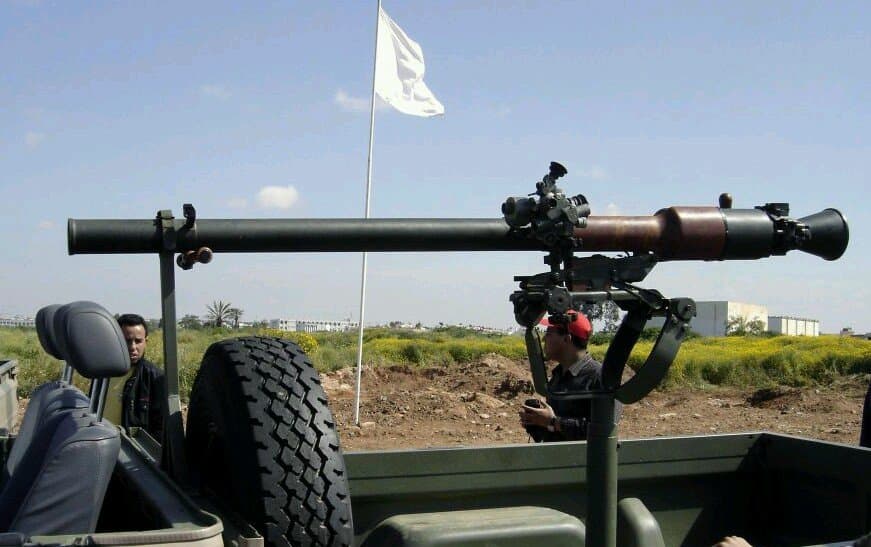
| Source measurement | The 122mm D-74 towed gun is a Soviet field gun. Developed in the late 1940s, it served with the Soviet Army and was widely exported. A number were produced under license in the People's Republic of China as the Type 60 .[source]D-74 122 mm field gun · Lead; only the objects and conditions stated in this passage The 122 mm (originally 48 lines ) calibre has been in Russian service since the early 20th century. After World War II the Soviet Union developed two new long range guns to replace existing 122 mm and 152 mm guns such as 122 mm gun M1931 (A-19) , 122 mm gun M1931/37 (A-19) , 152 mm gun M1910/30 and 152 mm gun M1935 (Br-2) . The two new guns were the 122 mm D-74 and the 130 mm M-46 .[source]D-74 122 mm field gun · History; only the objects and conditions stated in this passage The D-74 design was probably initiated in the late 1940s and it was first seen in public in 1955. It was designed by the well established design bureau at Artillery Plant No. 9 in Sverdlovsk (now Motovilikha Plants in Yekaterinburg), led by the eminent artillery designer Fëdor Fëdorovich Petrov who was also responsible for several World War II and later artillery designs. The design team also developed the 152 mm gun howitzer D-20 at much the same time, and both D-74 and D-20 use the same carriage.[source]D-74 122 mm field gun · History; only the objects and conditions stated in this passage Both the 122 mm D-74 and 130 mm M-46 entered Soviet service, but the heavier shell and greater range of the M-46 meant that it outlasted the D-74.[source]D-74 122 mm field gun · History; only the objects and conditions stated in this passage Top traverse totals 60° and the vertical elevation range in −5° to 50°.[source]D-74 122 mm field gun · Description; only the objects and conditions stated in this passage The non-reciprocating sights are designed for one-person laying. Included are a direct fire anti-tank telescope (OP4M), a panoramic periscopic indirect-fire sight, a dial sight, (PG1M), an angle of sight scale, and a range drum for the single charge engraved with the range (distance) scale, coupled to an elevation levelling bubble mounted on dial sight mount. The range drum enables the standard Soviet technique of semi-direct fire when the piece is laid visually on the target and the range set on the range drum.[source]D-74 122 mm field gun · Description; only the objects and conditions stated in this passage The gun fires separate ammunition using a metal cartridge case that also provides obturation. The ammunition is different to that used with 122 mm howitzers. There is a single charge without increments. The shell weight is 25 kg with a muzzle velocity of 900 m/s although the slightly lighter APHE shell has a higher muzzle velocity.[source]D-74 122 mm field gun · Description; only the objects and conditions stated in this passage Maximum rate of fire is usually stated as six rounds per minute.[source]D-74 122 mm field gun · Description; only the objects and conditions stated in this passage The detachment was either eight or nine men, probably differing between armies and period. In Soviet service the 5,600 kg gun was usually towed by a URAL-375 6×6 truck, AT-S or AT-L medium tractor in some regions.[source]D-74 122 mm field gun · Description; only the objects and conditions stated in this passage | The SPG-9 Kop'yo ( Russian : СПГ-9 Копьё , transliterated: Stankovyi Protivotankovyi Granatomet "Kop'yo" - Easel Anti-tank Grenade Launcher "Spear") is a tripod-mounted man-portable, 73mm caliber recoilless gun developed by the Soviet Union . It fires fin-stabilized, rocket-assisted high explosive (HE) and high-explosive anti-tank (HEAT) shaped charge projectiles similar to those fired by the 73mm 2A28 Grom low pressure gun of the BMP-1 armored vehicle. It was accepted into service in 1962, replacing the B-10 recoilless rifle .[source]SPG-9 · Lead; only the objects and conditions stated in this passage The projectile is launched from the gun by a small charge, which gives it an initial velocity of between 250–400 metres per second (820–1,310 ft/s). The launch charge also imparts spin to the projectile by a series of offset holes. Once the projectile has traveled approximately 20 metres (66 ft) from the launcher, a rocket motor in its base ignites. For the PG-9 projectile, this takes it to a velocity of 700 metres per second (2,300 ft/s) before the motor burns out.[source]SPG-9 · Description; only the objects and conditions stated in this passage The SPG-9 is heavy, ~60 kilograms (130 lb), and normally transported by vehicle, and carried into position by its two person crew. It can be deployed in about a minute. The weapon is in service with a large number of armed forces, and a variety of ammunition is produced; however, they are mostly copies of the original Soviet PG-9 HEAT and OG-9 fragmentation high explosive (Frag-HE) rounds.[source]SPG-9 · Description; only the objects and conditions stated in this passage |
|---|
| Country of origin | Soviet Union[source]Inventory Origin column; table 1, row 34, cell 5; revision 1370067933; retrieved 2026-10-01 | — |
|---|
| In service | — | 1962–present[source] |
|---|
| Feed system | — | Manually breech-loaded[source] |
|---|
| Sights | — | PGO-9 optical 4× sight or PGN-9 IR and passive night sight[source] |
|---|
| Reported operators |
|
|
|---|