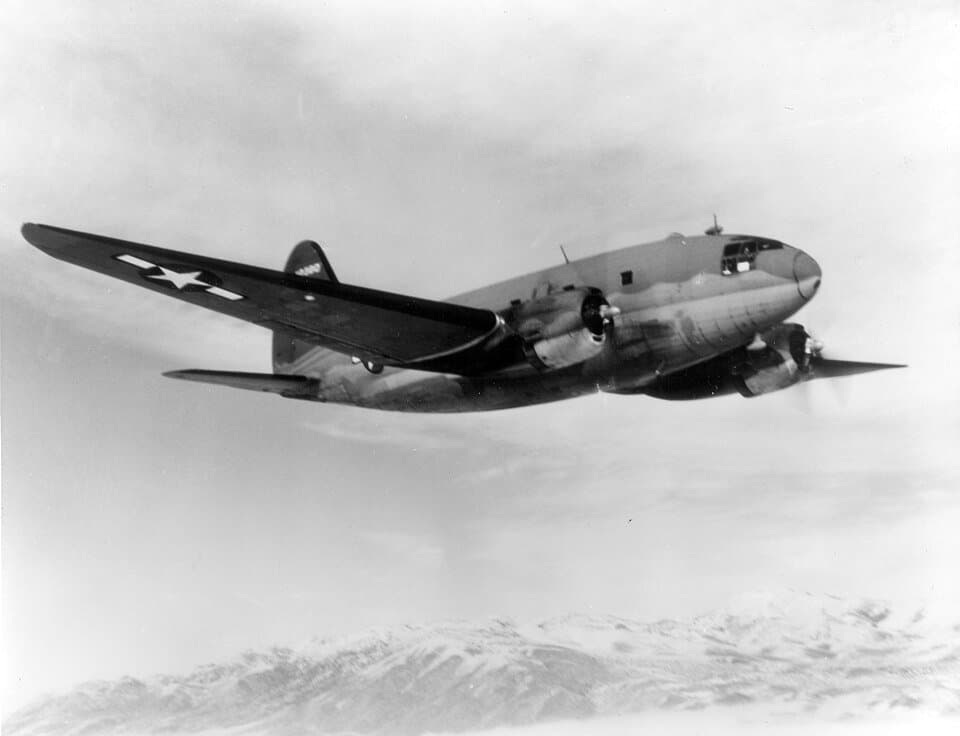

Credit
usaf · Public domain · Resized · Public domain · Source ↗ · Modified


Preparing your view.

At a glance
True scale
Side by side. From every angle. A human reference for perspective.
3.41 MB · Loads when you open it| Model | Length | Width / span | Height |
|---|---|---|---|
| Curtiss C-46 Commando | ≈ 23.27 m | ≈ 32.92 m (Width) | ≈ 6.63 m |
| Kawasaki C-1 | ≈ 29 m | ≈ 30.6 m (Width) | ≈ 9.99 m |
Scaled uniformly to the sourced length of 23.27 m. The shape was turned square to the axes; the height was fitted to the sourced 6.63 m; the width was fitted to the sourced 32.92 m. Not an official model or a measured survey.
ForceTally · All rights reserved
Scaled uniformly to the sourced length of 29 m. The shape was turned square to the axes; the height was fitted to the sourced 9.99 m; the width was fitted to the sourced 30.6 m. Not an official model or a measured survey.
ForceTally · All rights reserved
The human reference is a generic 1.75 m figure. Models describe external size, not combat performance.
Measured figures
C-46A · Length
Single source76 ft 4 in (23.27 m)[source]
Configuration
| Specification | Curtiss C-46 Commando | Kawasaki C-1 |
|---|---|---|
| Crew | 4 or 5[source] | 2 flight crew and 3 mission crew[source] |
| Type | Military transport aircraft[source] | Military transport aircraft[source] |
| National origin | United States[source] | Japan[source] |
| Manufacturer | Curtiss-Wright Higgins Aircraft[source] | Kawasaki Heavy Industries |
Kawasaki C-1 · Length
29 m (95 ft 2 in)[source]
Empty; C-46A · Empty weight
Single sourceGross; C-46A · Gross weight
Single sourceMaximum take-off; C-46A Commando · maximum takeoff weight · C-46A Commando · maximum takeoff weight
Single source30,669 lb (13,911 kg)[source]
45,000 lb (20,412 kg)[source]
45,000 lb.[source]C-46A Commando · maximum takeoff weight
Empty; Kawasaki C-1 · Empty weight
Single sourceMaximum take-off; Kawasaki C-1 · Max takeoff weight
Single sourceCruise; C-46A · Cruise speed
Single sourceMaximum; C-46A · at 15,000 ft (4,600 m)
Single source270 mph (430 km/h, 230 kn) at 15,000 ft (4,600 m)[source]
173 mph (278 km/h, 150 kn)[source]
Cruise; Kawasaki C-1 · at 10,670 m (35,010 ft) at 35,450 kg (78,150 lb)
Single sourceMaximum; Kawasaki C-1 · at 7,620 m (25,000 ft) at 35,450 kg (78,150 lb)
Single sourceC-46A · at 173 mph (150 kn; 278 km/h)
Single sourceC-46A · at 237 mph (206 kn; 381 km/h)
Single source3,150 mi (5,070 km, 2,740 nmi) at 173 mph (150 kn; 278 km/h); 1,000 mi (870 nmi; 1,600 km) at 237 mph (206 kn; 381 km/h)[source]
Kawasaki C-1 · with max fuel & 2,300 kg (5,100 lb) payload
Single source3,353 km (2,083 mi, 1,810 nmi) with max fuel & 2,300 kg (5,100 lb) payload[source]
C-46A · 2 × Pratt & Whitney R-2800-51 Double Wasp 18-cylinder air-cooled radial piston engines each
Single source2 × Pratt & Whitney R-2800-51 Double Wasp 18-cylinder air-cooled radial piston engines, 2,000 hp (1,500 kW) each[source]
Kawasaki C-1 · 2 × Pratt & Whitney JT8D -M-9 ( Mitsubishi -built) low-bypass turbofans thrust each
Single source2 × Pratt & Whitney JT8D -M-9 ( Mitsubishi -built) low-bypass turbofans , 64 kN (14,500 lbf) thrust each[source]
Kawasaki C-1 · (3,494 ft/min) at sea level
Single source17.75 m/s (3,494 ft/min) at sea level[source]
Bars compare reported quantities only. A larger figure does not make a system better; configurations and test conditions differ.
| Status | Active in limited civilian use[source] | Retired[source] |
|---|
| Primary users | Buffalo Airways United States Air Force United States Marine Corps United States Navy[source] | — |
|---|
| Number built | 3,181[source] | 31[source] |
|---|
| Manufactured | 1940–1945[source] | — |
|---|
| Introduction date | 1941[source] | December 1974[source] |
|---|
| First flight | 26 March 1940[source] | 12 November 1970[source] |
|---|
| Capacity | 40 troops or 30 stretcher patients or 15,000 lb (6,800 kg) cargo[source] | 8,000 kg (18,000 lb) normal payload[source] |
|---|
| Airfoil | root: NACA 23017 ; tip: NACA 4410.5[source] | — |
|---|
| Propellers | 4-bladed Curtiss Electric constant-speed propellers[source] | — |
|---|
| Time to altitude | 10,000 ft (3,000 m) in 17 minutes 24 seconds[source] | — |
|---|
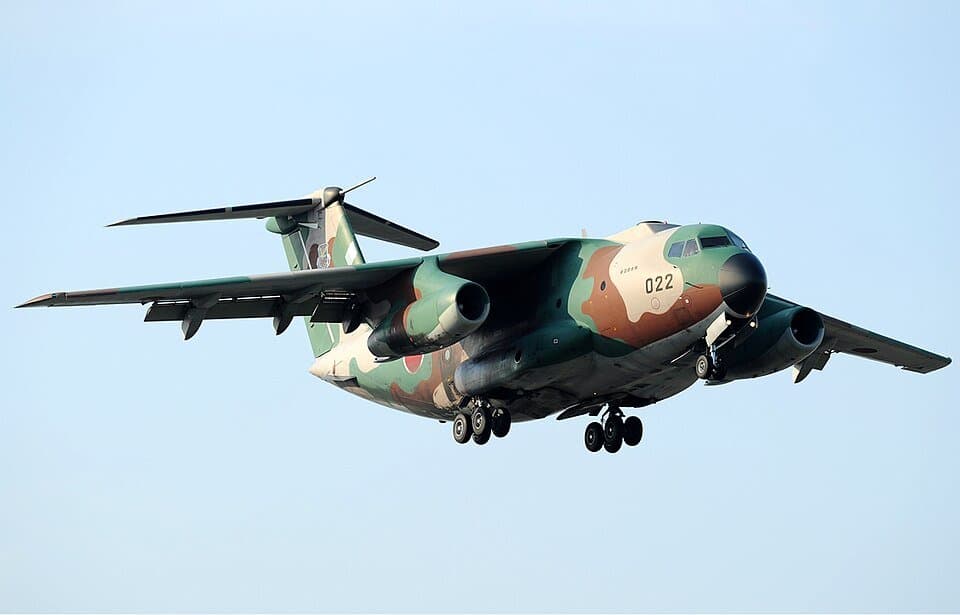
| Source measurement | The Curtiss C-46 Commando is a low-wing , twin-engine aircraft derived from the Curtiss CW-20 pressurized high-altitude airliner design. Early press reports used the name "Condor III" but the Commando name was in use by early 1942 in company publicity. It was used primarily as a cargo aircraft during World War II , with fold-down seating for military transport and some use in delivering paratroops. Mainly deployed by the United States Army Air Forces , it also served the U.S. Navy / Marine Corps , which called it R5C . The C-46 filled similar roles as its Douglas-built counterpart, the C-47 Skytrain , with some 3,200 C-46s produced to approximately 10,200 C-47s.[source]Curtiss C-46 Commando · Lead; only the objects and conditions stated in this passage The company approached many airlines to obtain their requirements for an advanced airliner. No firm orders resulted, although 25 letters of intent were received, sufficient to begin production. The design of a 24–34 passenger airliner proceeded to the prototype stage as the CW-20 at the St. Louis, Missouri facility with the initial configuration featuring twin vertical tail surfaces. Powered by two 1,700 hp (1,300 kW ) R-2600-C14-BA2 Wright Twin Cyclones , the prototype, registered NX-19436 flew for the first time on 26 March 1940 with test pilot Edmund T. "Eddie" Allen at the controls. After testing, modifications, including the fitting of a large single tail to improve stability at low speeds were made.[source]Curtiss C-46 Commando · Design and development; only the objects and conditions stated in this passage A total of 200 C-46As in two batches were ordered in 1940, although only two were actually delivered by 7 December 1941. An important change was made: more powerful 2,000 hp (1,500 kW)c Pratt & Whitney R-2800 Double Wasp engines replaced the Twin Cyclones. By November 1943, 721 modifications had been made to production models, although many were minor, such as fuel system changes and a reduction in cabin windows. Subsequent military contracts for the C-46A extended the production run to 1,454 examples, 40 of which were destined for the U.S. Marine Corps, to be called R5C-1 . The military model was fitted with double cargo doors, a strengthened floor and a hydraulically operated cargo handling winch; 40 folding seats were the sole passenger accommodation for what was essentially a cargo hauler. Two C-46 were delivered from Higgins Industries Michoud Factory Field in 1942.[source]Curtiss C-46 Commando · Design and development; only the objects and conditions stated in this passage The final large production-run C-46D arrived in 1944–45 and featured single doors to facilitate paratroop drops. Production totaled 1,430 aircraft. Although a one-off XC-46B experimented with a stepped windscreen and more powerful engines, a small run of 17 C-46E s had many of the same features as the XC-46B, along with three-bladed Hamilton-Standard propellers replacing the standard Curtiss-Electric four-bladed units. A last contract for 234 C-46F s reverted to the earlier cockpit shape but introduced square wing tips. A sole C-46G had the stepped windscreen and square wing tips but the end of the war resulted in the cancellation of any additional orders for the type.[source]Curtiss C-46 Commando · Design and development; only the objects and conditions stated in this passage Its powerful engines enabled it to climb satisfactorily with heavy loads, staying aloft on one engine if not overloaded, though "war emergency" load limits of up to 40,000 lb (18,000 kg) often erased any safety margins.[source]Curtiss C-46 Commando · Operational history / Pacific Theater; only the objects and conditions stated in this passage The operation's paratroop drop phase was flown in daylight at low speeds at very low altitudes by an unarmed cargo aircraft without self-sealing fuel tanks , over heavy concentrations of German 20 mm, 37 mm and larger caliber anti-aircraft (AA) cannon firing explosive, incendiary and armor-piercing incendiary ammunition.[source]Curtiss C-46 Commando · Operational history / Europe; only the objects and conditions stated in this passage Indeed, Eastern Air Lines lost only one C-46 in more than two years of operation.[source]Curtiss C-46 Commando · Operational history / Design shortcomings; only the objects and conditions stated in this passage The type served in the Central Intelligence Agency (CIA). The C-46 played a supporting role in many clandestine operations during the late 1940s and early 1950s, including supply efforts to Chiang Kai-Shek 's troops battling Mao 's Communists in China as well as flying cargoes of military and medical supplies to French forces via Gialam Airfield in Hanoi and other bases in French Indochina. The CIA operated its own "airline" for these operations, Civil Air Transport, which was eventually renamed Air America in 1959. An Air America C-46 was the last fixed-wing aircraft flown out of Vietnam [Saigon] at the close of hostilities there. On 29 April 1975, Capt. E. G. Adams flew a 52-seat version, with 152 people on board, to Bangkok, Thailand .[source]Curtiss C-46 Commando · Operational history / Postwar / Operators; only the objects and conditions stated in this passage Prices for a used C-46 in 1960 ranged from £20,000 for a C-46F conversion, to £60,000 for a C-46R.[source]Curtiss C-46 Commando · Operational history / Postwar / Operators; only the objects and conditions stated in this passage Company designation for the C-46G .[source]Curtiss C-46 Commando · Variants; only the objects and conditions stated in this passage CW-20G[source]Curtiss C-46 Commando · Variants; only the objects and conditions stated in this passage CW-20H[source]Curtiss C-46 Commando · Variants; only the objects and conditions stated in this passage 1. The original passenger airliner prototype, fitted with a dihedralled tailplane and endplate fins, powered by two 1,700 hp (1,300 kW) Wright R-2600 Twin Cyclone radial piston engines .[source]Curtiss C-46 Commando · Variants; only the objects and conditions stated in this passage Twin-engined military transport aircraft, powered by two 2,000 hp (1,500 kW) Pratt & Whitney R-2800-43 radial piston engines.[source]Curtiss C-46 Commando · Variants; only the objects and conditions stated in this passage Twin-engined military transport aircraft, powered by two 2,000 hp Pratt & Whitney R-2800-51 radial piston engines, fitted with a large cargo door on the port side of the fuselage, equipped with strengthened cargo floor, a hydraulic winch and folding seats for up to 40 troops.[source]Curtiss C-46 Commando · Variants; only the objects and conditions stated in this passage One C-46A was converted into a test aircraft to evaluate a stepped windscreen design, it was powered by two 2,100 hp (1,600 kW) R-2800-34W radial piston engines with water injection.[source]Curtiss C-46 Commando · Variants; only the objects and conditions stated in this passage Redesignated from C-46G, later redesignated XC-113.[source]Curtiss C-46 Commando · Variants; only the objects and conditions stated in this passage 17 C-46Ds modified with a large single cargo door on the port side of the fuselage, fitted with a stepped windscreen and 2,000 hp R-2800-75 engines with 3-bladed Hamilton Standard propellers.[source]Curtiss C-46 Commando · Variants; only the objects and conditions stated in this passage C-46G Commando[source]Curtiss C-46 Commando · Variants; only the objects and conditions stated in this passage C-46H[source]Curtiss C-46 Commando · Variants; only the objects and conditions stated in this passage More powerful version of C-46F, equipped with twin tail wheels, 300 ordered but later cancelled. One C-46A was modified to C-46H standard after WWII.[source]Curtiss C-46 Commando · Variants; only the objects and conditions stated in this passage Unbuilt version, intended to be powered by two 2,500 hp (1,900 kW) Wright R-3350-BD radial piston engines.[source]Curtiss C-46 Commando · Variants; only the objects and conditions stated in this passage Conversion project for C-46F with two 2,500 hp Wright R-3350-BD engines.[source]Curtiss C-46 Commando · Variants; only the objects and conditions stated in this passage Mid 1950s modification in response to CAB certification mandate (see text) offered by Riddle Airlines , which added 40 mph (64 km/h) to cruising speed and 2,200 lb (1,000 kg) to the payload.[source]Curtiss C-46 Commando · Variants; only the objects and conditions stated in this passage Engine change: One C-46G, s/n 44-78945, was converted into an engine testbed, the aircraft was fitted with a General Electric T31 turboprop in place of right-hand side R-2800. The aircraft handled so poorly on the ground that it was never flown.[source]Curtiss C-46 Commando · Variants; only the objects and conditions stated in this passage Capacity: 40 troops or 30 stretcher patients or 15,000 lb (6,800 kg) cargo[source]Curtiss C-46 Commando · Specifications (C-46A); only the objects and conditions stated in this passage Length: 76 ft 4 in (23.27 m)[source]Curtiss C-46 Commando · Specifications (C-46A); only the objects and conditions stated in this passage Wingspan: 108 ft 0 in (32.92 m)[source]Curtiss C-46 Commando · Specifications (C-46A); only the objects and conditions stated in this passage Height: 21 ft 9 in (6.63 m)[source]Curtiss C-46 Commando · Specifications (C-46A); only the objects and conditions stated in this passage Wing area: 1,360 sq ft (126 m 2 )[source]Curtiss C-46 Commando · Specifications (C-46A); only the objects and conditions stated in this passage Empty weight: 30,669 lb (13,911 kg)[source]Curtiss C-46 Commando · Specifications (C-46A); only the objects and conditions stated in this passage Gross weight: 45,000 lb (20,412 kg)[source]Curtiss C-46 Commando · Specifications (C-46A); only the objects and conditions stated in this passage Powerplant: 2 × Pratt & Whitney R-2800-51 Double Wasp 18-cylinder air-cooled radial piston engines, 2,000 hp (1,500 kW) each[source]Curtiss C-46 Commando · Specifications (C-46A); only the objects and conditions stated in this passage Maximum speed: 270 mph (430 km/h, 230 kn) at 15,000 ft (4,600 m)[source]Curtiss C-46 Commando · Specifications (C-46A); only the objects and conditions stated in this passage Cruise speed: 173 mph (278 km/h, 150 kn)[source]Curtiss C-46 Commando · Specifications (C-46A); only the objects and conditions stated in this passage Range: 3,150 mi (5,070 km, 2,740 nmi) at 173 mph (150 kn; 278 km/h); 1,000 mi (870 nmi; 1,600 km) at 237 mph (206 kn; 381 km/h)[source]Curtiss C-46 Commando · Specifications (C-46A); only the objects and conditions stated in this passage Service ceiling: 24,500 ft (7,500 m)[source]Curtiss C-46 Commando · Specifications (C-46A); only the objects and conditions stated in this passage Time to altitude: 10,000 ft (3,000 m) in 17 minutes 24 seconds[source]Curtiss C-46 Commando · Specifications (C-46A); only the objects and conditions stated in this passage | Development of the C-1 commenced in 1966 in response to a requirement from the JASDF, which sought an indigenous jet-powered replacement for its aging Second World War –era Curtiss C-46 Commando transport fleet. First flown on 12 November 1970, quantity production of the type commenced during the following year. The C-1 has formed the backbone of the JASDF's transport capability throughout the latter half of the twentieth century and the initial years of the twenty-first century as well. During the 2010s, Kawasaki developed a newer, larger, and longer-range airlifter, the Kawasaki C-2 , which will eventually replace the JASDF's C-1 fleet entirely.[source]Kawasaki C-1 · Lead; only the objects and conditions stated in this passage In terms of its basic configuration, the C-1 is a twin-engine medium-range airlifter, somewhat resembling the larger Lockheed C-141 Starlifter . It is powered by a pair of Pratt & Whitney JT8D -M-9 low-bypass turbofan engines, which were locally manufactured under license by Mitsubishi, each capable of generating up to 64 kN (14,500 lbf) of thrust. In terms of payload capacity, a single C-1 could carry up to 80 fully-equipped troops, 45 paratroopers , or 36 stretcher-bound personnel, in addition to bulky cargo, including a whole truck or a pair of jeeps , which would be loaded via a ramp deployed at the airlifter's rear. It was designed to be typically operated by a crew of five, comprising two pilots, a flight engineer , a navigator , and a loadmaster. The C-1 incorporates a high-lift system, which includes aerodynamic features such as a leading edge slat and a four-stage Fowler flap , facilitates a high level of short takeoff and landing (STOL) performance, while day-and-night all-weather operations are achieved via the application of numerous electronic navigation systems.[source]Kawasaki C-1 · Design and development; only the objects and conditions stated in this passage The maximum range of C-1 caused a problem after the island of Okinawa was returned to Japan from the United States; the airlifter was unable to fly directly to Okinawa from most parts of the Japanese home islands. This may have been a factor in the decision to reduce the planned procurement of the C-1 in favour of the American-built C-130H Hercules utility transport aircraft instead, which entered service with the JASDF's 401st Tactical Airlift Squadron in 1989. Another reason for the curtailment was the enactment of general cutbacks upon various military programmes and procurement initiatives during the 1970s. |
|---|
| Primary user | — | Japan Air Self-Defense Force[source] |
|---|
| Retired | — | 15 March 2025[source] |
|---|
| Aspect ratio | — | 7.8[source] |
|---|
| Fuel capacity | — | 15,200 L (4,000 US gal; 3,300 imp gal) in 4 integral tanks in the wings[source] |
|---|
| Wing loading | — | 321.2 kg/m 2 (65.8 lb/sq ft)[source] |
|---|
| Thrust/weight | — | 0.003 kN/kg (0.34 lbf/lb)[source] |
|---|
| Role | — | twin-engined short-range military transport aircraft[source] |
|---|
| Country of origin | — | Japan[source]Inventory Origin column; table 2, row 41, cell 2; revision 1359403478 |
|---|
806 km/h (501 mph, 435 kn) at 7,620 m (25,000 ft) at 35,450 kg (78,150 lb)[source]
657 km/h (408 mph, 355 kn) at 10,670 m (35,010 ft) at 35,450 kg (78,150 lb)[source]
The last five C-1s ordered were fitted with an additional 4,730-litre fuel tank.[source]Kawasaki C-1 · Variants; only the objects and conditions stated in this passage
Two C-1s of the 401st Tactical Airlift Squadron crashed near Toba, Mie when the lead two airplanes of a formation of 5 en route from Komaki Air Base to Iruma Air Base flew into a hill while flying in low visibility at low altitude. A third airplane narrowly avoided also crashing and struck trees, but was able to return to Komaki Air Base. Fourteen personnel were killed in these two aircraft, six personnel in airplane 68-1015 and eight in aircraft 58–1009.[source]Kawasaki C-1 · Accidents; only the objects and conditions stated in this passage
A C-1 crashed into the sea of Japan's west coast during a test flight with five personnel on board. There were no survivors.[source]Kawasaki C-1 · Accidents; only the objects and conditions stated in this passage
Capacity: 8,000 kg (18,000 lb) normal payload[source]Kawasaki C-1 · Specifications (Kawasaki C-1); only the objects and conditions stated in this passage
Length: 29 m (95 ft 2 in)[source]Kawasaki C-1 · Specifications (Kawasaki C-1); only the objects and conditions stated in this passage
Wingspan: 30.6 m (100 ft 5 in)[source]Kawasaki C-1 · Specifications (Kawasaki C-1); only the objects and conditions stated in this passage
Height: 9.99 m (32 ft 9 in)[source]Kawasaki C-1 · Specifications (Kawasaki C-1); only the objects and conditions stated in this passage
Wing area: 120.5 m 2 (1,297 sq ft)[source]Kawasaki C-1 · Specifications (Kawasaki C-1); only the objects and conditions stated in this passage
Empty weight: 23,220 kg (51,191 lb)[source]Kawasaki C-1 · Specifications (Kawasaki C-1); only the objects and conditions stated in this passage
Max takeoff weight: 38,700 kg (85,319 lb)[source]Kawasaki C-1 · Specifications (Kawasaki C-1); only the objects and conditions stated in this passage
Powerplant: 2 × Pratt & Whitney JT8D -M-9 ( Mitsubishi -built) low-bypass turbofans , 64 kN (14,500 lbf) thrust each[source]Kawasaki C-1 · Specifications (Kawasaki C-1); only the objects and conditions stated in this passage
Maximum speed: 806 km/h (501 mph, 435 kn) at 7,620 m (25,000 ft) at 35,450 kg (78,150 lb)[source]Kawasaki C-1 · Specifications (Kawasaki C-1); only the objects and conditions stated in this passage
Cruise speed: 657 km/h (408 mph, 355 kn) at 10,670 m (35,010 ft) at 35,450 kg (78,150 lb)[source]Kawasaki C-1 · Specifications (Kawasaki C-1); only the objects and conditions stated in this passage
Range: 3,353 km (2,083 mi, 1,810 nmi) with max fuel & 2,300 kg (5,100 lb) payload[source]Kawasaki C-1 · Specifications (Kawasaki C-1); only the objects and conditions stated in this passage
Service ceiling: 11,580 m (37,990 ft)[source]Kawasaki C-1 · Specifications (Kawasaki C-1); only the objects and conditions stated in this passage
Rate of climb: 17.75 m/s (3,494 ft/min) at sea level[source]Kawasaki C-1 · Specifications (Kawasaki C-1); only the objects and conditions stated in this passage