



Preparing your view.

At a glance
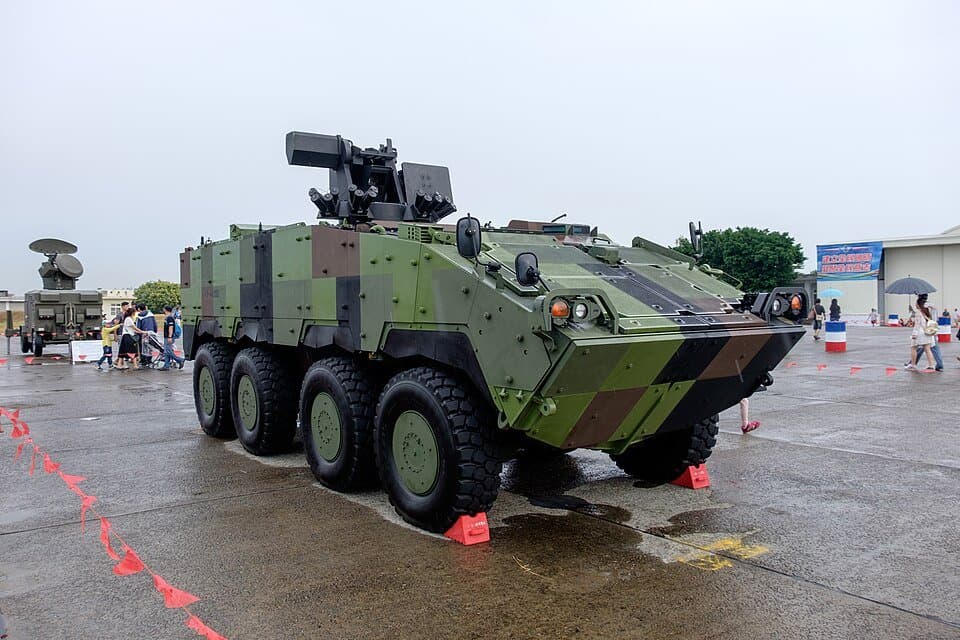
Clouded Leopard Armored Vehiclelarger figure on 1 of 5
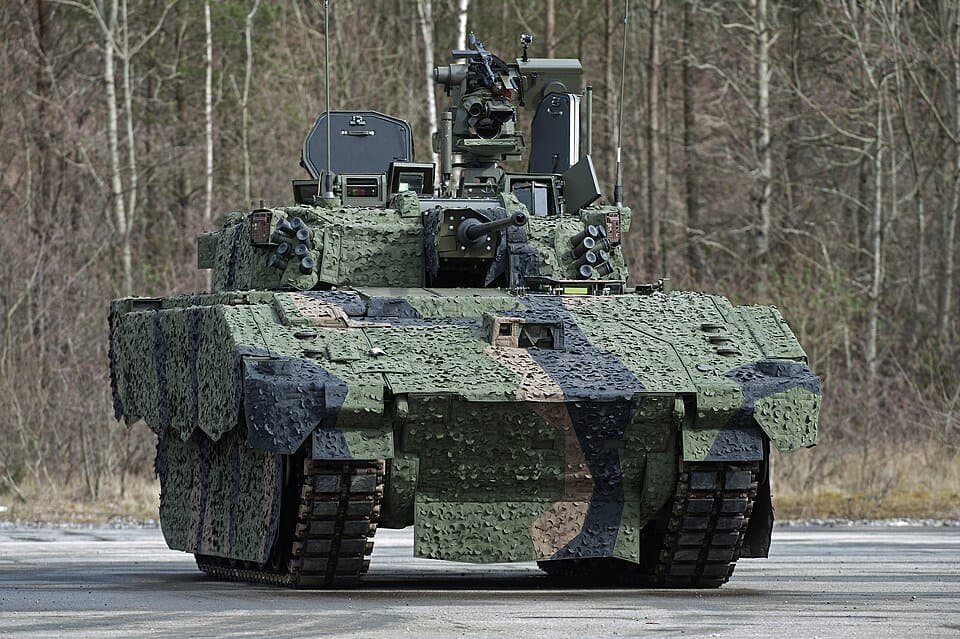
General Dynamics Ajaxlarger figure on 4 of 5
Measured figures
Configuration
| Specification | Clouded Leopard Armored Vehicle | General Dynamics Ajax |
|---|---|---|
| Type | Armoured fighting vehicle[source] | Armoured fighting vehicle[source] |
| Place of origin | Taiwan / Ireland[source] | United Kingdom[source] |
| Designer | Ordnance Readiness Development Center[source] | General Dynamics UK[source] |
| Designed | 2002[source] |
Counts only measures both sources give with the same scope. A larger figure is not a better system.
7.62 m (25 ft 0 in)[source]
Bars compare reported quantities only. A larger figure does not make a system better; configurations and test conditions differ.
| — |
| Manufacturer | Ordnance Readiness Development Center[source] | General Dynamics UK[source] |
|---|
| Unit cost | US$2 million[source] | — |
|---|
| Produced | 2007[source] | — |
|---|
| No. built | 378 CM32 and CM33 delivered (2018), 305 CM34 delivered (2023 )[source] | — |
|---|
| Armor | 12.7 mm AP front arc, 7.62 mm AP all around[source] | — |
|---|
| Main armament | 30 mm Mk44 Bushmaster II chaingun (CM34) 40 mm automatic grenade launcher (CM32/33) 105 mm rifled gun, or 120 mm mortar (planned)[source] | 40 mm (1.6 in) CTA International CTAS40 cannon[source] |
|---|
| Secondary armament | Type 74 7.62 mm machine gun (co-axial)[source] | 7.62 mm L94A1 coaxial chain gun Kongsberg Protector Remote Weapon Station (UK testing with 7.62 mm L7 General-purpose machine gun and Javelin ATGM )[source] |
|---|
| Suspension | 8×8 wheeled[source] | Torsion bar[source] |
|---|
| Source measurement | The Delco LAV-25 turret was tested on the first two prototypes but was not adopted on ground of cost and marginal firepower advantage compared to foreign vehicles; instead an indigenous turret armed with a 20 mm T75 revolver cannon was planned in the interest of getting the IFV into service as quickly as possible, and a prototype was demonstrated in 2009. It was hoped that any deficiency in terms of firepower can be alleviated by adopting the cannon to use the Mk 244 Mod 0 APDS ammunition already being ordered by the Republic of China Navy alongside the Phalanx Block 1B weapon systems, but issues with barrel life proved insurmountable, and in the meantime the 30 mm Bushmaster II chaingun was ultimately chosen instead and will be acquired from Orbital ATK . A prototype turret built on this definitive requirement was spotted in May 2015 and unveiled to the public in August 2017.[source]Clouded Leopard Armored Vehicle · Development; only the objects and conditions stated in this passage In 2019 the Ministry of National Defense announced that over the course of the development process 17 shortcomings with the system had been identified and corrected. Shortcomings identified included flaws in the types steel armor, oil leaks, and a lack of interchangeable spare parts. It was discovered that the vehicles had to cover at least 5 km every two weeks to remain in optimal condition.[source]Clouded Leopard Armored Vehicle · Development; only the objects and conditions stated in this passage The armor of the CM32 provides protection of 7.62 mm AP rounds, while the frontal arc withstands 12.7 mm AP rounds. NBC protection and fire suppression systems are also standard. The V-shaped hull provides protection from landmines and can withstand 12 kg of TNT under any wheel. In its basic APC form the CM32 is armed with a 40 mm automatic grenade launcher and a 7.62 mm co-axial machinegun, both mounted in a remote weapons station.[source]Clouded Leopard Armored Vehicle · Design; only the objects and conditions stated in this passage Performance records from 2008 to 2018 indicate an engine lifespan of 780,000 km. The type is a regular participant in the Han Kuang Exercises .[source]Clouded Leopard Armored Vehicle · Production and service history; only the objects and conditions stated in this passage In addition to the infantry carriers, other planned variants include command vehicle, NBC reconnaissance vehicle, mortar carrier (can be configured with either an 81 mm or 120 mm mortar), and assault gun (armed with a 105 mm rifled gun). The Ministry of National Defense is exploring a 155mm self-propelled howitzer based on the CM32.[source]Clouded Leopard Armored Vehicle · Variants; only the objects and conditions stated in this passage Base variant, with 40 mm grenade launcher and 7.62mm machine gun mounted in a remote weapon station . In service as of 2014. A total of 378 CM32 and CM33 have been produced.[source]Clouded Leopard Armored Vehicle · Variants / CM33; only the objects and conditions stated in this passage Taiwan's Ministry of National Defense (MND) exhibited a prototype of the next-generation 8×8 Cloud Leopard II armored vehicle development in public for the first time at the 2019 Taipei Aerospace & Defense Technology Exhibition. It is expected that the prototype will be able to configurate into a mortar carrier platform, a self-propelled howitzer and a fire support platform with a 105 mm gun, similar to U.S Army 's M1128 mobile gun system .[source]Clouded Leopard Armored Vehicle · Variants / Cloud Leopard II M2 prototype; only the objects and conditions stated in this passage Cloud Leopard P1 prototype with 105mm tank gun[source]Clouded Leopard Armored Vehicle · Gallery / Prototypes; only the objects and conditions stated in this passage TADTE 2015, Cloud Leopard II M2 prototype with 81mm mortar Prototype[source]Clouded Leopard Armored Vehicle · Gallery / Prototypes; only the objects and conditions stated in this passage Cloud Leopard II D2 prototype with 105mm tank gun, 2024[source]Clouded Leopard Armored Vehicle · Gallery / Prototypes; only the objects and conditions stated in this passage Cloud Leopard II D3 prototype with 105mm tank gun, 2025 Taipei Aerospace & Defense Technology Exhibition[source]Clouded Leopard Armored Vehicle · Gallery / Prototypes; only the objects and conditions stated in this passage CM32 on the 40mm grenade range during testing[source]Clouded Leopard Armored Vehicle · Gallery / Production and testing; only the objects and conditions stated in this passage CM34 with 30 mm cannon and modular ceramic armor[source]Clouded Leopard Armored Vehicle · Gallery / In operation; only the objects and conditions stated in this passage 110th National Day, CM34 with 30 mm cannon exhibit[source]Clouded Leopard Armored Vehicle · Gallery / In operation; only the objects and conditions stated in this passage | Initially, the Ajax was to be procured in a number of blocks totalling 1,010 vehicles. The first order of Block 1 vehicles encompassed Scout Reconnaissance, PMRS APC, and Repair and Recovery variants, with a following order of Block 2 to consist of Reconnaissance, C2, and Ambulance variants. There was a possibility for a third Block of vehicles encompassing a "Direct Fire" vehicle with a 120mm main gun, "Manoeuvre Support", and a "Joint Fires" variant equipped to succeed the FV102 Striker in the anti-tank role. However, in September 2014, Block 3 vehicles were dropped and the Ministry of Defence had "no plans" to order any Block 2 vehicles.[source]General Dynamics Ajax · Development; only the objects and conditions stated in this passage The turret ring is 1.7 m (5 ft 7 in) in diameter, allowing for much more work-space than comparable AFVs. The Scout SV is also equipped with a state of the art Intelligence, surveillance, target acquisition, and reconnaissance (ISTAR) package with advanced sensors and space for further future growth. This advanced ISTAR package allows for automated search, tracking and detection, more than doubling stand-off range at which targets can be identified and tracked.[source]General Dynamics Ajax · Design; only the objects and conditions stated in this passage The main armament for the Ajax variants is the innovative Anglo-French 40CT cannon which uses 40 mm telescoped ammunition with the warhead seated inside the propellant casing; the smaller size enables a much greater ammunition load. A linkless carousel magazine allows the crew to quickly change ammunition type, which includes high explosive with an impact fuze or timed for airburst, and solid shot or tungsten dart kinetic energy rounds , capable of penetrating 14 cm of armour at up to 1,500 metres. The rate of fire is 200 rounds per minute (RPM), compared to 90 RPM for the RARDEN gun which it replaces. The barrel can be elevated to 80°, allowing it to engage helicopters or unmanned aerial vehicles .[source]General Dynamics Ajax · Design; only the objects and conditions stated in this passage Ordered in 2014, the first delivery was scheduled for 2017, while it was stated that the first British Army squadron "will be equipped by mid-2019" so that they could be deployed by the end of 2020. This was delayed due to design and testing problems. Test crews were required to wear noise cancelling headphones and be checked for hearing loss at the end of operations and the vehicles were unable to reverse over obstacles more than 20 centimetres high. |
|---|
| Developed from | — | ASCOD 2[source] |
|---|
| Transmission | — | RENK 6 speed HSWL 256B[source] |
|---|
Test crews were then limited to 105 minutes inside and 20 miles per hour (32 km/h).[source]General Dynamics Ajax · Project progress / 2021: Problems get worse; only the objects and conditions stated in this passage
Limited User Validation Trials recommenced in October 2022, with a view to commencing Reliability Growth Trials in January 2023. On 21 December 2022, the Minister of State for the Ministry of Defence, Alex Chalk , stated that these trials could last from 18 to 24 months—a period which would mean that the results of the trials would not be available until after the next UK general election. Trials eventually included vehicles being tested over 42,000 kilometres (26,000 mi) of varying terrains, and the firing of 20,000 rounds from the 40 mm main armament.[source]General Dynamics Ajax · Project progress / 2022: Try to fix the problems; only the objects and conditions stated in this passage
On 26th November 2025, it was reported in the British media that the Army had halted the use of Ajax vehicles "after soldiers left vomiting". According to reports, around 30 soldiers became ill during training with the vehicles. An MoD spokesman said "This weekend, a small number of soldiers reported symptoms of noise and vibration, having taken part in an exercise involving the Ajax armoured fighting vehicle. Out of an abundance of caution, the minister for defence readiness and industry has asked the Army to pause all use of Ajax for training and exercising for two weeks, while a safety investigation is carried out into the events this weekend."[source]General Dynamics Ajax · Project progress / 2025: Problems still exist; only the objects and conditions stated in this passage