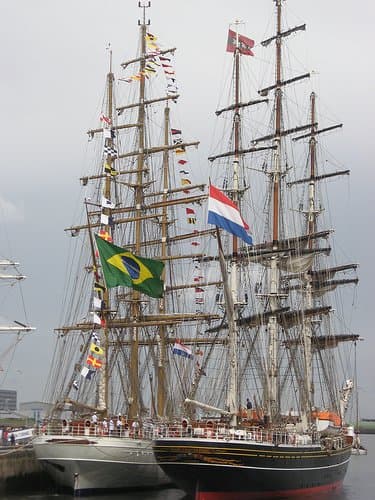
Credit
Educanezin · Public domain · Resized · Public domain · Source ↗ · Modified


Preparing your view.

At a glance
Cisne Brancolarger figure on 4 of 4
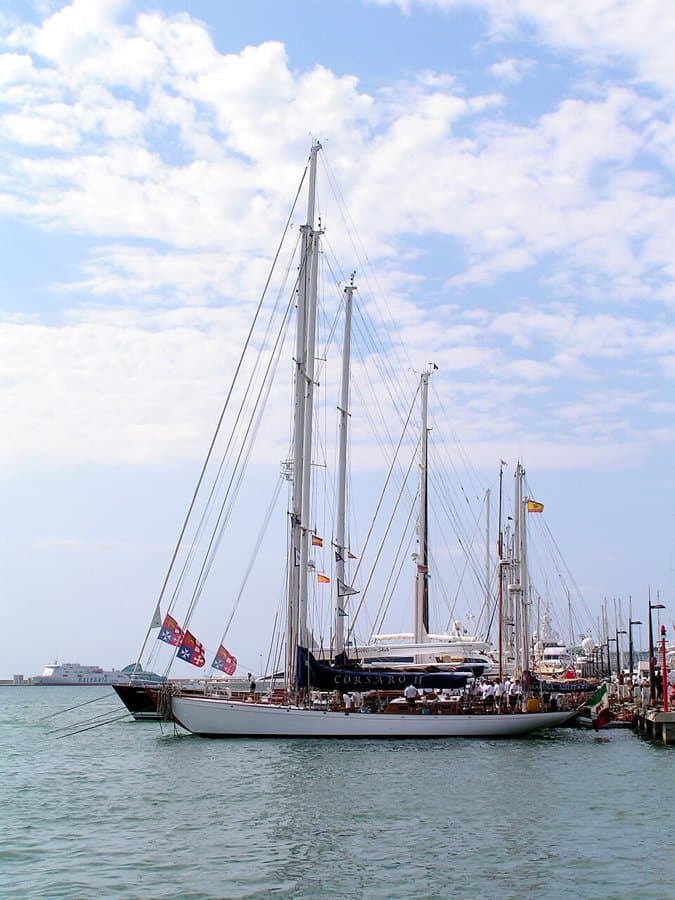
Italian training ship Corsaro IIlarger figure on 0 of 4
Counts only measures both sources give with the same scope. A larger figure is not a better system.
Measured figures
Length
Single sourceCisne Branco · Lüa
Single sourceConfiguration
| Specification | Cisne Branco | Italian training ship Corsaro II |
|---|---|---|
| Power | — | 1 x diesel engine FIAT AIFO 71.59 kW (96.00 bhp) 1 shaft 1 x diesel engine generator Fischer Panda[source] |
| Name | Cisne Branco[source] | Corsaro II[source] |
| Namesake | English: "White Swan"[source] | — |
| Operator | Brazilian Navy[source] | Italian Navy[source] |
| Builder | Damen Shipyard[source] |
NVe Cisne Branco
Single source76 m (249 ft 4 in)[source]
76 m[source]NVe Cisne Branco
76 m ( Lüa )[source]Cisne Branco · Lüa
76 m[source]
Cisne Branco · Displacement · Cisne Branco · Displacement
Single sourceDisplacement
Single sourceNVe Cisne Branco · carregado
Single source1,038 tonnes[source]Cisne Branco
1.038 t[source]
1 038 t ( carregado )[source]NVe Cisne Branco · carregado
1.038 t[source]Cisne Branco
1 038 tonnes[source]
a pieno carico
Single source47 t a pieno carico[source]a pieno carico
Maximum; max on engine
Single sourceMaximum; NVe Cisne Branco · 10 nós (18,5 km/) (motor) 17,5 nós ( ) (velas
Single sourceMaximum; sail
Single source11 knots (20 km/h; 13 mph) max on engine 17.5 knots (32.4 km/h; 20.1 mph) sail[source]
A vela : 11 nudos Con motor : 17.5 nudos[source]
10 nós (18,5 km/) (motor) 17,5 nós (32,4 km/h) (velas)[source]NVe Cisne Branco · 10 nós (18,5 km/) (motor) 17,5 nós ( ) (velas
10,7 nœud[source]
Maximum; 7 nodi (
Single sourceMaximum; by engine prop
Single sourceBars compare reported quantities only. A larger figure does not make a system better; configurations and test conditions differ.
Cantiere Navale Costaguta Voltri , Genova , Italy[source] |
| Laid down | 1998[source] | — |
|---|
| Launched | 4 August 1999[source] | 1960[source] |
|---|
| Home port | Rio de Janeiro[source] | La Spezia[source] |
|---|
| Identification | IMO number : 9203320 MMSI number : 710428000 Callsign : PWCB[source] | ITA 1643 (Sail number)[source] |
|---|
| Status | Active[source] | in service[source] |
|---|
| Type | Training tall ship[source] | Sail training ship[source] |
|---|
| Source measurement | Cisne Branco is the third Brazilian Navy sail-training yacht to carry this famous name. The first Cisne Branco was the classic 15-metre (49 ft) wooden yacht Tritonia , which was designed by the legendary naval architect Alfred Mylne , and built by Alexander Robertson & Sons in 1910. The yacht arrived in Brazil in 1978, and after extensive repairs undertook an extended 8-month voyage across the Atlantic. The second Cisne Branco (25 m, 83 ft), which had an aluminium hull, was used by the navy between 1980 and 1986 after which it was passed on to a naval college.[source]Cisne Branco · Previous vessels of the same name; only the objects and conditions stated in this passage | Designed by Sparkman & Stephens Designs New York City (United States), project 1505, Corsano II for the RORC 1st class, is a Bermudan-rig yawl , sister of Stella Polare , commissioned by Italian Navy to be used as a training ship for the cadets at the Italian Naval Academy in Livorno , Italy. She is constructed of wood; iroko keelson, acacia frames and double planked of Philippine mahogany. The ship's fasteners are silicon bronze, spars are of sitka spruce. Original engine Mercedes-Benz OM/321 (96 HP) was then replaced by a FIAT AIFO engine.[source]Italian training ship Corsaro II · Characteristics; only the objects and conditions stated in this passage Corsaro II can accommodate 16 persons. First Commander of the ship was Agostino Straulino , who won the 1952 Olympic Games in the class Star. In 1961 Corsaro II was the only naval ship to join in the Los Angeles – Honolulu classifying sixth in real time. In 1962 participated in the Newport – Bermuda with 138 boats arriving at the sixth place, and in the Torbay – Rotterdam arriving first in the class. In 1963 participated in: Annapolis – Newport, Newport – Plymouth (second place), the Channel Race and the Fastnet Race. In 1964 took part in the Lisbon – Canaries – Bermuda reaching the first place. In 1965 participated in the Buenos Aires – Rio de Janeiro then sailed to Sydney racing in local regatta. The following year sailed from Sydney to San Diego coming to Italy. From then on the Corsaro II participated mainly in the Mediterranean sea with home port in La Spezia .[source]Italian training ship Corsaro II · History; only the objects and conditions stated in this passage |
|---|
| Country of origin | Netherlands[source]Cisne Branco | United States[source]Corsaro II · own design project1505 by Sparkman & Stephens Designs, New York City, United States; Italian Navy sail-training commission. The source’s Corsano II spelling is retained in its excerpt. |
|---|
| Propulsion | motor Caterpillar Diesel a 1800 rpm[source] 3 mastros 2 195 m 2 de velas 1 hélice 1 propulsor de proa[source]NVe Cisne Branco | vela e motore Superficie velica: circa 205 m² Apparato motore: Iveco AIFO[source] |
|---|
| Capacity | 31 alumnos[source] | — |
|---|
| Commissioned | — | 5 January 1961[source] |
|---|
| In service | — |
|---|
| Notes | — | Pennant number A 5316[source] |
|---|
| Tonnage | — | 47 t (46 long tons) full load[source] |
|---|
| Sail plan | — | - Sail surface 700 square metres (7,500 square feet ) - Sail surface upwind 205 square metres (2,210 square feet )[source] |
|---|