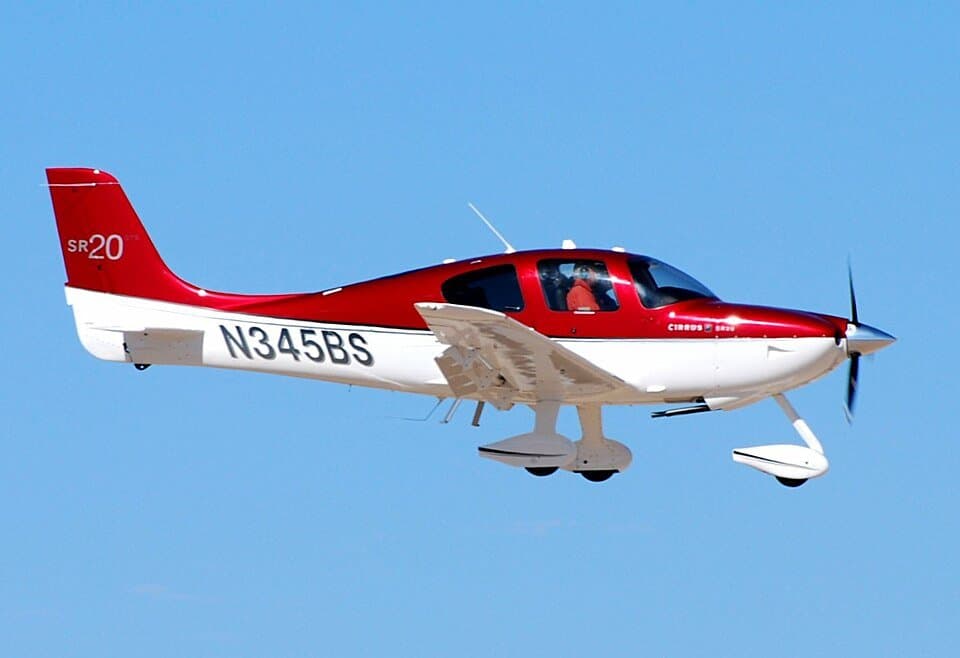

Credit
Tomás Del Coro from Las Vegas, Nevada, USA · CC BY-SA 2.0 · Resized · CC BY-SA 2.0 · Source ↗ · Modified


Preparing your view.

At a glance
True scale
Side by side. From every angle. A human reference for perspective.
3.21 MB · Loads when you open it| Model | Length | Width / span | Height |
|---|---|---|---|
| Cirrus SR20 | ≈ 7.92 m | ≈ 11.68 m (Width) | ≈ 2.72 m |
| Tecnam P92 | ≈ 6.4 m | ≈ 8.7 m (Width) | ≈ 2.66 m |
Scaled uniformly to the sourced length of 7.92 m. The shape was turned square to the axes; the height was fitted to the sourced 2.72 m; the width was fitted to the sourced 11.68 m. Not an official model or a measured survey.
ForceTally · All rights reserved
Scaled uniformly to the sourced length of 6.4 m. The shape was turned square to the axes; the width was fitted to the sourced 8.7 m. Not an official model or a measured survey.
ForceTally · All rights reserved
The human reference is a generic 1.75 m figure. Models describe external size, not combat performance.
Measured figures
SR20-G3 · Length
Single source26 ft 0 in (7.92 m)[source]
P92 Echo MkII · Length
Configuration
| Specification | Cirrus SR20 | Tecnam P92 |
|---|---|---|
| Type | Light aircraft[source] | Two-seat ultralight monoplane[source] |
| Manufacturer | Cirrus Aircraft[source] | Tecnam[source] |
| Number built | 2,084 (through 2025)[source] | — |
| Manufactured | 1999–present[source] | — |
| First flight | 21 March 1995[source] |
6.4 m (21 ft 0 in)[source]
Empty; SR20-G3 · Empty weight
Single sourceGross; SR20-G3 · Gross weight
Single source2,126 lb (964 kg)[source]
3,050 lb (1,383 kg)[source]
Max Takeoff Weight (lbs) . . . . . . . 3,050[source]SR20 only · manufacturer 2024 delivered-aircraft product configuration; literal row prefix carries pounds header and own 3,050 value, excludes adjacent SR22/SR22T/Vision Jet columns
Empty; P92 Echo MkII · Empty weight
Single sourceMaximum take-off; P92 Echo MkII · Max takeoff weight
Single sourceCruise; SR20-G3 · TAS
Single sourceCruise; SR20 only · manufacturer 2024 product configuration · maximum cruising speed · SR20 only · manufacturer 2024 product configuration · maximum cruising speed · SR20
Manufacturer claim155 kn (178 mph, 287 km/h) TAS[source]
155 KTAS[source]SR20 only · manufacturer 2024 product configuration · maximum cruising speed
Maximum; P92 Echo MkII · Max cruise speed TAS
Single source213 km/h (132 mph, 115 kn) Max cruise speed TAS[source]
SR20-G3 · 1 × Continental IO-360-ES six cylinder, horizontally-opposed piston aircraft engine
Single sourceSR20 only · manufacturer 2024 product configuration; not SR22 or SR22T · SR20 only · manufacturer 2024 product configuration; not SR22 or SR22T · SR20 · Lycoming engine
Manufacturer claim1 × Continental IO-360-ES six cylinder, horizontally-opposed piston aircraft engine , 200 hp (150 kW)[source]
P92 Echo MkII · 1 × Rotax 912ULS 4-cylinder air-cooled horizontally-opposed piston engine
Single source1 × Rotax 912ULS 4-cylinder air-cooled horizontally-opposed piston engine, 73.5 kW (98.6 hp)[source]
SR20-G3 · Service ceiling
Single sourceSR20 only · manufacturer 2024 product configuration · maximum operating altitude · SR20 only · manufacturer 2024 product configuration · maximum operating altitude · SR20
Manufacturer claim17,500 ft (5,300 m)[source]
17,500 feet[source]SR20 only · manufacturer 2024 product configuration · maximum operating altitude
Bars compare reported quantities only. A larger figure does not make a system better; configurations and test conditions differ.
14 March 1993[source] |
| Developed into | Cirrus SR22[source] | — |
|---|
| Capacity | 3 passengers (4 using 60/40 flex seating in post-2012 models)[source] | — |
|---|
| Propellers | 3-bladed[source] | 2-bladed Sensenich[source] |
|---|
| Stall speed | 56 kn (64 mph, 104 km/h) CAS[source] | 72 km/h (45 mph, 39 kn) flaps down[source] |
|---|
| National origin | United States[source] | Italy[source] |
|---|
| Source measurement | One of the major selling points for the SR20 is its Garmin Cirrus Perspective avionics suite with dual 10-inch (250 mm) or 12-inch (300 mm) screens: one primary flight display (PFD) and one multifunction display (MFD), first introduced by the company in May 2008. This provides all standard communication , navigation ( GPS and conventional VHF), and surveillance ( Mode S transponder ) functions. Other avionics features include in-flight weather information and TCAS -like traffic information.[source]Cirrus SR20 · Design and development; only the objects and conditions stated in this passage In 2012, "60/40 flex seating" was introduced, allowing up to three passengers in the rear with a split fold-down seat arrangement. This five-seat configuration was optional in 2012, but became standard equipment for 2013 SR20 models.[source]Cirrus SR20 · Design and development; only the objects and conditions stated in this passage In January 2020, the company introduced a new mobile application for the SR series, called "Cirrus IQ", which enables remote aircraft communication including access to preflight status information such as fuel and oxygen levels, battery voltage, oil temperature, aircraft location, and flight hours. Upgrades also included a new stabilized approach-advisory system for the flight deck. In January 2022, speed and aesthetic improvements were added to the G6 SR-series, with a 9 knots (17 km/h) increased cruise speed, upgrades to the mobile IQ app, USB-A and USB-C charging ports and more.[source]Cirrus SR20 · Design and development; only the objects and conditions stated in this passage In 2011, the accident records of the SR20 and -22 were the subject of a detailed examination by Aviation Consumer magazine. The review concluded that the series has an overall accident record that is better than average for light aircraft, exceeded only by the Diamond DA40 and DA42 . However, its fatal accident rate is much worse at 1.6/100,000 hours, placing it higher than the U.S. general aviation rate of 1.2 and higher than the Diamond DA40 (0.35), Cessna 172 (0.45), Diamond DA42 (0.54), Cessna 182 (0.69), and Cessna 400 (1.0), despite the Cirrus's CAPS.[source]Cirrus SR20 · Operational history; only the objects and conditions stated in this passage Introduced in 2007, the G3 has a lighter wing of greater area, incorporating a carbon-fiber spar . The new wing increased the SR20's cruise speed by 6–7 knots (11–13 km/h). The G3 also added a 50 pounds (23 kg) increased useful load by increasing the take-off weight to 3,050 pounds (1,380 kg), a redesigned main landing gear that is 2 inches (5 cm) taller, giving greater propeller and tail clearance, improved aircraft handling due to increased dihedral , improved aerodynamics including new wing root fairings , LED recognition lights, improved heat and ventilation, dual-redundant GPS WAAS -certified Garmin GNS 430W comm-navigators (that include a VHF radio and a VOR/LOC/ILS receiver), and an S-TEC Autopilot.[source]Cirrus SR20 · Variants; only the objects and conditions stated in this passage Introduced in January 2017, the G6 model adds a Lycoming IO-390 engine of 215 hp (160 kW), an enhanced "Perspective-Plus" flight deck with a 10-times faster instrument processing speed, new LED wingtip lights and a useful load increase of 150 lb (68 kg).[source]Cirrus SR20 · Variants; only the objects and conditions stated in this passage Capacity: 3 passengers (4 using 60/40 flex seating in post-2012 models)[source]Cirrus SR20 · Specifications (SR20-G3); only the objects and conditions stated in this passage Length: 26 ft 0 in (7.92 m)[source]Cirrus SR20 · Specifications (SR20-G3); only the objects and conditions stated in this passage Wingspan: 38 ft 4 in (11.68 m)[source]Cirrus SR20 · Specifications (SR20-G3); only the objects and conditions stated in this passage Height: 8 ft 11 in (2.72 m)[source]Cirrus SR20 · Specifications (SR20-G3); only the objects and conditions stated in this passage Empty weight: 2,126 lb (964 kg)[source]Cirrus SR20 · Specifications (SR20-G3); only the objects and conditions stated in this passage Gross weight: 3,050 lb (1,383 kg)[source]Cirrus SR20 · Specifications (SR20-G3); only the objects and conditions stated in this passage Powerplant: 1 × Continental IO-360-ES six cylinder, horizontally-opposed piston aircraft engine , 200 hp (150 kW)[source]Cirrus SR20 · Specifications (SR20-G3); only the objects and conditions stated in this passage Cruise speed: 155 kn (178 mph, 287 km/h) TAS[source]Cirrus SR20 · Specifications (SR20-G3); only the objects and conditions stated in this passage Stall speed: 56 kn (64 mph, 104 km/h) CAS[source]Cirrus SR20 · Specifications (SR20-G3); only the objects and conditions stated in this passage Service ceiling: 17,500 ft (5,300 m)[source]Cirrus SR20 · Specifications (SR20-G3); only the objects and conditions stated in this passage Rate of climb: 828 ft/min (4.21 m/s)[source]Cirrus SR20 · Specifications (SR20-G3); only the objects and conditions stated in this passage 406 MHz ELT[source]Cirrus SR20 · Specifications (SR20-G3); only the objects and conditions stated in this passage | Today, the P92 Echo MkII, features a strut-braced high wing, fixed tricycle landing gear, and side-by-side seating. Its airframe is primarily metal, with a composite (carbon‑fibre) fuselage, while earlier versions had all‑metal construction. It is powered by Rotax 912ULS series engines with 100 hp. The P92 Echo MkII has a published stall speed of approximately 39 knots (72 km/h) with full flaps, and a take-off distance of 1211ft (369 metres).[source]Tecnam P92 · Lead; only the objects and conditions stated in this passage The P92 prototype conducted its maiden flight on 14 March 1993 in Capua and shortly after debuted at the Bassano del Grappa Air Show. The P92 progressively entered service with a wide range of flying clubs and pilot training institutions. Throughout its development, Tecnam released multiple versions, such as the P92-J, P92 Echo Super, P92 Eaglet, and P92 MkII, each incorporating gradual upgrades in avionics, aerodynamics, construction materials (including the introduction of composite fuselages), and cockpit ergonomics. As reported by aviation journalist Dan Johnson, by 2018 more than 2,500 units had been delivered globally, making the P92 Tecnam’s most produced aircraft to date.[source]Tecnam P92 · Development; only the objects and conditions stated in this passage The aircraft is powered by a 100 hp Rotax 912ULS four-stroke engine in tractor configuration, and is equipped with a fixed-pitch propeller. According to published specifications, the Echo MkII has a stall speed of approximately 39 knots (72 km/h) with full flaps and a take-off distance of 1,211 ft (369 m) under standard atmospheric conditions.[source]Tecnam P92 · Design; only the objects and conditions stated in this passage The P92 Echo MkII is available in different configurations to comply with both European ultralight regulations (MTOW 472.5 kg) and US light-sport aircraft (LSA) standards (MTOW up to 600 kg). It is included in the list of FAA-accepted Special Light-Sport Aircraft (S-LSA) and is certified under various national civil aviation authorities.[source] |
|---|
| Powerplant | 215 horsepower Lycoming engine[source]SR20 only · manufacturer 2024 product configuration; not SR22 or SR22T | — |
|---|
| Useful load | 1,028 pounds[source]SR20 only · manufacturer 2024 product configuration · approximate useful load, not empty mass or payload alone | — |
|---|
| Designer | — | Luigi Pascale[source] |
|---|
| Status | — | In production[source] |
|---|
| Fuel capacity | — | 90 L (24 US gal; 20 imp gal) total with 80 L (21 US gal; 18 imp gal) usable[source] |
|---|
| Take-off run | — | 214 m (702 ft)[source] |
|---|
| Landing run | — | 154 m (505 ft)[source] |
|---|
| Take-Off Distance | — | 369 m (1,211 ft)[source] |
|---|
| Role | — | family of two-seat, high-wing , light aircraft[source] |
|---|
An upgraded version of the P92-J with 100 hp (75 kW) Rotax 912S . Changes include shortened wings, metal flaps, redesigned engine cowling and fairings.[source]Tecnam P92 · Variants; only the objects and conditions stated in this passage
Available with 80 hp (60 kW) Rotax 912UL or 100 hp (75 kW) Rotax 912ULS engine.[source]Tecnam P92 · Variants; only the objects and conditions stated in this passage
Redesigned wings, engine cowling, windshield and fairing to reduce drag. Available with 81 hp (60 kW) Rotax 912U or 100 hp (75 kW) Rotax 912S .[source]Tecnam P92 · Variants; only the objects and conditions stated in this passage
With 100 hp (75 kW) Rotax 912ULS .[source]Tecnam P92 · Variants; only the objects and conditions stated in this passage
An upgraded version of the Echo. Available with 81 hp (60 kW) Rotax 912U .[source]Tecnam P92 · Variants; only the objects and conditions stated in this passage
Fuselage redesigned, shorter wingspan, retractable landing gear. With 100 hp (75 kW) Rotax 912S engine.[source]Tecnam P92 · Variants; only the objects and conditions stated in this passage
100 hp (75 kW) Rotax 912 engine, adds winglets to improve aerodynamic efficiency[source]Tecnam P92 · Variants; only the objects and conditions stated in this passage
Tricycle landing gear equipped version with a gross weight of 500 kg (1,102 lb)[source]Tecnam P92 · Variants; only the objects and conditions stated in this passage
Length: 6.4 m (21 ft 0 in)[source]Tecnam P92 · Specifications (P92 Echo MkII); only the objects and conditions stated in this passage
Wingspan: 8.7 m (28 ft 7 in)[source]Tecnam P92 · Specifications (P92 Echo MkII); only the objects and conditions stated in this passage
Height: 2.5 m (8 ft 2 in)[source]Tecnam P92 · Specifications (P92 Echo MkII); only the objects and conditions stated in this passage
Empty weight: 356 kg (785 lb)[source]Tecnam P92 · Specifications (P92 Echo MkII); only the objects and conditions stated in this passage
Max takeoff weight: 600 kg (1,323 lb)[source]Tecnam P92 · Specifications (P92 Echo MkII); only the objects and conditions stated in this passage
Powerplant: 1 × Rotax 912ULS 4-cylinder air-cooled horizontally-opposed piston engine, 73.5 kW (98.6 hp)[source]Tecnam P92 · Specifications (P92 Echo MkII); only the objects and conditions stated in this passage
Maximum speed: 213 km/h (132 mph, 115 kn) Max cruise speed TAS[source]Tecnam P92 · Specifications (P92 Echo MkII); only the objects and conditions stated in this passage
Stall speed: 72 km/h (45 mph, 39 kn) flaps down[source]Tecnam P92 · Specifications (P92 Echo MkII); only the objects and conditions stated in this passage
Range: 1,296 km (805 mi, 700 nmi)[source]Tecnam P92 · Specifications (P92 Echo MkII); only the objects and conditions stated in this passage
Rate of climb: 4.9 m/s (960 ft/min)[source]Tecnam P92 · Specifications (P92 Echo MkII); only the objects and conditions stated in this passage
Take-off run: 214 m (702 ft)[source]Tecnam P92 · Specifications (P92 Echo MkII); only the objects and conditions stated in this passage
Landing run: 154 m (505 ft)[source]Tecnam P92 · Specifications (P92 Echo MkII); only the objects and conditions stated in this passage
Take-Off Distance: 369 m (1,211 ft)[source]Tecnam P92 · Specifications (P92 Echo MkII); only the objects and conditions stated in this passage