

Preparing your view.
At a glance
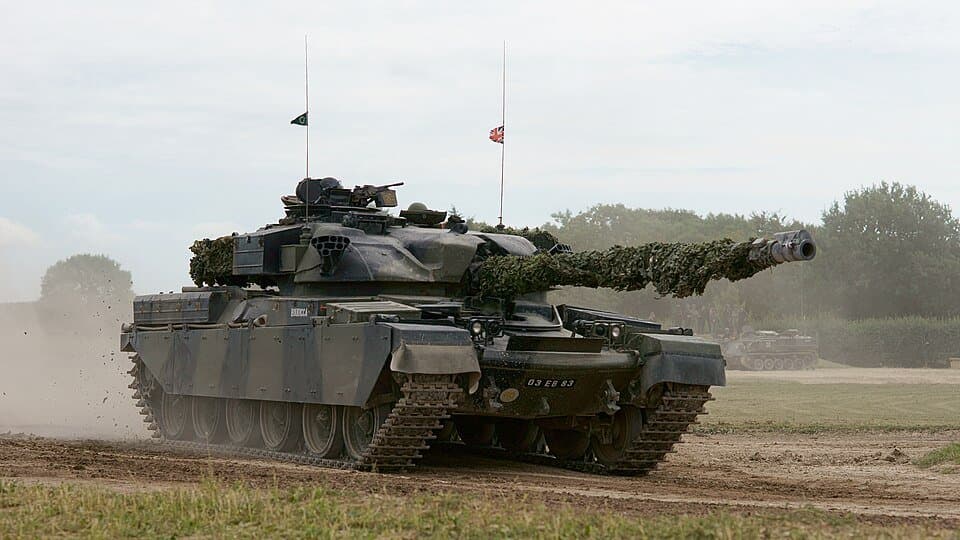
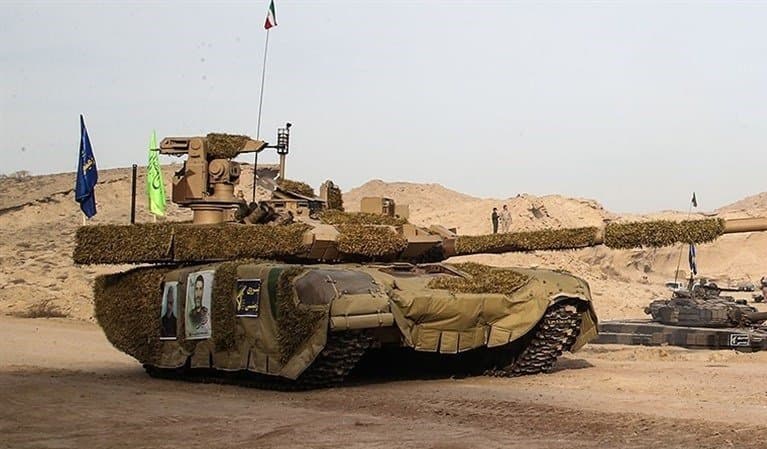
Chieftain (tank)larger figure on 1 of 1
True scale
Side by side. From every angle. A human reference for perspective.
3.24 MB · Loads when you open it| Model | Length | Width / span | Height |
|---|---|---|---|
| Chieftain (tank) | ≈ 9.22 m | ≈ 3.66 m (Width) | ≈ 3.28 m |
| Karrar (tank) | ≈ 8.92 m | ≈ 3.7 m (Width) | ≈ 3.23 m |
Scaled uniformly so that the hull matches the sourced 7.5 m hull length. Thin antennas or poles standing above the body were pressed down to it, so they do not set the height; the width was fitted to the sourced 3.66 m. Not an official model or a measured survey.
ForceTally · All rights reserved
Scaled uniformly so that the hull matches the sourced 6.8 m hull / length. The width was fitted to the sourced 3.7 m. Not an official model or a measured survey.
ForceTally · All rights reserved
The human reference is a generic 1.75 m figure. Models describe external size, not combat performance.
Measured figures
Gun forward
Single sourceHull
Single sourceConfiguration
| Specification | Chieftain (tank) | Karrar (tank) |
|---|---|---|
| Type | Main battle tank[source] | Main battle tank[source] |
| Place of origin | United Kingdom[source] | Iran[source] |
| In service | 1960s–1990s[source] | 2020–present[source] |
| Used by | United Kingdom , Iran , Iraq , Jordan , Kuwait , Oman[source] | Iran |
Counts only measures both sources give with the same scope. A larger figure is not a better system.
35 ft 4 in (10.77 m) – gun forward 7.5 m (24 ft 7 in) – hull[source]
/
Single source(hull) /
Single sourcetotal
Single source6.8 m (hull) / 9.5 m / 9.78 m (total)[source]
Leyland L60 (multifuel 2-stroke opposed-piston compression-ignition ) 6 Cyl, 19 litres
Single sourceMk. 5 · Opposed-piston engine Leyland L60 (diesel, multi-fuel compression ignition)
Single sourceLeyland L60 (multifuel 2-stroke opposed-piston compression-ignition ) 750 hp (560 kW) 6 Cyl, 19 litres.[source]
Opposed-piston engine Leyland L60 (diesel, multi-fuel compression ignition) 750 bhp (560 kW)[source]
Karrar; reference report based on factory signs · Karrar is equipped with a engine. This has not been officially stated but signs mounted on Karrar tanks present in Bani Hashem factory, Iran's main AFV factory alongside Shahid Zainuddin, had the words "hp 1000" written on them. Karrar's power to weight ratio is about 20 hp per tonne as a result, and its speed is stated to be around 70 km/h
Single sourceKarrar is equipped with a 1000 hp engine. This has not been officially stated but signs mounted on Karrar tanks present in Bani Hashem factory, Iran's main AFV factory alongside Shahid Zainuddin, had the words "hp 1000" written on them. Karrar's power to weight ratio is about 20 hp per tonne as a result, and its speed is stated to be around 70 km/h.
Mk. 5 · for the first minute and 6 thereafter
Single source10 rounds per minute for the first minute and 6 thereafter.[source]
Bars compare reported quantities only. A larger figure does not make a system better; configurations and test conditions differ.
| Wars | Iran–Iraq War Persian Gulf War[source] | — |
|---|
| Manufacturer | Leyland Motors[source] | Bani Hashim Defense Industrial Complex[source] |
|---|
| Unit cost | £90,000–£100,000 (1967)[source] | — |
|---|
| No. built | 1,896 (900 for UK, 996 exported)[source] | 150 ordered in 2017, another 650 ordered in 2018 which is to be finished by late 2020s. 800 total.[source] |
|---|
| Armour | Glacis : 127 mm (5.0 in) (72°) Hull sides: 50 mm (2.0 in) (10°) Turret: 350 mm (14 in) (60°)[source] | — |
|---|
| Main armament | L11A5 120 mm rifled gun[source] | 125 mm 2A46M /M-2/M-5 smoothbore gun (of the Russian design 2A46M) with stabilizer[source] |
|---|
| Secondary armament | 2 × L7 Machine Gun[source] | coaxial 7.62mm machine gun and a remotely controlled 12.7mm machine gun (copy of the Soviet DShKM) / 14.5mm machine gun[source] |
|---|
| Power/weight | 11.1 hp (8.3 kW)/ton (at sprocket)[source] | — |
|---|
| Transmission | TN 12[source] | — |
|---|
| Suspension | Horstmann: horizontal coil spring suspension bogies[source] | Torsion bar[source] |
|---|
| Ground clearance | 1 ft 10 in (0.56 m))[source] | — |
|---|
| Fuel capacity | 195 imp gal (890 L; 234 US gal)[source] | — |
|---|
| Former operator · United Kingdom | United Kingdom[source] | — |
|---|
| Former operator · Jordan | Jordan[source] | — |
|---|
| Former operator · Iraq | Iraq[source] | — |
|---|
| Role | primary main battle tank (MBT) of the United Kingdom[source] | — |
|---|
| Status | The Chieftain remains in service in Iran, with the Mobarez tank being a locally upgraded version.[source]Chieftain · source-literal primary status | — |
|---|
| Source measurement | The FV4201 Chieftain was the primary main battle tank (MBT) of the United Kingdom from the 1960s into the 1990s. Introduced in 1967, it was among the most heavily armed MBTs at the time, mounting a 120 mm Royal Ordnance L11 gun, equivalent to the much larger specialist heavy tanks in service. It was also among the most heavily armoured, with up to 195 mm (7.7 in) that was highly sloped to give 388 mm (15.3 in) thickness along the line of sight.[source]Chieftain (tank) · Lead; only the objects and conditions stated in this passage The Chieftain was an evolutionary development of the successful cruiser line of tanks that had emerged at the end of the Second World War . Its predecessor, the Centurion main battle tank (MBT), is widely considered to be one of the most successful of post-war MBT designs. However, the introduction of the Soviet IS-3 / IS-4 heavy tank along with Soviet T-54/T-55 led to the introduction of the Conqueror heavy tank armed with a 120 mm (4.7 in) gun. A single design combining the firepower of the Conqueror's 120 mm gun with the mobility and general usefulness of the Centurion was seen as the ideal combination.[source]Chieftain (tank) · Development; only the objects and conditions stated in this passage Leyland , who had been involved in the Centurion tank, had built their own prototypes of a new tank design in 1956. Several aspects of the design were trialled by the production of the FV4202 "40-ton Centurion" with a reclined driver position and mantletless gun mounting. In effect, the FV4202 was a shorter Centurion chassis with a prototype of what would become the Chieftain turret, but armed with the 20pdr gun.[source]Chieftain (tank) · Development; only the objects and conditions stated in this passage This work led to a War Office specification for a new tank. The General Staff specification drew on the experience of Centurion tanks in the Korean War as well as that of the Conqueror tank. The tank was expected to be able to engage the enemy at long range, from defensive positions, and be proof against medium artillery. To this end, the gun was to have a greater angle of depression than the 8 degrees of Conqueror and would be equipped with better frontal armour. The tank was expected to achieve a firing rate of 10 rounds per minute in the first minute and six per minute for the following four.[source]Chieftain (tank) · Development; only the objects and conditions stated in this passage The first few prototypes were provided for troop trials from 1959 which identified a number of changes. Improvements to address engine vibration and cooling resulted in a redesign of the rear hull. This increased the design weight to nearly 50 tons, so the suspension (which had been designed for 45 tons) was strengthened. Trackpads had to be fitted to protect roads from damage, and the ground clearance increased. The design was accepted in the early 1960s.[source]Chieftain (tank) · Development; only the objects and conditions stated in this passage In 1957, NATO had specified that its forces should use multi-fuel engines. The early Leyland engine delivered around 450 bhp (340 kW) to the sprocket, which meant a top road speed of around 25 mph (40 km/h) and cross-country performance was limited. Whilst the Horstmann coil spring suspension gave a poorer on-road ride quality than tanks with torsion bar suspension, Colonel Peter Hamer of the 11th Hussars commented that "over really bad rough ground it could leave a Leopard for dead". Due to the cylinder linings being pressure fitted, coolant leaks within the cylinder block were common, resulting in white smoke billowing from the exhaust.[source]Chieftain (tank) · Development; only the objects and conditions stated in this passage In the late 1970s, engine design changed with the introduction of Belzona , which was used to improve the lining seals. Engine output also increased, with later engines delivering 850 bhp (630 kW) to the sprocket. This meant better performance and an increased speed. However, cross-country speed remained limited.[source]Chieftain (tank) · Development; only the objects and conditions stated in this passage The design of the Chieftain included a heavily sloped hull and turret which greatly increased the effective thickness of the frontal armour. The cast turret made by FH Lloyd was up to 280 millimetres (11 in) thick and designed to stop 100 mm APHE rounds fired by the Soviet T-54 and T-55 at close ranges. The glacis plate was specified during development to be 120 mm thick at an angle of 60°, but this was changed to a thinner, highly sloped glacis made from cast armour steel, offering equivalent protection. It had a mantletless turret in order to take full advantage of reclining the vehicle up to ten degrees in a hull-down position.[source]Chieftain (tank) · Design; only the objects and conditions stated in this passage The main armament was the 120 mm L11A5 rifled gun .[source]Chieftain (tank) · Design; only the objects and conditions stated in this passage Other tank guns such as the 120mm L1 gun on the Conqueror, needed to store the spent shell cartridges or eject them outside.[source]Chieftain (tank) · Design; only the objects and conditions stated in this passage The gun could fire a wide range of ammunition but the most commonly loaded types were high explosive squash head (HESH), armour-piercing discarding sabot (APDS), or practice round equivalents for both types. The Chieftain could store up to 64 projectiles (although the propellant stowage allowed a maximum of 36 charges for APDS rounds). The gun was fully stabilised with a fully computerized integrated control system. The secondary armament consisted of a coaxial L8A1 7.62 mm machine gun and another 7.62 mm machine gun mounted on the commander's cupola. An advantage of using two-part ammunition was that in the case of inert rounds like APDS the loader could reach for the next round and hold it in his lap, ready to load while the gunner was acquiring the target and firing. This practice increases the rate of fire but would be hazardous with one-piece ammunition.[source]Chieftain (tank) · Design; only the objects and conditions stated in this passage The initial Fire-control system (FCS) was the Marconi FV/GCE Mk 4. A .50-inch (12.7 mm) ranging gun was mounted above the main gun (with 300 rounds available). This fired ranging shots out to a maximum of 2,600 yards (2,400 m), at which point the tracer in the ranging rounds burned out although the high explosive tip still created a visible "splash" on impact. The tank commander had a rotating cupola with nine vision blocks -giving all round view, plus the 7.62 mm machine-gun and an infrared (IR) capable projector coaxial with the weapon. The aiming systems were provided for both the gunner and the tank commander; they had 1x or 10x selectable magnification power, increasing to x15 in the Mk5 and beyond, and they were replaceable with IR vision systems for night operations (3x magnification power). The commander could rotate his cupola to bring his sight onto a target and then engage the mechanism that brought the turret round on to the correct bearing so that the gunner could complete the aiming.[source]Chieftain (tank) · Design; only the objects and conditions stated in this passage The left side of the turret had a large searchlight with an electrically controlled infrared filter inside an armoured box, with a relatively long range – up to 1–1.5 kilometres (0.62–0.93 mi).[source]Chieftain (tank) · Design; only the objects and conditions stated in this passage From the beginning of the 1970s, the Mk 3/3 version replaced the ranging gun with a Barr and Stroud LF-2 laser rangefinder with a 10 km (6.2 mi) range. This allowed engagements at much longer ranges, and also could be linked to the fire control system, allowing more rapid engagements and changes of target.[source]Chieftain (tank) · Design; only the objects and conditions stated in this passage On later models, fire control was provided by the Marconi IFCS (Improved Fire Control System), using a digital ballistic computer. The upgrade was not finished until the end of 1980, when some examples (but not the majority) had the IR searchlight replaced with TOGS. Many later examples had Stillbrew armour , intended to defeat Soviet 115 mm APFSDS rounds. These became the Mark 10 and then Mk 11 version. The Chieftain used the TESS (TElescopic Sighting System) developed in the early 1980s that was later sold as surplus for use on the RAF Phantom aircraft.[source]Chieftain (tank) · Design; only the objects and conditions stated in this passage It is hard for an armored brigade to destroy a division in 12 hours but it happened; it was a disaster for the Iranians".[source]Chieftain (tank) · Service; only the objects and conditions stated in this passage The available parliamentary evidence does not establish an undisputed average distance between engine failures. In February 1978, MP Winston Churchill stated that most British Army Chieftains were achieving well under 1,000 mi (1,600 km) per engine failure and claimed that this was approximately one quarter of the mileage achieved by engines intended for Iran. The responsible minister rejected the figure, stating that the failure rate was not below 1,000 miles and that the mileage achieved compared favourably with that of other NATO tanks; however, he did not provide an alternative numerical figure.[source]Chieftain (tank) · Engine reliability and development; only the objects and conditions stated in this passage Combat weight: 55 tons[source]Chieftain (tank) · Specifications (Mk. 5); only the objects and conditions stated in this passage Overall length: 10.8 m (35 ft 5.2 in) gun forward[source]Chieftain (tank) · Specifications (Mk. 5); only the objects and conditions stated in this passage Hull length: 7.5 m (24 ft 7.3 in)[source]Chieftain (tank) · Specifications (Mk. 5); only the objects and conditions stated in this passage Height: 2.9 m (9 ft 6.2 in)[source]Chieftain (tank) · Specifications (Mk. 5); only the objects and conditions stated in this passage Width: 3.5 m (11 ft 5.8 in)[source]Chieftain (tank) · Specifications (Mk. 5); only the objects and conditions stated in this passage Powerplant: Opposed-piston engine Leyland L60 (diesel, multi-fuel compression ignition) 750 bhp (560 kW)[source]Chieftain (tank) · Specifications (Mk. 5); only the objects and conditions stated in this passage Range: 500 km (310 mi)[source]Chieftain (tank) · Specifications (Mk. 5); only the objects and conditions stated in this passage Maximum road speed: 43 km/h (27 mph)[source]Chieftain (tank) · Specifications (Mk. 5); only the objects and conditions stated in this passage Cross-country speed: 30 km/h (19 mph)[source]Chieftain (tank) · Specifications (Mk. 5); only the objects and conditions stated in this passage Armour: turret front, 240 mm (9.4 in) to 280 mm (11.0 in) cast steel[source]Chieftain (tank) · Specifications (Mk. 5); only the objects and conditions stated in this passage 120 mm L11A5 rifled tank gun Rate of fire: 10 rounds per minute for the first minute and 6 thereafter. Elevation: −10 to +20 degree Laser rangefinder[source]Chieftain (tank) · Specifications (Mk. 5); only the objects and conditions stated in this passage Coaxial L8A1 7.62 mm machine gun[source]Chieftain (tank) · Specifications (Mk. 5); only the objects and conditions stated in this passage Cupola-mounted L37A1 7.62mm machine gun[source]Chieftain (tank) · Specifications (Mk. 5); only the objects and conditions stated in this passage Mark 1 and Mark 2 models had a coaxial Browning .50-inch (12.7 mm) ranging machine guns prior to the introduction of the laser rangefinder on the Mark 3/3 then later the Mark 5 model.[source]Chieftain (tank) · Specifications (Mk. 5); only the objects and conditions stated in this passage Prototypes. Seven built, 485 hp (362 kW) L60 Mk 1 or 485 hp (362 kW) L60 Mk 4, initial vehicles had internal exhaust silencers, short hull, small diameter road wheels. In an attempt at reducing the overall height of the vehicle the original design used road wheels of a smaller diameter which gave insufficient ground clearance. They were later replaced with Centurion road wheels of a larger diameter and by careful re-positioning of their mountings along with adjustment of the idler and final drive mountings resulted in a vehicle height only 1 in (25 mm) higher than with the original smaller wheels. Initial vehicle weight 45 long tons (46 t); 49.5 long tons (50.3 t) for later vehicles, 1959-1962[source]Chieftain (tank) · Variants; only the objects and conditions stated in this passage 40 training vehicles for 1965–1966 with 585 hp (436 kW) L60 Mk 4 engine, strengthened TN12 gearbox, exhaust silencers moved to external armoured box on hull rear plate, larger 'Centurion' 31.6-inch (80 cm) diameter road wheels, re-positioned final drive and idler wheel assemblies, two-piece commander's hatch cover, rubber track pads fitted for road protection in West Germany , resilient rubber coaming around engine rear decking to prevent damage from gun with gun depression when turret traversed to the rear, stowage rack added to left rear of turret, dummy stowage 'bin' on front glacis and canvas cover over turret nose to conceal ballistic shapes, weight 50 long tons (51 t), Issued to 1 RTR and 5 RTR for troop trials. All Mk.1 to Mk.1/4 vehicles were subsequently to be based at Bovington Camp and Catterick Garrison . 11 short hull units converted to become Chieftain, Armoured Vehicle-Launched Bridge Mk.6 (CH AVLB Mk 6).[source]Chieftain (tank) · Variants; only the objects and conditions stated in this passage Upgrade of Chieftain Mk.1 to Chieftain Mk.2 standard, fitted with 650 hp L60 Mk 4A2 engine, training use only[source]Chieftain (tank) · Variants; only the objects and conditions stated in this passage Upgrade of Chieftain Mk.1, fitted with 650 hp L60 Mk 6A engine and improved ranging gun, training use only.[source]Chieftain (tank) · Variants; only the objects and conditions stated in this passage First service model with 650 hp L60 Mk 4A2 engine, L11A2 or L11A3 main gun, NBC system fitted to rear of turret, revised turret stowage, one-piece commander's hatch cover, armour removed from searchlight cover, rigid flotation panels replaced by facility for deep wading, road speed 25 mph (40 km/h), range 250 miles (400 km), weight 51.5 long tons (52.3 t), first vehicles issued to 11th Hussars at Hohne in West Germany in early 1967, improved 650 hp (480 kW) L60 Mk 5A engine fitted 1969[source]Chieftain (tank) · Variants; only the objects and conditions stated in this passage Improved 650 hp L60 Mk 6A engine with two-stage air cleaner, improved auxiliary generator ( Coventry Climax H30 ), better stowage, new No. 15 Mk 2 commander's cupola, road speed improved to 30 mph (48 km/h), range increased to 310 miles (500 km), weight 53 long tons (54 t), 1970[source]Chieftain (tank) · Variants; only the objects and conditions stated in this passage Fitted with 720 hp (540 kW) L60 Mk 7A, 1971[source]Chieftain (tank) · Variants; only the objects and conditions stated in this passage Fitted with 720 hp L60 Mk 7A, Improved main gun range finding, provision for Barr & Stroud TLS (Tank Laser Sight) LF2 laser range finder , With the LF2, the Chieftain became the first vehicle to be fitted with such a range-finding system. 1971[source]Chieftain (tank) · Variants; only the objects and conditions stated in this passage Final production variant, 750 hp (560 kW) L60 Mark 8A, with upgrades to the NBC protection system, weight 54 long tons (55 t), 1975[source]Chieftain (tank) · Variants; only the objects and conditions stated in this passage Chieftain Mk.5 for Iran , 1975. Engine later upgraded to 750 hp (560 kW) L60 Mk 10A, 1977[source]Chieftain (tank) · Variants; only the objects and conditions stated in this passage In 1975 all British Army earlier Marks of tanks except Mark 1s were upgraded to Chieftain Mk.5 standard as part of the 1975 "Totem Pole" programme. "Exercise Totem Pole" was carried out in six-to-nine phases depending on the Mark of vehicle being modified (Chieftain Mk.5's already had some of the required changes incorporated at the factory) between 1975 and 1979 and included fitment of the Marconi Improved Fire Control System (IFCS), replacement of the searchlight with the Barr & Stroud Thermal Observation Gunnery System (TOGS), along with modifications for using FSAPDS ammunition. Upon completion of each phase the vehicle received an additional suffix to the designation, e.g., "Chieftain Mk.3/S(Y)2" denoting a Mark 3/S having completed the first three phases of "Totem Pole". including addition of Clansman radios, fitting of TLS, fitment of Muzzle Reference System (MRS) upon replacement of L11A3 barrel with L11A5 barrel, and fitment of 750 hp L60 Mark 8A. These vehicles were re-designated Chieftain Mk's.6 to Mk.8.[source]Chieftain (tank) · Variants; only the objects and conditions stated in this passage In 1977 the engines of all British Army vehicles were upgraded to the 750 hp L60 Mark 9A, followed by further upgrading with the L60 Mark 11A or L60 Mark 12A in 1978 as part of the 1977 "Dark Morn" and the 1978 "Sundance" programmes. "Exercise Sundance" concerned improvements in engine power, reliability, and other power train improvements, and was carried out in five main phases between 1976 and 1979. These, in themselves, had been preceded by "Dark Morn", "High Noon", and the initial "Fleetfoot" engine development programme which had completed in October 1971. Vehicles on which "Sundance" modifications had been carried out received an additional 'Z' suffix appended to their designations, the "Sundance" engines themselves were signified with a distinctive orange/yellow-coloured upper crankcase.[source]Chieftain (tank) · Variants; only the objects and conditions stated in this passage Re-engined Iranian FV4030/1 Chieftain Mark 5/3P fitted with the 800 bhp (600 kW) Rolls-Royce CV8 TCA engine and the fully automatic TN12 Mk. 5 transmission.[source]Chieftain (tank) · Variants; only the objects and conditions stated in this passage Two Mk. 5/3 (P) were converted by Royal Ordnance Factories by fitting the 900 bhp (670 kW) Rolls-Royce Condor 900E engine and the fully automatic TN12-1000 version of the Chieftain's gearbox, hence the name of Chieftain 900. The two Chieftain 900 prototypes were built in April 1982 and were exhibited the same year at the British Army Equipment Exhibition (BAEE). They were not fitted with real Chobham armour but were mocked up with cosmetic sheet-metal cladding to simulate the Chobham armour package. The project was abandoned by 1986.[source]Chieftain (tank) · Variants; only the objects and conditions stated in this passage Also known as " 4030 Phase 2 ". This tank formed Phase 2 of the Iranian contract for the supply of a new generation of MBTs (Phase 1 being for an Improved Chieftain). This project began in 1974. Shir 1 incorporated the Chieftain hull front and turret casting. The rear of the hull was reconfigured to accept a new power pack comprising Rolls-Royce CV12 1,200 hp (890 kW) (a turbocharged V12 four-stroke diesel engine), David Brown TN37 transmission and new cooling group. An improved bogie suspension (Super Horstmann), new final drives and tracks were included. The first vehicle-ran in April 1977 and no production deliveries had taken place when the project was cancelled in February 1979.[source]Chieftain (tank) · Variants; only the objects and conditions stated in this passage Development of the FV4201 Chieftain allowed for the interchangeability of guns with the U.S. T95 tank by means of exchanging turrets. The project was discontinued because of numerous problems with training crews to master two artillery systems. Equipped with a 90mm T208 (rifled) gun.[source]Chieftain (tank) · Variants; only the objects and conditions stated in this passage Test vehicle using Chieftain automotive sub systems (including the 750 bhp (560 kW) L60 engine), embodied in a new aluminium hull and turret structure incorporating Chobham Armour (CA) for the first time. The project began in October 1969. A feasibility study was completed by February 1970 which led to MVEE being asked to design and produce a prototype within a year. This timescale was achieved, the MVEE produced the first prototype in February 1971. Although the project was officially discontinued in 1972, research work within MVEE continued until 1974. A paper study on a Mk. 2 version was carried out and was considered during the FMBT (Future Main Battle Tank) studies in 1974.[source]Chieftain (tank) · Variants; only the objects and conditions stated in this passage Twin 30 mm AA turret.[source]Chieftain (tank) · Variants; only the objects and conditions stated in this passage The Chieftain chassis was adapted to mount air defence weapons ("Marksman" 2 x 35 mm cannon) and a 155 mm howitzer in a number of variants.[source]Chieftain (tank) · Variants; only the objects and conditions stated in this passage | — |
|---|
| Country of origin | United Kingdom[source]Inventory Origin column; table 4, row 3, cell 4; revision 1363422152 | — |
|---|
| Produced | — | 2017–present[source] |
|---|
| Armor | — | Composite armor for the turret, with ERA (Explosive Reactive Armor) armor for the hull (possibly Relikt ERA "copy" for turret) and wire cage armor[source] |
|---|
| Engine | — | diesel[source] |
|---|
| Reported operators |
|---|
Possibly around 500-550 km (plus with 200 -280 km more from fuel tank)[source]