
Credit
Alert5 · CC BY-SA 4.0 · Resized · CC BY-SA 4.0 · Source ↗ · Modified


Preparing your view.

At a glance
True scale
Side by side. From every angle. A human reference for perspective.
3.18 MB · Loads when you open it| Model | Length | Width / span | Height |
|---|---|---|---|
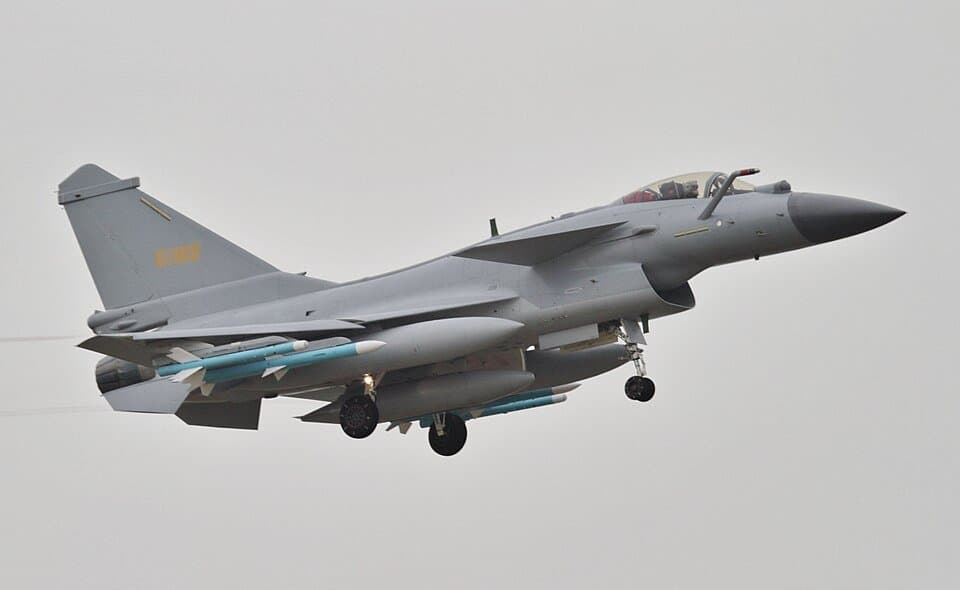
| Chengdu J-10 | ≈ 16.9 m | ≈ 9.8 m (Wingspan) | ≈ 6.26 m |
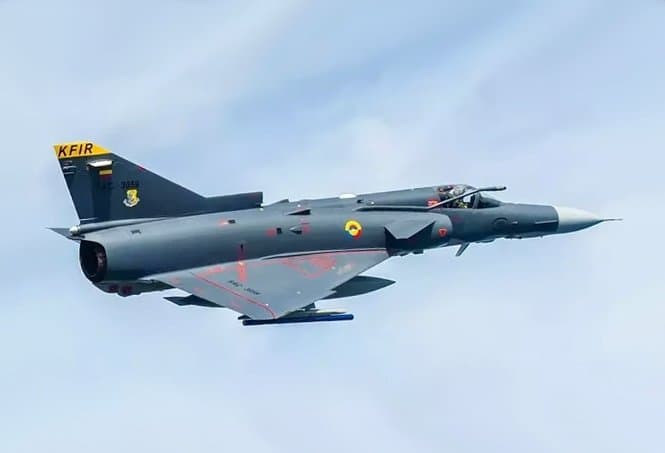
| IAI Kfir | ≈ 15.65 m | ≈ 8.22 m (Wingspan) | ≈ 4.55 m |
Scaled uniformly to the sourced length of 16.9 m. The shape was turned square to the axes; the width was fitted to the sourced 9.8 m wingspan. Not an official model or a measured survey.
ForceTally · All rights reserved
Scaled uniformly to the sourced length of 15.65 m. The shape was turned square to the axes; the height was fitted to the sourced 4.55 m; the width was fitted to the sourced 8.22 m wingspan. Not an official model or a measured survey.
ForceTally · All rights reserved
The human reference is a generic 1.75 m figure. Models describe external size, not combat performance.
Measured figures
J-10C · Length
Single source16.9 m (55 ft 5 in)[source]
Kfir C7 · Length
Configuration
| Specification | Chengdu J-10 | IAI Kfir |
|---|---|---|
| Type | Multirole combat aircraft[source] | Fighter-bomber , multirole combat aircraft[source] |
| National origin | China[source] | Israel[source] |
| Manufacturer | Chengdu Aircraft Corporation (1996 - 2024) Guizhou Aircraft Corporation (2024 - present)[source] | Israel Aircraft Industries[source] |
| Designer | Chengdu Aircraft Design Institute[source] | — |
15.65 m (51 ft 4 in)[source]
Gross; J-10C · Gross weight
Single source14,000 kg (30,865 lb)[source]
8,840公斤[source]
19,277公斤[source]
Empty; Kfir C7 · Empty weight
Single sourceGross; Kfir C7 · Empty weight+full internal fuel
Single sourceMaximum take-off; Kfir C7 · Max takeoff weight
Single source7,414 kg (16,345 lb)[source]
10,114 kg (22,298 lb) Empty weight+full internal fuel[source]
16,500 kg (36,376 lb)[source]
J-10C · Combat range
Single source1,240 km (770 mi, 670 nmi)[source]
Kfir C7 · 1,000 or 620 or
Single sourceKfir C7 · 540 or
Single sourceKfir C7 · ) Depends on if in attack or interceptor configuration
Single source1,000 or 670 km (620 or 420 mi, 540 or 360 nmi) Depends on if in attack or interceptor configuration[source]
J-10C · 1 × WS-10 B afterburning turbofan engines thrust
Single sourceJ-10C · with afterburner
Single source1 × WS-10 B afterburning turbofan engines, 89.17 kN (20,050 lbf) thrust , 135 kN - 144 kN with afterburner[source]
Kfir C7 · 1 × IAl Bedek-built General Electric J79 -J1E turbojet thrust dry
Single sourceKfir C7 · with afterburner
Single sourceKfir C7 · Bombs of payload on nine external hardpoints , including bombs such as the Mark 80 series , Paveway series of LGBs, Griffin LGBs , SMKBs , CBU-100 Rockeyes, BLU-107 Matra Durandal , reconnaissance pods or drop tanks
Single sourceBombs: 9,390 kg (20,701 lb) of payload on nine external hardpoints , including bombs such as the Mark 80 series , Paveway series of LGBs, Griffin LGBs , SMKBs , CBU-100 Rockeyes, BLU-107 Matra Durandal , reconnaissance pods or drop tanks[source]
Bars compare reported quantities only. A larger figure does not make a system better; configurations and test conditions differ.
| Status | In service[source] | In service with Colombia and Sri Lanka[source] |
|---|
| Primary users | People's Liberation Army Air Force Pakistan Air Force Uzbekistan Air and Air Defence Forces[source] | Israeli Air Force (historical) United States Navy (historical) Colombian Aerospace Force Sri Lanka Air Force[source] |
|---|
| Number built | 600+ (As of 2024 )[source] | 220+[source] |
|---|
| Manufactured | 2002–present[source] | — |
|---|
| Introduction date | 2004[source] | 1976[source] |
|---|
| First flight | 23 March 1998[source] | June 1973[source] |
|---|
| Developed from | Chengdu J-9[source] | Dassault Mirage 5 IAI Nesher[source] |
|---|
| Fuel capacity | 4000 L (3120 kg) external with 3 drop tanks (2 × 1600L + 1 × 800L)[source] | — |
|---|
| Guns | 1× Gryazev-Shipunov GSh-23[source] | 2× Rafael-built 30 mm (1.18 in) DEFA 553 cannon with 140 rpg[source] |
|---|
| Hardpoints | 11 in total (6 × under-wing, 2 × under-intake and 3 × under-fuselage) with a capacity of 5600 kg of external fuel and ordnance[source] | Bombs: 9,390 kg (20,701 lb) of payload on nine external hardpoints , including bombs such as the Mark 80 series , Paveway series of LGBs, Griffin LGBs , SMKBs , CBU-100 Rockeyes, BLU-107 Matra Durandal , reconnaissance pods or drop tanks[source] |
|---|
| Stall speed | 200 km/h (120 mph, 110 kn)[source] | — |
|---|
| Wing loading | 381 kg/m 2 (78 lb/sq ft)[source] | — |
|---|
| Thrust/weight | 1.04[source] | — |
|---|
| Rockets | 90 mm unguided rocket pods[source] | FFAR and Zuni unguided air-to-ground rockets[source] |
|---|
| Missiles | Air-to-air missiles : PL-8 short-range air-to-air missile PL-10 short-range air-to-air missile (J-10C) PL-12 BVR air-to-air missile PL-15 BVR air-to-air missile (J-10C) PL-17 BVR air-to-air missile (modified J-10C with DF-4/3 external pylons) Air-to-surface missiles : KD-88 standoff land attack missile YJ-91 anti-radiation missile Anti-ship missiles : YJ-83 K anti-ship cruise missile YJ-21 anti-ship ballistic missile (ongoing integration process for J-10C)[source] | 4× AIM-9 Sidewinders or Python -series AAMs[source] |
|---|
| Air-to-air missiles | PL-8 short-range air-to-air missile PL-10 short-range air-to-air missile (J-10C) PL-12 BVR air-to-air missile PL-15 BVR air-to-air missile (J-10C) PL-17 BVR air-to-air missile (modified J-10C with DF-4/3 external pylons)[source] | — |
|---|
| Air-to-surface missiles | KD-88 standoff land attack missile YJ-91 anti-radiation missile[source] | — |
|---|
| Anti-ship missiles | YJ-83 K anti-ship cruise missile YJ-21 anti-ship ballistic missile (ongoing integration process for J-10C)[source] | — |
|---|
| Bombs | Laser-guided bombs: (LS-500J, LT-2 ) Glide bombs: ( LS-6 , GB3 , GB2A , GB3A , GB250 ) Satellite-guided bombs: ( FT-1 ) Unguided bombs: 250 kg, 500 kg[source] | 9,390 kg (20,701 lb) of payload on nine external hardpoints , including bombs such as the Mark 80 series , Paveway series of LGBs, Griffin LGBs , SMKBs , CBU-100 Rockeyes, BLU-107 Matra Durandal , reconnaissance pods or drop tanks[source] |
|---|
| Others | Up to 3 external fuel drop-tanks (1 × under-fuselage, 2 × under-wing) for extended range and loitering time[source] | — |
|---|
| Source measurement | The J-10 is powered by a single turbofan . The J-10A entered production with the Russian Salyut AL-31 FN. The initial version generated a maximum static thrust of 12,500 kgf (123 kN ; 28,000 lbf ). In December 2013, Salyut reported it was testing an upgraded AL-31FN Series 3 for China with 250 hours more life and 1000 kgf more thrust; the Series 3 would be equipped on the improved J-10B. Compared to the original Lyulka-Saturn AL-31F, the AL-31FN was fitted to the J-10 by rotating the gearbox and accessory pack to the underside.[source]Chengdu J-10 · Design / Propulsion; only the objects and conditions stated in this passage The aircraft's internal armament consists of a Gryazev-Shipunov GSh-23 twin-barrel cannon , located underneath the port side of the intake. Other weaponry and equipment is mounted externally on 11 hardpoints, to which 5,600 kg (12,300 lb) of either missiles and bombs, drop-tanks containing fuel, or other equipment such as avionics pods can be attached.[source]Chengdu J-10 · Design / Weaponry and external loads; only the objects and conditions stated in this passage The J-10C has been reported to have consistently prevailed in simulated combat engagements against Su-35 fighters acquired from Russia, with the fighter's reduced radar visibility allowing it to detect and fire on its target first. The fighter's lower radar signature and significantly more advanced sensors and weaponry for both visual and beyond-visual range engagements were cited by experts as leading advantages the aircraft retained. The J-10C gained victories against both the Su-35 and the J-16 in exercises for three consecutive years from 2019 to 2021.[source]Chengdu J-10 · Operational history / China; only the objects and conditions stated in this passage PAF J-10CEs deployed against the Indian Air Force (IAF) during the May 2025 India–Pakistan conflict , and claimed to have shot down five IAF aircraft, including three Dassault Rafales . Chinese personnel were also deployed at PAF bases and provided on-site technical support to Pakistan. Chinese state media reported the J-10CE shooting down multiple aircraft in January 2026. According to French deputy Marc Chavent , several sources - including American analysts and NATO intelligence data - credited the J-10C with destroying a Rafale. The PL-15 E long-range air-to-air missile may have been used. On May 7, analysts attributed an increase in Chengdu Aircraft Corporation 's stock price to reports of the successful combat deployment of the J-10. This was the first use of the J-10 in combat.[source]Chengdu J-10 · Operational history / Pakistan; only the objects and conditions stated in this passage Length: 16.9 m (55 ft 5 in)[source]Chengdu J-10 · Specifications (J-10C); only the objects and conditions stated in this passage Wingspan: 9.8 m (32 ft 2 in)[source]Chengdu J-10 · Specifications (J-10C); only the objects and conditions stated in this passage Height: 5.7 m (18 ft 8 in)[source]Chengdu J-10 · Specifications (J-10C); only the objects and conditions stated in this passage Wing area: 37 m 2 (400 sq ft)[source]Chengdu J-10 · Specifications (J-10C); only the objects and conditions stated in this passage Gross weight: 14,000 kg (30,865 lb)[source]Chengdu J-10 · Specifications (J-10C); only the objects and conditions stated in this passage Fuel capacity: 4000 L (3120 kg) external with 3 drop tanks (2 × 1600L + 1 × 800L)[source]Chengdu J-10 · Specifications (J-10C); only the objects and conditions stated in this passage Powerplant: 1 × WS-10 B afterburning turbofan engines, 89.17 kN (20,050 lbf) thrust , 135 kN - 144 kN with afterburner[source]Chengdu J-10 · Specifications (J-10C); only the objects and conditions stated in this passage Stall speed: 200 km/h (120 mph, 110 kn)[source]Chengdu J-10 · Specifications (J-10C); only the objects and conditions stated in this passage Range: 1,850 km (1,150 mi, 1,000 nmi)[source]Chengdu J-10 · Specifications (J-10C); only the objects and conditions stated in this passage Combat range: 1,240 km (770 mi, 670 nmi)[source]Chengdu J-10 · Specifications (J-10C); only the objects and conditions stated in this passage Ferry range: 2,950 km (1,830 mi, 1,590 nmi)[source]Chengdu J-10 · Specifications (J-10C); only the objects and conditions stated in this passage Rate of climb: 300 m/s (59,000 ft/min)[source]Chengdu J-10 · Specifications (J-10C); only the objects and conditions stated in this passage Hardpoints: 11 in total (6 × under-wing, 2 × under-intake and 3 × under-fuselage) with a capacity of 5600 kg of external fuel and ordnance[source]Chengdu J-10 · Specifications (J-10C); only the objects and conditions stated in this passage Rockets: 90 mm unguided rocket pods[source]Chengdu J-10 · Specifications (J-10C); only the objects and conditions stated in this passage Bombs: Laser-guided bombs: (LS-500J, LT-2 ) Glide bombs: ( LS-6 , GB3 , GB2A , GB3A , GB250 ) Satellite-guided bombs: ( FT-1 ) Unguided bombs: 250 kg, 500 kg[source]Chengdu J-10 · Specifications (J-10C); only the objects and conditions stated in this passage Radar KLJ-7A AESA Radar(J-10C) Type 1473H pulse-doppler fire-control radar (J-10A)[source]Chengdu J-10 · Specifications (J-10C); only the objects and conditions stated in this passage | — |
|---|
| Role | Chinese medium-weight, single-engine, multirole combat aircraft using a delta wing and canard design,[source] | — |
|---|
| Variant | — | IAI Nammer[source] |
|---|
| Airfoil | — | 3.5%[source] |
|---|
| g limits | — | 7.5g[source] |
|---|
1 × IAl Bedek-built General Electric J79 -J1E turbojet , 52.9 kN (11,900 lbf) thrust dry, 79.62 kN (17,900 lbf) with afterburner[source]