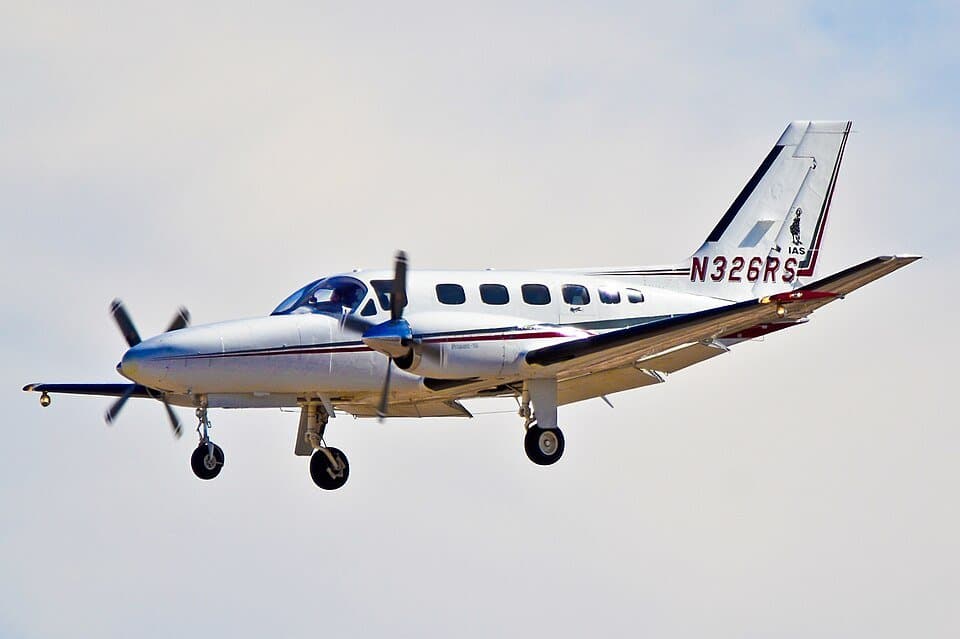

Credit
Tomás Del Coro from Las Vegas, Nevada, USA · CC BY-SA 2.0 · Resized · CC BY-SA 2.0 · Source ↗ · Modified


Preparing your view.

At a glance
True scale
Side by side. From every angle. A human reference for perspective.
3.43 MB · Loads when you open it| Model | Length | Width / span | Height |
|---|---|---|---|
| Cessna 441 Conquest II | ≈ 11.89 m | ≈ 15.04 m (Width) | ≈ 4.01 m |
| Embraer EMB 121 Xingu | ≈ 12.25 m | ≈ 14.05 m (Width) | ≈ 4.85 m |
Scaled uniformly to the sourced length of 11.89 m. The shape was turned square to the axes; the height was fitted to the sourced 4.01 m; the width was fitted to the sourced 15.04 m. Not an official model or a measured survey.
ForceTally · All rights reserved
Scaled uniformly to the sourced length of 12.25 m. The shape was turned square to the axes; the width was fitted to the sourced 14.05 m. Not an official model or a measured survey.
ForceTally · All rights reserved
The human reference is a generic 1.75 m figure. Models describe external size, not combat performance.
Measured figures
Conquest II · Length
Single source39 ft 0 in (11.89 m)[source]
Configuration
| Specification | Cessna 441 Conquest II | Embraer EMB 121 Xingu |
|---|---|---|
| Crew | 1 or 2 pilots[source] | 1/2[source] |
| Type | Utility aircraft[source] | Utility aircraft[source] |
| National origin | United States[source] | Brazil[source] |
| Manufacturer | Cessna[source] |
EMB 121A1 Xingu II · Length
12.25 m (40 ft 2 in)[source]
Empty; Conquest II · Empty weight
Single sourceGross; Conquest II · Gross weight
Single sourceMaximum take-off; Cessna Model441 ConquestII handbook, applicable serials441-0001 through441-0172; maximum takeoff9850lb, distinct from ramp9925lb and landing9360lb
Single source5,682 lb (2,577 kg)[source]
9,850 lb (4,468 kg)[source]
9850 Pounds[source]Cessna Model441 ConquestII handbook, applicable serials441-0001 through441-0172; maximum takeoff9850lb, distinct from ramp9925lb and landing9360lb
Empty; EMB 121A1 Xingu II · equipped
Single sourceMaximum take-off; EMB 121A1 Xingu II · Max takeoff weight
Single sourceCruise; Conquest II · at 35,000 ft (10,700 m)
Single sourceMaximum; Conquest II · at 16,000 ft (4,875 m)
Single source340 mph (550 km/h, 300 kn) at 16,000 ft (4,875 m)[source]
298 mph (480 km/h, 259 kn) at 35,000 ft (10,700 m)[source]
Cruise; EMB 121A1 Xingu II · at 3,050 m (10,010 ft)
Single sourceMaximum; EMB 121A1 Xingu II · Maximum speed
Single sourceConquest II · at 35,000 ft (10,700 m)
Single source2,525 mi (4,064 km, 2,194 nmi) at 35,000 ft (10,700 m)[source]
EMB 121A1 Xingu II · at 6,100 m (20,000 ft) maximum fuel with 45 minutes reserve
Single source1,230 km (760 mi, 660 nmi) at 6,100 m (20,000 ft) maximum fuel with 45 minutes reserve[source]
Conquest II · 2 × Garrett TPE331 -8-403S turboprops, 636 shp ( ) each
Single source2 × Garrett TPE331 -8-403S turboprops, 636 shp (474 kW) each[source]
EMB 121A1 Xingu II · 2 × Pratt & Whitney Canada PT6A-135 turboprop engines each
Single source2 × Pratt & Whitney Canada PT6A-135 turboprop engines, 559 kW (750 hp) each[source]
Bars compare reported quantities only. A larger figure does not make a system better; configurations and test conditions differ.
Embraer[source]
| Number built | 362[source] | 106[source] |
|---|
| Manufactured | 1977–1986[source] | 1977-1987[source] |
|---|
| First flight | August 26, 1975[source] | 10 October 1976[source] |
|---|
| Developed from | Cessna 404 Titan[source] | EMB 110 Bandeirante[source] |
|---|
| Capacity | Up to 10 passengers with one pilot; up to 9 passengers with two pilots[source] | 9 passengers or 770 kg (1,700 lb) cargo with 1 pilot[source] |
|---|
| Aspect ratio | 9.6:1[source] | 7.18[source] |
|---|
| Airfoil | NACA 23018 at root, NACA 23019 at tip[source] | — |
|---|
| Propellers | 3-bladed Hartzell or McCauley[source] | 4-bladed Hartzell HC-B4TN-3C/T9212B, 2.36 m (7 ft 9 in) diameter constant-speed metal propeller with auto-feathering and full reverse-pitch[source] |
|---|
| Stall speed | 86 mph (139 km/h, 75 kn) flaps and gear down[source] | 141 km/h (87 mph, 76 kn) power off, flaps down[source] |
|---|
| Source measurement | The Model 441 originated on paper in 1972 as the Model 431, powered by two 435 hp Continental GTSIO-520-X engines driving three-bladed propellers. By 1975, the design had evolved into the turboprop-powered Model 441. The Model 441 was certified by the FAA on August 19, 1977. Its high-aspect-ratio wings use bonded construction techniques.[source]Cessna 441 Conquest II · Development; only the objects and conditions stated in this passage Cessna renamed the Model 441 the Conquest II in 1983. Beginning with constructor number 195, McCauley propellers replaced the previous Hartzell units, saving a total of 23 lb (10 kg). Cessna built 362 aircraft between 1977 and 1986.[source]Cessna 441 Conquest II · Development; only the objects and conditions stated in this passage In September 2007, Cessna limited the Conquest II to 22,500 hours of air time through a Supplemental Inspection Document. This makes it effectively mandatory for US air carriers but only advisory for private operators.[source]Cessna 441 Conquest II · Development; only the objects and conditions stated in this passage A midweight Cessna 441 fitted with TPE331-10 engines cruises at 316 kn (364 mph; 585 km/h) true airspeed while burning 480 lb (220 kg) of fuel per hour at flight level 290. The aircraft's maximum range is 2,000 nmi (2,300 mi; 3,700 km) at 260 kn (300 mph; 480 km/h) TAS and 310 lb (140 kg)/h at FL350, assuming TPE331-10 engines. With one pilot and six to nine seats, its 6,400–6,500 lb (2,900–2,900 kg) basic operating weight (BOW) allows a 200–300 lb (91–136 kg) payload at full fuel, but MTOW can be increased by 490 lb (220 kg) with aftermarket modifications.[source]Cessna 441 Conquest II · Performance; only the objects and conditions stated in this passage November 22, 1994: TWA Flight 427 collided with a Cessna 441 Conquest, registration N441KM, at the intersection of runway 30R and taxiway Romeo at St. Louis Lambert International Airport . The TWA McDonnell Douglas MD-82 was taking off for Denver and had accelerated through 80 knots (150 km/h; 92 mph) when the collision occurred. The MD-82 sustained substantial damage during the collision. The Cessna 441, operated by Superior Aviation, was destroyed. The pilot and the passenger were killed. The investigation found the Cessna 441 had entered the wrong runway for its takeoff.[source]Cessna 441 Conquest II · Accidents and incidents; only the objects and conditions stated in this passage On 30 May 2017, an accident with a Rossair Cessna 441 (registered VH-XMJ) that took off from Renmark Airport and crashed approximately 4 kilometres away killed all three occupants on board.[source]Cessna 441 Conquest II · Accidents and incidents; only the objects and conditions stated in this passage On June 29, 2025, a Cessna 441 Conquest II, registration N441LS, crashed after departing the Youngstown–Warren Regional Airport. The aircraft crashed two miles west of the airport minutes after departure. The pilot and five passengers on board were killed. The crash is under investigation.[source]Cessna 441 Conquest II · Accidents and incidents; only the objects and conditions stated in this passage On March 19, 2026, a Cessna 441 Conquest II carrying two pilots and five passengers crashed into shallow water in Roebuck Bay shortly after taking off from Broome Airport for Mungalalu Truscott Airbase . One occupant sustained minor head injuries, and there were no fatalities.[source]Cessna 441 Conquest II · Accidents and incidents; only the objects and conditions stated in this passage On August 20, 2026, a Cessna 441 Conquest operated by Security Aviation crashed near Cape Newenham . All eight passengers and crew onboard perished.[source]Cessna 441 Conquest II · Accidents and incidents; only the objects and conditions stated in this passage Capacity: Up to 10 passengers with one pilot; up to 9 passengers with two pilots[source]Cessna 441 Conquest II · Specifications (Conquest II); only the objects and conditions stated in this passage Length: 39 ft 0 in (11.89 m)[source]Cessna 441 Conquest II · Specifications (Conquest II); only the objects and conditions stated in this passage Wingspan: 49 ft 4 in (15.04 m)[source]Cessna 441 Conquest II · Specifications (Conquest II); only the objects and conditions stated in this passage Height: 13 ft 2 in (4.01 m)[source]Cessna 441 Conquest II · Specifications (Conquest II); only the objects and conditions stated in this passage Wing area: 253.6 sq ft (23.56 m 2 )[source]Cessna 441 Conquest II · Specifications (Conquest II); only the objects and conditions stated in this passage Empty weight: 5,682 lb (2,577 kg)[source]Cessna 441 Conquest II · Specifications (Conquest II); only the objects and conditions stated in this passage Gross weight: 9,850 lb (4,468 kg)[source]Cessna 441 Conquest II · Specifications (Conquest II); only the objects and conditions stated in this passage Powerplant: 2 × Garrett TPE331 -8-403S turboprops, 636 shp (474 kW) each[source]Cessna 441 Conquest II · Specifications (Conquest II); only the objects and conditions stated in this passage Maximum speed: 340 mph (550 km/h, 300 kn) at 16,000 ft (4,875 m)[source]Cessna 441 Conquest II · Specifications (Conquest II); only the objects and conditions stated in this passage Cruise speed: 298 mph (480 km/h, 259 kn) at 35,000 ft (10,700 m)[source]Cessna 441 Conquest II · Specifications (Conquest II); only the objects and conditions stated in this passage Stall speed: 86 mph (139 km/h, 75 kn) flaps and gear down[source]Cessna 441 Conquest II · Specifications (Conquest II); only the objects and conditions stated in this passage Range: 2,525 mi (4,064 km, 2,194 nmi) at 35,000 ft (10,700 m)[source]Cessna 441 Conquest II · Specifications (Conquest II); only the objects and conditions stated in this passage Service ceiling: 35,000 ft (11,000 m)[source]Cessna 441 Conquest II · Specifications (Conquest II); only the objects and conditions stated in this passage Rate of climb: 2,435 ft/min (12.37 m/s)[source]Cessna 441 Conquest II · Specifications (Conquest II); only the objects and conditions stated in this passage | — |
|---|
| Status | — | Active[source] |
|---|
| Primary users | — | French Air and Space Force Brazilian Air Force French Navy[source] |
|---|
| Introduction date | — | 20 May 1977[source] |
|---|
| Fuel capacity | — | 1,308 kg (2,884 lb)[source] |
|---|
| Wing loading | — | 206.2 kg/m 2 (42.2 lb/sq ft)[source] |
|---|
| Fuel consumption | — | 0.52 kg/km (1.86 lb/mi) : 250 lb (110 kg)/h per engine at 234 kn (433 km/h) TAS, FL200, -4°C[source] |
|---|
| Power/mass | — | 0.197 kW/kg (0.12 shp/lb)[source] |
|---|