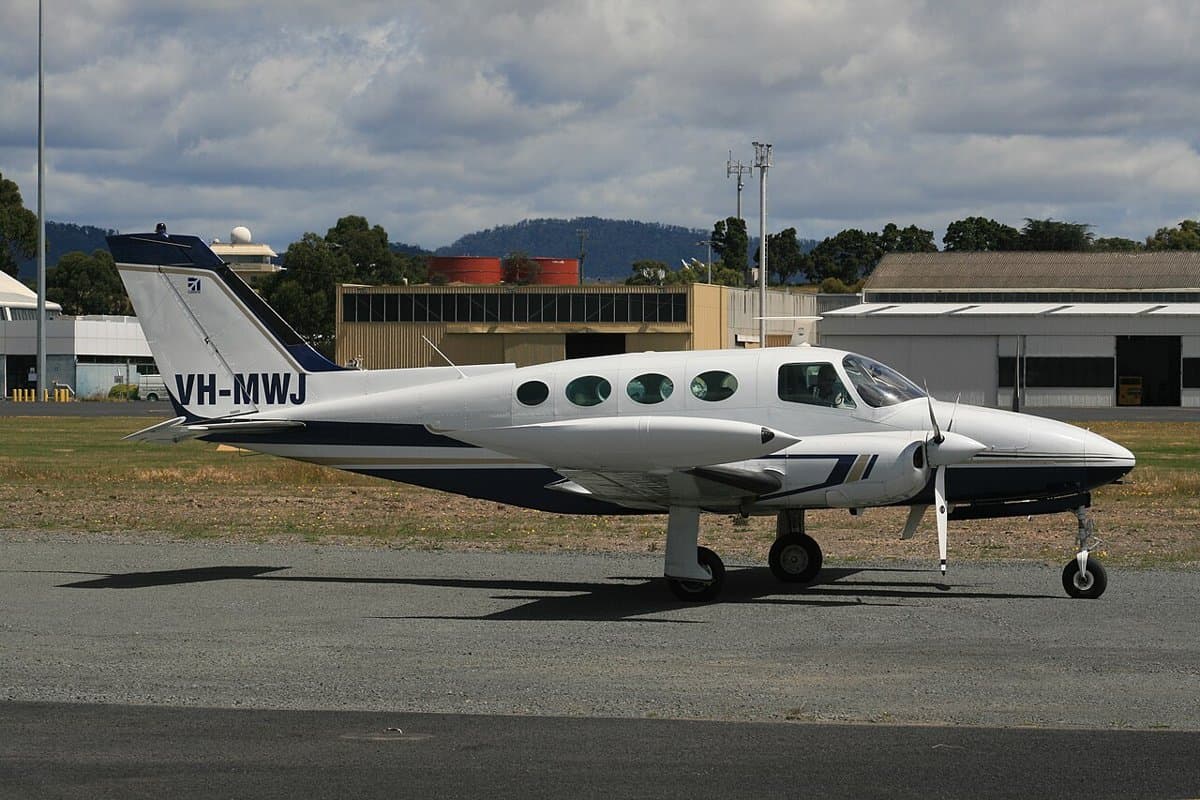

Credit
YSSYguy at English Wikipedia · CC BY-SA 3.0 · Resized · CC BY-SA 3.0 · Source ↗ · Modified


Preparing your view.
At a glance
True scale
Side by side. From every angle. A human reference for perspective.
3.15 MB · Loads when you open it| Model | Length | Width / span | Height |
|---|---|---|---|
| Cessna 411 | ≈ 10.2 m | ≈ 12.15 m (Width) | ≈ 3.52 m |
| Cirrus SR20 | ≈ 7.92 m | ≈ 11.68 m (Width) | ≈ 2.72 m |
Scaled uniformly to the sourced length of 10.2 m. The shape was turned square to the axes; the height was fitted to the sourced 3.52 m; the width was fitted to the sourced 12.15 m. Not an official model or a measured survey.
ForceTally · All rights reserved
Scaled uniformly to the sourced length of 7.92 m. The shape was turned square to the axes; the height was fitted to the sourced 2.72 m; the width was fitted to the sourced 11.68 m. Not an official model or a measured survey.
ForceTally · All rights reserved
The human reference is a generic 1.75 m figure. Models describe external size, not combat performance.
Measured figures
Length
Single source33 ft 5 + 1 ⁄ 2 in (10.20 m)[source]
SR20-G3 · Length
Single sourceConfiguration
| Specification | Cessna 411 | Cirrus SR20 |
|---|---|---|
| Type | Light business/cargo aircraft[source] | Light aircraft[source] |
| National origin | United States[source] | United States[source] |
| Manufacturer | Cessna[source] | Cirrus Aircraft[source] |
| Number built | 302[source] | 2,084 (through 2025) |
26 ft 0 in (7.92 m)[source]
Cruise; at 25,000 ft (7,600 m) (econ cruise)
Single sourceMaximum; at 16,000 ft (4,900 m)
Single source268 mph (431 km/h, 233 kn) at 16,000 ft (4,900 m)[source]
216 mph (348 km/h, 188 kn) at 25,000 ft (7,600 m) (econ cruise)[source]
Cruise; SR20-G3 · TAS
Single sourceCruise; SR20 only · manufacturer 2024 product configuration · maximum cruising speed · SR20 only · manufacturer 2024 product configuration · maximum cruising speed · SR20
Manufacturer claimat 216 mph (188 kn; 348 km/h) and 25,000 ft (7,600 m), normal fuel
Single source1,300 mi (2,100 km, 1,100 nmi) at 216 mph (188 kn; 348 km/h) and 25,000 ft (7,600 m), normal fuel[source]
709 nm[source]SR20 only · manufacturer 2024 product configuration · maximum range; same manufacturer portfolio table states 55% power
2 × Continental GTSIO-520 air-cooled geared, turbocharged flat-six engines each
Single source2 × Continental GTSIO-520 air-cooled geared, turbocharged flat-six engines, 340 hp (250 kW) each[source]
SR20-G3 · 1 × Continental IO-360-ES six cylinder, horizontally-opposed piston aircraft engine
Single sourceSR20 only · manufacturer 2024 product configuration; not SR22 or SR22T · SR20 only · manufacturer 2024 product configuration; not SR22 or SR22T · SR20 · Lycoming engine
Manufacturer claim1 × Continental IO-360-ES six cylinder, horizontally-opposed piston aircraft engine , 200 hp (150 kW)[source]
Service ceiling
Single source26,000 ft (7,900 m)[source]
SR20-G3 · Service ceiling
Single sourceSR20 only · manufacturer 2024 product configuration · maximum operating altitude · SR20 only · manufacturer 2024 product configuration · maximum operating altitude · SR20
Manufacturer claim17,500 ft (5,300 m)[source]
17,500 feet[source]SR20 only · manufacturer 2024 product configuration · maximum operating altitude
Bars compare reported quantities only. A larger figure does not make a system better; configurations and test conditions differ.
| Manufactured | 1962-1968[source] | 1999–present[source] |
|---|
| First flight | July 18, 1962[source] | 21 March 1995[source] |
|---|
| Developed from | Cessna 310[source] | — |
|---|
| Developed into | Cessna 401/402 Cessna 421[source] | Cirrus SR22[source] |
|---|
| Capacity | four to six passengers[source] | 3 passengers (4 using 60/40 flex seating in post-2012 models)[source] |
|---|
| Fuel capacity | 170 US gal (140 imp gal; 640 L) standard, 196 US gal (163 imp gal; 740 L) with auxiliary tanks[source] | — |
|---|
| Propellers | 3-bladed constant-speed, 7 ft 4 in (2.24 m) diameter[source] | 3-bladed[source] |
|---|
| Stall speed | 84 mph (135 km/h, 73 kn) (flaps down)[source] | 56 kn (64 mph, 104 km/h) CAS[source] |
|---|
| Takeoff distance to 50 ft (15m) | 1,890 ft (580 m)[source] | — |
|---|
| Landing distance from 50 ft (15 m) | 1,815 ft (553 m)[source] | — |
|---|
| Source measurement | — | One of the major selling points for the SR20 is its Garmin Cirrus Perspective avionics suite with dual 10-inch (250 mm) or 12-inch (300 mm) screens: one primary flight display (PFD) and one multifunction display (MFD), first introduced by the company in May 2008. This provides all standard communication , navigation ( GPS and conventional VHF), and surveillance ( Mode S transponder ) functions. Other avionics features include in-flight weather information and TCAS -like traffic information.[source]Cirrus SR20 · Design and development; only the objects and conditions stated in this passage In 2012, "60/40 flex seating" was introduced, allowing up to three passengers in the rear with a split fold-down seat arrangement. This five-seat configuration was optional in 2012, but became standard equipment for 2013 SR20 models.[source]Cirrus SR20 · Design and development; only the objects and conditions stated in this passage In January 2020, the company introduced a new mobile application for the SR series, called "Cirrus IQ", which enables remote aircraft communication including access to preflight status information such as fuel and oxygen levels, battery voltage, oil temperature, aircraft location, and flight hours. Upgrades also included a new stabilized approach-advisory system for the flight deck. In January 2022, speed and aesthetic improvements were added to the G6 SR-series, with a 9 knots (17 km/h) increased cruise speed, upgrades to the mobile IQ app, USB-A and USB-C charging ports and more.[source]Cirrus SR20 · Design and development; only the objects and conditions stated in this passage In 2011, the accident records of the SR20 and -22 were the subject of a detailed examination by Aviation Consumer magazine. The review concluded that the series has an overall accident record that is better than average for light aircraft, exceeded only by the Diamond DA40 and DA42 . However, its fatal accident rate is much worse at 1.6/100,000 hours, placing it higher than the U.S. general aviation rate of 1.2 and higher than the Diamond DA40 (0.35), Cessna 172 (0.45), Diamond DA42 (0.54), Cessna 182 (0.69), and Cessna 400 (1.0), despite the Cirrus's CAPS.[source]Cirrus SR20 · Operational history; only the objects and conditions stated in this passage Introduced in 2007, the G3 has a lighter wing of greater area, incorporating a carbon-fiber spar . The new wing increased the SR20's cruise speed by 6–7 knots (11–13 km/h). The G3 also added a 50 pounds (23 kg) increased useful load by increasing the take-off weight to 3,050 pounds (1,380 kg), a redesigned main landing gear that is 2 inches (5 cm) taller, giving greater propeller and tail clearance, improved aircraft handling due to increased dihedral , improved aerodynamics including new wing root fairings , LED recognition lights, improved heat and ventilation, dual-redundant GPS WAAS -certified Garmin GNS 430W comm-navigators (that include a VHF radio and a VOR/LOC/ILS receiver), and an S-TEC Autopilot.[source]Cirrus SR20 · Variants; only the objects and conditions stated in this passage Introduced in January 2017, the G6 model adds a Lycoming IO-390 engine of 215 hp (160 kW), an enhanced "Perspective-Plus" flight deck with a 10-times faster instrument processing speed, new LED wingtip lights and a useful load increase of 150 lb (68 kg).[source]Cirrus SR20 · Variants; only the objects and conditions stated in this passage Capacity: 3 passengers (4 using 60/40 flex seating in post-2012 models)[source]Cirrus SR20 · Specifications (SR20-G3); only the objects and conditions stated in this passage Length: 26 ft 0 in (7.92 m)[source]Cirrus SR20 · Specifications (SR20-G3); only the objects and conditions stated in this passage Wingspan: 38 ft 4 in (11.68 m)[source]Cirrus SR20 · Specifications (SR20-G3); only the objects and conditions stated in this passage Height: 8 ft 11 in (2.72 m)[source]Cirrus SR20 · Specifications (SR20-G3); only the objects and conditions stated in this passage Empty weight: 2,126 lb (964 kg)[source]Cirrus SR20 · Specifications (SR20-G3); only the objects and conditions stated in this passage Gross weight: 3,050 lb (1,383 kg)[source]Cirrus SR20 · Specifications (SR20-G3); only the objects and conditions stated in this passage Powerplant: 1 × Continental IO-360-ES six cylinder, horizontally-opposed piston aircraft engine , 200 hp (150 kW)[source]Cirrus SR20 · Specifications (SR20-G3); only the objects and conditions stated in this passage Cruise speed: 155 kn (178 mph, 287 km/h) TAS[source]Cirrus SR20 · Specifications (SR20-G3); only the objects and conditions stated in this passage Stall speed: 56 kn (64 mph, 104 km/h) CAS[source]Cirrus SR20 · Specifications (SR20-G3); only the objects and conditions stated in this passage Service ceiling: 17,500 ft (5,300 m)[source]Cirrus SR20 · Specifications (SR20-G3); only the objects and conditions stated in this passage Rate of climb: 828 ft/min (4.21 m/s)[source]Cirrus SR20 · Specifications (SR20-G3); only the objects and conditions stated in this passage 406 MHz ELT[source]Cirrus SR20 · Specifications (SR20-G3); only the objects and conditions stated in this passage |
|---|
| Powerplant | — | 215 horsepower Lycoming engine[source]SR20 only · manufacturer 2024 product configuration; not SR22 or SR22T |
|---|
| Useful load | — | 1,028 pounds[source]SR20 only · manufacturer 2024 product configuration · approximate useful load, not empty mass or payload alone |
|---|