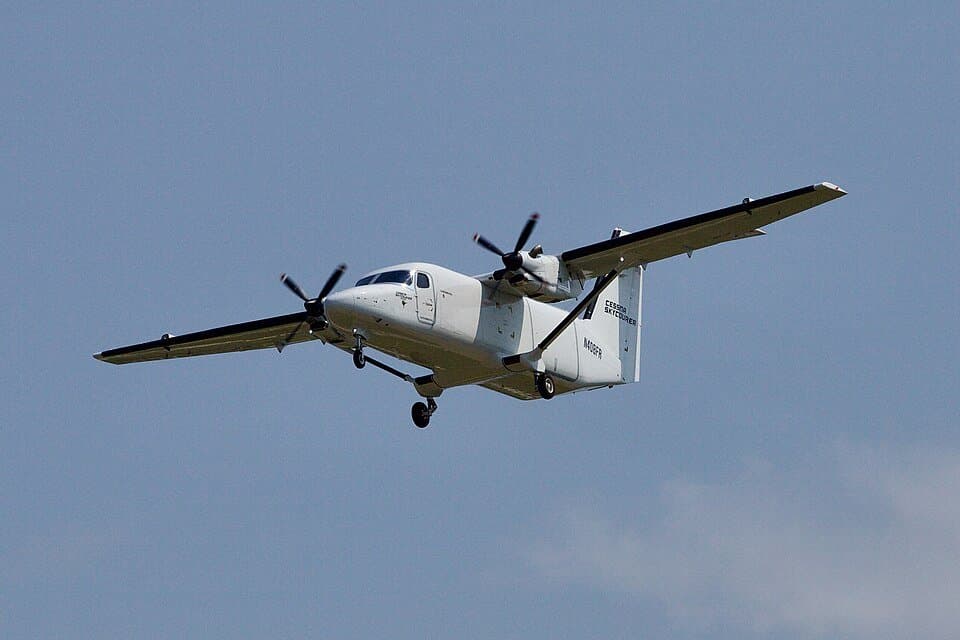

Credit
H. Michael Miley from Schaumburg, USA · CC BY-SA 2.0 · Resized · CC BY-SA 2.0 · Source ↗ · Modified


Preparing your view.

At a glance
Cessna 408 SkyCourierlarger figure on 6 of 6
True scale
Side by side. From every angle. A human reference for perspective.
3.18 MB · Loads when you open it| Model | Length | Width / span | Height |
|---|---|---|---|
| Cessna 408 SkyCourier | ≈ 16.8 m | ≈ 22.02 m (Width) | ≈ 6.3 m |
| Tecnam P2012 Traveller | ≈ 11.8 m | ≈ 16.6 m (Width) | ≈ 4.4 m |
Scaled uniformly to the sourced length of 16.8 m. The shape was turned square to the axes; the height was fitted to the sourced 6.3 m; the width was fitted to the sourced 22.02 m. Not an official model or a measured survey.
ForceTally · All rights reserved
Scaled uniformly to the sourced length of 11.8 m. The shape was turned square to the axes; the height was fitted to the sourced 4.4 m; the width was fitted to the sourced 16.6 m. Not an official model or a measured survey.
ForceTally · All rights reserved
The human reference is a generic 1.75 m figure. Models describe external size, not combat performance.
Measured figures
Configuration
| Specification | Cessna 408 SkyCourier | Tecnam P2012 Traveller |
|---|---|---|
| Crew | single-pilot-capable[source]SkyCourier passenger configuration · single-pilot capability 2 pilots[source]SkyCourier passenger configuration · typically equipped operating-weight configuration with listed options and two pilots | 1 or 2[source] |
| Type | Utility aircraft[source] | — |
| National origin | United States[source] | Italy[source]P2012 Traveller |
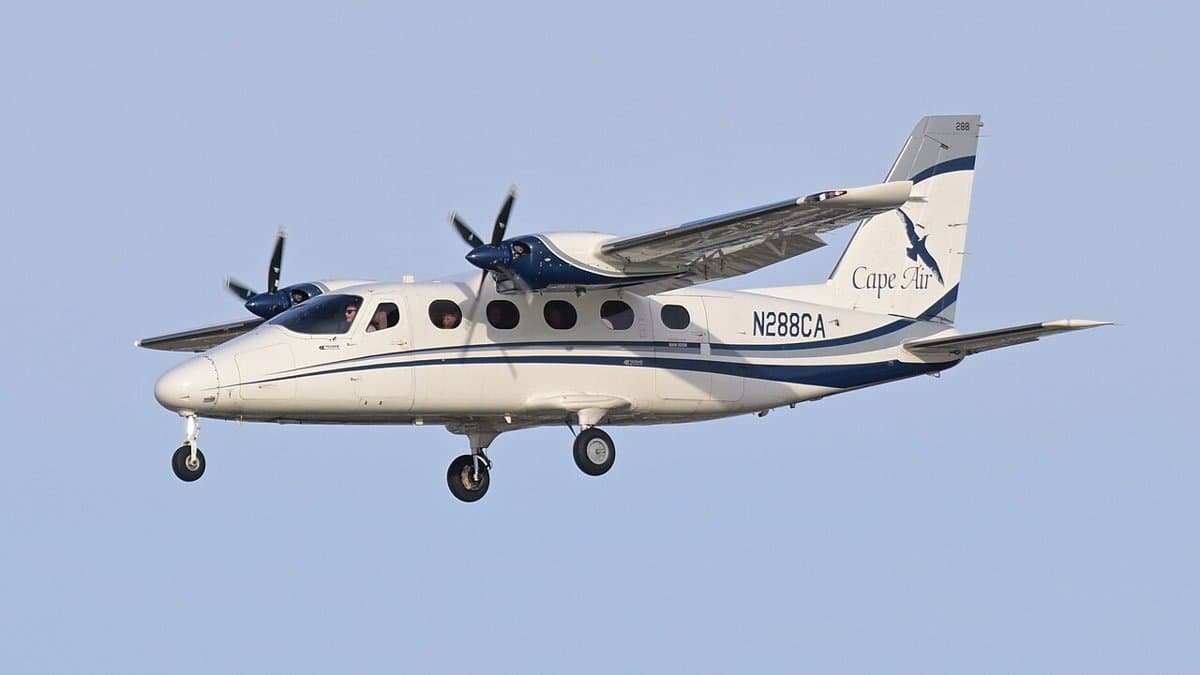
Tecnam P2012 Travellerlarger figure on 0 of 6
Counts only measures both sources give with the same scope. A larger figure is not a better system.
Length
Single source11.8 m (38 ft 9 in)[source]
Empty; Empty weight
Single sourceMaximum take-off; Max takeoff weight
Single sourceEmpty; Freighter
Single source12,325 lb (5,591 kg) , Freighter: 11,000 lb (4,990 kg)[source]
19,000 lb (8,618 kg)[source]
8,618 kg[source]
Empty; Empty weight
Single sourceMaximum take-off; Max takeoff weight
Single sourceCruise; maximum
Single source210 kn (240 mph, 390 km/h) maximum[source]
Ferry; Ferry range
Single sourceIFR reserves, FL100
Single sourcewith 19 passengers, LRC
Single source386 nmi (444 mi, 715 km) with 19 passengers, LRC, 100nmi IFR reserves, FL100[source]
920 nmi (1,060 mi, 1,700 km)[source]
Range
Single source2,500 km (1,600 mi, 1,300 nmi)[source]
2 × Pratt & Whitney Canada PT6A -65SC turboprop each
Single source2 × Pratt & Whitney Canada PT6A -65SC turboprop , 1,110 hp (830 kW) each[source]
2 × Lycoming TEO-540C1A 6-cylinder air-cooled horizontally-opposed turbocharged piston engines each
Single source2 × Lycoming TEO-540C1A 6-cylinder air-cooled horizontally-opposed turbocharged piston engines, 280 kW (375 hp) each[source]
1,140 ft/min
Single source(1,285 ft/min) on STOL variant
Single source5.8 m/s (1,140 ft/min) ; 6.53 m/s (1,285 ft/min) on STOL variant[source]
Bars compare reported quantities only. A larger figure does not make a system better; configurations and test conditions differ.
| Manufacturer |
|---|
Cessna ( Textron Aviation )[source] |
Tecnam[source]P2012 Traveller |
| Status | In production[source] | — |
|---|
| Primary user | FedEx Feeder[source] | — |
|---|
| Number built | 61(February 2026)[source] | 120[source]P2012 Traveller |
|---|
| Introduction date | May 9, 2022[source] | 22 February 2020[source]P2012 Traveller |
|---|
| First flight | May 17, 2020[source] | 21 July 2016[source]P2012 Traveller |
|---|
| Capacity | 19 passengers/5,000 lb (2,268 kg) payload (commuter) or 3× LD3s /6,000 lb (2,722 kg) payload (cargo)[source] | 9 passenger seats / 1,414 kg (3,117 lb) useful load including fuel[source] |
|---|
| Aspect ratio | 11.8[source] | 7.7[source] |
|---|
| Fuel capacity | 4,826 lb (2,189 kg) / 720 gal (2,725 L)[source] | 880 L (230 US gal) usable fuel[source] |
|---|
| Propellers | 4-bladed McCauley Blackmac aluminum, auto feathering, reverse[source] | 3 or 4-bladed MT-Propeller, 1.95 m (6 ft 5 in) diameter constant-speed fully-feathering propeller[source] |
|---|
| Takeoff Distance | 3,660 ft (1,116 m)[source] | 791 m (2,595 ft); 682 m (2,238 ft) on STOL variant[source] |
|---|
| Role | American utility aircraft[source] | Utility aircraft[source]P2012 Traveller |
|---|
| Source measurement | The non- pressurized design is built from aluminium and is equipped with Pratt & Whitney Canada PT6A engines and fixed landing gear . The 19,000-pound (8,600 kg) MTOW airplane can cruise up to 210 knots (390 km/h; 240 mph), with a range of 386 nautical miles (715 km; 444 mi) with 19 passengers.[source]Cessna 408 SkyCourier · Lead; only the objects and conditions stated in this passage The Model 408 was launched on November 28, 2017, by Textron Aviation , with an introduction planned for 2020, as a FAR Part 23 type certified design. Like the earlier Cessna 208 Caravan , the 408's design was developed with FedEx Express to match the needs of FedEx Feeder service; FedEx requested an aircraft that could haul 6,000 lb (2,700 kg), twice the payload of the 208, and could accommodate entire LD3 sized unit load devices .[source]Cessna 408 SkyCourier · Development; only the objects and conditions stated in this passage The mating of the wing and fuselage of the first aircraft was completed in December 2019. By March 2020, initial ground testing was completed, checking the fuel system, engines, avionics interfaces and electrical systems. The first flight was completed on May 17, 2020, operating from Beech Factory Airport for a 2-hour and 15-minute flight. The prototype aircraft, a passenger version, along with five additional flight and ground test articles, was used for testing leading to certification. The second prototype, a freighter version which first flew in August 2020, was the first production-conforming aircraft and was used for testing the engines, propellers, environmental controls and avionics . A third test aircraft first flew in September 2020.[source]Cessna 408 SkyCourier · Development; only the objects and conditions stated in this passage By early 2022, the three test aircraft had accumulated over 2,100 flight hours as the first production aircraft for FedEx was rolled out on February 3, 2022. Cessna was aiming for certification in the first half of the year before first delivery later in 2022. Federal Aviation Administration type certification was granted on March 11, 2022, after 2,100 hours of flight tests. Certification by the National Civil Aviation Agency of Brazil was granted on August 8, 2023. Certification was awarded by the Civil Aviation Authority of the Philippines (CAAP) in August 2024, and Transport Canada Civil Aviation granted certification of the type in December 2024.[source]Cessna 408 SkyCourier · Development; only the objects and conditions stated in this passage In February 2023, a gravel runway operations kit was approved for the aircraft. In 2023, its equipped price was $7.195M for the freighter and $7.745M for the passenger version.[source]Cessna 408 SkyCourier · Development; only the objects and conditions stated in this passage In 2024, the price was $8.35M for the passenger variant and $7.75M for the cargo variant.[source]Cessna 408 SkyCourier · Development; only the objects and conditions stated in this passage The SkyCourier is a twin- turboprop , high-wing, utility aircraft . It is available in a 19-passenger variant with large cabin windows and separate crew and passenger doors, or in a cargo variant sized for three LD3s and 6,000 lb (2,700 kg) of payload, featuring a "large cargo door and a flat floor cabin". Its cruise speed is up to 200 kn (370 km/h; 230 mph), with a maximum range of 900 nmi (1,700 km; 1,000 mi). It also includes a single-point refueling system which reduces turnaround times.[source]Cessna 408 SkyCourier · Design; only the objects and conditions stated in this passage The airframe consists of traditional aluminum materials and is equipped with Pratt & Whitney Canada PT6A -65 engines, fixed landing gear and Garmin G1000 avionics. The non- pressurized cabin is 70 in (178 cm) tall and wide, with a flat floor and an 87 in (221 cm) cargo door. The cabin of the passenger version is designed for quick conversion to a freight configuration; using patented quick-release fixtures, two people can remove the passenger seats and interior bulkheads in about one hour.[source]Cessna 408 SkyCourier · Design; only the objects and conditions stated in this passage This is an option for the passenger version which enables nine passengers to be accommodated at the front of the cabin and freight to be loaded at the rear. A freighter option allows for all-freight operation as well. It gained US FAA certification in May 2024 and the first example was delivered to Everts Air two months later.[source]Cessna 408 SkyCourier · Variants; only the objects and conditions stated in this passage Capacity: 19 passengers/5,000 lb (2,268 kg) payload (commuter) or 3× LD3s /6,000 lb (2,722 kg) payload (cargo)[source]Cessna 408 SkyCourier · Specifications; only the objects and conditions stated in this passage Length: 55 ft 1 in (16.80 m)[source]Cessna 408 SkyCourier · Specifications; only the objects and conditions stated in this passage Wingspan: 72 ft 3 in (22.02 m)[source]Cessna 408 SkyCourier · Specifications; only the objects and conditions stated in this passage Height: 20 ft 8 in (6.30 m)[source]Cessna 408 SkyCourier · Specifications; only the objects and conditions stated in this passage Wing area: 441.0 sq ft (40.97 m 2 )[source]Cessna 408 SkyCourier · Specifications; only the objects and conditions stated in this passage Empty weight: 12,325 lb (5,591 kg) , Freighter: 11,000 lb (4,990 kg)[source]Cessna 408 SkyCourier · Specifications; only the objects and conditions stated in this passage Max takeoff weight: 19,000 lb (8,618 kg)[source]Cessna 408 SkyCourier · Specifications; only the objects and conditions stated in this passage Fuel capacity: 4,826 lb (2,189 kg) / 720 gal (2,725 L)[source]Cessna 408 SkyCourier · Specifications; only the objects and conditions stated in this passage Powerplant: 2 × Pratt & Whitney Canada PT6A -65SC turboprop , 1,110 hp (830 kW) each[source]Cessna 408 SkyCourier · Specifications; only the objects and conditions stated in this passage Cruise speed: 210 kn (240 mph, 390 km/h) maximum[source]Cessna 408 SkyCourier · Specifications; only the objects and conditions stated in this passage Range: 386 nmi (444 mi, 715 km) with 19 passengers, LRC, 100nmi IFR reserves, FL100[source]Cessna 408 SkyCourier · Specifications; only the objects and conditions stated in this passage Ferry range: 920 nmi (1,060 mi, 1,700 km)[source]Cessna 408 SkyCourier · Specifications; only the objects and conditions stated in this passage Service ceiling: 25,000 ft (7,600 m)[source]Cessna 408 SkyCourier · Specifications; only the objects and conditions stated in this passage Takeoff Distance : 3,660 ft (1,116 m)[source]Cessna 408 SkyCourier · Specifications; only the objects and conditions stated in this passage | — |
|---|
| Designer | — | Luigi Pascale[source]P2012 Traveller |
|---|
| Primary users | — | Cape Air FLN Frisia Luftverkehr APEX flight academy Pago Wings Pacific Air Charters[source]P2012 Traveller |
|---|
| In service | — | 2020–present[source]P2012 Traveller |
|---|
| Stall speed | — | 120 km/h (75 mph, 65 kn) full flaps; 122 km/h (76 mph; 66 kn) full flaps on STOL variant[source] |
|---|
| Never exceed speed | — | 419 km/h (260 mph, 226 kn)[source] |
|---|
| Wing loading | — | 145 kg/m 2 (30 lb/sq ft)[source] |
|---|
| Power/mass | — | 6.6 kg/kW (10.8 lb/hp)[source] |
|---|
| Takeoff run | — | 564 m (1,850 ft); 445 m (1,460 ft) on STOL variant[source] |
|---|
| Landing run | — | 365 m (1,198 ft); 290 m (950 ft) on STOL variant[source] |
|---|
| Landing distance | — | 743 m (2,438 ft); 590 m (1,940 ft) on STOL variant[source] |
|---|
| Fuel Consumption | — | 117 L/h (31 US gal/h)[source] |
|---|
Empty; on STOL variant
Single source