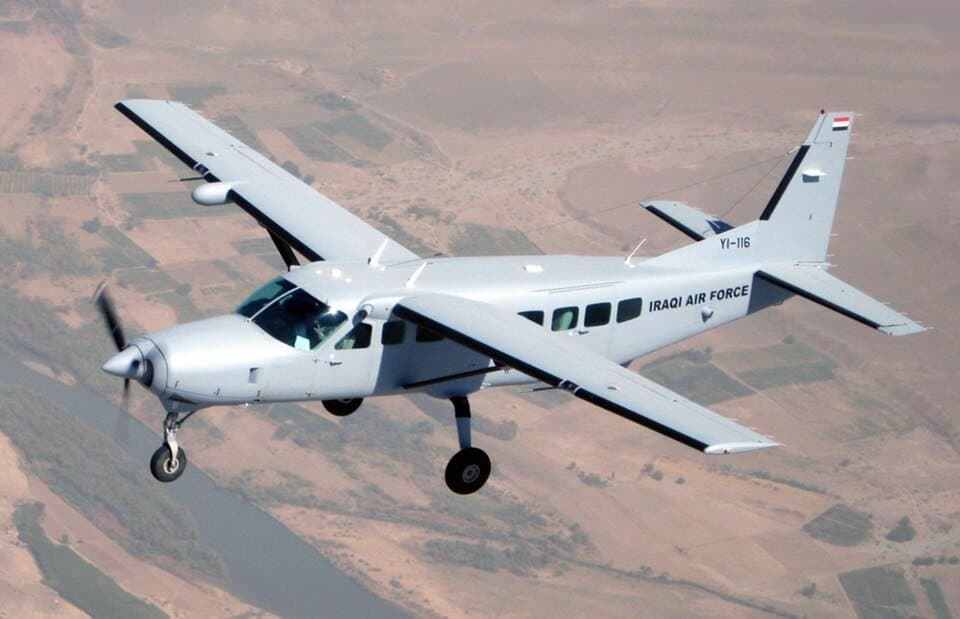

Credit
Lt. Col. Scott Voskovitch · Public domain · Resized · Public domain · Source ↗ · Modified


Preparing your view.

At a glance
Measured figures
208 Caravan · Length
Single source37 ft 7 in (11.46 m)[source]
Falcon 20F · Length
Single sourceConfiguration
| Specification | Cessna 208 Caravan | Dassault Falcon 20 |
|---|---|---|
| Type | Regional airliner , utility aircraft[source] | Business jet[source] |
| National origin | United States[source] | France[source] |
| Manufacturer | Cessna[source] | Dassault Aviation[source] |
| Status | In service[source] |
17.15 m (56 ft 3 in)[source]
Empty; 208 Caravan · Empty weight
Single sourceMaximum take-off; 208 Caravan · Max takeoff weight
Single source4,730 lb (2,145 kg)[source]
8,000 lb (3,629 kg)[source]
Empty; Falcon 20F · Empty weight
Single sourceMaximum take-off; Falcon 20F · Max takeoff weight
Single sourceCruise; 208 Caravan · true air speed
Single source186 kn (214 mph, 344 km/h) true air speed[source]
Cruise; Falcon 20F · at 12,200 m (40,000 ft) (econ. cruise)
Single sourceMaximum; Falcon 20F · at 7,620 m (25,000 ft) (max cruise)
Single source862 km/h (536 mph, 465 kn) at 7,620 m (25,000 ft) (max cruise)[source]
750 km/h (470 mph, 400 kn) at 12,200 m (40,000 ft) (econ. cruise)[source]
208 Caravan · 1 × Pratt & Whitney Canada PT6A -114A turboprop, 675 shp (
Single source1 × Pratt & Whitney Canada PT6A -114A turboprop, 675 shp (503 kW)[source]
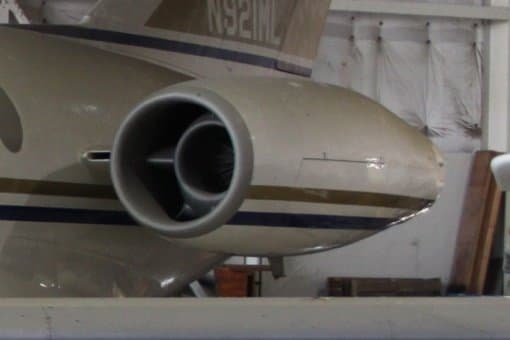
Falcon 20F · 2 × General Electric CF700 -2D-2 turbofans thrust each
Single source2 × General Electric CF700 -2D-2 turbofans , 20 kN (4,500 lbf) thrust each[source]
208 Caravan · 1,234 ft/min (
Single source1,234 ft/min (6.27 m/s)[source]
Bars compare reported quantities only. A larger figure does not make a system better; configurations and test conditions differ.
Out of production, in active service[source] |
| Primary users | FedEx Feeder Brazilian Air Force Afghan Air Force Colombian Aerospace Force[source] | Federal Express (formerly) French Navy United States Coast Guard[source] |
|---|
| Number built | 3,000 (2022)[source] | 512[source] |
|---|
| Manufactured | 1982–present[source] | 1965–1991[source] |
|---|
| Introduction date | 1984[source] | 3 June 1965[source] |
|---|
| First flight | December 9, 1982[source] | 4 May 1963[source] |
|---|
| Variant | Soloy Pathfinder 21[source] | — |
|---|
| Capacity | 9 passengers (13 with FAR Part 23 waiver)[source] | 8–14 passengers[source] |
|---|
| Aspect ratio | 9.702[source] | 6.4:1[source] |
|---|
| Airfoil | wing root: NACA 23017.424, wing tip: NACA 23012[source] | — |
|---|
| Fuel capacity | 2,224 lb (1,009 kg) / 332 US gal (1,257 L)[source] | 5,200 L (1,100 imp gal; 1,400 US gal)[source] |
|---|
| Cabin height | 54 in (1.37 m)[source] | — |
|---|
| Cabin width | 64 in (1.63 m)[source] | — |
|---|
| Propellers | 3-bladed McCauley constant speed, full feathering, reversible pitch[source] | — |
|---|
| Stall speed | 61 kn (70 mph, 113 km/h) calibrated air speed[source] | 152 km/h (94 mph, 82 kn)[source] |
|---|
| Wing loading | 28.674 lb/sq ft (140.00 kg/m 2 )[source] | — |
|---|
| Role | utility aircraft[source] | French business jet[source] |
|---|
| Source measurement | The Cessna 208 Caravan is a utility aircraft produced by Cessna . The project was commenced on November 20, 1981, and the prototype first flew on December 9, 1982. The production model was certified by the FAA in October 1984 and its Cargomaster freighter variant was developed for FedEx . The 4 ft (1.2 m) longer 208B Super Cargomaster first flew in 1986 and was developed into the passenger 208B Grand Caravan.[source]Cessna 208 Caravan · Lead; only the objects and conditions stated in this passage The strutted , high wing 208 typically seats nine passengers in its unpressurized cabin, is powered by a single Pratt & Whitney Canada PT6A tractor turboprop and has a fixed tricycle landing gear , floats , or skis.[source]Cessna 208 Caravan · Lead; only the objects and conditions stated in this passage Another cargo variant for Federal Express, with a longer fuselage and a cargo pod under the belly, was developed as the 208B Super Cargomaster and flew for the first time in 1986. Stretched by 4 ft (1.2 m), it received its FAA type certification also in 1986. A passenger model, the 208B Grand Caravan, was derived from the Super Cargomaster. It was first delivered in 1990.[source]Cessna 208 Caravan · Development; only the objects and conditions stated in this passage The Cessna 208 is a high-wing braced cabin monoplane powered by a single Pratt & Whitney Canada PT6 A turboprop in tractor configuration . The cabin has room for nine passengers and two crew when used as a passenger aircraft with four doors: one for each crew member, an airstair door on the right side of the cabin and a cargo door on the left. The aircraft can be optionally fitted with an underslung cargo pod.[source]Cessna 208 Caravan · Design; only the objects and conditions stated in this passage The airplane typically seats nine passengers with a single pilot, although with a FAR Part 23 waiver it can seat up to fourteen passengers. The aircraft is also used for cargo operations.[source]Cessna 208 Caravan · Design; only the objects and conditions stated in this passage The short-fuselage Caravan burns 48 US gal (180 L) of fuel per hour at 170 kn (310 km/h; 200 mph) for 200 nmi (370 km; 230 mi) stages.[source]Cessna 208 Caravan · Design; only the objects and conditions stated in this passage First production variant with a PT6A-114 turboprop engine and seating for up to nine passengers. The landplane variant was type approved on October 23, 1984, and the seaplane version with Wipline Model 8000 Amphibious/Seaplane Floats was type approved on March 26, 1986. Early aircraft can be modified to use the higher-powered PT6A-114A but have restricted operating limits.[source]Cessna 208 Caravan · Variants / Civilian; only the objects and conditions stated in this passage Officially named the 208B Caravan but marketed as the Grand Caravan . The 208B is 4 ft (1.2 m) longer than the 208; extending the cabin by the same amount. The 208B has a PT6A-114A engine. It was originally certified as a two-seater cargo version on October 9, 1986, and as an 11-seater passenger aircraft on December 13, 1989.[source]Cessna 208 Caravan · Variants / Civilian; only the objects and conditions stated in this passage 208B Grand Caravan EX Marketing name for upgraded version of the 208B Caravan certified in December 2012, with a more powerful 867 hp (647 kW) Pratt and Whitney Canada PT6A-140 that improves the rate of climb by 38% and was developed by Pratt & Whitney Canada specifically to power the 208B. The unladen weight is 807 lb (366 kg) more but maximum payload is only 90 lb (41 kg) more. While the 192 hp (143 kW) more powerful PT6A-140 gives a 11-knot (20 km/h) higher cruise speed – and rate of climb is improved by 94 feet per minute (0.48 m/s), range is reduced to 964 nautical miles (1,785 km; 1,109 mi) on a similar fuel capacity. It requires a longer take off run at 2,160 feet (660 m) and its landing roll is at 1,871 feet (570 m). In early October 2019, after just under six years in production, the company had delivered 500 Grand Caravan EXs.[source]Cessna 208 Caravan · Variants / Civilian; only the objects and conditions stated in this passage Single example of a twin-engined stretched fuselage development of the 208 by the Soloy Corporation. Two PT6D-114A engines mounted side-by-side drove a single propeller; and the fuselage was extended by 70 inches (1.8 m) behind the wing. The project was abandoned as the design was unable to meet certification requirements.[source]Cessna 208 Caravan · Variants / Aftermarket variants; only the objects and conditions stated in this passage 208 with an 850 hp (634 kW) Honeywell TPE331-12JR-701S engine, installed by Aero Twin Inc.[source]Cessna 208 Caravan · Variants / Aftermarket variants; only the objects and conditions stated in this passage 208B with a 1,000 hp (746 kW) Honeywell TPE331-12JR-704AT engine, installed by Aero Twin Inc.[source]Cessna 208 Caravan · Variants / Aftermarket variants; only the objects and conditions stated in this passage 208 and 208B conversion to 850 hp (634 kW) PT6A-42A.[source]Cessna 208 Caravan · Variants / Aftermarket variants; only the objects and conditions stated in this passage 208B with a 850 hp (634 kW) (900 hp (671 kW) flat-rated) Honeywell TPE331-12JR engine, installed by Texas Turbine Conversions, Inc.[source]Cessna 208 Caravan · Variants / Aftermarket variants; only the objects and conditions stated in this passage 208B with an 850 hp (634 kW) Pratt & Whitney Canada PT6A-42A engine, installed by Blackhawk[source]Cessna 208 Caravan · Variants / Aftermarket variants; only the objects and conditions stated in this passage The eCaravan is an electric aircraft modification of the 208B built by AeroTEC and magniX powered by a 750 hp (560 kW) motor and a 1 t (2,200 lb), 750 V lithium-ion battery . The plane's 30-minute first flight happened from Grant County International Airport in Moses Lake, Washington, on May 28, 2020, consuming US$6 worth of electricity, needing 30–40 min of charging.[source]Cessna 208 Caravan · Variants / Experimental; only the objects and conditions stated in this passage The Magni500-powered variant can fly 100 nautical miles (185 km; 115 mi) with 4–5 passengers while keeping reserve power, and aims for a certification by the end of 2021, hoping to operate 100 nmi (185 km; 115 mi) flights with a full load of nine passengers with better batteries.[source]Cessna 208 Caravan · Variants / Experimental; only the objects and conditions stated in this passage Capacity: 9 passengers (13 with FAR Part 23 waiver)[source]Cessna 208 Caravan · Specifications (208 Caravan); only the objects and conditions stated in this passage Length: 37 ft 7 in (11.46 m)[source]Cessna 208 Caravan · Specifications (208 Caravan); only the objects and conditions stated in this passage Wingspan: 52 ft 1 in (15.87 m)[source]Cessna 208 Caravan · Specifications (208 Caravan); only the objects and conditions stated in this passage Height: 14 ft 11 in (4.53 m)[source]Cessna 208 Caravan · Specifications (208 Caravan); only the objects and conditions stated in this passage Wing area: 279 sq ft (25.96 m 2 )[source]Cessna 208 Caravan · Specifications (208 Caravan); only the objects and conditions stated in this passage Empty weight: 4,730 lb (2,145 kg)[source]Cessna 208 Caravan · Specifications (208 Caravan); only the objects and conditions stated in this passage Max takeoff weight: 8,000 lb (3,629 kg)[source]Cessna 208 Caravan · Specifications (208 Caravan); only the objects and conditions stated in this passage Fuel capacity: 2,224 lb (1,009 kg) / 332 US gal (1,257 L)[source]Cessna 208 Caravan · Specifications (208 Caravan); only the objects and conditions stated in this passage Cabin height: 54 in (1.37 m)[source]Cessna 208 Caravan · Specifications (208 Caravan); only the objects and conditions stated in this passage Cabin width: 64 in (1.63 m)[source]Cessna 208 Caravan · Specifications (208 Caravan); only the objects and conditions stated in this passage Powerplant: 1 × Pratt & Whitney Canada PT6A -114A turboprop, 675 shp (503 kW)[source]Cessna 208 Caravan · Specifications (208 Caravan); only the objects and conditions stated in this passage Cruise speed: 186 kn (214 mph, 344 km/h) true air speed[source]Cessna 208 Caravan · Specifications (208 Caravan); only the objects and conditions stated in this passage Stall speed: 61 kn (70 mph, 113 km/h) calibrated air speed[source]Cessna 208 Caravan · Specifications (208 Caravan); only the objects and conditions stated in this passage Range: 1,070 nmi (1,230 mi, 1,980 km)[source]Cessna 208 Caravan · Specifications (208 Caravan); only the objects and conditions stated in this passage Service ceiling: 25,000 ft (7,600 m)[source]Cessna 208 Caravan · Specifications (208 Caravan); only the objects and conditions stated in this passage Rate of climb: 1,234 ft/min (6.27 m/s)[source]Cessna 208 Caravan · Specifications (208 Caravan); only the objects and conditions stated in this passage | During the 1950s and 1960s, the French government, which had taken a significant interest in the re-establishment and growth of its national aviation industries in the aftermath of the Second World War , developed a detailed request for a combined liaison / trainer aircraft, to be equipped with twin-turbofan engines. Among those companies that took interest in the government request was French aircraft manufacturer Dassault Aviation . In December 1961, French aircraft designer and head of Dassault Aviation, Marcel Dassault , gave the go-ahead to proceed with work towards the production of an eight- to 10-seat executive jet /military liaison aircraft, which was initially named as the Dassault-Breguet Mystère 20 . The emerging design was of a low-wing monoplane, which drew upon the aerodynamics of the transonic Dassault Mystère IV fighter-bomber , and was equipped with a pair of rear-mounted 14.68 kN (3,300 lbf) Pratt & Whitney JT12A-8 turbojet engines.[source]Dassault Falcon 20 · Development / Origins; only the objects and conditions stated in this passage Progress between Dassault and Pan Am was rapid, moving from engineering evaluations of the type to the formation of general agreements between the two companies. In response to feedback received from Pan American, the aircraft was re-engined with a pair of General Electric CF700 engines and several dimensions were increased. Accordingly, Pan American formed an agreement with Dassault to distribute the Mystère 20 in the western hemisphere; the firm placed an initial order for 40 aircraft along with options for a further 120. On 10 July 1964, the re-engined aircraft made its first flight. On 1 January 1965, the first production aircraft performed its maiden flight; in June 1965, both French and American type certifications were awarded. On 10 June 1965, French aviator Jacqueline Auriol achieved the women's world speed record using the first Mystère 20 prototype, having flown at an average recorded speed of 859 km/h over a distance of 1000 km.[source]Dassault Falcon 20 · Development / Origins; only the objects and conditions stated in this passage In 1973, FedEx's Falcons, designation FA-20-DC, cost $1.2 million each and were modified with a 55-by-74.5-inch forward cargo door with independent power supply, higher mtow, reinforced floor, plugged windows, and bigger brakes.[source] |
|---|
| Developed into | — | Dassault Falcon 10 Dassault Falcon 50[source] |
|---|
| Country of origin | — | France[source]Inventory Origin column; table 1, row 54, cell 4; revision 1377423821; retrieved 2026-10-02 |
|---|
An improved model of the aircraft, designated the Falcon 200 , was developed, which featured more advanced jet engines and other major improvements to increase range, capacity, and comfort. The Falcon 200, along with the Falcon 20G and HU-25 models, were powered by a pair of Garrett ATF3 engines. According to the magazine Flying , the Falcon 200 variant was more comparable to the newer Falcon 50 trijet than the original Falcon 20 model.[source]Dassault Falcon 20 · Development / Further development; only the objects and conditions stated in this passage
During 2013, the FAA modified 14 CFR part 91 rules to prohibit the operation of jets weighing 75,000 pounds or less that were not Stage 3 noise compliant after 31 December 2015. The Falcon 20 was listed explicitly in Federal Register 78 FR 39576 . Any examples of the type that had not been modified, either by the installation of Stage 3 noise-compliant engines or have had hush kits installed upon noncompliant engines, were no longer permitted to fly anywhere in the contiguous 48 states after 31 December 2015. However, 14 CFR §91.883 Special flight authorizations for jet airplanes weighing 75,000 pounds or less – lists special flight authorizations that may be granted for operation after 31 December 2015.[source]Dassault Falcon 20 · Development / Further development; only the objects and conditions stated in this passage
Prototype, one built. F-WLKB, initially powered by two 14.68 kN (3,300 lbf) Pratt & Whitney JT12A-8 turbojet engines. Now stored at Musée Air et Espace Aéroport Paris – Le Bourget.[source]Dassault Falcon 20 · Variants; only the objects and conditions stated in this passage
Initial production version, with lengthened fuselage compared to first prototype and with 10–12 seats. Powered by 4,200 lbf (19 kN) CF700-2B engines.[source]Dassault Falcon 20 · Variants; only the objects and conditions stated in this passage
Falcon 20CC (s/n 073)[source]Dassault Falcon 20 · Variants; only the objects and conditions stated in this passage
Falcon 20G[source]Dassault Falcon 20 · Variants; only the objects and conditions stated in this passage
Falcon 20H[source]Dassault Falcon 20 · Variants; only the objects and conditions stated in this passage
Improved variant, powered by two 2360-kg (5,200-lb) Garrett ATF3-6A-4C turbofan engines and with more fuel. First flown on 30 April 1980.[source]Dassault Falcon 20 · Variants; only the objects and conditions stated in this passage
United States Coast Guard version of the Falcon 20G. 41 built. Equipped with two Garrett AiResearch Garrett ATF3-6-2C turbofan engines.[source]Dassault Falcon 20 · Variants; only the objects and conditions stated in this passage
Enlarged, 30-passenger commuter airliner derivative of Falcon 20, powered by two 27.0 kN (6,070 lbf) Lycoming ALF 502 D turbofans. One prototype built, first flying on 11 May 1973. No further production of Falcon 30 or proposed 40-passenger, shorter-range Mystére 40-100 .[source]Dassault Falcon 20 · Variants; only the objects and conditions stated in this passage
Pakistan Air Force – 3 in service, including 2 DA-20s in EW , ECM , ESM roles[source]Dassault Falcon 20 · Operators / Current military operators; only the objects and conditions stated in this passage
Royal Australian Air Force – Three in service from 1967 to 1989. No. 34 Squadron RAAF[source]Dassault Falcon 20 · Operators / Former military operators; only the objects and conditions stated in this passage
Capacity: 8–14 passengers[source]Dassault Falcon 20 · Specifications (Falcon 20F); only the objects and conditions stated in this passage
Length: 17.15 m (56 ft 3 in)[source]Dassault Falcon 20 · Specifications (Falcon 20F); only the objects and conditions stated in this passage
Wingspan: 16.30 m (53 ft 6 in)[source]Dassault Falcon 20 · Specifications (Falcon 20F); only the objects and conditions stated in this passage
Height: 5.32 m (17 ft 5 in)[source]Dassault Falcon 20 · Specifications (Falcon 20F); only the objects and conditions stated in this passage
Wing area: 41.00 m 2 (441.3 sq ft)[source]Dassault Falcon 20 · Specifications (Falcon 20F); only the objects and conditions stated in this passage
Empty weight: 7,530 kg (16,601 lb)[source]Dassault Falcon 20 · Specifications (Falcon 20F); only the objects and conditions stated in this passage
Max takeoff weight: 13,000 kg (28,660 lb)[source]Dassault Falcon 20 · Specifications (Falcon 20F); only the objects and conditions stated in this passage
Powerplant: 2 × General Electric CF700 -2D-2 turbofans , 20 kN (4,500 lbf) thrust each[source]Dassault Falcon 20 · Specifications (Falcon 20F); only the objects and conditions stated in this passage
Maximum speed: 862 km/h (536 mph, 465 kn) at 7,620 m (25,000 ft) (max cruise)[source]Dassault Falcon 20 · Specifications (Falcon 20F); only the objects and conditions stated in this passage
Cruise speed: 750 km/h (470 mph, 400 kn) at 12,200 m (40,000 ft) (econ. cruise)[source]Dassault Falcon 20 · Specifications (Falcon 20F); only the objects and conditions stated in this passage
Stall speed: 152 km/h (94 mph, 82 kn)[source]Dassault Falcon 20 · Specifications (Falcon 20F); only the objects and conditions stated in this passage
Range: 3,350 km (2,080 mi, 1,810 nmi)[source]Dassault Falcon 20 · Specifications (Falcon 20F); only the objects and conditions stated in this passage
Service ceiling: 12,800 m (42,000 ft) (absolute ceiling)[source]Dassault Falcon 20 · Specifications (Falcon 20F); only the objects and conditions stated in this passage