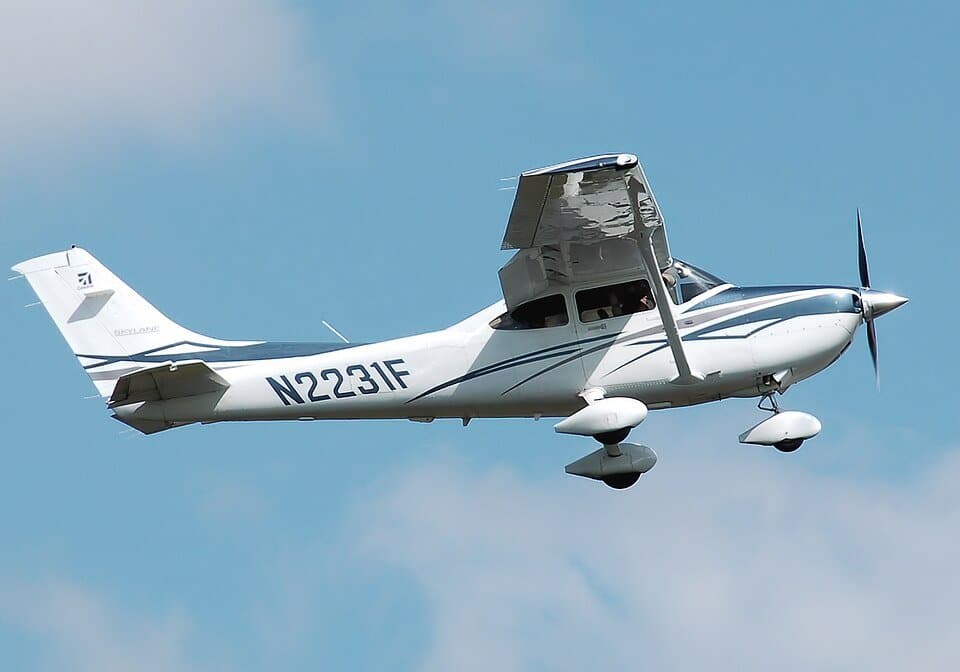

Credit
Adrian Pingstone ( Arpingstone ) · Public domain · Resized · Public domain · Source ↗ · Modified


Preparing your view.

At a glance
Measured figures
Cessna 182T · Length
Single source29 ft 0 in (8.84 m)[source]
YS-11A-200 · Length
Single sourceConfiguration
| Specification | Cessna 182 Skylane | NAMC YS-11 |
|---|---|---|
| Type | Light utility aircraft[source] | Turboprop airliner[source] |
| National origin | United States[source] | Japan[source] |
| Manufacturer | Cessna Aircraft Company[source] | Nihon Aircraft Manufacturing Corporation[source] |
| Status | In production[source] | Three in service with the Japan Air Self-Defense Force (as of 30 June 2024) |
26.3 m (86 ft 3 in)[source]
Empty; Cessna 182T · Empty weight
Single sourceMaximum take-off; Cessna 182T · Max takeoff weight
Single source1,970 lb (894 kg)[source]
3,100 lb (1,406 kg)[source]
Empty; YS-11A-200 · operating weight, empty
Single sourceMaximum take-off; YS-11A-200 · Max takeoff weight
Single sourceCruise; Cessna 182T · Cruise speed
Single sourceMaximum; Cessna 182T · Maximum speed
Single source150 kn (170 mph, 280 km/h)[source]
145 kn (167 mph, 269 km/h)[source]
Cruise; YS-11A-200 · maximum at 4,575 m (15,010 ft)
Single source469 km/h (291 mph, 253 kn) maximum at 4,575 m (15,010 ft)[source]
Cessna 182T · 1 × Lycoming IO-540-AB1A5 air-cooled flat-six
Single source1 × Lycoming IO-540-AB1A5 air-cooled flat-six , 230 hp (170 kW)[source]
YS-11A-200 · 2 × Rolls-Royce Dart Mk.542-10K turboprop engines each
Single source2 × Rolls-Royce Dart Mk.542-10K turboprop engines, 2,250 kW (3,020 hp) each[source]
Bars compare reported quantities only. A larger figure does not make a system better; configurations and test conditions differ.
| Number built | 23,237+[source] | 182[source] |
|---|
| Manufactured | 1956–1985, 1996–2012, 2015–present[source] | 1962–1974[source] |
|---|
| Introduction date | 1956[source] | 30 March 1965, for All Nippon Airways (first passenger flight with Japan Air Commuter in 1965)[source] |
|---|
| First flight | 10 September 1955[source] | 30 August 1962[source] |
|---|
| Developed from | Cessna 180[source] | — |
|---|
| Capacity | 3 passengers[source] | 64 passengers / 6,604 kg (14,559 lb)[source] |
|---|
| Propellers | 3-bladed constant speed[source] | 4-bladed constant-speed fully-feathering reversible propellers[source] |
|---|
| Stall speed | 49 kn (56 mph, 91 km/h)[source] | 140 km/h (87 mph, 76 kn) at MLW, flaps down[source] |
|---|
| Never exceed speed | 175 kn (201 mph, 324 km/h)[source] | 546 km/h (339 mph, 295 kn) below 4,695 m (15,404 ft)[source] |
|---|
| Alternative designation | Cessna 182[source] | — |
|---|
| Aspect ratio | — | 10.8[source] |
|---|
| Airfoil | — | root: NACA 64A-218 ; tip: NACA 64A-412[source] |
|---|
| Maximum landing weight | — | 24,000 kg (52,911 lb)[source] |
|---|
| Economical cruising speed | — | 452 km/h (281 mph; 244 kn) at 6,100 m (20,013 ft)[source] |
|---|
| Service ceiling, one engine | — | 2,740 m (8,990 ft)[source] |
|---|
| Wing loading | — | 258 kg/m 2 (53 lb/sq ft)[source] |
|---|
| Power/mass | — | 0.25 kW/kg (0.15 hp/lb)[source] |
|---|
| Take-off distance to 10 m (33 ft) | — | 1,110 m (3,642 ft)[source] |
|---|
| Landing distance from 15 m (49 ft) | — | 660 m (2,165 ft) at MLW[source] |
|---|
| Role | — | turboprop airliner[source] |
|---|
| Source measurement | — | NAMC designed a low-winged twin- turboprop -engined monoplane , capable of seating up to 60 passengers, dubbed the YS-11 . Amongst the design team was Jiro Horikoshi , who had previously been the designer of the famed wartime Mitsubishi A6M Zero fighter. Another prominent engineer on the project was Teruo Tojo, the second son of Prime Minister Hideki Tojo , who later became chairman of Mitsubishi Motors . The twin-engined YS-11 was projected as delivering similar operational performance to the four-engined British-built Vickers Viscount , while possessing 50% greater capacity than the similarly configured Dutch-built Fokker F27 Friendship . MITI supervised the pricing of the aircraft in order to ensure that it was competitive with the American-built Martin 4-0-4 .[source]NAMC YS-11 · Development and design / Origins; only the objects and conditions stated in this passage Although the tentative aircraft was mainly designed and manufactured in Japan, the engine selected to power the airliner was the 2,275 kW (3,050 ehp) Rolls-Royce Dart RDa.10/1 powerplant, which was both developed and produced by British-based company Rolls-Royce . Furthermore, according to author Stephen C Mercado, due to the lack of available domestic technology at the time, several of the key aircraft systems, such as cabin pressurization , were copied from foreign sources; such information was gleaned from a combination of Japanese airlines, trading companies and diplomats. Throughout the YS-11's production lifetime, its electronic equipment, avionics, mechanical and fuselage components were supplied by a combination of Japanese companies and foreign suppliers.[source]NAMC YS-11 · Development and design / Origins; only the objects and conditions stated in this passage In 2007, the YS-11 was added to the Mechanical Engineering Heritage of Japan as item number 13. As of 2014 , fifteen were operated by the Japanese military, and two in Mexico. As of 2017 , only eight remained in service with the Japan Air Self-Defense Force , which were being used for flight checks and other ancillary purposes. As of August 2020 , two aircraft remain in commercial service in South America and Africa. As of March 2021 , the Japan Air Self-Defense Force retired the YS-11 after 57 years of service.[source]NAMC YS-11 · Operational history / End of production; only the objects and conditions stated in this passage Initial production variant. 23,500 kg (51,810 lb) gross weight. 48 built.[source]NAMC YS-11 · Variants; only the objects and conditions stated in this passage Increased gross weight (24,500 kg (54,010 lb) passenger airliner.[source]NAMC YS-11 · Variants; only the objects and conditions stated in this passage Passenger airliner with further increased (25,000 kg (55,110 lb)) gross weight produced from 1970.[source]NAMC YS-11 · Variants; only the objects and conditions stated in this passage JMSDF 2 YS-11M for Freighter 2 YS-11M-A for Freighter 6 YS-11T-A for MPA trainer[source]NAMC YS-11 · Operators / Former military operators; only the objects and conditions stated in this passage 13 November 1966, All Nippon Airways Flight 533 crashed into the sea near Matsuyama , Japan with the loss of all five crew and 45 passengers.[source]NAMC YS-11 · Accidents and incidents; only the objects and conditions stated in this passage 20 October 1969, All Nippon Airways Flight 104 overran the runway at Miyazaki Airport , Japan. All four crew and 49 passengers survived.[source]NAMC YS-11 · Accidents and incidents; only the objects and conditions stated in this passage 11 December 1969, a Korean Air flight from Gangneung to Seoul was hijacked by a North Korean agent and flown to Sǒndǒk Airfield near Wonsan . The aircraft was damaged on landing and written off. The aircraft, its crew, and seven passengers are still held in North Korean territory.[source]NAMC YS-11 · Accidents and incidents; only the objects and conditions stated in this passage 12 August 1970, China Airlines Flight 206 crashed into Yuan Mountain on approach to Taipei , Taiwan . Two crew and 12 passengers were killed.[source]NAMC YS-11 · Accidents and incidents; only the objects and conditions stated in this passage 3 July 1971, Toa Domestic Airlines Flight 63 flew into Yokotsu Mountain while on approach to Hakodate Airport , Japan. All four crew and 64 passengers were killed, the worst loss of life in an accident involving the YS-11.[source]NAMC YS-11 · Accidents and incidents; only the objects and conditions stated in this passage 12 April 1972, a VASP flight between São Paulo and Rio de Janeiro crashed 50 kilometres (31 mi) north of Rio de Janeiro. All four crew and 21 passengers were killed.[source]NAMC YS-11 · Accidents and incidents; only the objects and conditions stated in this passage 21 October 1972, Olympic Airways Flight 506 en route from Corfu (Kerkyra) to Athens crashed into the sea in Voula whilst attempting an approach to Ellinikon International Airport , Athens , in a heavy storm. One crew member (the co-pilot) and 36 passengers were killed, while the captain, the two stewardesses and 16 passengers survived.[source]NAMC YS-11 · Accidents and incidents; only the objects and conditions stated in this passage 23 October 1973, a VASP YS-11 overran the runway at Santos Dumont Airport , Rio de Janeiro after a rejected take-off and ended up in Guanabara Bay . Eight passengers were killed.[source]NAMC YS-11 · Accidents and incidents; only the objects and conditions stated in this passage 5 March 1974, a Pacific Southwest Airlines YS-11 crash landed in the desert 14 kilometres (8.7 mi) east of Borrego Springs , California while on a training flight. Aircraft was written off.[source]NAMC YS-11 · Accidents and incidents; only the objects and conditions stated in this passage 23 November 1976, Olympic Airways Flight 830 flew into Mount Metaxas near the village of Servia in Kozani , Greece, in low clouds and almost zero visibility. All four crew and 46 passengers were killed.[source]NAMC YS-11 · Accidents and incidents; only the objects and conditions stated in this passage 28 September 2009, Japanese Maritime Self-Defense Force YS-11M-A serial number 9044 overran the runway upon landing at Ozuki Air Field and was substantially damaged.[source]NAMC YS-11 · Accidents and incidents; only the objects and conditions stated in this passage Capacity: 64 passengers / 6,604 kg (14,559 lb)[source]NAMC YS-11 · Specifications (YS-11A-200); only the objects and conditions stated in this passage Length: 26.3 m (86 ft 3 in)[source]NAMC YS-11 · Specifications (YS-11A-200); only the objects and conditions stated in this passage Wingspan: 32 m (105 ft 0 in)[source]NAMC YS-11 · Specifications (YS-11A-200); only the objects and conditions stated in this passage Height: 8.98 m (29 ft 6 in)[source]NAMC YS-11 · Specifications (YS-11A-200); only the objects and conditions stated in this passage Wing area: 94.83 m 2 (1,020.7 sq ft)[source]NAMC YS-11 · Specifications (YS-11A-200); only the objects and conditions stated in this passage Empty weight: 15,396 kg (33,942 lb) operating weight, empty[source]NAMC YS-11 · Specifications (YS-11A-200); only the objects and conditions stated in this passage Max takeoff weight: 24,500 kg (54,013 lb)[source]NAMC YS-11 · Specifications (YS-11A-200); only the objects and conditions stated in this passage Maximum landing weight: 24,000 kg (52,911 lb)[source]NAMC YS-11 · Specifications (YS-11A-200); only the objects and conditions stated in this passage Powerplant: 2 × Rolls-Royce Dart Mk.542-10K turboprop engines, 2,250 kW (3,020 hp) each[source]NAMC YS-11 · Specifications (YS-11A-200); only the objects and conditions stated in this passage Cruise speed: 469 km/h (291 mph, 253 kn) maximum at 4,575 m (15,010 ft)[source]NAMC YS-11 · Specifications (YS-11A-200); only the objects and conditions stated in this passage Economical cruising speed: 452 km/h (281 mph; 244 kn) at 6,100 m (20,013 ft)[source]NAMC YS-11 · Specifications (YS-11A-200); only the objects and conditions stated in this passage Stall speed: 140 km/h (87 mph, 76 kn) at MLW, flaps down[source]NAMC YS-11 · Specifications (YS-11A-200); only the objects and conditions stated in this passage Never exceed speed : 546 km/h (339 mph, 295 kn) below 4,695 m (15,404 ft)[source]NAMC YS-11 · Specifications (YS-11A-200); only the objects and conditions stated in this passage Mach 0.601 above 4,695 m (15,404 ft)[source]NAMC YS-11 · Specifications (YS-11A-200); only the objects and conditions stated in this passage Range: 2,110 km (1,310 mi, 1,140 nmi) max fuel without centre-section bag tanks, no reserves[source]NAMC YS-11 · Specifications (YS-11A-200); only the objects and conditions stated in this passage 1,090 km (680 mi; 590 nmi) with max payload, no reserves 3,215 km (1,998 mi; 1,736 nmi) max fuel with centre-section bag tanks, no reserves[source]NAMC YS-11 · Specifications (YS-11A-200); only the objects and conditions stated in this passage Service ceiling: 6,982 m (22,907 ft)[source]NAMC YS-11 · Specifications (YS-11A-200); only the objects and conditions stated in this passage Service ceiling, one engine: 2,740 m (8,990 ft)[source]NAMC YS-11 · Specifications (YS-11A-200); only the objects and conditions stated in this passage Rate of climb: 6.2 m/s (1,220 ft/min)[source]NAMC YS-11 · Specifications (YS-11A-200); only the objects and conditions stated in this passage Take-off distance to 10 m (33 ft): 1,110 m (3,642 ft)[source]NAMC YS-11 · Specifications (YS-11A-200); only the objects and conditions stated in this passage Landing distance from 15 m (49 ft): 660 m (2,165 ft) at MLW[source]NAMC YS-11 · Specifications (YS-11A-200); only the objects and conditions stated in this passage |
|---|