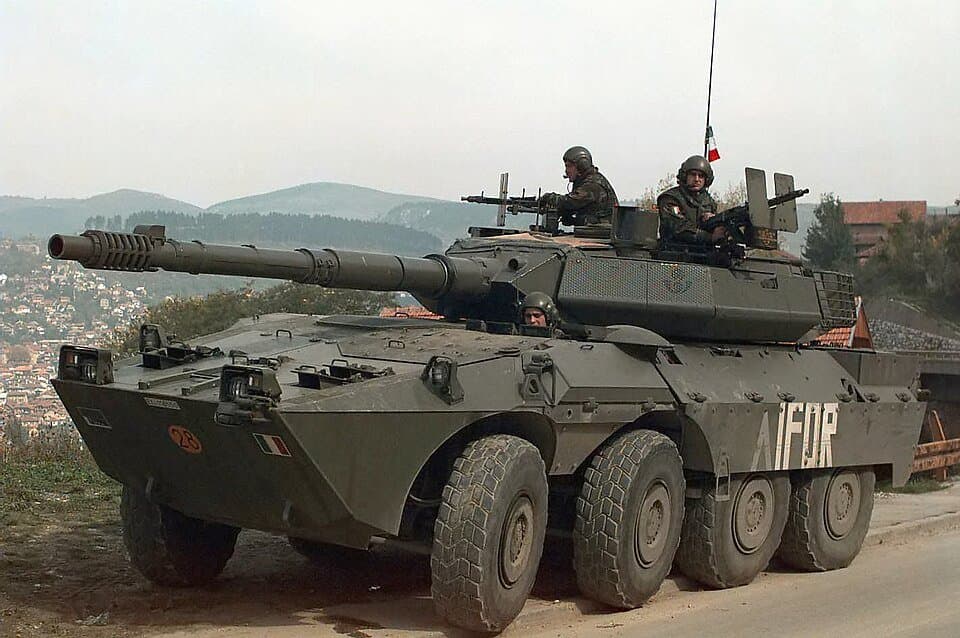

Credit
PH2 Jeffery Russell · Public domain · Resized · Public domain · Source ↗ · Modified


Preparing your view.

At a glance
Centauro (Tank destroyer)larger figure on 2 of 2
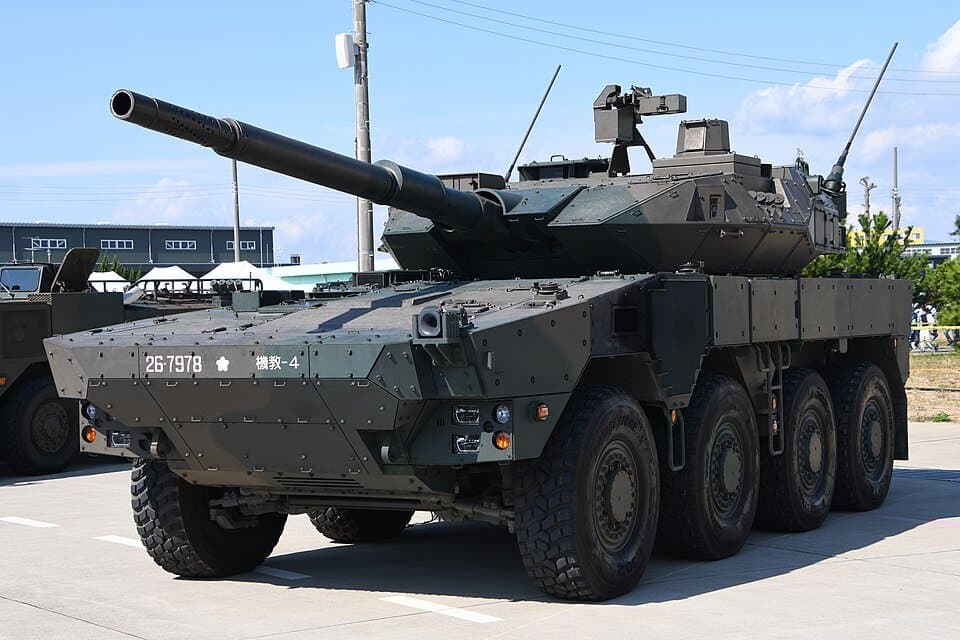
Type 16 MCVlarger figure on 0 of 2
True scale
Side by side. From every angle. A human reference for perspective.
3.26 MB · Loads when you open it| Model | Length | Width / span | Height |
|---|---|---|---|
| Centauro (Tank destroyer) | ≈ 8.26 m | ≈ 3.12 m (Width) | ≈ 4.03 m |
| Type 16 MCV | ≈ 8.45 m | ≈ 2.98 m (Width) | ≈ 3.43 m |
Scaled uniformly to the sourced length of 8.26 m. Thin antennas or poles standing above the body were pressed down to it, so they do not set the height; the width was fitted to the sourced 3.12 m. Not an official model or a measured survey.
ForceTally · All rights reserved
Scaled uniformly to the sourced length of 8.45 m. The width was fitted to the sourced 2.98 m. Not an official model or a measured survey.
ForceTally · All rights reserved
The human reference is a generic 1.75 m figure. Models describe external size, not combat performance.
Measured figures
Centauro 1
Single sourceCentauro 2
Single sourceConfiguration
| Specification | Centauro (Tank destroyer) | Type 16 MCV |
|---|---|---|
| Type | Wheeled tank destroyer[source] | armored car assault gun tank destroyer[source] |
| Place of origin | Italy[source] | Japan[source] |
| In service | 1991 - present[source] | — |
| Used by | See Operators[source] | — |
| Wars | United Nations Operation in Somalia II Implementation Force Kosovo Force Iraq War UNIFIL (United Nations Interim Force in Lebanon) Russo-Ukrainian war |
Counts only measures both sources give with the same scope. A larger figure is not a better system.
Centauro 1: 7.85 m (25 ft 9 in) Centauro 2: 8.26 m (27 ft 1 in)[source]
Length
Single source8.45 m (27 ft 9 in)[source]
Centauro 1: Iveco VTCA V6 , turbo-diesel engine ( ) Centauro 2: Iveco Vector 8V V8 engine (
Single sourceEngine
Single sourceCentauro 1: Iveco VTCA V6 , turbo-diesel engine (520 hp (390 kW)) Centauro 2: Iveco Vector 8V V8 engine (704 hp (525 kW))[source]
4-cylinder water-cooled turbocharged diesel 11.3 litre
Single source4-cylinder water-cooled turbocharged diesel 11.3 litre 570 hp (430 kW)[source]
Bars compare reported quantities only. A larger figure does not make a system better; configurations and test conditions differ.
| — |
| Designed | 1986[source] | 2007 onwards[source] |
|---|
| Manufacturer | Iveco Fiat (hull, propulsion) Oto Melara (weapons, turrets)[source] | Mitsubishi Heavy Industries[source] |
|---|
| Unit cost | € 1.6 million[source] | 700 million yen (5.1 million USD)[source] |
|---|
| Produced | Centauro: 1991–2006 Centauro 2: 2021–present[source] | planned start in 2015[source] |
|---|
| No. built | 490+ (plus 249 Freccia)[source] | 142 (as of FY2020)[source] |
|---|
| Variants | See Variants[source] | Mitsubishi Armored Vehicle[source] |
|---|
| Armor | Welded steel armoured hull[source] | — |
|---|
| Main armament | Centauro 1: Oto Melara 105 mm/52 (rifled) Centauro 2: Oto Melara 120mm L/45 LRF (smoothbore)[source] | 105 mm L/52 gun (developed by Japan Steel Works )[source] |
|---|
| Secondary armament | Centauro 1: Coaxial: 1 × GPMG ( 7.62×51mm NATO ) Pintle: 1 × GPMG ( 7.62×51mm NATO ) Centauro 2: Coaxial: 1 × GPMG ( 7.62×51mm NATO ) RWS Hitrole Mod.L or pintle: 1 × GPMG or ( 7.62×51mm NATO / 12.7×99mm NATO )[source] | 12.7 mm (0.5 in) M2 Browning machine gun , 7.62 mm NATO coaxial Sumitomo Type 74 machine gun (replacing M2 Browning) Type 96 40 mm Automatic grenade launcher or FN Minimi 5.56 mm NATO light machine gun[source] |
|---|
| Payload capacity | 350 kg (770 lb)[source] | — |
|---|
| Transmission | Hydropneumatic automatic transmission with 5 forward and 2 reverse gears 8×8 wheels[source] | — |
|---|
| Suspension | independent MacPherson struts[source] | Wheeled 8 x 8[source] |
|---|
| Designer | — | TRDI (Technical Research & Development Institute)[source] |
|---|
| Developed into | — | Common tactical wheeled vehicle[source] |
|---|
| Power/weight | — | 21.9 hp/tonne[source] |
|---|
| Source measurement | — | The first concept for a Japanese wheeled chassis mounting a 105 mm cannon appeared with the "Future Combat Vehicle" (将来装輪戦闘車両) program in 2003. The program was centered around a universal wheeled chassis mounting a variety of weaponry including a 40 mm CTA cannon, 120 mm mortar system, 155 mm howitzer, and a 105 mm cannon. The Future Combat Vehicle program was cancelled due to development expenses, but the concept for a 105 mm cannon would be expanded upon in the Light Combat Vehicle Program.[source]Type 16 MCV · History; only the objects and conditions stated in this passage In 2009, resistance testing of the shielding against HEAT rounds was conducted using the Carl Gustav M2 ; and against regular kinetic ammunition the frontal shield was developed to resist shots from 20 mm to 30 mm autocannons while the side armor was deemed sufficient to resist 14.5 mm heavy machine gun fire.[source]Type 16 MCV · Design; only the objects and conditions stated in this passage In June 2014, Mitsubishi Heavy Industries unveiled the MAV (Mitsubishi Armored Vehicle), an eight-wheeled armoured vehicle, at the Eurosatory defence and security trade show in France. The MAV incorporates technology from the Type 16 Maneuver Combat Vehicle and was developed independently by Mitsubishi, rather than under the direction of Japan's Ministry of Defence. A prototype has already been built and undergone internal testing. The Armoured Personnel Carrier (APC) variant of the MAV measures 8 metres in length, 2.98 metres in width, and 2.2 metres in height, with an unladen weight of 18 tonnes. These dimensions do not include additional protection such as slat armour or reactive armour. Its maximum combat weight is 28 tonnes. The model displayed at Eurosatory featured slat armour. For protection against landmines and improvised explosive devices (IEDs), the vehicle includes floating seats inside and can be fitted with V-shaped add-on armour underneath. It is designed to carry a crew of 11, including the commander and driver.[source]Type 16 MCV · Variants; only the objects and conditions stated in this passage Various MAV variants are under consideration, including an armoured field ambulance and command and communications vehicle, both featuring a higher cabin roof than the APC version. A broader development programme known as the “Common Tactical Wheeled Vehicle” is also underway, aiming to standardise platforms based on the Type 16. A prototype of an infantry fighting vehicle fitted with a 30mm autocannon and a self-propelled 120mm mortar variant was sighted in September 2022. By spring 2023, a reconnaissance combat vehicle variant had also been seen, featuring the same 30mm cannon as the infantry fighting vehicle, along with a retractable surveillance sensor and a satellite communications dome.[source]Type 16 MCV · Variants; only the objects and conditions stated in this passage On 31 August 2023, Japan's Ministry of Defence included budget allocations in its FY2024 request for the procurement of 24 infantry fighting vehicles and eight self-propelled mortar vehicles. As a result, three MAV-based variants are planned for procurement: the “ Type 24 Wheeled Armored Fighting Vehicle ” (infantry fighting vehicle), the “ Type 24 Wheeled 120mm Mobile Mortar ” (self-propelled mortar), and a reconnaissance combat variant of the Common Tactical Wheeled Vehicle, which, although unnamed as of now, is expected to follow a year behind the other two in deployment. Both vehicles debuted at the 2025 Fuji Firepower exercises with the Type 24 Reconnaissance and Surveillance Vehicle.[source]Type 16 MCV · Variants; only the objects and conditions stated in this passage |
|---|