
Credit
PH2 Jeffery Russell · Public domain · Resized · Public domain · Source ↗ · Modified


Preparing your view.

At a glance
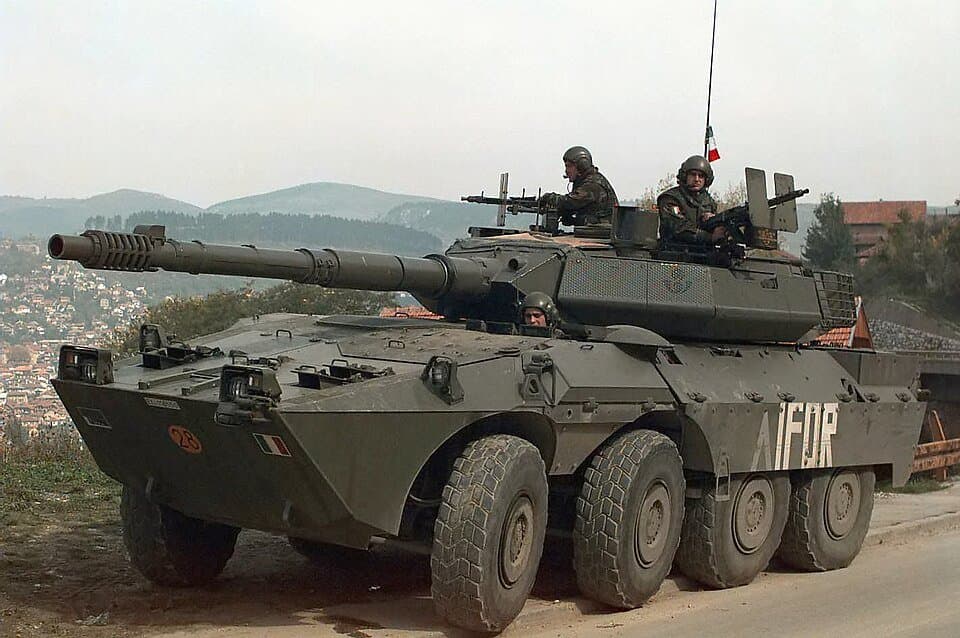
Centauro (Tank destroyer)larger figure on 0 of 1
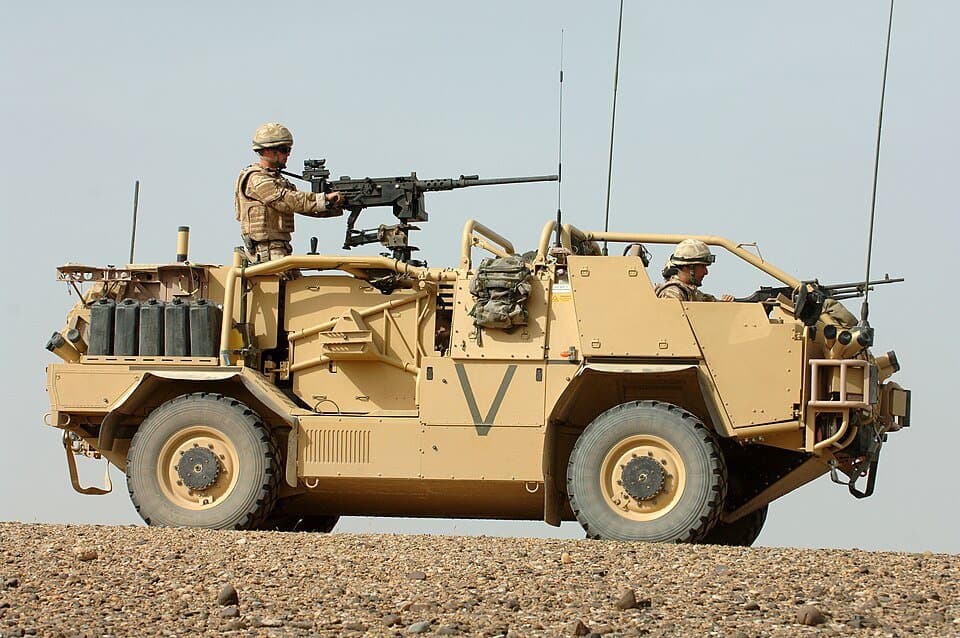
Jackal (vehicle)larger figure on 1 of 1
Counts only measures both sources give with the same scope. A larger figure is not a better system.
True scale
Side by side. From every angle. A human reference for perspective.
3.34 MB · Loads when you open it| Model | Length | Width / span | Height |
|---|---|---|---|
| Centauro (Tank destroyer) | ≈ 8.26 m | ≈ 3.12 m (Width) | ≈ 4.03 m |
| Jackal (vehicle) | ≈ 5.39 m | ≈ 2 m (Width) | ≈ 2.53 m |
Scaled uniformly to the sourced length of 8.26 m. Thin antennas or poles standing above the body were pressed down to it, so they do not set the height; the width was fitted to the sourced 3.12 m. Not an official model or a measured survey.
ForceTally · All rights reserved
Scaled uniformly to the sourced length of 5.39 m. Thin antennas or poles standing above the body were pressed down to it, so they do not set the height; the width was fitted to the sourced 2 m. Not an official model or a measured survey.
ForceTally · All rights reserved
The human reference is a generic 1.75 m figure. Models describe external size, not combat performance.
Measured figures
Centauro 1
Single sourceCentauro 2
Single sourceConfiguration
| Specification | Centauro (Tank destroyer) | Jackal (vehicle) |
|---|---|---|
| Type | Wheeled tank destroyer[source] | Armoured Wheeled Vehicle[source] |
| Place of origin | Italy[source] | United Kingdom[source] |
| In service | 1991 - present[source] | — |
| Used by | See Operators[source] | — |
| Wars | United Nations Operation in Somalia II Implementation Force Kosovo Force Iraq War UNIFIL (United Nations Interim Force in Lebanon) Russo-Ukrainian war |
Centauro 1: 7.85 m (25 ft 9 in) Centauro 2: 8.26 m (27 ft 1 in)[source]
Length
Single source5.39 m (17 ft 8 in)[source]
Centauro 1: Iveco VTCA V6 , turbo-diesel engine ( ) Centauro 2: Iveco Vector 8V V8 engine (
Single sourceEngine
Single sourceCentauro 1: Iveco VTCA V6 , turbo-diesel engine (520 hp (390 kW)) Centauro 2: Iveco Vector 8V V8 engine (704 hp (525 kW))[source]
5.9 litre Cummins ISBe Euro3 six-cylinder diesel
Single source5.9 litre Cummins ISBe Euro3 six-cylinder diesel 185 bhp (138 kW)[source]
Bars compare reported quantities only. A larger figure does not make a system better; configurations and test conditions differ.
| — |
| Designed | 1986[source] | — |
|---|
| Manufacturer | Iveco Fiat (hull, propulsion) Oto Melara (weapons, turrets)[source] | DML[source] |
|---|
| Unit cost | € 1.6 million[source] | — |
|---|
| Produced | Centauro: 1991–2006 Centauro 2: 2021–present[source] | — |
|---|
| No. built | 490+ (plus 249 Freccia)[source] | — |
|---|
| Variants | See Variants[source] | — |
|---|
| Armor | Welded steel armoured hull[source] | — |
|---|
| Main armament | Centauro 1: Oto Melara 105 mm/52 (rifled) Centauro 2: Oto Melara 120mm L/45 LRF (smoothbore)[source] | 12.7 mm heavy machine gun , or Heckler & Koch GMG[source] |
|---|
| Secondary armament | Centauro 1: Coaxial: 1 × GPMG ( 7.62×51mm NATO ) Pintle: 1 × GPMG ( 7.62×51mm NATO ) Centauro 2: Coaxial: 1 × GPMG ( 7.62×51mm NATO ) RWS Hitrole Mod.L or pintle: 1 × GPMG or ( 7.62×51mm NATO / 12.7×99mm NATO )[source] | 7.62 mm general purpose machine gun[source] |
|---|
| Payload capacity | 350 kg (770 lb)[source] | — |
|---|
| Transmission | Hydropneumatic automatic transmission with 5 forward and 2 reverse gears 8×8 wheels[source] | — |
|---|
| Suspension | independent MacPherson struts[source] | Independent double wishbone, air operated springs and external bypass shock absorbers (2 per wheel station) with variable ride height[source] |
|---|
| Designer | — | Supacat[source] |
|---|
| Armour | — | Additional composite armour kit[source] |
|---|
| Source measurement | — | The MWMIK can carry increased payload and fuel compared to its predecessor, allowing it to carry greater amounts of additional equipment and protection over longer distances, and it is able to support itself and its crew for distances of over 500 mi (800 km).[source]Jackal (vehicle) · Lead; only the objects and conditions stated in this passage According to the Ministry of Defence, the Jackal "was built to meet the British Army's specific requirements for an agile, well-armed, light patrol vehicle." The vehicle's height-adjustable air suspension system can be lowered onto the bump-stops to provide a stable firing platform when stationary or raised to a maximum 380 mm (15 in) ground clearance allowing it to clear large obstacles. The high levels of off-road mobility enable troops to avoid more conventional routes which may be subject to ambush or enemy reconnaissance.[source]Jackal (vehicle) · Design and development; only the objects and conditions stated in this passage The vehicle is based on the HMT (High Mobility Transporter) 400 high-mobility 4×4 design developed by a former subsidiary of Supacat, now built under licence from Lockheed Martin . The chassis is built by Universal Engineering Ltd , the engine by Cummins , the transmission by Allison , the suspension shock absorbers by Fox Racing Shox and the electronics package by Fujitsu and Smartgauge Electronics. The blast and ballistic armour packages, and the blast mitigating seating were designed and built by Jankel Armouring Ltd. The vehicles can be fitted with a range of weapons, such as a 12.7 mm heavy machine gun , 7.62 mm general purpose machine gun (GPMG) and 40 mm automatic grenade launcher .[source]Jackal (vehicle) · Design and development; only the objects and conditions stated in this passage The Jackal is capable of maintaining off-road speeds of up to 49 mph (79 km/h) and can reach a top speed of 80 mph (130 km/h).[source]Jackal (vehicle) · Design and development; only the objects and conditions stated in this passage The Coyote tactical support vehicle (TSV light) is based on the HMT 600 6×6 chassis from Supacat and is a larger derivative of the Jackal 2, the two vehicles are designed to be complementary. The extra two wheels give a heavier vehicle approaching 10,500 kg (10.3 long tons; 10.5 t) which will act in support of the Jackal 2 and allow transport of supplies and equipment over similar terrain [the payload for supplies and equipment will be 3,900 kg (3.8 long tons; 3.9 t)]. The Coyote has been designed to fulfil the role of a light tactical service vehicle.[source]Jackal (vehicle) · Variants / Coyote; only the objects and conditions stated in this passage The United Kingdom ordered 100 vehicles initially, followed by a further 72 in 2008 and 140 in 2010.[source]Jackal (vehicle) · Operators / Current operators; only the objects and conditions stated in this passage |
|---|