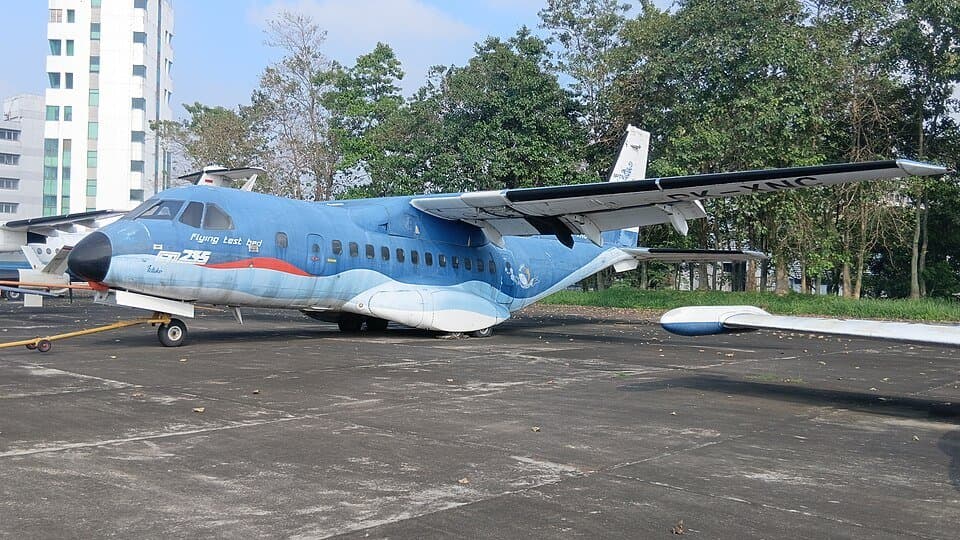


Credit
Jauhsekali · CC BY-SA 4.0 · Resized · CC BY-SA 4.0 · Source ↗ · Modified


Preparing your view.
At a glance
Measured figures
CN235 · Length
Single source21.40 m (70 ft 2.5 in)[source]
Cessna 177B · Length
Single sourceConfiguration
| Specification | CASA/IPTN CN-235 | Cessna 177 Cardinal |
|---|---|---|
| Type | Transport aircraft / maritime patrol aircraft[source] | Light utility aircraft[source] |
| National origin | Spain / Indonesia[source] | — |
| Manufacturer | CASA IPTN[source] | Cessna Aircraft Company[source] |
| Status | In service[source] | — |
| Primary users | Turkish Air Force French Air and Space Force Indonesian Air Force Royal Malaysian Air Force |
27 ft 8 in (8.43 m)[source]
CN235 · 2 × General Electric CT7 -9C3 turboprops each (take-off)
Single source2 × General Electric CT7 -9C3 turboprops , 1,305 kW (1,750 hp) each (take-off)[source]
Cessna 177B · 1 × Lycoming O-360 -A1F6D air-cooled flat-4 engine
Single source1 × Lycoming O-360 -A1F6D air-cooled flat-4 engine , 180 hp (130 kW)[source]
Bars compare reported quantities only. A larger figure does not make a system better; configurations and test conditions differ.
| — |
| Number built | 286 (IPTN 69 )[source] | 4,295[source] |
|---|
| Manufactured | 1983–present[source] | 1968–1978[source] |
|---|
| Introduction date | 1 March 1988[source] | 1968[source] |
|---|
| First flight | 11 November 1983[source] | July 15, 1966[source] |
|---|
| Variant | EADS HC-144 Ocean Sentry[source] | — |
|---|
| Developed into | EADS CASA C-295 Indonesian Aerospace N245[source] | — |
|---|
| Capacity | 51 passengers, 35 paratroops, 18 stretchers or four HCU-6/E pallets including one on the ramp and 6,000 kg (13,100 lb)[source] | 3 passengers[source] |
|---|
| Aspect ratio | 11.27:1[source] | — |
|---|
| Airfoil | NACA 65 3 -218[source] | — |
|---|
| Fuel capacity | 4150 kg[source] | — |
|---|
| Propellers | 4-bladed Hamilton Sundstrand 14RF Propeller[source] | — |
|---|
| Stall speed | 156 km/h (97 mph, 84 kn) (flaps down)[source] | — |
|---|
| Role | medium-range twin-engined turboprop tactical transport aircraft[source] | — |
|---|
| Source measurement | The CN-235 has been conceived of during the late 1970s as a twin- turboprop powered transport capable of accommodating up to 35 passengers or various military payloads. It had been observed that there was a growing global market for such transports, while there was also a need in the domestic market. The Spanish aerospace company Construcciones Aeronáuticas SA (CASA) was keen to seek out international collaboration to develop this concept into a working programme, and promptly approach the newly formed Indonesian company IPTN (later known as Indonesian Aerospace or PT. Dirgantara Indonesia ). The company was offered an equal share in the venture along with technology transfer opportunities from CASA, and was presented as being mutually beneficial from an economic standpoint. Coincidentally, IPTN had been independently looking into possible configurations for such an aircraft prior to CASA's approach.[source]CASA/IPTN CN-235 · Design and development / Background; only the objects and conditions stated in this passage Its main cabin facilitated a four-abreast single-aisle seating arrangement, which could accommodate up to 44 passengers in the most dense seating configuration.[source]CASA/IPTN CN-235 · Design and development / Background; only the objects and conditions stated in this passage The third phase of development was to secure certification and to conduct the aircraft's first delivery to customers. In support of this effort, static and fatigue testing was conducted by the Serpong Laboratory for Structural Testing. By September 1984, orders for several dozen aircraft had been secured at a reported unit cost of $6m; many of these early orders for the type had originated from local customers within the two partner company's home nations.[source]CASA/IPTN CN-235 · Design and development / Into flight; only the objects and conditions stated in this passage The Royal Malaysian Air Force has operated a fleet of CN-235 transports. During early 2020, it was announced that several Malaysian aircraft would be converted into a maritime surveillance configuration using financial assistance from the United States. On 17 June 2022, the Royal Malaysian Air Force receive the first of three such modified CN235-220M MSA as part of the Malaysian Maritime Security Initiative program.[source]CASA/IPTN CN-235 · Operational history / Military sector; only the objects and conditions stated in this passage During 1992, Aerolíneas Argentinas , which was a subsidiary of Iberia at that time, ordered a pair of CN-235s to be operated by its own subsidiary, Austral . In August 2006, it was reported that several CASA CN-235-10 were in service with African airlines, including two operated by Safair and one with Tiko Air . Around 2007, Asian Spirit operated a lone CN-235-220 in the Philippines.[source]CASA/IPTN CN-235 · Operational history / Commercial airliner; only the objects and conditions stated in this passage During 2015, Indonesian Aerospace announced that they were in the early stages of developing a new variant of the CN-235, the N245 , which has been specifically designed to perform civil operations and is able to carry up to 60 passengers. Alternatively also referred to as the CN-235NG , this variant is planned to be fully launched following the completion of the Indonesian Aerospace N219 project, at one point, it was expected to be fully certified sometime in 2019. A further derivative has been envisioned, referred to as the N-270 , it is a stretched version of the N245 and is planned to be able to carry up to 70–90 passengers; the original timeframe for development was set between 2019 and 2024.[source]CASA/IPTN CN-235 · Operational history / Commercial airliner; only the objects and conditions stated in this passage Generally as series 10, but with GE CT7-9C engines in new composites nacelles; replaced Series 10 in 1988 from 31st production aircraft. Series 100 is Spanish-built, series 110 Indonesian-built, with improved electrical, warning and environmental systems.[source]CASA/IPTN CN-235 · Variants; only the objects and conditions stated in this passage Modification of Series 200/220, offered by IPTN with new Honeywell avionics, ARL-2002 EW system and 16,800 kg/37,037 lb MTOW, to the Royal Australian Air Force to meet Project Air 5190 tactical airlift requirement, but was forced by financial constraints to withdraw in 1998.[source]CASA/IPTN CN-235 · Variants; only the objects and conditions stated in this passage A light gunship modified with integrated weapons pylons to carry AGM-114 Hellfire missiles and 70 mm rockets ; it also has a side-mounted 30 mm cannon and a Synthetic aperture radar .[source]CASA/IPTN CN-235 · Variants; only the objects and conditions stated in this passage The Royal Brunei Air Force operates one CN235-110M.[source]CASA/IPTN CN-235 · Operators / Military operators; only the objects and conditions stated in this passage The Royal Saudi Air Force operates four CN235-10M, two of which are used for VIP purposes.[source]CASA/IPTN CN-235 · Operators / Military operators; only the objects and conditions stated in this passage On 18 October 1992, Merpati Nusantara Airlines (Registration PK-MNN) CN-235-10 Flight 5601 crashed in Garut , Indonesia, killing all 31 people on board,[source]CASA/IPTN CN-235 · Notable accidents; only the objects and conditions stated in this passage On 19 January 2001, a Turkish Air Force CN-235 training mission crashed near Kayseri after entering a spin from which recovery was not possible, killing all three people on board.[source]CASA/IPTN CN-235 · Notable accidents; only the objects and conditions stated in this passage On 16 May 2001, a Turkish Air Force CN-235 crashed after the pilot lost control, killing all 34 people on board.[source]CASA/IPTN CN-235 · Notable accidents; only the objects and conditions stated in this passage On 18 May 2001, a Turkish Navy CN-235 crashed after the pilot lost control after reaching an altitude of just 100 feet, killing all 4 people on board.[source]CASA/IPTN CN-235 · Notable accidents; only the objects and conditions stated in this passage On 29 August 2001, Binter Mediterráneo Flight 8261 (Registration EC-FBC) crash-landed at Málaga , Spain, killing four of the 47 passengers and crew aboard. The aircraft was scrapped.[source]CASA/IPTN CN-235 · Notable accidents; only the objects and conditions stated in this passage On 11 February 2013, a CN-235 crashed into a forest 45 km south of Monrovia , Liberia , 8 km to Roberts International Airport , killing 11 people amongst them Souleymane Kelefa Diallo , Guinea army chief.[source]CASA/IPTN CN-235 · Notable accidents; only the objects and conditions stated in this passage On 1 August 2015 a CN-235-200M operated by the Colombian Air Force crashed in Cesar province, Colombia due to engine failure, killing 11 people.[source]CASA/IPTN CN-235 · Notable accidents; only the objects and conditions stated in this passage Capacity: 51 passengers, 35 paratroops, 18 stretchers or four HCU-6/E pallets including one on the ramp and 6,000 kg (13,100 lb)[source]CASA/IPTN CN-235 · Specifications (CN235); only the objects and conditions stated in this passage Length: 21.40 m (70 ft 2.5 in)[source]CASA/IPTN CN-235 · Specifications (CN235); only the objects and conditions stated in this passage Wingspan: 25.81 m (84 ft 8 in)[source]CASA/IPTN CN-235 · Specifications (CN235); only the objects and conditions stated in this passage Height: 8.18 m (26 ft 10 in)[source]CASA/IPTN CN-235 · Specifications (CN235); only the objects and conditions stated in this passage Wing area: 59.10 m 2 (636.1 sq ft)[source]CASA/IPTN CN-235 · Specifications (CN235); only the objects and conditions stated in this passage Empty weight: 9,800 kg (21,605 lb)[source]CASA/IPTN CN-235 · Specifications (CN235); only the objects and conditions stated in this passage Max takeoff weight: 16,100 kg (35,420 lb)[source]CASA/IPTN CN-235 · Specifications (CN235); only the objects and conditions stated in this passage Fuel capacity: 4150 kg[source]CASA/IPTN CN-235 · Specifications (CN235); only the objects and conditions stated in this passage Powerplant: 2 × General Electric CT7 -9C3 turboprops , 1,305 kW (1,750 hp) each (take-off)[source]CASA/IPTN CN-235 · Specifications (CN235); only the objects and conditions stated in this passage Cruise speed: 450 km/h (286 mph, 248 kn) at 4,575 m (15,000 ft)[source]CASA/IPTN CN-235 · Specifications (CN235); only the objects and conditions stated in this passage Stall speed: 156 km/h (97 mph, 84 kn) (flaps down)[source]CASA/IPTN CN-235 · Specifications (CN235); only the objects and conditions stated in this passage Range: 4,355 km (2,706 mi, 2,350 nmi)[source]CASA/IPTN CN-235 · Specifications (CN235); only the objects and conditions stated in this passage Service ceiling: 9,100 m (30,000 ft)[source]CASA/IPTN CN-235 · Specifications (CN235); only the objects and conditions stated in this passage Rate of climb: 7.8 m/s (1,780 ft/min)[source]CASA/IPTN CN-235 · Specifications (CN235); only the objects and conditions stated in this passage | — |
|---|