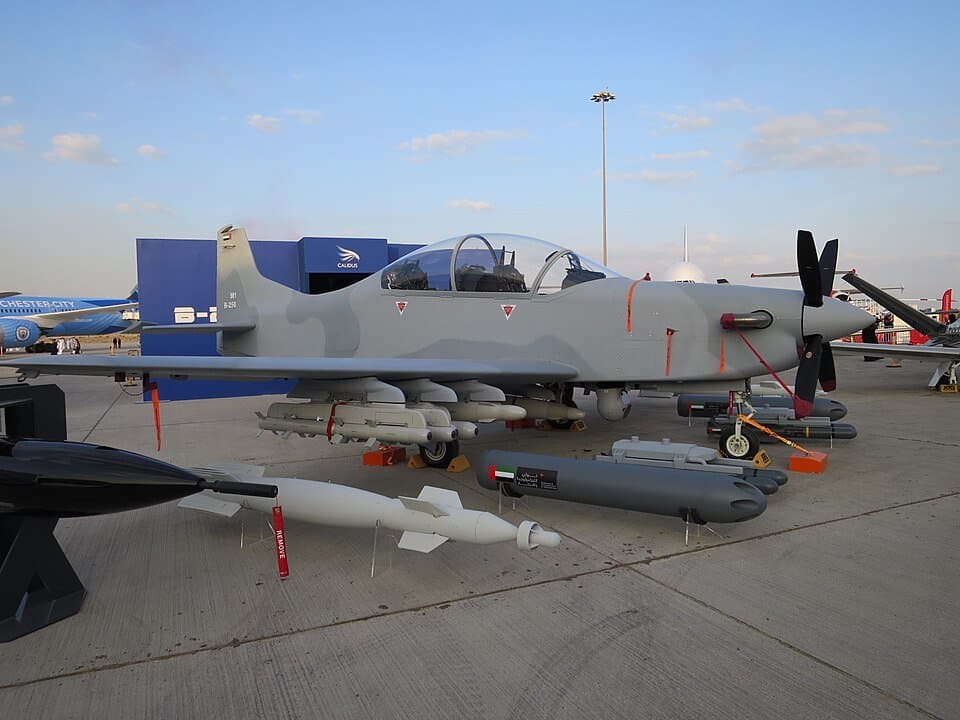


Credit
Mztourist · CC BY-SA 4.0 · Resized · CC BY-SA 4.0 · Source ↗ · Modified


Preparing your view.

At a glance
Measured figures
Length
Single source10.98 m (36 ft 0 in)[source]
SF-260M · Length
Single sourceConfiguration
| Specification | Calidus B-250 | SIAI-Marchetti SF.260 |
|---|---|---|
| Type | Military trainer Light attack aircraft[source] | Trainer /Light attack[source] |
| National origin | United Arab Emirates / Brazil[source] | Italy[source] |
| Manufacturer | Calidus[source] | SIAI-Marchetti Aermacchi Alenia Aermacchi Leonardo S.p.A.[source] |
| Designer | Novaer[source] | Stelio Frati |
7.10 m (23 ft 4 in)[source]
Maximum take-off; Max takeoff weight
Single source5 200 kg[source]
combat radius, 4x laser guided bombs, 2x Air-to-air missiles and 1x fuel tank
Single source560 km (350 mi, 300 nmi) (combat radius, 4x laser guided bombs, 2x Air-to-air missiles and 1x fuel tank)[source]
1 × Pratt & Whitney Canada PT6 A-68 turboprop 1,600 shp
Single source1 × Pratt & Whitney Canada PT6 A-68 turboprop , 1,200 kW (1,600 shp)[source]
SF-260M · 1 × Textron Lycoming O-540-E4A5 / Textron Lycoming AEIO-540-D4A5 6-cylinder air-cooled horizontally-opposed piston engine
Single source1 × Textron Lycoming O-540-E4A5 / Textron Lycoming AEIO-540-D4A5 6-cylinder air-cooled horizontally-opposed piston engine, 190 kW (260 hp)[source]
SF-260M · Wing area
Single source10.10 m 2 (108.7 sq ft)[source]
SF-260M · 1,500 ft/min
Single source7.6 m/s (1,500 ft/min)[source]
Bars compare reported quantities only. A larger figure does not make a system better; configurations and test conditions differ.
| Status | In production[source] | In service[source] |
|---|
| Primary user | United Arab Emirates Air Force[source] | — |
|---|
| Number built | 2 (as of January 2018)[source] | 900 (2012)[source] |
|---|
| First flight | July 2017[source] | 15 July 1964[source] |
|---|
| Hardpoints | 7 with a capacity of 1,800 kg (3,960 lb)[source] | — |
|---|
| Role | tandem -seat, turboprop , light attack aircraft[source] | Italian light aircraft[source] |
|---|
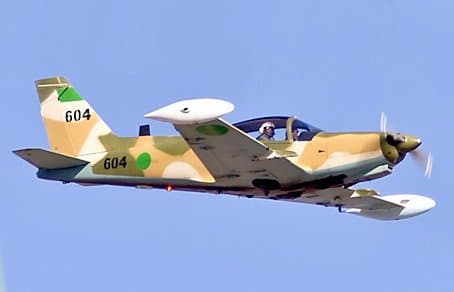
| Source measurement | Length: 10.98 m (36 ft 0 in)[source]Calidus B-250 · Specifications; only the objects and conditions stated in this passage Wingspan: 12.09 m (39 ft 8 in)[source]Calidus B-250 · Specifications; only the objects and conditions stated in this passage Height: 3.79 m (12 ft 5 in)[source]Calidus B-250 · Specifications; only the objects and conditions stated in this passage Powerplant: 1 × Pratt & Whitney Canada PT6 A-68 turboprop , 1,200 kW (1,600 shp)[source]Calidus B-250 · Specifications; only the objects and conditions stated in this passage Maximum speed: 557 km/h (346 mph, 301 kn)[source]Calidus B-250 · Specifications; only the objects and conditions stated in this passage Cruise speed: 520 km/h (320 mph, 280 kn) (clean)[source]Calidus B-250 · Specifications; only the objects and conditions stated in this passage Combat range: 560 km (350 mi, 300 nmi) (combat radius, 4x laser guided bombs, 2x Air-to-air missiles and 1x fuel tank)[source]Calidus B-250 · Specifications; only the objects and conditions stated in this passage Ferry range: 2,400 km (1,500 mi, 1,300 nmi)[source]Calidus B-250 · Specifications; only the objects and conditions stated in this passage Endurance: 12 hr[source]Calidus B-250 · Specifications; only the objects and conditions stated in this passage Service ceiling: 9,100 m (30,000 ft)[source]Calidus B-250 · Specifications; only the objects and conditions stated in this passage Hardpoints: 7 with a capacity of 1,800 kg (3,960 lb)[source]Calidus B-250 · Specifications; only the objects and conditions stated in this passage | The original model of the SF.260 was powered by a single Lycoming O-540 engine, capable of providing 260 hp. The standard engine made use of a carburetor , while a fuel injected engine was available as an optional extra. The SF.260 has been described as having the power to be immune to the gyration-like effects of turbulence and possessing a high rate of climb. During the 1980s, aerospace publication Flying stated the SF.260 to be: "the fastest normally aspirated piston single in production". The SF.260 holds the airspeed records for aircraft in its class over the 100 km (62 mi) and 1,000 km (620 mi) closed circuits. Later-built models often made use of turboprop engines; the initial model to be equipped as such, designated as the SF.260TP , was powered by a single Allison Model 250 engine, flat-rated at 350 shp.[source]SIAI-Marchetti SF.260 · Design; only the objects and conditions stated in this passage The pilot and up to two passengers (or pilot and one student in trainer versions) are accommodated under a broad, extensively glazed canopy . The pilot, who accesses the aircraft via purpose-built walkways along the wing, would be typically seated on the right-hand side of the cockpit; military pilots are trained to control the aircraft using their right hand on the stick and their left on the throttle.[source]SIAI-Marchetti SF.260 · Design; only the objects and conditions stated in this passage The SF.260WL was intended for pilot training, but was also used for ground support during the war in Chad . Dozens of Italian pilots served as instructors for Libyan cadets from 1977. Their number decreased in 1982, as they were supplemented by a group of 15 Libyan instructors, who had been trained at SIAI Marchetti's facilities in Italy. Libyan SF.260s played an important role during the country's involvement in Chad. They were used as light ground attack aircraft, using machine gun pods, rockets and bombs. Their first known actions took place in February 1978, when they participated in air strikes on the Chadian army garrison of Faya-Largeau together with Mil Mi-25 helicopters. As a result of the sustained bombardment, the majority of the 5,000 troops deployed there fled, and around 1,500 of them were taken prisoners on February 18.[source] |
|---|
| Primary users | — | Italian Air Force Libyan Air Force Philippine Air Force Belgian Air Force[source] |
|---|
| Manufactured | — | 1964–2017[source] |
|---|
| Introduction date | — | April 1966 (FAA certification)[source] |
|---|
| Capacity | — | 1 passenger[source] |
|---|
| Aspect ratio | — | 6.3:1 excluding tip-tanks[source] |
|---|
| Airfoil | — | root: NACA 641 1 -212 (modified); tip: NACA 641 1 -210 (modified)[source] |
|---|
| Fuel capacity | — | internal: 235 L (62 US gal; 52 imp gal) usable[source] |
|---|
| Propellers | — | 2-bladed Hartzell HC-C2YK-1BF/8477-8R constant-speed propeller , 1.93 m (6 ft 4 in) diameter[source] |
|---|
| Stall speed | — | 126 km/h (78 mph, 68 kn) flaps and landing gear down[source] |
|---|
| Never exceed speed | — | 436 km/h (271 mph, 235 kn)[source] |
|---|
| g limits | — | +6 -3 at max aerobatic T-O weight[source] |
|---|
| Time to altitude | — | 1,500 m (4,900 ft) in 4 minutes 2,300 m (7,500 ft) in 6 minutes 50 seconds 3,000 m (9,800 ft) in 10 minutes[source] |
|---|
| Take-off run | — | 384 m (1,260 ft)[source] |
|---|
| Landing run | — | 345 m (1,132 ft)[source] |
|---|
| Take-off run to 15 m (50 ft) | — | 606 m (1,988 ft)[source] |
|---|
| Landing run from 15 m (50 ft) | — | 606 m (1,988 ft)[source] |
|---|
333 km/h (207 mph, 180 kn) at sea level[source]
300 km/h (190 mph, 160 kn) at 75% power at 1,500 m (4,900 ft)[source]
After continuing the advance towards the south, by late November, pro-Libyan units had reached Dougia, only 60 kilometres north of N'Djamena. Libyan SF.260s were forward-deployed there, together with Mi-25s. On 8 December, these aircraft, joined on 12 December by Tu-22 bombers, D-30 howitzers , and M-46 field guns , started attacking N'Djamena. The week-long bombing caused a huge amount of destruction in the Chadian capital, and a number of civilian casualties that remains unknown today. After Habré fled to Cameroon , resistance collapsed and his surviving fighters escaped to Sudan .[source]SIAI-Marchetti SF.260 · Operational history / Libya; only the objects and conditions stated in this passage
F.250 – first prototype powered by 187 kW (250 hp) Lycoming O-540 -AID. The prototype, regn. I-ZUAR, was destroyed in a crash at Sestri Ponente , Genoa on 7 November 1965.[source]SIAI-Marchetti SF.260 · Variants / Aviamilano; only the objects and conditions stated in this passage
F.260 – two prototypes powered by 194 kW (260 hp) Lycoming O-540-E4A5[source]SIAI-Marchetti SF.260 · Variants / Aviamilano; only the objects and conditions stated in this passage
Royal Thai Air Force , 18 SF-260M (1973–1999)[source]SIAI-Marchetti SF.260 · Operators / Former military operators; only the objects and conditions stated in this passage
Length: 7.10 m (23 ft 4 in)[source]SIAI-Marchetti SF.260 · Specifications (SF-260M); only the objects and conditions stated in this passage
Wingspan: 8.35 m (27 ft 5 in) over tip-tanks[source]SIAI-Marchetti SF.260 · Specifications (SF-260M); only the objects and conditions stated in this passage
Height: 2.41 m (7 ft 11 in)[source]SIAI-Marchetti SF.260 · Specifications (SF-260M); only the objects and conditions stated in this passage
Wing area: 10.10 m 2 (108.7 sq ft)[source]SIAI-Marchetti SF.260 · Specifications (SF-260M); only the objects and conditions stated in this passage
Empty weight: 755 kg (1,664 lb)[source]SIAI-Marchetti SF.260 · Specifications (SF-260M); only the objects and conditions stated in this passage
Gross weight: 1,140 kg (2,513 lb)[source]SIAI-Marchetti SF.260 · Specifications (SF-260M); only the objects and conditions stated in this passage
Max takeoff weight: 1,200 kg (2,646 lb)[source]SIAI-Marchetti SF.260 · Specifications (SF-260M); only the objects and conditions stated in this passage
Powerplant: 1 × Textron Lycoming O-540-E4A5 / Textron Lycoming AEIO-540-D4A5 6-cylinder air-cooled horizontally-opposed piston engine, 190 kW (260 hp)[source]SIAI-Marchetti SF.260 · Specifications (SF-260M); only the objects and conditions stated in this passage
Propellers: 2-bladed Hartzell HC-C2YK-1BF/8477-8R constant-speed propeller , 1.93 m (6 ft 4 in) diameter[source]SIAI-Marchetti SF.260 · Specifications (SF-260M); only the objects and conditions stated in this passage
Maximum speed: 333 km/h (207 mph, 180 kn) at sea level[source]SIAI-Marchetti SF.260 · Specifications (SF-260M); only the objects and conditions stated in this passage
Cruise speed: 300 km/h (190 mph, 160 kn) at 75% power at 1,500 m (4,900 ft)[source]SIAI-Marchetti SF.260 · Specifications (SF-260M); only the objects and conditions stated in this passage
Stall speed: 126 km/h (78 mph, 68 kn) flaps and landing gear down[source]SIAI-Marchetti SF.260 · Specifications (SF-260M); only the objects and conditions stated in this passage
Never exceed speed : 436 km/h (271 mph, 235 kn)[source]SIAI-Marchetti SF.260 · Specifications (SF-260M); only the objects and conditions stated in this passage
Range: 1,650 km (1,030 mi, 890 nmi) 2 crew, with maximum fuel[source]SIAI-Marchetti SF.260 · Specifications (SF-260M); only the objects and conditions stated in this passage
Service ceiling: 4,700 m (15,300 ft)[source]SIAI-Marchetti SF.260 · Specifications (SF-260M); only the objects and conditions stated in this passage
Rate of climb: 7.6 m/s (1,500 ft/min)[source]SIAI-Marchetti SF.260 · Specifications (SF-260M); only the objects and conditions stated in this passage
Take-off run: 384 m (1,260 ft)[source]SIAI-Marchetti SF.260 · Specifications (SF-260M); only the objects and conditions stated in this passage
Landing run: 345 m (1,132 ft)[source]SIAI-Marchetti SF.260 · Specifications (SF-260M); only the objects and conditions stated in this passage
Take-off run to 15 m (50 ft): 606 m (1,988 ft)[source]SIAI-Marchetti SF.260 · Specifications (SF-260M); only the objects and conditions stated in this passage
Landing run from 15 m (50 ft): 606 m (1,988 ft)[source]SIAI-Marchetti SF.260 · Specifications (SF-260M); only the objects and conditions stated in this passage