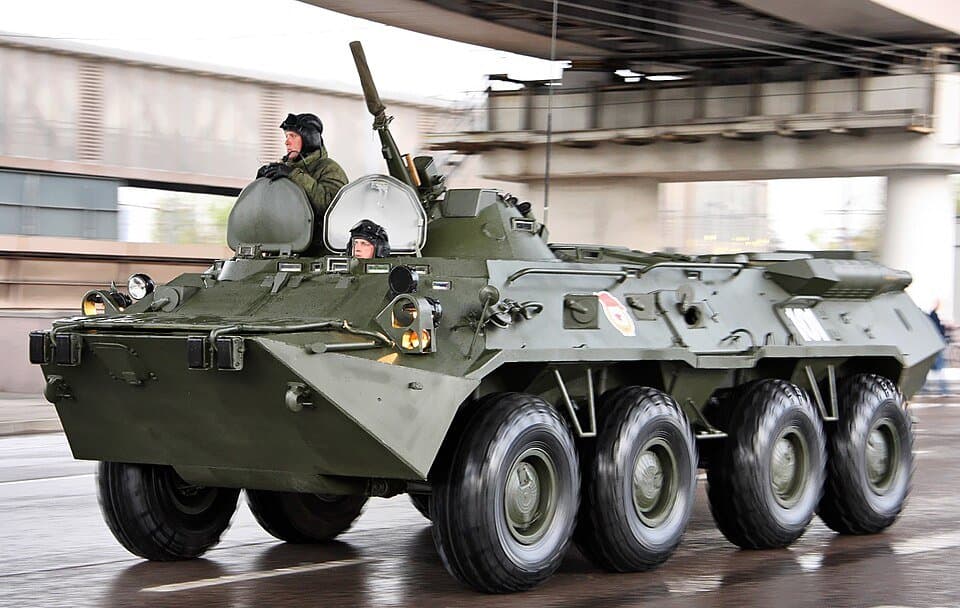
AArmoured vehicles
BTR-80
Amphibious armored personnel carrier Variants : Infantry fighting vehicle Self-propelled artillery
Credit
Vitaly V. Kuzmin · CC BY-SA 4.0 · Resized · CC BY-SA 4.0 · Source ↗ · Modified


Preparing your view.
AArmoured vehicles
Amphibious armored personnel carrier Variants : Infantry fighting vehicle Self-propelled artillery

At a glance
BTR-80larger figure on 1 of 1
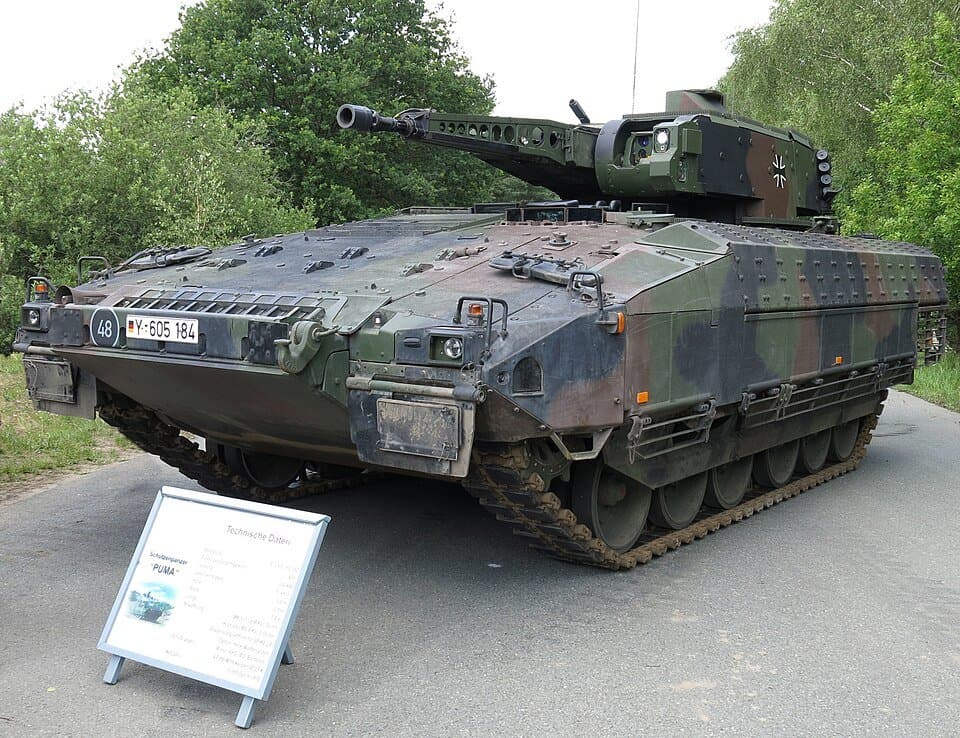
Puma (German infantry fighting vehicle)larger figure on 0 of 1
Counts only measures both sources give with the same scope. A larger figure is not a better system.
Measured figures
Length
Single source7.7 m (25.3 ft)[source]
Length
Single sourceConfiguration
| Specification | BTR-80 | Puma (German infantry fighting vehicle) |
|---|---|---|
| Type | Amphibious armored personnel carrier Variants : Infantry fighting vehicle Self-propelled artillery[source] | Infantry fighting vehicle[source] |
| Place of origin | Soviet Union[source] | Germany[source] |
| In service | 1986–present[source] | 2015–present[source] |
| Used by | See Operators[source] |
Official specification · puma; 7.4 m
Manufacturer claimSchützenpanzer Puma · Length · Länge
Single sourceWidth
Single source2.9 m (9.5 ft)[source]
Maximum; (49.7–55.9 m/h) swim
Single sourceMaximum; 6.2 m/h
Single source80–90 km/h (49.7–55.9 m/h) swim 10 km/h (6.2 m/h)[source]
Maximum; Official specification · puma; 70 km/h
Manufacturer claimMaximum; On road
Single sourcediesel KamAZ -7403
Single sourcediesel KamAZ -7403 260 hp (190 kW)[source]
MTU Fried. MT 892 Ka-501 v10 11.1-litre (at 3,800 rpm), 2,200 N⋅m (1,623 ft⋅lb)
Single sourceOfficial specification · puma; 800 kW
Manufacturer claimMTU Fried. MT 892 Ka-501 v10 11.1-litre 1,088 PS (800 kW) (at 3,800 rpm), 2,200 N⋅m (1,623 ft⋅lb)[source]
800 kW[source]
1.088 PS[source]Schützenpanzer Puma · MotorleistungSource text · numeric interpretation needs review
Bars compare reported quantities only. A larger figure does not make a system better; configurations and test conditions differ.
Bundeswehr[source] |
| Wars | Soviet–Afghan War First Nagorno-Karabakh War Georgian Civil War Kurdish–Turkish conflict (1978–2025) Transnistria War Tajikistan Civil War War in Afghanistan Iraq War First Chechen War War of Dagestan Second Chechen War Russo-Georgian War Insurgency in the North Caucasus Iraqi insurgency (2011–13) Sudanese conflict in South Kordofan and Blue Nile Sri Lankan Civil War War in Donbas 2020 Nagorno-Karabakh conflict Russo-Ukrainian war United Nations Interim Force In Lebanon[source] | — |
|---|
| Manufacturer | Arzamas Machine-Building Plant , Nizhniy Novgorod[source] | Rheinmetall AG, KNDS Deutschland[source] |
|---|
| Produced | 1984–present[source] | 2009–present[source] |
|---|
| No. built | 5,000[source] | 350 as of December 2022[source] |
|---|
| Armor | 10 mm (hull) 7 mm (turret)[source] | AMAP modular composite armor composite armour[source] |
|---|
| Main armament | 14.5 mm KPVT machine gun or 30 mm 2A72[source] | Autocanon MK 30-2/ABM ( 30 mm , 200 rounds ready to fire, 200 in storage)[source] |
|---|
| Secondary armament | 7.62 mm PKT machine gun[source] | Base variant: HK MG4 ( 5.56×45mm NATO ) S1 variant: Spike LR (MELLS) ATGM Multishot grenade launcher for close-in defense[source] |
|---|
| Power/weight | 19 hp/tonne[source] | 18.6 kW/t[source] |
|---|
| Suspension | wheeled 8×8[source] | Horstman hydrostruts[source] |
|---|
| Former operator · Estonia | Estonia[source] | — |
|---|
| Former operator · Ethiopia | Ethiopia[source] | — |
|---|
| Former operator · Finland | Finland[source] | — |
|---|
| Former operator · Romania | Romania[source] | — |
|---|
| Former operator · Turkey | Turkey[source] | — |
|---|
| Former operator · Soviet Union | Soviet Union[source] | — |
|---|
| Source measurement | The BTR-80 was developed into the larger BTR-90 in the early 1990s.[source]BTR-80 · Lead; only the objects and conditions stated in this passage The BTR-80 is based on the BTR-70 APC, which itself was based on the BTR-60 . It has a single 260-hp V-8 turbocharged water-cooled diesel engine, an improvement over the twin gasoline engines installed in the BTR-60 and BTR-70 vehicles. The reconfigured rear portion of the hull accommodates the new, single engine. The Soviets removed the roof chamfers of the modified BTR-70, raised the rear, and squared off the rearward-sloping engine compartment.[source]BTR-80 · Description; only the objects and conditions stated in this passage Standard equipment includes TNPO vision blocks, TNP-B and TKN-3 optical devices for the driver and commander, an OU-3GA2M infrared search light, six 81 mm smoke grenade launchers 902V "Tucha", a radioset (R-173 or R-163-50U), an intercom , and hydrojets for amphibious propulsion.[source]BTR-80 · Description; only the objects and conditions stated in this passage The Soviets modified the truncated cone turret used on the BTR-70 for the BTR-80 by redesigning the mantlet . This allows the 14.5 mm (0.57 in) KPVT and coaxial 7.62 mm (0.3 in) PKT machine guns to be elevated to a maximum of 60 degrees. This high angle of fire is useful in engaging targets on steep slopes, in urban fighting, and for engaging low slow flying air targets.[source]BTR-80 · Description / Capabilities; only the objects and conditions stated in this passage The BTR-80's protection is similar to that of prior models, intended only to provide protection from small arms ball ammo and small bomb splinters all-around. However it has minor armor upgrades: the front and sides of the hull were thickened from 7 mm to 9 mm (on par with the turret). Its armor scheme in high-hardness steel is as follows:[source]BTR-80 · Description / Protection; only the objects and conditions stated in this passage Turret front and sides: 9 mm at 45 degrees (13 mm line of sight (LOS) thickness)[source]BTR-80 · Description / Protection; only the objects and conditions stated in this passage Upper hull front: 9 mm at 64 degrees (21 mm LOS)[source]BTR-80 · Description / Protection; only the objects and conditions stated in this passage Lower hull front: 9 mm at 45 degrees (13 mm LOS)[source]BTR-80 · Description / Protection; only the objects and conditions stated in this passage Upper and lower hull sides: 9 mm at ~25 degrees (10 mm LOS)[source]BTR-80 · Description / Protection; only the objects and conditions stated in this passage Turret rear: 7 mm at 45 degrees (10 mm LOS)[source]BTR-80 · Description / Protection; only the objects and conditions stated in this passage Hull rear and roof: 7 mm, vertical[source]BTR-80 · Description / Protection; only the objects and conditions stated in this passage The 30mm autocannon used on IFV variants are effective against most targets apart from main battle tanks , against which they can still cause significant damage to optics, weapons, and important systems. The main gun is not stabilized, so accurate fire on the move is limited to low speeds. The turret's rotation mechanism is manually operated.[source]BTR-80 · Description / Remakes; only the objects and conditions stated in this passage The gunner sits in a roof-mounted chair located above the flat floor behind the driver/commander and two passengers, and before the passenger bench.[source]BTR-80 · Description / Remakes; only the objects and conditions stated in this passage BTR-80 (GAZ-5903) – armored personnel carrier. BTR-80K (GAZ-59031) ( kommandnyj ) – command vehicle APC with telescopic antenna mast, TNA-4 navigation device and R-163-50У series of radio equipment. BTR-80M – an improved model with a 240 hp DMZ-238M2 engine, a slightly longer hull and new tires. In production since 1993. It is understood that only a small number were produced until the original engine was ready for production again.[source]BTR-80 · Variants / Russia; only the objects and conditions stated in this passage BTR-80A (GAZ-59034) – IFV with a 2A72 30 mm gun and 300 rounds as the primary weapon. The turret is called BPPU and is equipped with sights 1PZ-9 (day) and TPN-3 or TPN-3-42 "Kristall" (night). In production and service since 1994. BTR-80S – variant of the BTR-80A for the Internal Troops of the MVD , equipped with a KPVT 14.5-mm machine gun and 7.62 mm PKT in the turret. BTR-80AK – A command variant of the BTR-80A, with two whip antennas in the rear corners and with only one firing port on the right hull side. BRDM -3 ( bronirovannaya razvedivatel’no-dozornaya mashina ) – An armoured reconnaissance/surveillance vehicle, based on the BTR-80AK and with a new day/night vision device in front of the commander's position. The crew consists of six men. In some Western sources, the name BRDM-3 is incorrectly used for the 9P148 ATGM carrier.[source]BTR-80 · Variants / Russia; only the objects and conditions stated in this passage BTR-82 – the latest production version with improved armour, spall liners , more modern night vision device TKN-4GA, GLONASS navigation system and a more powerful 300 hp engine.[source]BTR-80 · Variants / Russia; only the objects and conditions stated in this passage BTR-82A BTR-82A – the latest production version with improved armour, spall liners, a more modern night vision device TKN-4GA-02, 2A72 30 mm gun (lighter, less complex than the 2A42), GLONASS navigation system and a more powerful 300 hp engine.[source]BTR-80 · Variants / Russia; only the objects and conditions stated in this passage Russia integrated the AU-220M Baikal remote turret to the BTR-82A fitted with an autocannon firing the 57x348SR mm shells at 120 rpm.[source]BTR-80 · Variants / Russia; only the objects and conditions stated in this passage 2S23 Nona-SVK 2S23 "Nona-SVK" – fire support vehicle with the 120 mm 2A60 rifled gun-mortar – developed on the base of 2А51 rifled gun/mortar of the 2S9 Nona – and a crew of 4. Adopted in 1990.[source]BTR-80 · Variants / Russia; only the objects and conditions stated in this passage RKhM-4 ( razvedivatel’naya khimicheskaya mashina ) – NBC reconnaissance vehicle with detection devices including the IMD-21BA and DP-5V, an automatic chemical alarm system GSA-12, a detection set for chemical agents KPKhR-3, an MK-3M meteo set, a KPO-1 sampling device, an ASP automatic detector and a KZO-2 flag dispenser to mark contaminated areas.[source]BTR-80 · Variants / Russia; only the objects and conditions stated in this passage RKhM-4-01 – improved version with more modern equipment, including the GSA-13, IMD-1R, ASP-12 systems, a PGO-11 semi-automatic detection device, R-171M and R-173M radios instead of the older R-123 M.[source]BTR-80 · Variants / Russia; only the objects and conditions stated in this passage RKhM-6 "Povozka" – latest version with state-of-the-art detection systems, including the PRKhDD-2B with a detection range of about 3 km.[source]BTR-80 · Variants / Russia; only the objects and conditions stated in this passage BPDM Tajfun-M base security vehicle based on the BTR-80 "BPDM 15TS56M Typhoon M" – new version for the Strategic Rocket units (RVSN), developed on the basis of the BTR-82 that will replace the base security vehicles MBP on BTR-60/70 chassis. Signal from the optoelectronic station displayed on liquid crystal screens; operator or commander can monitor the environment and attack the detected targets using the existing machine gun. The BTR-80 version is equipped with a new turret with a 7.62 mm machine gun, an Eleron-3SV unmanned aerial vehicle with a 5 km range, new optical and infrared bands observation device TKN-4S and a "Kredo-1" radar. In service since 2013. Around 70 vehicles were delivered in 2012–2020.[source]BTR-80 · Variants / Russia; only the objects and conditions stated in this passage PU-12M6 (9S482M6) ( punkt upravleniya ) – battery command vehicle (BKP – batarejnyj kommandnyj punkt ) for air defence units equipped with "Strela-1M" ( SA-9 ), "Strela-10M2 ( SA-13 ), "Osa-AK" ( SA-8 ), 2S6 "Tunguska" and ZSU-23-4 "Shilka".[source]BTR-80 · Variants / Russia; only the objects and conditions stated in this passage The radio sets have a declared range of 20–350 km on the move and 40–1,000 km deployed.[source]BTR-80 · Variants / Russia; only the objects and conditions stated in this passage R-439-BK "Legenda 2BK" – satellite communications vehicle, operates within 3400-3900 MHz (reception) and 5725-6225 MHz (transmission) ranges.[source]BTR-80 · Variants / Russia; only the objects and conditions stated in this passage BTR-80 "Caribe" – version for Colombian marines with .50cal machine gun instead of 14.5 mm KPVT . 100 ordered. Caribe project is assembled in COTECMAR ( Corporación Tecnológica del Mar Caribe ) Plant in Cartagena de Indias, Colombia[source]BTR-80 · Variants / Colombia; only the objects and conditions stated in this passage BTR-80M – Upgraded version with passive day/night sight KM-1M on top of the roof, stowage box for water bottles on the left hull side, improved NBC protection system and Kronsberg radio set.[source]BTR-80 · Variants / Hungary; only the objects and conditions stated in this passage M2010 8×8 – Following the acquisition of 32 BTR-80As, North Korea appears to have produced and put into service a domestic clone of the vehicle of an unknown designation. It carries 3 crew and 7–8 troops and is fitted with an indigenous turret equipped with two 14.5 mm and one 7.62 mm machine guns. Other features such as protection, engine placement, entry and exit points, and amphibious capabilities are similar to the BTR-80. It is known unofficially as the M-2010 or Chunma-D, since it first appeared in a military parade in 2010.[source]BTR-80 · Variants / North Korea; only the objects and conditions stated in this passage Lince/Lynx - allegedly a Peruvian upgrade for BTR-80-type APCs by Desarrollos Industriales Casanave, which consist of a better suspension system, engine and gearbox. A 30mm autocannon with FCS controls is installed with two Defender missiles on the cannon.[source]BTR-80 · Variants / Peru; only the objects and conditions stated in this passage TAB Zimbru (B33) ( transportorul amfibiu blindat ) – A modified version of the BTR-80 with Model 1240 V8-DTS engine of 268 hp (197 kW), R-1231B radio set and 500 additional rounds 7.62 mm. Made by CN RomArm SA.[source]BTR-80 · Variants / Romania; only the objects and conditions stated in this passage Zimbru 2000 – An improved version with bigger hull, new Deutz BF6M 1013FC 285 hp (212 kW) engine, new transmission Allison -MD 3060 PR etc. Can be fitted with a new turret like the OWS 25R. Prototype.[source]BTR-80 · Variants / Romania; only the objects and conditions stated in this passage BTR-80UP – An improved version, produced in Ukraine in cooperation with Poland for Iraq (98 planned). Fitted with a new 300 hp engine, additional armour and air conditioner. BTR-80UP-KB – battalion level command vehicle. BTR-80UP-KR – company level command vehicle. BTR-80UP-S – staff vehicle. BTR-80UP-M – ambulance. BTR-80UP-BREM – recovery vehicle. BTR-80UP-R – reconnaissance version. BTR-80UP-T – cargo version.[source]BTR-80 · Variants / Ukraine; only the objects and conditions stated in this passage KShM "Kushetka-B" – command vehicle, based on the K1Sh1 chassis and developed by Radioprylad from Ukraine. The specialised equipment consists of the "Berkut-M" HF radioset and several, VHF sets – R-171M, R-173M "Abzats-M", R-163-50U, R-163-10V and R-163-1V "Arbalet" (with a range from 5 to 350 km). Other equipment includes a navigation apparatus (probably TNA-4-6), an AB-1-P28,5-B-V1 generator as well as DLYa4.115.002 and DLYa2.091.008 telescopic antenna masts.[source]BTR-80 · Variants / Ukraine; only the objects and conditions stated in this passage | — |
|---|
| Designer | — | Krauss-Maffei Wegmann Rheinmetall Landsysteme[source] |
|---|
| Designed | — | 1995–2009[source] |
|---|
| Passengers | — |
|---|
| Transmission | — | Renk HSWL 256[source] |
|---|
| Fuel capacity | — | 900 L (240 U.S. gal; 200 imp gal)[source] |
|---|
| Reported occupants | — | 3+6[source]Schützenpanzer Puma · BesatzungSource text · numeric interpretation needs review |
|---|
| Reported operators |
| — |
|---|