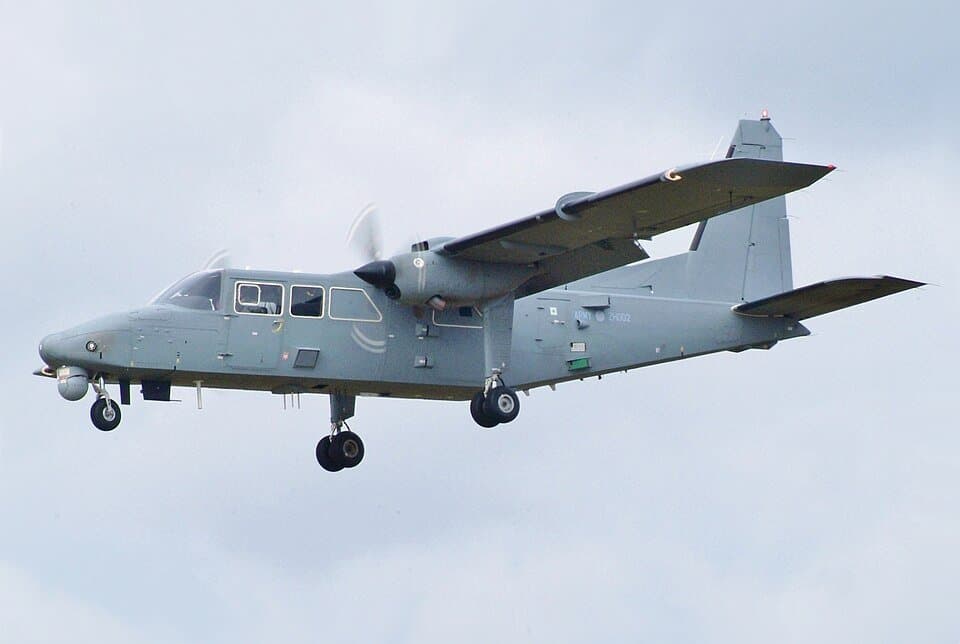

Credit
Jerry Gunner · CC BY-SA 4.0 · Resized · CC BY-SA 4.0 · Source ↗ · Modified


Preparing your view.

At a glance
True scale
Side by side. From every angle. A human reference for perspective.
3.23 MB · Loads when you open it| Model | Length | Width / span | Height |
|---|---|---|---|
| Britten-Norman Defender | ≈ 12.2 m | ≈ 16.15 m (Width) | ≈ 4.4 m |
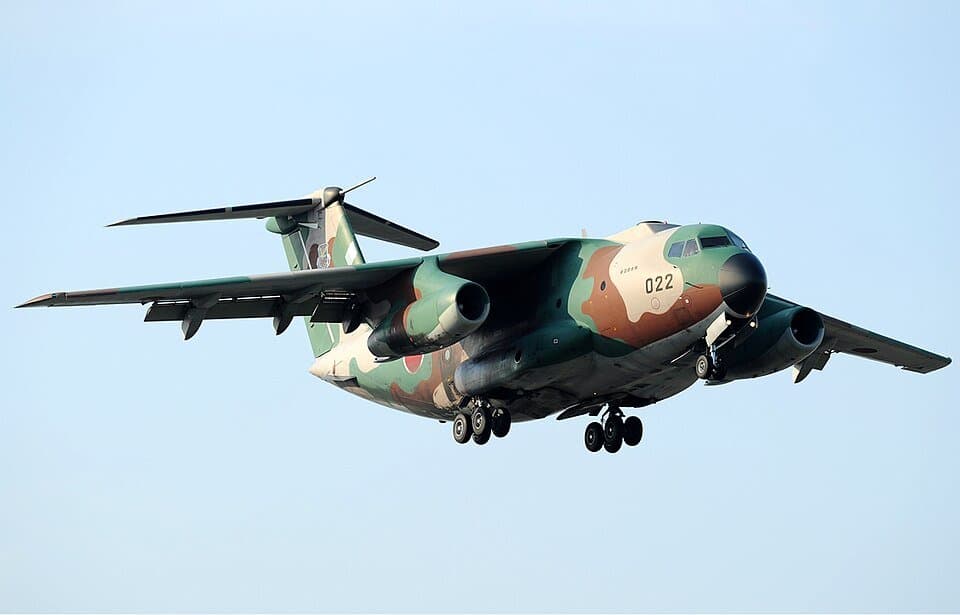
| Kawasaki C-1 | ≈ 29 m | ≈ 30.6 m (Width) | ≈ 9.99 m |
Scaled uniformly to the sourced length of 12.2 m. The shape was turned square to the axes; the height was fitted to the sourced 4.4 m; the width was fitted to the sourced 16.15 m. Not an official model or a measured survey.
ForceTally · All rights reserved
Scaled uniformly to the sourced length of 29 m. The shape was turned square to the axes; the height was fitted to the sourced 9.99 m; the width was fitted to the sourced 30.6 m. Not an official model or a measured survey.
ForceTally · All rights reserved
The human reference is a generic 1.75 m figure. Models describe external size, not combat performance.
Measured figures
Defender 4000 · Length
Single source12.20 m (40 ft 0 in)[source]
Configuration
| Specification | Britten-Norman Defender | Kawasaki C-1 |
|---|---|---|
| Type | Transport, patrol, reconnaissance[source] | Military transport aircraft[source] |
| National origin | United Kingdom[source] | Japan[source] |
| Manufacturer | Britten-Norman[source] | Kawasaki Heavy Industries[source] |
| Status | In service[source] |
Kawasaki C-1 · Length
29 m (95 ft 2 in)[source]
Empty; Defender 4000 · empty equipped
Single sourceMaximum take-off; Defender 4000 · Max takeoff weight
Single source2,223 kg (4,900 lb) (empty equipped)[source]
3,856 kg (8,500 lb)[source]
Empty; Kawasaki C-1 · Empty weight
Single sourceMaximum take-off; Kawasaki C-1 · Max takeoff weight
Single sourceCruise; Defender 4000 · (72% power, at 1525 m (5000 ft))
Single sourceMaximum; Defender 4000 · (Max cruise, at 3050 m (10000 ft))
Single source326 km/h (203 mph, 176 kn) (Max cruise, at 3050 m (10000 ft))[source]
280 km/h (170 mph, 150 kn) (72% power, at 1525 m (5000 ft))[source]
Cruise; Kawasaki C-1 · at 10,670 m (35,010 ft) at 35,450 kg (78,150 lb)
Single sourceMaximum; Kawasaki C-1 · at 7,620 m (25,000 ft) at 35,450 kg (78,150 lb)
Single sourceDefender 4000 · 2 × Rolls-Royce 250 B17F turboprops (400 shp) each
Single source2 × Rolls-Royce 250 B17F turboprops , 300 kW (400 shp) each[source]
Kawasaki C-1 · 2 × Pratt & Whitney JT8D -M-9 ( Mitsubishi -built) low-bypass turbofans thrust each
Single source2 × Pratt & Whitney JT8D -M-9 ( Mitsubishi -built) low-bypass turbofans , 64 kN (14,500 lbf) thrust each[source]
Defender 4000 · Endurance
Single source8 hr 30 minutes[source]
Bars compare reported quantities only. A larger figure does not make a system better; configurations and test conditions differ.
Retired[source]
| First flight | May 1970[source] | 12 November 1970[source] |
|---|
| Developed from | Britten-Norman Islander[source] | — |
|---|
| Capacity | Up to 16 troops in transport role[source] | 8,000 kg (18,000 lb) normal payload[source] |
|---|
| Aspect ratio | 8.0:1[source] | 7.8[source] |
|---|
| Airfoil | NACA 23012[source] | — |
|---|
| Fuel capacity | 1,131 L (299 US gal; 249 imp gal)[source] | 15,200 L (4,000 US gal; 3,300 imp gal) in 4 integral tanks in the wings[source] |
|---|
| Stall speed | 87 km/h (54 mph, 47 kn) (flaps down)[source] | — |
|---|
| Take-off run to 15 m (50 ft) | 565 m (1,854 ft)[source] | — |
|---|
| Landing run from 15 m (50 ft) | 589 m (1,932 ft)[source] | — |
|---|
| Role | multi-role utility transport aircraft[source] | twin-engined short-range military transport aircraft[source] |
|---|
| Primary user | — | Japan Air Self-Defense Force[source] |
|---|
| Number built | — | 31[source] |
|---|
| Introduction date | — | December 1974[source] |
|---|
| Retired | — | 15 March 2025[source] |
|---|
| Wing loading | — | 321.2 kg/m 2 (65.8 lb/sq ft)[source] |
|---|
| Thrust/weight | — | 0.003 kN/kg (0.34 lbf/lb)[source] |
|---|
| Source measurement | — | Development of the C-1 commenced in 1966 in response to a requirement from the JASDF, which sought an indigenous jet-powered replacement for its aging Second World War –era Curtiss C-46 Commando transport fleet. First flown on 12 November 1970, quantity production of the type commenced during the following year. The C-1 has formed the backbone of the JASDF's transport capability throughout the latter half of the twentieth century and the initial years of the twenty-first century as well. During the 2010s, Kawasaki developed a newer, larger, and longer-range airlifter, the Kawasaki C-2 , which will eventually replace the JASDF's C-1 fleet entirely.[source]Kawasaki C-1 · Lead; only the objects and conditions stated in this passage In terms of its basic configuration, the C-1 is a twin-engine medium-range airlifter, somewhat resembling the larger Lockheed C-141 Starlifter . It is powered by a pair of Pratt & Whitney JT8D -M-9 low-bypass turbofan engines, which were locally manufactured under license by Mitsubishi, each capable of generating up to 64 kN (14,500 lbf) of thrust. In terms of payload capacity, a single C-1 could carry up to 80 fully-equipped troops, 45 paratroopers , or 36 stretcher-bound personnel, in addition to bulky cargo, including a whole truck or a pair of jeeps , which would be loaded via a ramp deployed at the airlifter's rear. It was designed to be typically operated by a crew of five, comprising two pilots, a flight engineer , a navigator , and a loadmaster. The C-1 incorporates a high-lift system, which includes aerodynamic features such as a leading edge slat and a four-stage Fowler flap , facilitates a high level of short takeoff and landing (STOL) performance, while day-and-night all-weather operations are achieved via the application of numerous electronic navigation systems.[source]Kawasaki C-1 · Design and development; only the objects and conditions stated in this passage The maximum range of C-1 caused a problem after the island of Okinawa was returned to Japan from the United States; the airlifter was unable to fly directly to Okinawa from most parts of the Japanese home islands. This may have been a factor in the decision to reduce the planned procurement of the C-1 in favour of the American-built C-130H Hercules utility transport aircraft instead, which entered service with the JASDF's 401st Tactical Airlift Squadron in 1989. Another reason for the curtailment was the enactment of general cutbacks upon various military programmes and procurement initiatives during the 1970s.[source]Kawasaki C-1 · Design and development; only the objects and conditions stated in this passage The last five C-1s ordered were fitted with an additional 4,730-litre fuel tank.[source]Kawasaki C-1 · Variants; only the objects and conditions stated in this passage Two C-1s of the 401st Tactical Airlift Squadron crashed near Toba, Mie when the lead two airplanes of a formation of 5 en route from Komaki Air Base to Iruma Air Base flew into a hill while flying in low visibility at low altitude. A third airplane narrowly avoided also crashing and struck trees, but was able to return to Komaki Air Base. Fourteen personnel were killed in these two aircraft, six personnel in airplane 68-1015 and eight in aircraft 58–1009.[source]Kawasaki C-1 · Accidents; only the objects and conditions stated in this passage A C-1 crashed into the sea of Japan's west coast during a test flight with five personnel on board. There were no survivors.[source]Kawasaki C-1 · Accidents; only the objects and conditions stated in this passage Capacity: 8,000 kg (18,000 lb) normal payload[source]Kawasaki C-1 · Specifications (Kawasaki C-1); only the objects and conditions stated in this passage Length: 29 m (95 ft 2 in)[source]Kawasaki C-1 · Specifications (Kawasaki C-1); only the objects and conditions stated in this passage Wingspan: 30.6 m (100 ft 5 in)[source]Kawasaki C-1 · Specifications (Kawasaki C-1); only the objects and conditions stated in this passage Height: 9.99 m (32 ft 9 in)[source]Kawasaki C-1 · Specifications (Kawasaki C-1); only the objects and conditions stated in this passage Wing area: 120.5 m 2 (1,297 sq ft)[source]Kawasaki C-1 · Specifications (Kawasaki C-1); only the objects and conditions stated in this passage Empty weight: 23,220 kg (51,191 lb)[source]Kawasaki C-1 · Specifications (Kawasaki C-1); only the objects and conditions stated in this passage Max takeoff weight: 38,700 kg (85,319 lb)[source]Kawasaki C-1 · Specifications (Kawasaki C-1); only the objects and conditions stated in this passage Powerplant: 2 × Pratt & Whitney JT8D -M-9 ( Mitsubishi -built) low-bypass turbofans , 64 kN (14,500 lbf) thrust each[source]Kawasaki C-1 · Specifications (Kawasaki C-1); only the objects and conditions stated in this passage Maximum speed: 806 km/h (501 mph, 435 kn) at 7,620 m (25,000 ft) at 35,450 kg (78,150 lb)[source]Kawasaki C-1 · Specifications (Kawasaki C-1); only the objects and conditions stated in this passage Cruise speed: 657 km/h (408 mph, 355 kn) at 10,670 m (35,010 ft) at 35,450 kg (78,150 lb)[source]Kawasaki C-1 · Specifications (Kawasaki C-1); only the objects and conditions stated in this passage Range: 3,353 km (2,083 mi, 1,810 nmi) with max fuel & 2,300 kg (5,100 lb) payload[source]Kawasaki C-1 · Specifications (Kawasaki C-1); only the objects and conditions stated in this passage Service ceiling: 11,580 m (37,990 ft)[source]Kawasaki C-1 · Specifications (Kawasaki C-1); only the objects and conditions stated in this passage Rate of climb: 17.75 m/s (3,494 ft/min) at sea level[source]Kawasaki C-1 · Specifications (Kawasaki C-1); only the objects and conditions stated in this passage |
|---|
| Country of origin | — | Japan[source]Inventory Origin column; table 2, row 41, cell 2; revision 1359403478 |
|---|