


Preparing your view.

At a glance
Measured figures
BN-2B Islander · Length
Single source35 ft 7 + 3 ⁄ 4 in (10.86 m)[source]
Configuration
| Specification | Britten-Norman BN-2 Islander | Dassault Falcon 20 |
|---|---|---|
| Type | Utility aircraft/airliner[source] | Business jet[source] |
| National origin | United Kingdom[source] | France[source] |
| Manufacturer | Britten-Norman[source] | Dassault Aviation[source] |
| Designer | John Britten, Desmond Norman[source] |
Falcon 20F · Length
17.15 m (56 ft 3 in)[source]
Empty; BN-2B Islander · equipped (without avionics)
Single sourceMaximum take-off; BN-2B Islander · Max takeoff weight
Single source4,114 lb (1,866 kg) equipped (without avionics)[source]
6,600 lb (2,994 kg)[source]
Empty; Falcon 20F · Empty weight
Single sourceMaximum take-off; Falcon 20F · Max takeoff weight
Single sourceCruise; BN-2B Islander · at 12,000 ft (3,700 m) (59% power)
Single sourceMaximum; BN-2B Islander · at sea level
Single source148 kn (170 mph, 274 km/h) at sea level[source]
130 kn (150 mph, 240 km/h) at 12,000 ft (3,700 m) (59% power)[source]
Cruise; Falcon 20F · at 12,200 m (40,000 ft) (econ. cruise)
Single sourceMaximum; Falcon 20F · at 7,620 m (25,000 ft) (max cruise)
Single sourceBN-2B Islander · 59% power, standard fuel
Single sourceBN-2B Islander · at 130 kn (150 mph; 241 km/h) and
Single source755 nmi (869 mi, 1,398 km) at 130 kn (150 mph; 241 km/h) and 12,000 ft (3,700 m) (59% power, standard fuel)[source]
Falcon 20F · Range
Single source3,350 km (2,080 mi, 1,810 nmi)[source]
BN-2B Islander · 2 × Lycoming O-540-E4C5 6-cylinder air-cooled horizontally-opposed piston engines each
Single source2 × Lycoming O-540-E4C5 6-cylinder air-cooled horizontally-opposed piston engines, 260 hp (190 kW) each[source]
Falcon 20F · 2 × General Electric CF700 -2D-2 turbofans thrust each
Single source2 × General Electric CF700 -2D-2 turbofans , 20 kN (4,500 lbf) thrust each[source]
BN-2B Islander · 860 ft/min ( ) at sea level
Single source860 ft/min (4.4 m/s) at sea level[source]
Bars compare reported quantities only. A larger figure does not make a system better; configurations and test conditions differ.
| — |
| Status | In active service[source] | Out of production, in active service[source] |
|---|
| Primary users | Vieques Air Link FLN Frisia Luftverkehr Air Flamenco Cape Air[source] | Federal Express (formerly) French Navy United States Coast Guard[source] |
|---|
| Number built | 1,280[source] | 512[source] |
|---|
| Manufactured | 1965–present[source] | 1965–1991[source] |
|---|
| First flight | 13 June 1965[source] | 4 May 1963[source] |
|---|
| Developed into | Britten-Norman Defender Britten-Norman Trislander[source] | Dassault Falcon 10 Dassault Falcon 50[source] |
|---|
| Capacity | 9 passengers / 2,048 lb (929 kg) maximum payload[source] | 8–14 passengers[source] |
|---|
| Aspect ratio | 7.4:1[source] | 6.4:1[source] |
|---|
| Airfoil | NACA 23012[source] | — |
|---|
| Fuel capacity | 137 imp gal (165 US gal; 620 L)[source] | 5,200 L (1,100 imp gal; 1,400 US gal)[source] |
|---|
| Propellers | 2-bladed Hartzell HC-C2YK-2B constant speed propellers , 6 ft 6 in (1.98 m) diameter[source] | — |
|---|
| Stall speed | 40 kn (46 mph, 74 km/h) (flaps down)[source] | 152 km/h (94 mph, 82 kn)[source] |
|---|
| Never exceed speed | 183 kn (211 mph, 339 km/h)[source] | — |
|---|
| Take-off run to 50 ft (15 m) | 1,218 ft (370 m) (at sea level)[source] | — |
|---|
| Landing run from 50 ft (15 m) | 980 ft (300 m) (at sea level)[source] | — |
|---|
| Role | British light piston utility aircraft and regional airliner[source] | French business jet[source] |
|---|
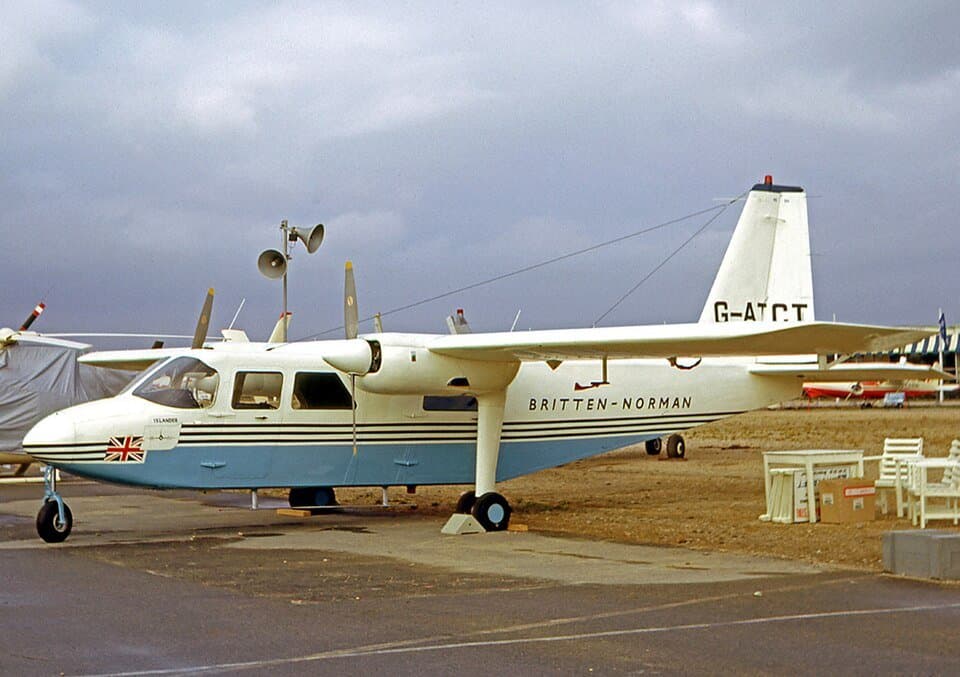
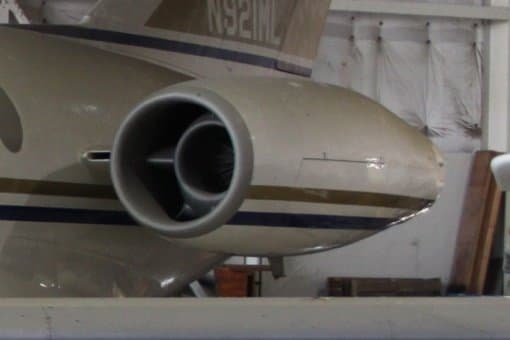
| Source measurement | Another development was a turbo-normalizing system with RaJay turbocharger for the -2, -3, -6, -8, and -9 models allowing full power up to 14,000 feet (4,300 metres) with attendant increase in true airspeed and takeoff and climb performance. Presently Talco in Texas holds the STC.[source]Britten-Norman BN-2 Islander · Development / Further development; only the objects and conditions stated in this passage In early 2008, B-N was studying a version powered by 350 hp (260 kW) aircraft diesel engines with SMA Engines , already offering the 230 hp (170 kW) SMA SR305-230 . In May 2010, Britten-Norman announced that manufacturing of the Islander would be relocated from Romania to a new site in the UK, due to the rising costs of production in Romania.[source]Britten-Norman BN-2 Islander · Development / Further development; only the objects and conditions stated in this passage The Britten-Norman BN-2 Islander is a shoulder-wing cantilever monoplane with a rectangular fuselage and two wing-mounted engines; early aircraft were equipped with a pair of piston engines while later production models may be alternatively fitted with turboprop engines in their place. The rectangular cross section fuselage, which is furnished with a conventional tail unit and fixed tricycle landing gear , can accommodate a single pilot and up to nine passengers in a commuter configuration, or operate in a mixed cargo/passenger capacity. The cabin can be rapidly reconfigured, allowing for a single aircraft to undertake a diverse range of tasks within a minimal period of time. Often referring to the type as "The world's most versatile aircraft", Britten-Norman promotes the Islander's low direct operating costs, minimal maintenance, and its stability in flight as major attributes of the aircraft.[source]Britten-Norman BN-2 Islander · Design; only the objects and conditions stated in this passage Immediately following commercial availability, US distributor Jonas Aircraft ordered 30 Islanders, and placed orders for another 112 aircraft within a year. When equipped with four 54-gallon fuel tanks, the Islander was able to ferry itself across the transatlantic route, via Gander International Airport , Newfoundland , for US deliveries. The Islander's long-range capabilities were highlighted when the type won the 1969 London - Sydney air race.[source]Britten-Norman BN-2 Islander · Operational history; only the objects and conditions stated in this passage Between 1976 and 2006, Scottish airline Loganair operated a number of Islanders as air ambulances, covering areas such as the island communities in the Hebrides . The Islander services Loganair 's Westray to Papa Westray flight , the shortest scheduled flight in the world at 1.7 mi (2.7 km); the scheduled flight time including taxiing is two minutes.[source]Britten-Norman BN-2 Islander · Operational history; only the objects and conditions stated in this passage Prototype first flown in 1966 with two 260 hp (190 kW) Lycoming O-540-E4B5 piston engines.[source]Britten-Norman BN-2 Islander · Variants; only the objects and conditions stated in this passage A BN-2A with modified flaps, and two 300 hp (220 kW) Lycoming IO-540-K1B5 (fuel injected) engines.[source]Britten-Norman BN-2 Islander · Variants; only the objects and conditions stated in this passage A BN-2A with wing leading edge modifications and two 260 hp (190 kW) Lycoming O-540-E4C5 engine.[source]Britten-Norman BN-2 Islander · Variants; only the objects and conditions stated in this passage A BN-2A-8 with increased takeoff weight and 270 hp (200 kW) Lycoming TIO-540-H1A (turbo-charged, fuel injected) engines.[source]Britten-Norman BN-2 Islander · Variants; only the objects and conditions stated in this passage Defender military variant with 300 hp (220 kW) IO-540-K1B5 engines and underwing hard points and military modifications.[source]Britten-Norman BN-2 Islander · Variants; only the objects and conditions stated in this passage Turbine Islander based on BN-2A-26 with two 320 shp (240 kW) Allison 250-B17C turboprops. Seating for up to 9 passengers.[source]Britten-Norman BN-2 Islander · Variants; only the objects and conditions stated in this passage Three-engined Trislander, a stretched BN-2A with 18 seats and three 260 hp (190 kW) Lycoming O-540-E4C5 piston engines.[source]Britten-Norman BN-2 Islander · Variants; only the objects and conditions stated in this passage 1974 Harbor Airlines accident - On 26 December 1974, a Britten-Norman BN-2A crashed 1 mile (1.6 km) north of Seattle-Tacoma International Airport in a snowstorm; the pilot and three of the five passengers died. The cause was determined to be a clogged pitot tube.[source]Britten-Norman BN-2 Islander · Accidents; only the objects and conditions stated in this passage 1989 New England Airlines Britten-Norman Islander Crash - November 28, 1989, a BN-2A Islander, N127JL, flying to Westerly crashed into the sea 3 to 5 miles northwest of Block Island . All 8 people on board, 7 passengers and pilot were killed.[source]Britten-Norman BN-2 Islander · Accidents; only the objects and conditions stated in this passage 2022 Air Flamenco crash - On 15 February 2022, a Britten-Norman BN-2A Islander (N821RR) veered off the runway at Culebra Airport (CPX), Puerto Rico doing substantial right wing and propeller damage. None of the three persons on board were injured.[source]Britten-Norman BN-2 Islander · Accidents; only the objects and conditions stated in this passage 2024 Air Taxi Vanuatu crash - On 15 July 2024, a BN-2A Islander operated by Air Taxi Vanuatu crashed close to its destination of Port Vila ; one of the five people on board died.[source]Britten-Norman BN-2 Islander · Accidents; only the objects and conditions stated in this passage Capacity: 9 passengers / 2,048 lb (929 kg) maximum payload[source]Britten-Norman BN-2 Islander · Specifications (BN-2B Islander); only the objects and conditions stated in this passage Length: 35 ft 7 + 3 ⁄ 4 in (10.86 m)[source]Britten-Norman BN-2 Islander · Specifications (BN-2B Islander); only the objects and conditions stated in this passage Wingspan: 49 ft 0 in (14.94 m)[source]Britten-Norman BN-2 Islander · Specifications (BN-2B Islander); only the objects and conditions stated in this passage Height: 13 ft 8 + 3 ⁄ 4 in (4.18 m)[source]Britten-Norman BN-2 Islander · Specifications (BN-2B Islander); only the objects and conditions stated in this passage Wing area: 325.0 sq ft (30.19 m 2 )[source]Britten-Norman BN-2 Islander · Specifications (BN-2B Islander); only the objects and conditions stated in this passage Empty weight: 4,114 lb (1,866 kg) equipped (without avionics)[source]Britten-Norman BN-2 Islander · Specifications (BN-2B Islander); only the objects and conditions stated in this passage Max takeoff weight: 6,600 lb (2,994 kg)[source]Britten-Norman BN-2 Islander · Specifications (BN-2B Islander); only the objects and conditions stated in this passage Powerplant: 2 × Lycoming O-540-E4C5 6-cylinder air-cooled horizontally-opposed piston engines, 260 hp (190 kW) each[source]Britten-Norman BN-2 Islander · Specifications (BN-2B Islander); only the objects and conditions stated in this passage Propellers: 2-bladed Hartzell HC-C2YK-2B constant speed propellers , 6 ft 6 in (1.98 m) diameter[source]Britten-Norman BN-2 Islander · Specifications (BN-2B Islander); only the objects and conditions stated in this passage Maximum speed: 148 kn (170 mph, 274 km/h) at sea level[source]Britten-Norman BN-2 Islander · Specifications (BN-2B Islander); only the objects and conditions stated in this passage Cruise speed: 130 kn (150 mph, 240 km/h) at 12,000 ft (3,700 m) (59% power)[source]Britten-Norman BN-2 Islander · Specifications (BN-2B Islander); only the objects and conditions stated in this passage Stall speed: 40 kn (46 mph, 74 km/h) (flaps down)[source]Britten-Norman BN-2 Islander · Specifications (BN-2B Islander); only the objects and conditions stated in this passage Never exceed speed : 183 kn (211 mph, 339 km/h)[source]Britten-Norman BN-2 Islander · Specifications (BN-2B Islander); only the objects and conditions stated in this passage Range: 755 nmi (869 mi, 1,398 km) at 130 kn (150 mph; 241 km/h) and 12,000 ft (3,700 m) (59% power, standard fuel)[source]Britten-Norman BN-2 Islander · Specifications (BN-2B Islander); only the objects and conditions stated in this passage Service ceiling: 13,000 ft (4,000 m)[source]Britten-Norman BN-2 Islander · Specifications (BN-2B Islander); only the objects and conditions stated in this passage Rate of climb: 860 ft/min (4.4 m/s) at sea level[source]Britten-Norman BN-2 Islander · Specifications (BN-2B Islander); only the objects and conditions stated in this passage Take-off run to 50 ft (15 m): 1,218 ft (370 m) (at sea level)[source]Britten-Norman BN-2 Islander · Specifications (BN-2B Islander); only the objects and conditions stated in this passage Landing run from 50 ft (15 m): 980 ft (300 m) (at sea level)[source]Britten-Norman BN-2 Islander · Specifications (BN-2B Islander); only the objects and conditions stated in this passage | During the 1950s and 1960s, the French government, which had taken a significant interest in the re-establishment and growth of its national aviation industries in the aftermath of the Second World War , developed a detailed request for a combined liaison / trainer aircraft, to be equipped with twin-turbofan engines. Among those companies that took interest in the government request was French aircraft manufacturer Dassault Aviation . In December 1961, French aircraft designer and head of Dassault Aviation, Marcel Dassault , gave the go-ahead to proceed with work towards the production of an eight- to 10-seat executive jet /military liaison aircraft, which was initially named as the Dassault-Breguet Mystère 20 . The emerging design was of a low-wing monoplane, which drew upon the aerodynamics of the transonic Dassault Mystère IV fighter-bomber , and was equipped with a pair of rear-mounted 14.68 kN (3,300 lbf) Pratt & Whitney JT12A-8 turbojet engines.[source]Dassault Falcon 20 · Development / Origins; only the objects and conditions stated in this passage Progress between Dassault and Pan Am was rapid, moving from engineering evaluations of the type to the formation of general agreements between the two companies. In response to feedback received from Pan American, the aircraft was re-engined with a pair of General Electric CF700 engines and several dimensions were increased. Accordingly, Pan American formed an agreement with Dassault to distribute the Mystère 20 in the western hemisphere; the firm placed an initial order for 40 aircraft along with options for a further 120. On 10 July 1964, the re-engined aircraft made its first flight. On 1 January 1965, the first production aircraft performed its maiden flight; in June 1965, both French and American type certifications were awarded. On 10 June 1965, French aviator Jacqueline Auriol achieved the women's world speed record using the first Mystère 20 prototype, having flown at an average recorded speed of 859 km/h over a distance of 1000 km.[source]Dassault Falcon 20 · Development / Origins; only the objects and conditions stated in this passage In 1973, FedEx's Falcons, designation FA-20-DC, cost $1.2 million each and were modified with a 55-by-74.5-inch forward cargo door with independent power supply, higher mtow, reinforced floor, plugged windows, and bigger brakes.[source] |
|---|
| Introduction date | — | 3 June 1965[source] |
|---|
| Country of origin | — | France[source]Inventory Origin column; table 1, row 54, cell 4; revision 1377423821; retrieved 2026-10-02 |
|---|
862 km/h (536 mph, 465 kn) at 7,620 m (25,000 ft) (max cruise)[source]
750 km/h (470 mph, 400 kn) at 12,200 m (40,000 ft) (econ. cruise)[source]
An improved model of the aircraft, designated the Falcon 200 , was developed, which featured more advanced jet engines and other major improvements to increase range, capacity, and comfort. The Falcon 200, along with the Falcon 20G and HU-25 models, were powered by a pair of Garrett ATF3 engines. According to the magazine Flying , the Falcon 200 variant was more comparable to the newer Falcon 50 trijet than the original Falcon 20 model.[source]Dassault Falcon 20 · Development / Further development; only the objects and conditions stated in this passage
During 2013, the FAA modified 14 CFR part 91 rules to prohibit the operation of jets weighing 75,000 pounds or less that were not Stage 3 noise compliant after 31 December 2015. The Falcon 20 was listed explicitly in Federal Register 78 FR 39576 . Any examples of the type that had not been modified, either by the installation of Stage 3 noise-compliant engines or have had hush kits installed upon noncompliant engines, were no longer permitted to fly anywhere in the contiguous 48 states after 31 December 2015. However, 14 CFR §91.883 Special flight authorizations for jet airplanes weighing 75,000 pounds or less – lists special flight authorizations that may be granted for operation after 31 December 2015.[source]Dassault Falcon 20 · Development / Further development; only the objects and conditions stated in this passage
Prototype, one built. F-WLKB, initially powered by two 14.68 kN (3,300 lbf) Pratt & Whitney JT12A-8 turbojet engines. Now stored at Musée Air et Espace Aéroport Paris – Le Bourget.[source]Dassault Falcon 20 · Variants; only the objects and conditions stated in this passage
Initial production version, with lengthened fuselage compared to first prototype and with 10–12 seats. Powered by 4,200 lbf (19 kN) CF700-2B engines.[source]Dassault Falcon 20 · Variants; only the objects and conditions stated in this passage
Falcon 20CC (s/n 073)[source]Dassault Falcon 20 · Variants; only the objects and conditions stated in this passage
Falcon 20G[source]Dassault Falcon 20 · Variants; only the objects and conditions stated in this passage
Falcon 20H[source]Dassault Falcon 20 · Variants; only the objects and conditions stated in this passage
Improved variant, powered by two 2360-kg (5,200-lb) Garrett ATF3-6A-4C turbofan engines and with more fuel. First flown on 30 April 1980.[source]Dassault Falcon 20 · Variants; only the objects and conditions stated in this passage
United States Coast Guard version of the Falcon 20G. 41 built. Equipped with two Garrett AiResearch Garrett ATF3-6-2C turbofan engines.[source]Dassault Falcon 20 · Variants; only the objects and conditions stated in this passage
Enlarged, 30-passenger commuter airliner derivative of Falcon 20, powered by two 27.0 kN (6,070 lbf) Lycoming ALF 502 D turbofans. One prototype built, first flying on 11 May 1973. No further production of Falcon 30 or proposed 40-passenger, shorter-range Mystére 40-100 .[source]Dassault Falcon 20 · Variants; only the objects and conditions stated in this passage
Pakistan Air Force – 3 in service, including 2 DA-20s in EW , ECM , ESM roles[source]Dassault Falcon 20 · Operators / Current military operators; only the objects and conditions stated in this passage
Royal Australian Air Force – Three in service from 1967 to 1989. No. 34 Squadron RAAF[source]Dassault Falcon 20 · Operators / Former military operators; only the objects and conditions stated in this passage
Capacity: 8–14 passengers[source]Dassault Falcon 20 · Specifications (Falcon 20F); only the objects and conditions stated in this passage
Length: 17.15 m (56 ft 3 in)[source]Dassault Falcon 20 · Specifications (Falcon 20F); only the objects and conditions stated in this passage
Wingspan: 16.30 m (53 ft 6 in)[source]Dassault Falcon 20 · Specifications (Falcon 20F); only the objects and conditions stated in this passage
Height: 5.32 m (17 ft 5 in)[source]Dassault Falcon 20 · Specifications (Falcon 20F); only the objects and conditions stated in this passage
Wing area: 41.00 m 2 (441.3 sq ft)[source]Dassault Falcon 20 · Specifications (Falcon 20F); only the objects and conditions stated in this passage
Empty weight: 7,530 kg (16,601 lb)[source]Dassault Falcon 20 · Specifications (Falcon 20F); only the objects and conditions stated in this passage
Max takeoff weight: 13,000 kg (28,660 lb)[source]Dassault Falcon 20 · Specifications (Falcon 20F); only the objects and conditions stated in this passage
Powerplant: 2 × General Electric CF700 -2D-2 turbofans , 20 kN (4,500 lbf) thrust each[source]Dassault Falcon 20 · Specifications (Falcon 20F); only the objects and conditions stated in this passage
Maximum speed: 862 km/h (536 mph, 465 kn) at 7,620 m (25,000 ft) (max cruise)[source]Dassault Falcon 20 · Specifications (Falcon 20F); only the objects and conditions stated in this passage
Cruise speed: 750 km/h (470 mph, 400 kn) at 12,200 m (40,000 ft) (econ. cruise)[source]Dassault Falcon 20 · Specifications (Falcon 20F); only the objects and conditions stated in this passage
Stall speed: 152 km/h (94 mph, 82 kn)[source]Dassault Falcon 20 · Specifications (Falcon 20F); only the objects and conditions stated in this passage
Range: 3,350 km (2,080 mi, 1,810 nmi)[source]Dassault Falcon 20 · Specifications (Falcon 20F); only the objects and conditions stated in this passage
Service ceiling: 12,800 m (42,000 ft) (absolute ceiling)[source]Dassault Falcon 20 · Specifications (Falcon 20F); only the objects and conditions stated in this passage