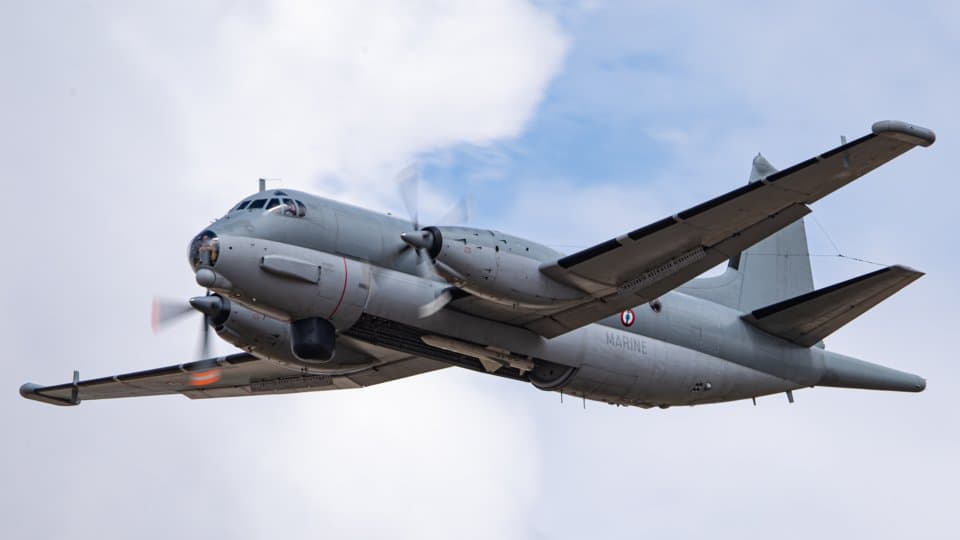

Credit
OTOMATICC · CC BY-SA 4.0 · Resized · CC BY-SA 4.0 · Source ↗ · Modified


Preparing your view.
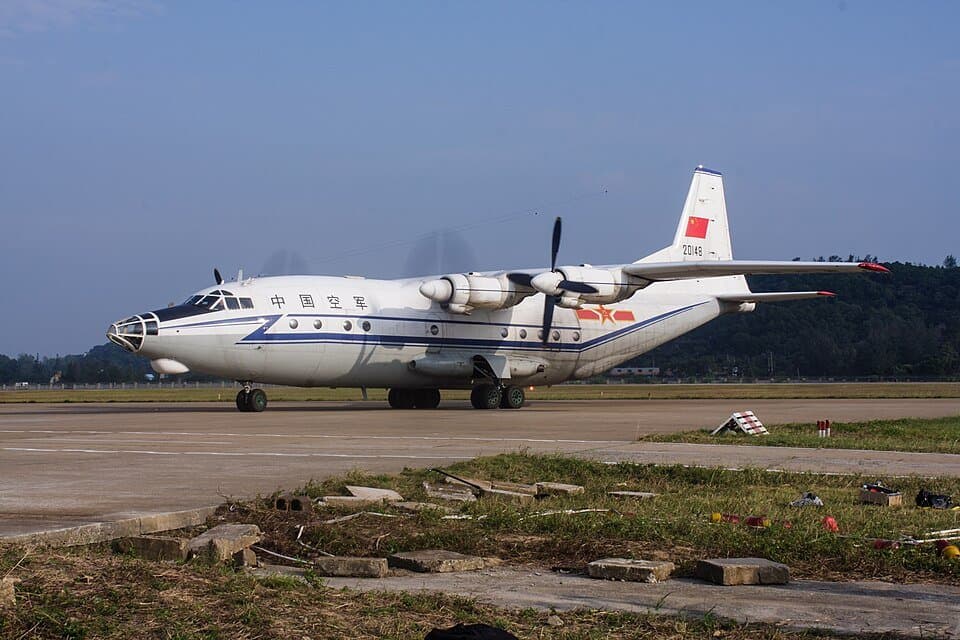

At a glance
True scale
Side by side. From every angle. A human reference for perspective.
3.18 MB · Loads when you open it| Model | Length | Width / span | Height |
|---|---|---|---|
| Bréguet 1150 Atlantic | ≈ 31.62 m | ≈ 37.42 m (Width) | ≈ 10.89 m |
| Shaanxi Y-8 | ≈ 34.02 m | ≈ 38 m (Width) | ≈ 11.16 m |
Scaled uniformly to the sourced length of 31.62 m. The shape was turned square to the axes; the height was fitted to the sourced 10.89 m; the width was fitted to the sourced 37.42 m. Not an official model or a measured survey.
ForceTally · All rights reserved
Scaled uniformly to the sourced length of 34.02 m. The shape was turned square to the axes; the height was fitted to the sourced 11.16 m; the width was fitted to the sourced 38 m. Not an official model or a measured survey.
ForceTally · All rights reserved
The human reference is a generic 1.75 m figure. Models describe external size, not combat performance.
Measured figures
Atlantique 2 · Length
Single source31.62 m (103 ft 9 in)[source]
Configuration
| Specification | Bréguet 1150 Atlantic | Shaanxi Y-8 |
|---|---|---|
| Type | Maritime patrol aircraft[source] | Military transport aircraft / Maritime patrol aircraft[source] |
| Manufacturer | Breguet Aviation[source] | Shaanxi Aircraft Corporation[source] |
| Status | Active service[source] | In service, in production[source] |
| Primary users | French Navy German Navy Italian Air Force Royal Netherlands Navy[source] |
Y-8 · Length
34.02 m (111 ft 7 in)[source]
Empty; Atlantique 2 · Empty weight
Single sourceGross; Atlantique 2 · Gross weight
Single sourceMaximum take-off; Atlantique 2 · Max takeoff weight
Single source25,700 kg (56,659 lb)[source]
45,000 kg (99,208 lb)[source]
46,200 kg (101,854 lb)[source]
Empty; Y-8 · Empty weight
Single sourceMaximum take-off; Y-8 · Max takeoff weight
Single sourceAtlantique 2 · 2 × Rolls-Royce Tyne RTy.20 Mk 21 2-spool turboprop engines (6,100 shp) each (equivalent)
Single source2 × Rolls-Royce Tyne RTy.20 Mk 21 2-spool turboprop engines, 4,500 kW (6,100 shp) each (equivalent)[source]
Y-8 · 4 × Zhuzhou WoJiang-6 (WJ-6) turboprop engines each
Single source4 × Zhuzhou WoJiang-6 (WJ-6) turboprop engines, 3,170 kW (4,250 hp) each[source]
Atlantique 2 · Endurance
Single source18 hours[source]
Bars compare reported quantities only. A larger figure does not make a system better; configurations and test conditions differ.
People's Liberation Army Air Force People's Liberation Army Navy Air Force Myanmar Air Force Pakistan Air Force[source] |
| Number built | 87 Atlantique 1 28 Atlantique 2[source] | 169 (2010)[source] |
|---|
| Manufactured | 1961–1987[source] | 1981–present[source] |
|---|
| Introduction date | 1965[source] | — |
|---|
| First flight | 21 October 1961[source] | 25 December 1974[source] |
|---|
| Capacity | 12 passengers or relief crew[source] | ≈90 equipped troops / 20,000 kg (44,092 lb) payload[source] |
|---|
| Stall speed | 167 km/h (104 mph, 90 kn) flaps down[source] | — |
|---|
| Role | long-range maritime patrol aircraft[source] | medium-size, four-engine turboprop military transport aircraft[source] |
|---|
| Source measurement | By 2012, the Atlantique 2 had been rebranded as the ATL2, at which point France had a total of 22 in service. In 2012, 18 French Atlantiques were undergoing a series of upgrades to increase the type's effectiveness in two stages, Phase I addressing obsolescence issues and Phase II adding new capabilities. Also in 2012, a separate project was conducted to integrate the MU90 Impact torpedo. Aircraft that received these upgrades shall have an extended service life as well, enabling Atlantique operations to be extended to around 2032.[source]Bréguet 1150 Atlantic · Development; only the objects and conditions stated in this passage The Breguet Br.1150 Atlantic is a twin-engined, mid-winged monoplane with a "double-bubble" fuselage; the upper lobe comprising a pressurised crew compartment, and the lower lobe housing a 9 m (27 ft 6 in) long weapons bay, with sonobuoy tubes aft of the weapons bay. A radar scanner is housed in a retractable underfuselage radome , while a magnetic anomaly detector is housed in a tail boom. It is powered by a pair of Rolls-Royce Tyne turboprop engines. An all-aluminium structure is used throughout the Atlantic's airframe; corrosion is alleged to be a considerable problem due to environmental factors imposed by the maritime environment.[source]Bréguet 1150 Atlantic · Design; only the objects and conditions stated in this passage Power for the Atlantique 2 was served through 2 x Rolls-Royce Tyne RTy.20 Mk 21 series turboprop engines (twin shaft) developing 6,100 horsepower each.[source]Bréguet 1150 Atlantic · Variants / Atlantique 2; only the objects and conditions stated in this passage maximum speed of 400 miles per hour,[source]Bréguet 1150 Atlantic · Variants / Atlantique 2; only the objects and conditions stated in this passage cruising speed of 200 miles per hour,[source]Bréguet 1150 Atlantic · Variants / Atlantique 2; only the objects and conditions stated in this passage ferry range of 5,635 miles[source]Bréguet 1150 Atlantic · Variants / Atlantique 2; only the objects and conditions stated in this passage mission endurance time of up to 18 hours[source]Bréguet 1150 Atlantic · Variants / Atlantique 2; only the objects and conditions stated in this passage operations at altitudes from 100 feet up to 30,000 feet through use of a pressurized cabin and flight deck.[source]Bréguet 1150 Atlantic · Variants / Atlantique 2; only the objects and conditions stated in this passage Rate-of-climb at 2,900 feet per minute.[source]Bréguet 1150 Atlantic · Variants / Atlantique 2; only the objects and conditions stated in this passage French Navy French Naval Aviation – The original model was retired in 1996. Second generation Atlantique 2 in service. To be replaced by Airbus A321MPA .[source]Bréguet 1150 Atlantic · Operators / Current operators; only the objects and conditions stated in this passage 15 August 1973 - A Dutch marine surveillance Breguet serial 257 suffered a problem with the elevator and ditched at 1500 hrs 1.5 km off the beach at Wassenaar, Netherlands. All 14 crew survived. The aircraft remained afloat and was salvaged, but later scrapped.[source]Bréguet 1150 Atlantic · Accidents and incidents; only the objects and conditions stated in this passage 15 January 1981 – A Dutch Marine Atlantic SP-13A was shadowing the Soviet Navy aircraft carrier Kiev in foul weather, with 30 ft waves and blizzard conditions. The Atlantic's crew transmitted a Mayday at 09:58 after suffering control problems due to a control rod failure in the horizontal stabilizer. It was not able to maintain height and was forced to ditch 113 miles west of the Inner Hebrides about half an hour later. Nine survivors were rescued by an RAF Sea King helicopter about two hours after the crash. Three crew members drowned.[source]Bréguet 1150 Atlantic · Accidents and incidents; only the objects and conditions stated in this passage March 10 1981 – Shortly after taking off from Prince Said Ibrahim International Airport in Moroni, Comoros, on a maritime patrol mission over the Mozambique Channel, a French Navy Breguet 1150 Atlantic number 29 from Lann-Bihoué (France) flotilla 23F crashes into the mountain 15 kilometers (9.4 miles) from the airport, killing all 18 people on board. One engine caught fire shortly after take off.[source]Bréguet 1150 Atlantic · Accidents and incidents; only the objects and conditions stated in this passage 18 May 1986 – While flying in cloud, a French Navy Atlantic crashed into a mountain in Djibouti , killing all 19 people on board.[source]Bréguet 1150 Atlantic · Accidents and incidents; only the objects and conditions stated in this passage Capacity: 12 passengers or relief crew[source]Bréguet 1150 Atlantic · Specifications (Atlantique 2); only the objects and conditions stated in this passage Length: 31.62 m (103 ft 9 in)[source]Bréguet 1150 Atlantic · Specifications (Atlantique 2); only the objects and conditions stated in this passage Wingspan: 37.42 m (122 ft 9 in) including wingtip pods[source]Bréguet 1150 Atlantic · Specifications (Atlantique 2); only the objects and conditions stated in this passage Height: 10.89 m (35 ft 9 in)[source]Bréguet 1150 Atlantic · Specifications (Atlantique 2); only the objects and conditions stated in this passage Wing area: 120.34 m 2 (1,295.3 sq ft)[source]Bréguet 1150 Atlantic · Specifications (Atlantique 2); only the objects and conditions stated in this passage Empty weight: 25,700 kg (56,659 lb)[source]Bréguet 1150 Atlantic · Specifications (Atlantique 2); only the objects and conditions stated in this passage Gross weight: 45,000 kg (99,208 lb)[source]Bréguet 1150 Atlantic · Specifications (Atlantique 2); only the objects and conditions stated in this passage Max takeoff weight: 46,200 kg (101,854 lb)[source]Bréguet 1150 Atlantic · Specifications (Atlantique 2); only the objects and conditions stated in this passage Powerplant: 2 × Rolls-Royce Tyne RTy.20 Mk 21 2-spool turboprop engines, 4,500 kW (6,100 shp) each (equivalent)[source]Bréguet 1150 Atlantic · Specifications (Atlantique 2); only the objects and conditions stated in this passage Maximum speed: 648 km/h (403 mph, 350 kn)[source]Bréguet 1150 Atlantic · Specifications (Atlantique 2); only the objects and conditions stated in this passage Cruise speed: 315 km/h (196 mph, 170 kn) patrol speed[source]Bréguet 1150 Atlantic · Specifications (Atlantique 2); only the objects and conditions stated in this passage Stall speed: 167 km/h (104 mph, 90 kn) flaps down[source]Bréguet 1150 Atlantic · Specifications (Atlantique 2); only the objects and conditions stated in this passage Endurance: 18 hours[source]Bréguet 1150 Atlantic · Specifications (Atlantique 2); only the objects and conditions stated in this passage Service ceiling: 9,145 m (30,000 ft)[source]Bréguet 1150 Atlantic · Specifications (Atlantique 2); only the objects and conditions stated in this passage Rate of climb: 14.7 m/s (2,900 ft/min)[source]Bréguet 1150 Atlantic · Specifications (Atlantique 2); only the objects and conditions stated in this passage Up to 3,500 kg (7,700 lb), including torpedoes , depth charges , mines , anti-ship missiles , bombs and/or buoys[source]Bréguet 1150 Atlantic · Specifications (Atlantique 2); only the objects and conditions stated in this passage | The Shaanxi Y-8 or Yunshuji Y-8 ( Chinese : 运-8 ; pinyin : Yùn Bā ) aircraft is a medium-size, four-engine turboprop military transport aircraft produced by Shaanxi Aircraft Corporation in China , based on the Soviet Antonov An-12 . It has become one of China's most popular military and civilian transport/cargo aircraft, with many variants produced and exported. Although the Soviet Union ended production of the An-12 in 1973, the Chinese Y-8 continues to be upgraded and produced. An estimated 169 Y-8 aircraft had been built by 2010.[source]Shaanxi Y-8 · Lead; only the objects and conditions stated in this passage Design of the aircraft was completed by February 1972. Major features of the Y-8 included a glazed nose and tail turret derived from that of the H-6 bomber, a roller-type palletized-cargo-handling device instead of the overhead conveyor, and a gaseous oxygen system as opposed to a liquid oxygen system. The original Y-8 inherited the An-12's twin 23 mm cannon tail turret, but this was removed on subsequent variants.[source]Shaanxi Y-8 · Design and development / Domestic; only the objects and conditions stated in this passage The Y-8 is capable of carrying troops, dropping supplies, parachute drops, and functioning as an air ambulance. It also can be used for commercial purposes as a freighter. It is capable of hauling 20 tons of cargo, approximately 96 soldiers, or about 82 paratroopers in the cargo compartment which is 13.5 metres long, 3 metres wide and 2.4 metres high. It can also carry 60 severely wounded soldiers with their stretchers, 20 slightly injured soldiers and 3 medical attendants. Many variants for specialized roles have been built, but information on them can be vague or difficult to obtain due to the secretive nature of the Chinese military.[source]Shaanxi Y-8 · Design and development / Domestic; only the objects and conditions stated in this passage In 1986, two engineers from Beijing's Ministry of Aviation visited Lockheed. They could not speak very much English, and the Lockheed-Georgia sales person who met them could not speak Chinese. So for half a day, they did a point-and-grunt tour until they found a Lockheed employee who could speak Chinese. The Chinese wanted to purchase Lockheed wind tunnel testing on the Y-8 in order to address the stall problem. |
|---|
| Country of origin | France[source] | — |
|---|
| National origin | — | China[source] |
|---|
| Developed from | — | Antonov An-12[source] |
|---|
| Variant | — | Shaanxi KJ-200[source] |
|---|
| Developed into | — | Shaanxi Y-9[source] |
|---|
| Airfoil | — | root: C-5-18; tip: C-3-14[source] |
|---|
| Propellers | — | 4-bladed constant-speed propellers[source] |
|---|
| Guns | — | 2× 23 mm (0.906 in) cannon in tail turret (early models only)[source] |
|---|
| Origin reported by inventory | — | China / Pakistan[source]Inventory Origin column; table 1, row 52, cell 4; revision 1377423821; retrieved 2026-10-02 |
|---|
As a result of these wind tunnel tests, conducted in 1986, Lockheed was given a contract to do a flight test series on the Y-8. Lockheed was told that flight test data was not provided by the Soviets when they helped China build the Y-8 factory. The flight test series was flown by Lockheed test pilot Hank Dees. Hank had flown the test flight series for the Lockheed L-1011 and later for China's Y-12 in Harbin.[source]Shaanxi Y-8 · Design and development / Modification; only the objects and conditions stated in this passage
Y-8F-200 : This model has a 2.2m (7 ft 10in) stretched fuselage. Capacity: 23 tons.[source]Shaanxi Y-8 · Variants; only the objects and conditions stated in this passage
Y-8F-300 : Civil transport with western avionics. Capacity: 23 tons.[source]Shaanxi Y-8 · Variants; only the objects and conditions stated in this passage
Y-8F-400 : As for Y-8F-300 but with pressurised cargo hold. Capacity: 23 tons.[source]Shaanxi Y-8 · Variants; only the objects and conditions stated in this passage
Y-8F-600 : Newest civilian transport variant with a redesigned fuselage, Pratt and Whitney turboprop engines, an Electronic Flight Instrument System "glass cockpit", and a two-person crew. Capacity: 25 tons. Cancelled in 2008 and developed into the Y-9 .[source]Shaanxi Y-8 · Variants; only the objects and conditions stated in this passage
Y-8G : IFR tanker. (project). Also identified as the Y-8GX3.[source]Shaanxi Y-8 · Variants; only the objects and conditions stated in this passage
Y-8H : Aerial survey aircraft.[source]Shaanxi Y-8 · Variants; only the objects and conditions stated in this passage
Capacity: ≈90 equipped troops / 20,000 kg (44,092 lb) payload[source]Shaanxi Y-8 · Specifications (Y-8); only the objects and conditions stated in this passage
Length: 34.02 m (111 ft 7 in)[source]Shaanxi Y-8 · Specifications (Y-8); only the objects and conditions stated in this passage
Wingspan: 38 m (124 ft 8 in)[source]Shaanxi Y-8 · Specifications (Y-8); only the objects and conditions stated in this passage
Height: 11.16 m (36 ft 7 in)[source]Shaanxi Y-8 · Specifications (Y-8); only the objects and conditions stated in this passage
Wing area: 121.9 m 2 (1,312 sq ft)[source]Shaanxi Y-8 · Specifications (Y-8); only the objects and conditions stated in this passage
Empty weight: 35,490 kg (78,242 lb)[source]Shaanxi Y-8 · Specifications (Y-8); only the objects and conditions stated in this passage
Max takeoff weight: 61,000 kg (134,482 lb)[source]Shaanxi Y-8 · Specifications (Y-8); only the objects and conditions stated in this passage
Powerplant: 4 × Zhuzhou WoJiang-6 (WJ-6) turboprop engines, 3,170 kW (4,250 hp) each[source]Shaanxi Y-8 · Specifications (Y-8); only the objects and conditions stated in this passage
Maximum speed: 660 km/h (410 mph, 360 kn)[source]Shaanxi Y-8 · Specifications (Y-8); only the objects and conditions stated in this passage
Cruise speed: 550 km/h (340 mph, 300 kn)[source]Shaanxi Y-8 · Specifications (Y-8); only the objects and conditions stated in this passage
Range: 5,615 km (3,489 mi, 3,032 nmi)[source]Shaanxi Y-8 · Specifications (Y-8); only the objects and conditions stated in this passage
Service ceiling: 10,400 m (34,100 ft)[source]Shaanxi Y-8 · Specifications (Y-8); only the objects and conditions stated in this passage
Rate of climb: 10 m/s (2,000 ft/min)[source]Shaanxi Y-8 · Specifications (Y-8); only the objects and conditions stated in this passage
Guns: 2× 23 mm (0.906 in) cannon in tail turret (early models only)[source]Shaanxi Y-8 · Specifications (Y-8); only the objects and conditions stated in this passage