FORCETALLY
Loading the evidence…
Preparing your view.


Preparing your view.

At a glance
Brazilian research ship Ary Rongellarger figure on 0 of 2
Measured figures
Length
Single source75.3 m (247 ft 1 in)[source]
Approx Gepard 3.9 batch II
Single sourceConfiguration
| Specification | Brazilian research ship Ary Rongel | Gepard-class frigate |
|---|---|---|
| Name | Polar Queen[source] | Gepard class (Project 1166.1)[source] |
| Builder | Georg Eide's Sønner[source] | — |
| Laid down | 27 September 1980[source] | — |
| Launched | 22 January 1981[source] | — |
| Completed | March 1981[source] | 6 |
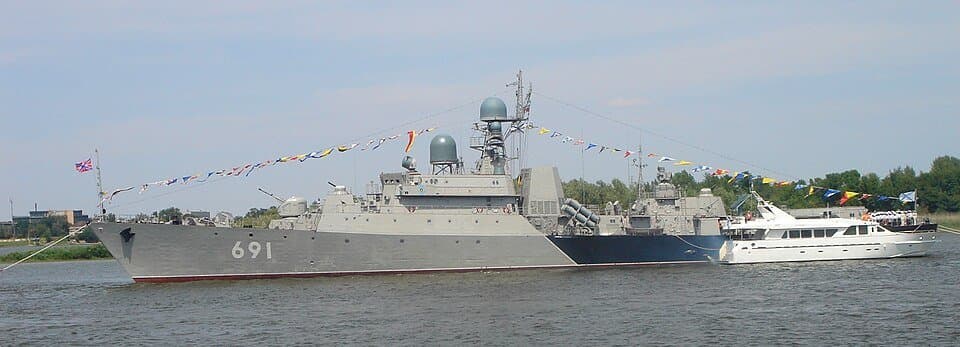
Gepard-class frigatelarger figure on 2 of 2
Counts only measures both sources give with the same scope. A larger figure is not a better system.
Approx 102.4 m (336 ft) (Gepard 3.9 batch II)[source]
2 × MaK 6M-453 diesel engines
Single source2 × MaK 6M-453 diesel engines 4,500 hp (3,356 kW)[source]
Bars compare reported quantities only. A larger figure does not make a system better; configurations and test conditions differ.
| Identification | IMO number : 7922142 MMSI number : 710400000 Callsign : PWAR[source] | — |
|---|
| Fate | Acquired by Brazilian Navy , 1994[source] | — |
|---|
| Namesake | Admiral Ary dos Santos Rongel[source] | — |
|---|
| Acquired | 19 April 1994[source] | — |
|---|
| Commissioned | 25 April 1994[source] | — |
|---|
| Home port | Rio de Janeiro[source] | — |
|---|
| Status | in active service[source] | — |
|---|
| Type | Research ship[source] | Frigate[source] |
|---|
| Ice class | Ice-strengthened[source] | — |
|---|
| Propulsion | 1 × controllable pitch propeller 1 × stern thruster 2 × bow thrusters[source] | Twin-shaft CODOG , FPP, 2 × 14,300 + 1 × 6,000 (kW)[source] |
|---|
| Capacity | 2,400 m 3 (85,000 cu ft)[source] | — |
|---|
| Aircraft carried | 2 × Helibrás Esquilo (locally designated as UH-12/13)[source] | — |
|---|
| Aviation facilities | Helipad and hangar[source] | — |
|---|
| Source measurement | As built, the ship was an ice-strengthened research vessel . The vessel measured 1,496 gross register tons (GRT) and 1,050 tons deadweight (DWT), was 65.1 metres (213 ft 7 in) long overall and 56.0 metres (183 ft 9 in) between perpendiculars with a beam of 13.1 metres (43 ft 0 in). In 1986, the ship was lengthened to 75.3 metres (247 ft 1 in) long overall and 67.4 metres (221 ft 2 in) between perpendiculars. The vessel was remeasured as 1,982 gross tonnage (GT) and 1,100 deadweight.[source]Brazilian research ship Ary Rongel · Description; only the objects and conditions stated in this passage The ship is powered by two MaK 6M-453 diesel engines driving one shaft turning a controllable pitch propeller , one stern thruster and two bow thrusters rated at 4,500 horsepower (3,356 kW). The ship is capable of 14.5 knots (26.9 km/h; 16.7 mph) and has a cruising range of 17,000 nautical miles (31,000 km; 20,000 mi) at 12 knots (22 km/h; 14 mph).[source]Brazilian research ship Ary Rongel · Description; only the objects and conditions stated in this passage In Brazilian naval service, the research ship has a standard displacement of 1,928 long tons (1,959 t) and 3,628 long tons (3,686 t) at full load. The ship is equipped with a helipad and is capable of operating up to two UH-13 Helibrás Esquilo helicopters. The vessel's cargo capacity in naval service is 2,400 m 3 (85,000 cu ft) and the ship has a complement of 70 including 19 officers and space for 22 scientists.[source]Brazilian research ship Ary Rongel · Description; only the objects and conditions stated in this passage | — |
|---|
| Builders | — | Zelenodolsk Plant Gorky[source] |
|---|
| Operators | — | Russian Navy Vietnam People's Navy[source] |
|---|
| Preceded by | — | Koni class Grisha class[source] |
|---|
| Subclasses | — | Project 11661 Tatarstan Project 11661K Dagestan Project 11661E Gepard: Gepard 3.9: Batch I; Batch II Gepard 5.1 Gepard 5.3[source] |
|---|
| Cost | — | 11661E (Gepard 3.9 batch I): US$175 million per ship 11661E (Gepard 3.9 batch II): US$350 million per ship (price included ammunition, maintenance packages signed between Vietnam and Russia )[source] |
|---|
| Built | — | 1991–2016[source] |
|---|
| Planned | — | 10[source] |
|---|
| Cancelled | — |
|---|
| Active | — |
|---|
| Endurance | — | 20 days[source] |
|---|
| Sensors & processing systems | — | MR-231-1 Pal navigation radar Mineral-ME shipborne multifunctional radar system (including guidance and target designation functions for cruise missiles ) 5P-26/MR-352 Pozitiv-ME1/-ME1.2 3D active shipborne radars 5P-10E-03E Laska fire control radar for naval gun and CIWS Sonar : MGK-335EM-03 with under-keel antenna[source] |
|---|
| Electronic warfare & decoys | — | EW Suite : 2 × Bell Shroud passive intercept, 2 × Bell Squat jammers, Countermeasures : 4 × 16-barreled Pk-16 decoy launchers[source] |
|---|
| Armament | — | Artillery: 1 × 76.2mm AK-176M/MA naval gun 2 × AK-630M CIWS ( Tatarstan and VPN configuration) Cruise missiles : 8 × UKSK VLS cells for Kalibr missiles ( Dagestan ) (up to 16x cells in configurations offered to the export market; options for Club-N , Yakhont and BrahMos missile systems are available) 2 × quadruple launchers (2×4) Kh-35 anti-ship missiles ( Tatarstan and VPN 's Batch I & II configuration) Anti-submarine warfare : 2 × 533mm DTA-53 twin-tube (2×2) torpedo launchers (not featured on VPN 's Batch I) Naval mines Anti-air warfare : 1 × Palash/Palma-SU CIWS featured with 8x Sosna-R short range air defense missiles ( Dagestan and VPN configuration) 1 × Osa-M twin-launcher for 20x 9M33M short range air defense missiles ( Tatarstan ) 12 × Shtil-1 VLS cells for 9M317ME medium-range surface-to-air missiles (offered configuration for the export market)[source] |
|---|
| Notes | — | [1][source] |
|---|
| National origin | — | Russia[source] |
|---|