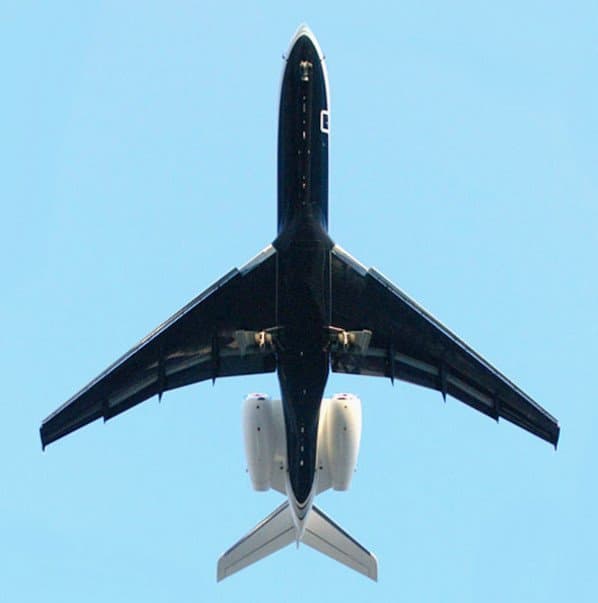

Credit
P. Alejandro Diaz · CC BY-SA 2.5 · Resized · CC BY-SA 2.5 · Source ↗ · Modified


Preparing your view.

At a glance
Measured figures
Length
Single source96 ft 10 in (29.51 m)[source]
Wilga 35A · Length
Single sourceConfiguration
| Specification | Bombardier Global Express | PZL-104 Wilga |
|---|---|---|
| Thrust | 14,750 lbf (65.6 kN)[source] | — |
| Type | Business jet[source] | Utility aircraft[source] |
| National origin | Canada[source] | Poland[source] |
| Manufacturer | Bombardier Aviation[source] | PZL Warszawa-Okęcie[source] |
8.10 m (26 ft 6 in)[source]
Wilga 35A · 1 × Ivchenko AI-14 RA air-cooled 9-cylinder radial piston engine
Single source1 × Ivchenko AI-14 RA air-cooled 9-cylinder radial piston engine , 194 kW (260 hp)[source]
Maximum payload
Single source7,139 lb (3,238 kg)[source]
Wilga 35A · Wing area
Single source15.50 m 2 (166.85 sq ft)[source]
Wilga 35A · 1,082 ft/min
Single source5.5 m/s (1,082 ft/min)[source]
Bars compare reported quantities only. A larger figure does not make a system better; configurations and test conditions differ.
| Status | In service[source] | Production Ended[source] |
|---|
| Number built | 816 (Oct 2018)[source] | 1,000+[source] |
|---|
| Manufactured | 1998–present[source] | 1962-2006[source] |
|---|
| Introduction date | July 1999[source] | — |
|---|
| First flight | 13 October 1996[source] | 24 April 1962[source] |
|---|
| Developed from | Challenger 600 & CRJ-100/-200[source] | — |
|---|
| Variants | Saab GlobalEye Raytheon Sentinel[source] | — |
|---|
| Developed into | Global 7500/8000[source] | — |
|---|
| Passengers | 16[source] | — |
|---|
| Wing geometry | 94 ft (29 m) span, 1,021 ft 2 (94.9 m 2 ) area, 8.7 AR[source] | — |
|---|
| Operating empty weight | 50,861 lb (23,070 kg)[source] | — |
|---|
| Powerplant | BR700-710A2-20[source] | — |
|---|
| Role | large cabin, long-range business jet[source] | Polish short-takeoff-and-landing (STOL) civil aviation utility aircraft[source] |
|---|
| Source measurement | After acquiring Canadair along with its Challenger 600 business jet in 1986, Bombardier studied a longer range business aircraft in which it aimed to carry eight passengers and four crew over 12,000 km (6,500 nmi) at Mach 0.85. To meet this goal, a joint-definition team was established at the company's Montreal facility in the early 1990s. By 1994, the team comprised 200 engineers, evenly divided between Canadair and various partners, including Japanese company Mitsubishi Heavy Industries and Anglo-German engine manufacturer BMW Rolls-Royce .[source]Bombardier Global Express · Development / Project definition; only the objects and conditions stated in this passage By June 1995, the backlog was over 40 aircraft, sold out until 2000, leading to Bombardier to expand its early production plans. At launch, range was extended to 12,000 km (6,500 nmi; 7,500 mi) to outdo rival Gulfstream . Bombardier guaranteed the empty weight and range to reply to Gulfstream criticism. Around 100 sales were needed to cover the development costs. In October 1995, the first prototype manufacture began. The first sections were expected in December at de Havilland's in Toronto , with final assembly to start in March 1996. By June 1996, the prototype was complete and conducting flight-readiness reviews ahead of its roll-out and first flight.[source]Bombardier Global Express · Development / Launch and flight testing; only the objects and conditions stated in this passage On 13 October 1996, the first prototype performed its maiden flight from Toronto, one month later than planned, lasting for 2 hours 46 minutes and attaining 11,000 ft (3,400 m) and 210 kn (240 mph; 390 km/h). The flight test programme used four prototypes, accumulating 2,200 flight hours. The Bombardier Flight Test Center in Wichita, Kansas was extended by 9,100 m 2 (98,000 ft 2 ) for the test programme. In February 1997, the second prototype made its first flight and the third in May 1997.[source]Bombardier Global Express · Development / Launch and flight testing; only the objects and conditions stated in this passage The Global Express is a high speed business/corporate aircraft with a range of 6,500 nmi (7,500 mi; 12,000 km) at Mach 0.80 (528 mph; 459 kn; 850 km/h), a 51,000 ft (16,000 m) service ceiling and a 14-hour endurance. The semi monocoque airframe is made of lightweight aluminum alloys and composite materials. It has a low wing , tricycle landing gear and fuselage-mounted engines .[source]Bombardier Global Express · Design; only the objects and conditions stated in this passage The clean-sheet design draws upon the earlier Canadair CL-600 and Bombardier CRJ . It shares its fuselage cross-section with these aircraft, paired with a new T-tail and wing. The latter is a supercritical airfoil with a 35° wing sweep and winglets . This flexible wing naturally attenuates turbulence . It was initially powered by two BMW- Rolls-Royce BR710 turbofans controlled by FADEC . The flightdeck features a six screen Honeywell Primus 2000XP EFIS suite.[source]Bombardier Global Express · Design; only the objects and conditions stated in this passage The Global Express was the business jet with the largest cabin, until being surpassed by the later Gulfstream G650 . It can accommodate 12 to 16 passengers in three cabin sections: mostly a forward four-chair club section, a central four-seat conference grouping and an aft three-place divan facing two chairs. Most have a forward galley , crew rest chair and crew lavatory. The 10.3-psi cabin pressurization maintains a 4,500-ft. cabin altitude up to FL 450 and 5,680 ft. at the FL 510 ceiling. The cabin has an unobstructed length of 14.6 m (48 ft) while the floor is dropped by 51 mm (2.0 in) from the Challenger to increase width at shoulder level, while the windows have been repositioned and enlarged by 25%.[source]Bombardier Global Express · Design; only the objects and conditions stated in this passage The Global 5000 was announced in October 2001. It was launched in February 2002, with letters of intent for 15 aircraft with a 87,700 lb (39,800 kg) MTOW , and a 4,800 nmi (5,500 mi; 8,900 km) range at Mach 0.85. The first aircraft flew on 7 March 2003. It was introduced in April 2005. There were 224 in service in 2018. In April 2008, Bombardier lifted its MTOW to 92,500 lb (42,000 kg) to increase its Mach 0.85 range to 5,200 nmi (6,000 mi; 9,600 km).[source]Bombardier Global Express · Variants / Global 5000; only the objects and conditions stated in this passage Its cabin is 5.9 ft (1.8 m) shorter than the Global 6000 with a 5,800–7,000 lb (2,600–3,200 kg) lower MTOW depending on service bulletins . It has a 5,000–5,400 nmi (5,800–6,200 mi; 9,300–10,000 km) range at LRC . The spec basic operating weight is 50,350 lb (22,840 kg) but are actually closer to 51,600 lb (23,400 kg). Early models kept the Honeywell Primus 2000XP avionics, updated with the Bombardier Vision flight deck based on the Rockwell Collins Pro Line Fusion avionics since 2012.[source]Bombardier Global Express · Variants / Global 5000; only the objects and conditions stated in this passage It can carry between 8 and 19 passengers. The new seat converts to a full berth. There is an optional private room aft and the galley has room to prepare 16 five-course meals. It was priced at $40M in 2008. It has forward and aft lavatories. The crew rest area was removed, but could be restored. The tail fuel tank was removed and fuel is limited in the wings. Some avionics are rearranged to gain usable cabin length. The interior completions allowance is 3,200 kg.[source]Bombardier Global Express · Variants / Global 5000; only the objects and conditions stated in this passage In 2018, its unit cost was US$50.44 million. At high-speed cruise, it burns 5,000 lb (2,300 kg) of fuel in the first hour, then 4,000 lb (1,800 kg) the second hour and 3,000 lb (1,400 kg) for the third hour. In 2018, Early models with Honeywell avionics were sold for $10–20 million, while post-2012 aircraft with the modern Cockpit can fetch $22–36 million. A major inspection every 180 months cost $800,000-1.2 million. Two 8,000h engine overhauls can cost $4 million. The cheaper and more efficient Gulfstream G450 or Falcon 900 LX are slower, have less range and smaller cabins.[source]Bombardier Global Express · Variants / Global 5000; only the objects and conditions stated in this passage The improved Global Express XRS was announced on 6 October 2003 during the NBAA Convention at Orlando, Florida. It replaced the original Global Express and provides greater range at high speed, cabin upgrades, improved takeoff performance, fast fueling capability and the Bombardier Enhanced Vision System (BEVS) as standard equipment. A new forward fuel tank in the wing/body fairing increases the usable fuel capacity by up to 1,486 lbs, allowing it to fly 6,500 nm at Mach 0.82, 6,150 nm at Mach 0.85 or 5,450 nm at Mach 0.87. It provides improved pressurization with a 4,500 ft cabin altitude at 45,000 ft and a 5,700 ft cabin altitude at 51,000 ft; a 25% improvement on the previous Global cabin.[source]Bombardier Global Express · Variants / Global Express XRS; only the objects and conditions stated in this passage On long trips, its fuel burn is 5,000 lb (2.3 t) in the first hour, 4,000 lb (1.8 t) in the second hour, 3,000 lb (1.4 t) in the third hour and 2,500 lb (1.1 t) for every subsequent hour. A Checks are scheduled every 750 hours, and for C Checks every 30 months. Engine reserves amount to $260 per hour. Over 315 were delivered by March 2019. Its competitors include the 6,200 nmi (7,100 mi; 11,500 km) Dassault Falcon 8X , the 6,500 nmi (7,500 mi; 12,000 km) Gulfstream G600 or even the 6,900 nmi (7,900 mi; 12,800 km) G650 .[source]Bombardier Global Express · Variants / Global 6000; only the objects and conditions stated in this passage In May 2018, Bombardier unveiled the Global 5500 and 6500. It was expected to enter service at the end of 2019. It has an optimized wing for a Mach 0.90 top speed, a revamped cabin inspired by the Global 7500 with its Nuage seat and updated Rolls-Royce BR710 Pearl engines with up to 13% lower fuel burn for better operating costs. It has better hot and high performance and 500 and 600 nmi (580 and 690 mi; 930 and 1,110 km) of additional range for 5,700 and 6,600 nmi (6,600 and 7,600 mi; 10,600 and 12,200 km), respectively. The engines have 9% more thrust.[source]Bombardier Global Express · Variants / Global 5500/6500; only the objects and conditions stated in this passage By October 2018, 70% of the flight testing hours were completed. The programme involved two flight-test Global 6500s, as the 5500 is a simple 0.8 m (2 ft 7 in) shrink. The redesigned wings are built by Mitsubishi Heavy Industries . By December, the flight-test program was nearly three-quarters complete. By May 2019, 90% of the flight testing was completed by two modified 6000s and one modified 5000.[source]Bombardier Global Express · Variants / Global 5500/6500; only the objects and conditions stated in this passage In September 2019, Bombardier announced the Transport Canada Type Certification of both models, before entry-into-service later in 2019 and FAA / EASA approval. Bombardier announced the Global 6500 entry-into-service on 1 October. EASA Type Certification of both models was announced in October 2019. Shortly after, the Global 5500 range was extended by 200 nmi (230 mi; 370 km) to 5,900 nmi (6,800 mi; 10,900 km) at Mach 0.85.[source]Bombardier Global Express · Variants / Global 5500/6500; only the objects and conditions stated in this passage FAA Type Certification of both variants was announced in December 2019. Bombardier announced the entry-into-service of the Global 5500 in June 2020. The first Global 5500 was delivered in July 2020, to " longtime Bombardier customer Unicorp National Developments, headquartered in Orlando, Florida."[source]Bombardier Global Express · Variants / Global 5500/6500; only the objects and conditions stated in this passage Most operators fly 450 to 600 hours per year. Fleet operators frequently fly more than 100 hours per month. By February 2015, over 600 aircraft accumulated more than 1.5 million flight hours and 570,000 cycles. In May 2018, 20 years after the type's introduction, more than 750 Globals were in service.[source]Bombardier Global Express · Operators; only the objects and conditions stated in this passage A dozen 6000s are registered in the Isle of Man for anonymity, a few are registered in the Cayman Islands . Four are registered in Austria, three in Switzerland, two in France and Denmark, and one each in Finland, Germany, Ireland and Turkey. Three are registered in China, one in Malaysia and one in Hong Kong. Two are based in São Paulo, two are in South Africa and one is in India.[source]Bombardier Global Express · Operators; only the objects and conditions stated in this passage US Air Force 7 Global 6000 in service + 4 on order, known as E-11A, used as command and control / battlefield airborne communication node[source]Bombardier Global Express · Operators / Military / Military mission; only the objects and conditions stated in this passage | The PZL-104 was designed for robust use in sports and civil aviation, with a strong emphasis on glider -towing and parachute training. On 24 April 1962, the prototype of the initial Wilga Mark 1 variant made the type's first flight, powered by an existing Polish 220 hp (160 kW) horizontally-opposed engine , the PZL WN-6RB. The subsequent flight test programme with the prototype exposed a number of design faults, the most serious of which was the airframe's excessive weight and a rear view restriction that prevented the crew from easily seeing a towed glider. Accordingly, an airframe review was performed by the design team that resulted in the thorough redevelopment of the aircraft, led by Polish aeronautical engineers Bronisław Żurakowski and Andrzej Frydrychewicz .[source]PZL-104 Wilga · Development / Origins; only the objects and conditions stated in this passage On 1 August 1963, the revised aircraft, which was designated as the PZL-104 Wilga Mark 2 , conducted its first flight. While testing validated the qualities of the Wilga 2's airframe and had proved the aircraft to be a successful design, the WN-6RB engine that powered the model was not fully developed and thus, the aircraft did not enter serial production. In response, the decision was taken to convert the assembly line to instead manufacture the improved Wilga C and Wilga Mark 3 configurations instead. On 30 December 1963, the Wilga C (or Wilga Mark 2 Subvariant C ) made its first flight; this variant which was a dedicated export model of the type for Indonesia powered by the imported North American -certified 225 hp (168 kW) horizontally opposed Continental O-470 engine.[source]PZL-104 Wilga · Development / Origins; only the objects and conditions stated in this passage To address the immaturity of the original WN-6RB engine, the design team decided to adopt an in-production radial engine , the 260 hp (190 kW) Ivchenko AI-14 R; furnished with this engine, the aircraft became the PZL-104 Wilga Mark 3 variant, which first flew on 31 December 1965. The new engine was more powerful but it spoilt the previously clean and aerodynamic fuselage lines, originally designed for a flat engine; nonetheless, the new variant was successful. Due in combination to the power of the AI-14R engine and the STOL capability of the airframe, an extraordinary high rate of climb of 11 m/s (2,165 fpm) (maximum) under minimal load was possible. One of a few remaining flaws was that the engine was relatively uneconomical to operate. |
|---|
| Origin reported by inventory | Canada Turkey[source]Inventory Origin column; table 1, row 15, cell 2; revision 1372398204; retrieved 2026-10-02 | — |
|---|
| Primary user | — | Polish military and civilian aviation[source] |
|---|
| Capacity | — |
|---|
| Country of origin | — | Poland[source]Inventory Origin column; table 1, row 41, cell 2; revision 1360230767; retrieved 2026-10-02 |
|---|
The Wilga 32 was an improved small-series export variant of the type, powered by a Continental flat engine, which was also locally produced in Indonesia as the "Gelatik". After completing an initial batch of 13 Wilga 3s, there were some improvements made to the model, most notably the landing gear base being increased from 2.12 to 2.83 m (7.0 to 9.3 ft) to improve stability during takeoff runs. On 29 June 1967, an improved model, designated as the PZL-104 Wilga 35 , made its first flight, it subsequently entered mass production as well. The most numerous variant of Wilga 35 was the utility plane Wilga 35A, while most others were built in small numbers or remained as prototypes alone.[source]PZL-104 Wilga · Development / Further development; only the objects and conditions stated in this passage
In 1996, it was announced that PZL had developed an improved version of the aircraft, known as the PZL-104MA Wilga 2000 . The Wilga 2000 family benefitted from various improvements, it adopted an American Lycoming O-540 engine, capable of generating a maximum of 225 kW (300 hp), along with an AlliedSignal - Bendix avionics suite and a new wing, the latter of which offered increased fuel capacity and endurance, as well with aerodynamic refinements, such as fairings around the undercarriage. In May 2004, Canadian-based company Sealand Aviation demonstrated an amphibious version of the Wilga 2000 in Anchorage .[source]PZL-104 Wilga · Development / Further development; only the objects and conditions stated in this passage
Early aircraft were typically powered by the Soviet-designed Ivchenko AI-14 R radial engine , which was capable of generating up to 260 hp (190 kW); notably, the engine rotates in the opposite direction to North American standards. The Al-14R would normally drive a two-bladed composite wooden propeller, which was strengthened with bonded metal sections fitted along their leading edges . The newest models of the Wilga have been furnished with fully metal propellers and are powered by the North American Continental O-470 engine, which rotate in the opposite direction to the earlier Soviet engine. Other engines from other manufacturers have also been adapted to power the type. Regardless of the engine fitted, fuel is primarily housed within a pair of 195 L (43 imp gal; 52 US gal) fuel tanks, which were located within the aircraft's wings.[source]PZL-104 Wilga · Design; only the objects and conditions stated in this passage
Wilga 3 with Continental O-470 engine for Indonesia. 6 aircraft built in Poland, 18 in Indonesia under the name Gelatik . Some were fitted as agricultural aircraft .[source]PZL-104 Wilga · Variants; only the objects and conditions stated in this passage
Wilga 35H[source]PZL-104 Wilga · Variants; only the objects and conditions stated in this passage
Wilga 80/1400 (80H)[source]PZL-104 Wilga · Variants; only the objects and conditions stated in this passage
Export floatplane variant of 1982 built in cooperation with Canada, powered by PZL AI-14RD (206 kW /280 HP) engine.[source]PZL-104 Wilga · Variants; only the objects and conditions stated in this passage
PZL-104M Wilga 2000[source]PZL-104 Wilga · Variants; only the objects and conditions stated in this passage
PZL-104MW Wilga 2000 Hydro[source]PZL-104 Wilga · Variants; only the objects and conditions stated in this passage
Last variant of Wilga 2000 made in 2005, with improved aerodynamics and winglets , powered by Lycoming I0-540 300 hp engine. No longer in production.[source]PZL-104 Wilga · Variants; only the objects and conditions stated in this passage
Polish Border Guard operates some (5 in 2005) PZL-104MF Wilgas 2000 as patrol aircraft.[source]PZL-104 Wilga · Operators / Military operators; only the objects and conditions stated in this passage
On 12 Jan 1996, a PZL-104 (VH-PZS) crashed on North Stradbroke Island near Brisbane . The pilot and his three passengers were killed.[source]PZL-104 Wilga · Accidents and incidents; only the objects and conditions stated in this passage
On 16 September 2019, a PZL-104 2000 (N123T, popularly known as Draco ) was attempting to takeoff from Reno Stead Airport in a crosswind with 38 knot gusts with a subsequent ground loop and crashed beside the runway. The three occupants got out uninjured.[source]PZL-104 Wilga · Accidents and incidents; only the objects and conditions stated in this passage
Length: 8.10 m (26 ft 6 in)[source]PZL-104 Wilga · Specifications (Wilga 35A); only the objects and conditions stated in this passage
Wingspan: 11.12 m (36 ft 5 in)[source]PZL-104 Wilga · Specifications (Wilga 35A); only the objects and conditions stated in this passage
Height: 2.96 m (9 ft 6 in)[source]PZL-104 Wilga · Specifications (Wilga 35A); only the objects and conditions stated in this passage
Wing area: 15.50 m 2 (166.85 sq ft)[source]PZL-104 Wilga · Specifications (Wilga 35A); only the objects and conditions stated in this passage
Empty weight: 900 kg (1,984 lb)[source]PZL-104 Wilga · Specifications (Wilga 35A); only the objects and conditions stated in this passage
Gross weight: 1,300 kg (2,868 lb)[source]PZL-104 Wilga · Specifications (Wilga 35A); only the objects and conditions stated in this passage
Powerplant: 1 × Ivchenko AI-14 RA air-cooled 9-cylinder radial piston engine , 194 kW (260 hp)[source]PZL-104 Wilga · Specifications (Wilga 35A); only the objects and conditions stated in this passage
Maximum speed: 195 km/h (121 mph, 105 kn)[source]PZL-104 Wilga · Specifications (Wilga 35A); only the objects and conditions stated in this passage
Range: 670 km (416 mi, 361 nmi)[source]PZL-104 Wilga · Specifications (Wilga 35A); only the objects and conditions stated in this passage
Service ceiling: 4,040 m (13,250 ft)[source]PZL-104 Wilga · Specifications (Wilga 35A); only the objects and conditions stated in this passage
Rate of climb: 5.5 m/s (1,082 ft/min)[source]PZL-104 Wilga · Specifications (Wilga 35A); only the objects and conditions stated in this passage