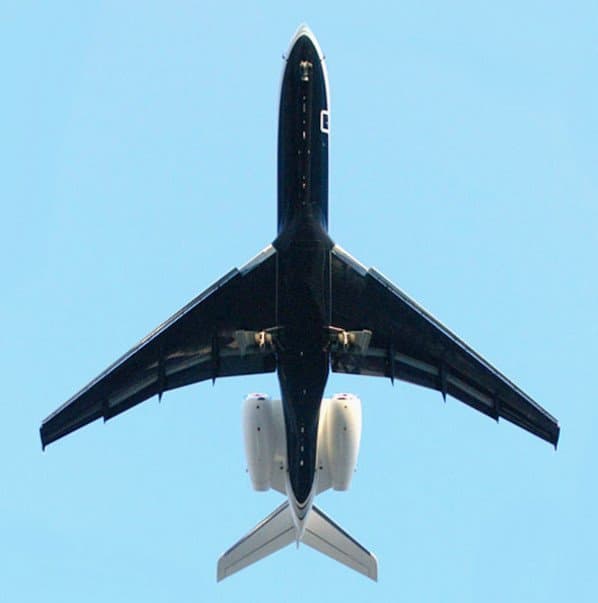

Credit
P. Alejandro Diaz · CC BY-SA 2.5 · Resized · CC BY-SA 2.5 · Source ↗ · Modified


Preparing your view.
At a glance
Bombardier Global Expresslarger figure on 2 of 2
Measured figures
Length
Single source96 ft 10 in (29.51 m)[source]
Length
Single sourceConfiguration
| Specification | Bombardier Global Express | GAF Nomad |
|---|---|---|
| Crew | Two[source] | — |
| Thrust | 14,750 lbf (65.6 kN)[source] | — |
| Type | Business jet[source] | Light utility aircraft[source] |
| National origin | Canada[source] | — |
| Manufacturer | Bombardier Aviation[source] | Government Aircraft Factories |
GAF Nomadlarger figure on 0 of 2
Counts only measures both sources give with the same scope. A larger figure is not a better system.
41 ft 3 in / 12.57 m[source]
Maximum payload
Single source7,139 lb (3,238 kg)[source]
9:1 AR , modified NACA 23018 airfoil
Single source324 sq.ft / 30.1 m 2 , 9:1 AR , modified NACA 23018 airfoil[source]
Bars compare reported quantities only. A larger figure does not make a system better; configurations and test conditions differ.
| Status | In service[source] | In limited service[source] |
|---|
| Number built | 816 (Oct 2018)[source] | 172[source] |
|---|
| Manufactured | 1998–present[source] | 1975–1985[source] |
|---|
| Introduction date | July 1999[source] | — |
|---|
| First flight | 13 October 1996[source] | 23 July 1971 (N-22) 5 December 1971 (N-24)[source] |
|---|
| Developed from | Challenger 600 & CRJ-100/-200[source] | — |
|---|
| Variants | Saab GlobalEye Raytheon Sentinel[source] | — |
|---|
| Developed into | Global 7500/8000[source] | — |
|---|
| Passengers | 16[source] | 12[source] |
|---|
| Wing geometry | 94 ft (29 m) span, 1,021 ft 2 (94.9 m 2 ) area, 8.7 AR[source] | — |
|---|
| Operating empty weight | 50,861 lb (23,070 kg)[source] | — |
|---|
| Powerplant | BR700-710A2-20[source] | — |
|---|
| Role | large cabin, long-range business jet[source] | utility aircraft[source] |
|---|
| Source measurement | After acquiring Canadair along with its Challenger 600 business jet in 1986, Bombardier studied a longer range business aircraft in which it aimed to carry eight passengers and four crew over 12,000 km (6,500 nmi) at Mach 0.85. To meet this goal, a joint-definition team was established at the company's Montreal facility in the early 1990s. By 1994, the team comprised 200 engineers, evenly divided between Canadair and various partners, including Japanese company Mitsubishi Heavy Industries and Anglo-German engine manufacturer BMW Rolls-Royce .[source]Bombardier Global Express · Development / Project definition; only the objects and conditions stated in this passage By June 1995, the backlog was over 40 aircraft, sold out until 2000, leading to Bombardier to expand its early production plans. At launch, range was extended to 12,000 km (6,500 nmi; 7,500 mi) to outdo rival Gulfstream . Bombardier guaranteed the empty weight and range to reply to Gulfstream criticism. Around 100 sales were needed to cover the development costs. In October 1995, the first prototype manufacture began. The first sections were expected in December at de Havilland's in Toronto , with final assembly to start in March 1996. By June 1996, the prototype was complete and conducting flight-readiness reviews ahead of its roll-out and first flight.[source]Bombardier Global Express · Development / Launch and flight testing; only the objects and conditions stated in this passage On 13 October 1996, the first prototype performed its maiden flight from Toronto, one month later than planned, lasting for 2 hours 46 minutes and attaining 11,000 ft (3,400 m) and 210 kn (240 mph; 390 km/h). The flight test programme used four prototypes, accumulating 2,200 flight hours. The Bombardier Flight Test Center in Wichita, Kansas was extended by 9,100 m 2 (98,000 ft 2 ) for the test programme. In February 1997, the second prototype made its first flight and the third in May 1997.[source]Bombardier Global Express · Development / Launch and flight testing; only the objects and conditions stated in this passage The Global Express is a high speed business/corporate aircraft with a range of 6,500 nmi (7,500 mi; 12,000 km) at Mach 0.80 (528 mph; 459 kn; 850 km/h), a 51,000 ft (16,000 m) service ceiling and a 14-hour endurance. The semi monocoque airframe is made of lightweight aluminum alloys and composite materials. It has a low wing , tricycle landing gear and fuselage-mounted engines .[source]Bombardier Global Express · Design; only the objects and conditions stated in this passage The clean-sheet design draws upon the earlier Canadair CL-600 and Bombardier CRJ . It shares its fuselage cross-section with these aircraft, paired with a new T-tail and wing. The latter is a supercritical airfoil with a 35° wing sweep and winglets . This flexible wing naturally attenuates turbulence . It was initially powered by two BMW- Rolls-Royce BR710 turbofans controlled by FADEC . The flightdeck features a six screen Honeywell Primus 2000XP EFIS suite.[source]Bombardier Global Express · Design; only the objects and conditions stated in this passage The Global Express was the business jet with the largest cabin, until being surpassed by the later Gulfstream G650 . It can accommodate 12 to 16 passengers in three cabin sections: mostly a forward four-chair club section, a central four-seat conference grouping and an aft three-place divan facing two chairs. Most have a forward galley , crew rest chair and crew lavatory. The 10.3-psi cabin pressurization maintains a 4,500-ft. cabin altitude up to FL 450 and 5,680 ft. at the FL 510 ceiling. The cabin has an unobstructed length of 14.6 m (48 ft) while the floor is dropped by 51 mm (2.0 in) from the Challenger to increase width at shoulder level, while the windows have been repositioned and enlarged by 25%.[source]Bombardier Global Express · Design; only the objects and conditions stated in this passage The Global 5000 was announced in October 2001. It was launched in February 2002, with letters of intent for 15 aircraft with a 87,700 lb (39,800 kg) MTOW , and a 4,800 nmi (5,500 mi; 8,900 km) range at Mach 0.85. The first aircraft flew on 7 March 2003. It was introduced in April 2005. There were 224 in service in 2018. In April 2008, Bombardier lifted its MTOW to 92,500 lb (42,000 kg) to increase its Mach 0.85 range to 5,200 nmi (6,000 mi; 9,600 km).[source]Bombardier Global Express · Variants / Global 5000; only the objects and conditions stated in this passage Its cabin is 5.9 ft (1.8 m) shorter than the Global 6000 with a 5,800–7,000 lb (2,600–3,200 kg) lower MTOW depending on service bulletins . It has a 5,000–5,400 nmi (5,800–6,200 mi; 9,300–10,000 km) range at LRC . The spec basic operating weight is 50,350 lb (22,840 kg) but are actually closer to 51,600 lb (23,400 kg). Early models kept the Honeywell Primus 2000XP avionics, updated with the Bombardier Vision flight deck based on the Rockwell Collins Pro Line Fusion avionics since 2012.[source]Bombardier Global Express · Variants / Global 5000; only the objects and conditions stated in this passage It can carry between 8 and 19 passengers. The new seat converts to a full berth. There is an optional private room aft and the galley has room to prepare 16 five-course meals. It was priced at $40M in 2008. It has forward and aft lavatories. The crew rest area was removed, but could be restored. The tail fuel tank was removed and fuel is limited in the wings. Some avionics are rearranged to gain usable cabin length. The interior completions allowance is 3,200 kg.[source]Bombardier Global Express · Variants / Global 5000; only the objects and conditions stated in this passage In 2018, its unit cost was US$50.44 million. At high-speed cruise, it burns 5,000 lb (2,300 kg) of fuel in the first hour, then 4,000 lb (1,800 kg) the second hour and 3,000 lb (1,400 kg) for the third hour. In 2018, Early models with Honeywell avionics were sold for $10–20 million, while post-2012 aircraft with the modern Cockpit can fetch $22–36 million. A major inspection every 180 months cost $800,000-1.2 million. Two 8,000h engine overhauls can cost $4 million. The cheaper and more efficient Gulfstream G450 or Falcon 900 LX are slower, have less range and smaller cabins.[source]Bombardier Global Express · Variants / Global 5000; only the objects and conditions stated in this passage The improved Global Express XRS was announced on 6 October 2003 during the NBAA Convention at Orlando, Florida. It replaced the original Global Express and provides greater range at high speed, cabin upgrades, improved takeoff performance, fast fueling capability and the Bombardier Enhanced Vision System (BEVS) as standard equipment. A new forward fuel tank in the wing/body fairing increases the usable fuel capacity by up to 1,486 lbs, allowing it to fly 6,500 nm at Mach 0.82, 6,150 nm at Mach 0.85 or 5,450 nm at Mach 0.87. It provides improved pressurization with a 4,500 ft cabin altitude at 45,000 ft and a 5,700 ft cabin altitude at 51,000 ft; a 25% improvement on the previous Global cabin.[source]Bombardier Global Express · Variants / Global Express XRS; only the objects and conditions stated in this passage On long trips, its fuel burn is 5,000 lb (2.3 t) in the first hour, 4,000 lb (1.8 t) in the second hour, 3,000 lb (1.4 t) in the third hour and 2,500 lb (1.1 t) for every subsequent hour. A Checks are scheduled every 750 hours, and for C Checks every 30 months. Engine reserves amount to $260 per hour. Over 315 were delivered by March 2019. Its competitors include the 6,200 nmi (7,100 mi; 11,500 km) Dassault Falcon 8X , the 6,500 nmi (7,500 mi; 12,000 km) Gulfstream G600 or even the 6,900 nmi (7,900 mi; 12,800 km) G650 .[source]Bombardier Global Express · Variants / Global 6000; only the objects and conditions stated in this passage In May 2018, Bombardier unveiled the Global 5500 and 6500. It was expected to enter service at the end of 2019. It has an optimized wing for a Mach 0.90 top speed, a revamped cabin inspired by the Global 7500 with its Nuage seat and updated Rolls-Royce BR710 Pearl engines with up to 13% lower fuel burn for better operating costs. It has better hot and high performance and 500 and 600 nmi (580 and 690 mi; 930 and 1,110 km) of additional range for 5,700 and 6,600 nmi (6,600 and 7,600 mi; 10,600 and 12,200 km), respectively. The engines have 9% more thrust.[source]Bombardier Global Express · Variants / Global 5500/6500; only the objects and conditions stated in this passage By October 2018, 70% of the flight testing hours were completed. The programme involved two flight-test Global 6500s, as the 5500 is a simple 0.8 m (2 ft 7 in) shrink. The redesigned wings are built by Mitsubishi Heavy Industries . By December, the flight-test program was nearly three-quarters complete. By May 2019, 90% of the flight testing was completed by two modified 6000s and one modified 5000.[source]Bombardier Global Express · Variants / Global 5500/6500; only the objects and conditions stated in this passage In September 2019, Bombardier announced the Transport Canada Type Certification of both models, before entry-into-service later in 2019 and FAA / EASA approval. Bombardier announced the Global 6500 entry-into-service on 1 October. EASA Type Certification of both models was announced in October 2019. Shortly after, the Global 5500 range was extended by 200 nmi (230 mi; 370 km) to 5,900 nmi (6,800 mi; 10,900 km) at Mach 0.85.[source]Bombardier Global Express · Variants / Global 5500/6500; only the objects and conditions stated in this passage FAA Type Certification of both variants was announced in December 2019. Bombardier announced the entry-into-service of the Global 5500 in June 2020. The first Global 5500 was delivered in July 2020, to " longtime Bombardier customer Unicorp National Developments, headquartered in Orlando, Florida."[source]Bombardier Global Express · Variants / Global 5500/6500; only the objects and conditions stated in this passage Most operators fly 450 to 600 hours per year. Fleet operators frequently fly more than 100 hours per month. By February 2015, over 600 aircraft accumulated more than 1.5 million flight hours and 570,000 cycles. In May 2018, 20 years after the type's introduction, more than 750 Globals were in service.[source]Bombardier Global Express · Operators; only the objects and conditions stated in this passage A dozen 6000s are registered in the Isle of Man for anonymity, a few are registered in the Cayman Islands . Four are registered in Austria, three in Switzerland, two in France and Denmark, and one each in Finland, Germany, Ireland and Turkey. Three are registered in China, one in Malaysia and one in Hong Kong. Two are based in São Paulo, two are in South Africa and one is in India.[source]Bombardier Global Express · Operators; only the objects and conditions stated in this passage US Air Force 7 Global 6000 in service + 4 on order, known as E-11A, used as command and control / battlefield airborne communication node[source]Bombardier Global Express · Operators / Military / Military mission; only the objects and conditions stated in this passage | The GAF Nomad is a twin-engine utility/commuter aircraft capable of Short Takeoff/Landing (STOL) operations. It was produced in two primary variants, the N22B and N24A, the latter being 5 ft 10 in (177 cm) longer than the N22B; the N24A also differed by its larger nose compartment and separated access provided for the main baggage compartment, which was located aft of the cabin. Key features of the Nomad's general configuration included its rugged and straightforward design, STOL performance, its compact and economic engines and its relatively unobstructed and flat cabin floor. It had been designed to meet or exceed established military requirements of the era, as well as in compliance with regulations set out in the Federal Aviation Administration 's (FAA) FAR Part 23 .[source]GAF Nomad · Design; only the objects and conditions stated in this passage The Nomad was powered by a pair of Allison 250 B17B/C turboprop engines, capable of generating up to 400 hp (300 kW) each. Journalist Hugh Field observed the selection of this powerplant to be atypical, while its basic model had a strong reputation from its widespread use on helicopters , the Nomad was the first application of this engine model. GAF's design team, although reportedly having been initially hesitant about applying a new engine to a new airframe, praised the engine's behaviour upon the prototypes. In-flight, core engine operations could be controlled via a single lever, although additional controls are used for atypical actions such as feathering . For ease of maintenance, the nacelles were built for easy access, while the engines consist of sub-assemblies that can be individually overhauled or replaced without extracting the entire engine.[source]GAF Nomad · Design; only the objects and conditions stated in this passage The Nomad's cockpit, while typically fitted with dual flight controls, is designed to be operated by a single pilot. All of the primary controls are either duplicated or of a fail-safe design; both the flaps and undercarriage are electrically actuated; to aid low-speed manoeuvring, an auto-flap button immediately selects 20° flap. For militarised models, the cockpit can be outfitted with Stanley Aviation zero-zero ejection seats , boron - carbide armour protection around the seats, forward bulkhead and side-panels, as well as bullet-resistant glass installed in the panels of windscreen. The cockpit reportedly possesses above-average external visibility in most directions. |
|---|
| Origin reported by inventory | Canada Turkey[source]Inventory Origin column; table 1, row 15, cell 2; revision 1372398204; retrieved 2026-10-02 | — |
|---|
| Primary users | — | Philippine Air Force Australian Army (historical) Indonesian Navy (historical)[source] |
|---|
| Retired | — | Royal Australian Air Force (1993)[source] |
|---|
Initial production version for 12 passengers for the Australian Army.[source]GAF Nomad · Variants; only the objects and conditions stated in this passage
Cargo variant modified from N.22B with Maximum Takeoff Weight increased to 4,050 kilograms (8,930 lb).[source]GAF Nomad · Variants; only the objects and conditions stated in this passage
Utility transport aircraft with a fuselage lengthened by 1.14 m (3.7 ft).[source]GAF Nomad · Variants; only the objects and conditions stated in this passage
Improved version for 17 passengers, 40 built.[source]GAF Nomad · Variants; only the objects and conditions stated in this passage
On 23 December 1979, a Nomad operated by Douglas Airways (P2-DNL) crashed on the airstrip (MRM) at Manari, a village on the Kokoda Track in the Central Province of Papua New Guinea , killing all 16 passengers and crew.[source]GAF Nomad · Notable incidents; only the objects and conditions stated in this passage
On 12 Mar 1990, a Nomad (A18-401) of the Royal Australian Air Force (RAAF) crashed following an in-flight failure of the horizontal stabiliser, killing the test pilot who was the sole occupant. The aircraft had previously done 177 hours of single-engine ground running in tests performed by the aircraft manufacturer.[source]GAF Nomad · Notable incidents; only the objects and conditions stated in this passage
On 9 September 1991, an Australian Army N22B Nomad crashed near Drake in northern NSW with the loss of four people, including the pilot.[source]GAF Nomad · Notable incidents; only the objects and conditions stated in this passage
On 18 September 1998, two US Customs N22S Nomads collided over the sea between Puerto Rico and Curaçao. Both damaged planes attempted to return to Puerto Rico, however, one plane crashed into the sea one mile east of Mona Island. The pilot was killed while the copilot was rescued. The second plane was able to land safely in Aquadilla. Puerto Rico.[source]GAF Nomad · Notable incidents; only the objects and conditions stated in this passage
On 2 July, 2000, a Philippine Air Force GAF Nomad experienced possible engine trouble after takeoff from Cagayancillo Airport on Cagayancillo off Palawan in the Philippines . Its pilot attempted to return to the airport, but the plane overshot the runway and crashed into the Sulu Sea , killing 11 of the 12 people on board. Philippine governor Salvatore Socrates and Philippine Air Force Major General Santiago Madrid were among the dead.[source]GAF Nomad · Notable incidents; only the objects and conditions stated in this passage
On 10 February 2001, Gum Air ’s N24A Nomad (PZ-TBP) crashed on a flight from Paramaribo – Zanderij ( Johan Adolf Pengel International Airport PBM/SMJP ) to Njoeng Jacob Kondre Airstrip SMJK . The aircraft had fallen out of radio contact, and personnel at the airstrip in Jacob Kondre said it was flying low, and crashed into a mountain. All nine passengers plus the pilot perished.[source]GAF Nomad · Notable incidents; only the objects and conditions stated in this passage