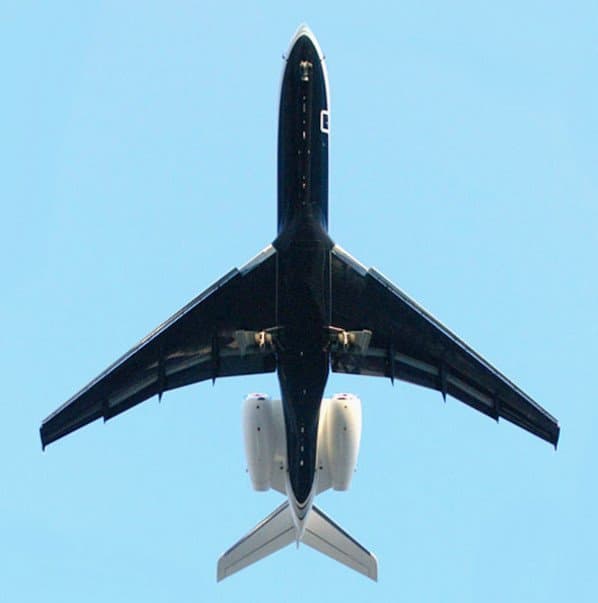

Credit
P. Alejandro Diaz · CC BY-SA 2.5 · Resized · CC BY-SA 2.5 · Source ↗ · Modified


Preparing your view.
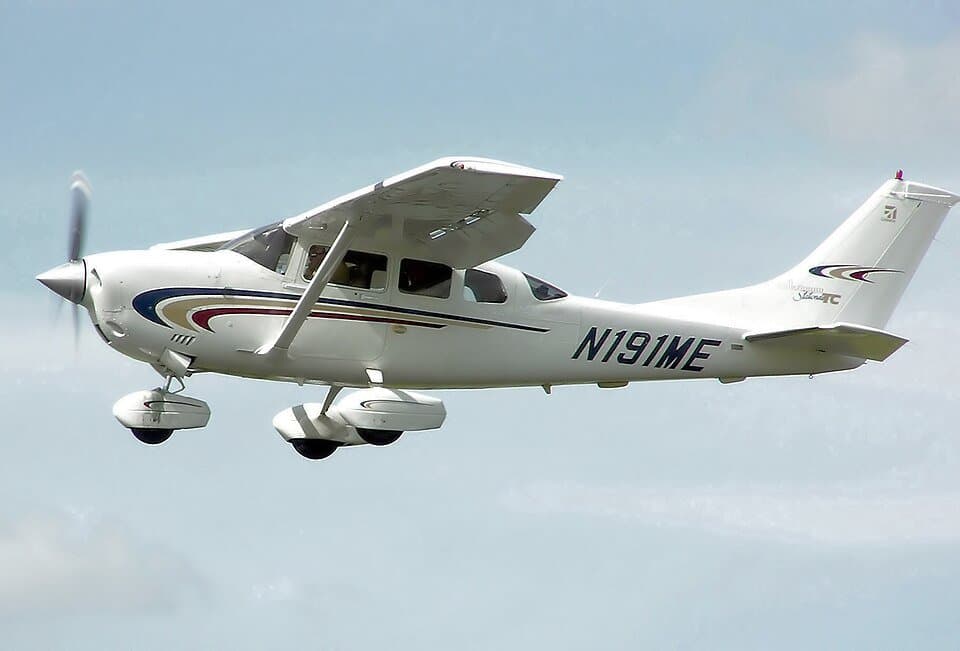

At a glance
Measured figures
Length
Single source96 ft 10 in (29.51 m)[source]
206H Stationair · Length
Single sourceConfiguration
| Specification | Bombardier Global Express | Cessna 206 |
|---|---|---|
| Crew | Two[source] | one[source] |
| Thrust | 14,750 lbf (65.6 kN)[source] | — |
| Type | Business jet[source] | Light aircraft[source] |
| National origin | Canada[source] | — |
| Manufacturer | Bombardier Aviation |
28 ft 3 in (8.61 m)[source]
Cruise; Mach high-speed, Mach
Single sourceCruise; typical
Single sourceMach 0.89[source]
Mach 0.88 - 504 kn (933 km/h; 580 mph) high-speed, Mach 0.85 - 487 kn (902 km/h; 560 mph) typical[source]
Cruise; 206H Stationair · at 6,200 ft (1,900 m) (75% power)
Single sourceMaximum; 206H Stationair · at sea level
Single source206H Stationair · 1 × Lycoming IO-540-AC1A naturally aspirated air-cooled flat-six engine
Single source1 × Lycoming IO-540-AC1A naturally aspirated air-cooled flat-six engine , 300 hp (220 kW)[source]
Maximum payload
Single source7,139 lb (3,238 kg)[source]
206H Stationair · Wing area
Single source175.5 sq ft (16.30 m 2 )[source]
206H Stationair · 988 ft/min (
Single source988 ft/min (5.02 m/s)[source]
Bars compare reported quantities only. A larger figure does not make a system better; configurations and test conditions differ.
Cessna[source] |
| Status | In service[source] | In production[source] |
|---|
| Number built | 816 (Oct 2018)[source] | over 8509 (as of approx. 2006)[source] |
|---|
| Manufactured | 1998–present[source] | 1962–1986 and 1998–present[source] |
|---|
| Introduction date | July 1999[source] | 1962 ( 1962 ) (206)[source] |
|---|
| First flight | 13 October 1996[source] | — |
|---|
| Developed from | Challenger 600 & CRJ-100/-200[source] | Cessna 210[source] |
|---|
| Variants | Saab GlobalEye Raytheon Sentinel[source] | — |
|---|
| Developed into | Global 7500/8000[source] | — |
|---|
| Passengers | 16[source] | — |
|---|
| Wing geometry | 94 ft (29 m) span, 1,021 ft 2 (94.9 m 2 ) area, 8.7 AR[source] | — |
|---|
| Operating empty weight | 50,861 lb (23,070 kg)[source] | — |
|---|
| Powerplant | BR700-710A2-20[source] | — |
|---|
| Role | large cabin, long-range business jet[source] | — |
|---|
| Source measurement | After acquiring Canadair along with its Challenger 600 business jet in 1986, Bombardier studied a longer range business aircraft in which it aimed to carry eight passengers and four crew over 12,000 km (6,500 nmi) at Mach 0.85. To meet this goal, a joint-definition team was established at the company's Montreal facility in the early 1990s. By 1994, the team comprised 200 engineers, evenly divided between Canadair and various partners, including Japanese company Mitsubishi Heavy Industries and Anglo-German engine manufacturer BMW Rolls-Royce .[source]Bombardier Global Express · Development / Project definition; only the objects and conditions stated in this passage By June 1995, the backlog was over 40 aircraft, sold out until 2000, leading to Bombardier to expand its early production plans. At launch, range was extended to 12,000 km (6,500 nmi; 7,500 mi) to outdo rival Gulfstream . Bombardier guaranteed the empty weight and range to reply to Gulfstream criticism. Around 100 sales were needed to cover the development costs. In October 1995, the first prototype manufacture began. The first sections were expected in December at de Havilland's in Toronto , with final assembly to start in March 1996. By June 1996, the prototype was complete and conducting flight-readiness reviews ahead of its roll-out and first flight.[source]Bombardier Global Express · Development / Launch and flight testing; only the objects and conditions stated in this passage On 13 October 1996, the first prototype performed its maiden flight from Toronto, one month later than planned, lasting for 2 hours 46 minutes and attaining 11,000 ft (3,400 m) and 210 kn (240 mph; 390 km/h). The flight test programme used four prototypes, accumulating 2,200 flight hours. The Bombardier Flight Test Center in Wichita, Kansas was extended by 9,100 m 2 (98,000 ft 2 ) for the test programme. In February 1997, the second prototype made its first flight and the third in May 1997.[source]Bombardier Global Express · Development / Launch and flight testing; only the objects and conditions stated in this passage The Global Express is a high speed business/corporate aircraft with a range of 6,500 nmi (7,500 mi; 12,000 km) at Mach 0.80 (528 mph; 459 kn; 850 km/h), a 51,000 ft (16,000 m) service ceiling and a 14-hour endurance. The semi monocoque airframe is made of lightweight aluminum alloys and composite materials. It has a low wing , tricycle landing gear and fuselage-mounted engines .[source]Bombardier Global Express · Design; only the objects and conditions stated in this passage The clean-sheet design draws upon the earlier Canadair CL-600 and Bombardier CRJ . It shares its fuselage cross-section with these aircraft, paired with a new T-tail and wing. The latter is a supercritical airfoil with a 35° wing sweep and winglets . This flexible wing naturally attenuates turbulence . It was initially powered by two BMW- Rolls-Royce BR710 turbofans controlled by FADEC . The flightdeck features a six screen Honeywell Primus 2000XP EFIS suite.[source]Bombardier Global Express · Design; only the objects and conditions stated in this passage The Global Express was the business jet with the largest cabin, until being surpassed by the later Gulfstream G650 . It can accommodate 12 to 16 passengers in three cabin sections: mostly a forward four-chair club section, a central four-seat conference grouping and an aft three-place divan facing two chairs. Most have a forward galley , crew rest chair and crew lavatory. The 10.3-psi cabin pressurization maintains a 4,500-ft. cabin altitude up to FL 450 and 5,680 ft. at the FL 510 ceiling. The cabin has an unobstructed length of 14.6 m (48 ft) while the floor is dropped by 51 mm (2.0 in) from the Challenger to increase width at shoulder level, while the windows have been repositioned and enlarged by 25%.[source]Bombardier Global Express · Design; only the objects and conditions stated in this passage The Global 5000 was announced in October 2001. It was launched in February 2002, with letters of intent for 15 aircraft with a 87,700 lb (39,800 kg) MTOW , and a 4,800 nmi (5,500 mi; 8,900 km) range at Mach 0.85. The first aircraft flew on 7 March 2003. It was introduced in April 2005. There were 224 in service in 2018. In April 2008, Bombardier lifted its MTOW to 92,500 lb (42,000 kg) to increase its Mach 0.85 range to 5,200 nmi (6,000 mi; 9,600 km).[source]Bombardier Global Express · Variants / Global 5000; only the objects and conditions stated in this passage Its cabin is 5.9 ft (1.8 m) shorter than the Global 6000 with a 5,800–7,000 lb (2,600–3,200 kg) lower MTOW depending on service bulletins . It has a 5,000–5,400 nmi (5,800–6,200 mi; 9,300–10,000 km) range at LRC . The spec basic operating weight is 50,350 lb (22,840 kg) but are actually closer to 51,600 lb (23,400 kg). Early models kept the Honeywell Primus 2000XP avionics, updated with the Bombardier Vision flight deck based on the Rockwell Collins Pro Line Fusion avionics since 2012.[source]Bombardier Global Express · Variants / Global 5000; only the objects and conditions stated in this passage It can carry between 8 and 19 passengers. The new seat converts to a full berth. There is an optional private room aft and the galley has room to prepare 16 five-course meals. It was priced at $40M in 2008. It has forward and aft lavatories. The crew rest area was removed, but could be restored. The tail fuel tank was removed and fuel is limited in the wings. Some avionics are rearranged to gain usable cabin length. The interior completions allowance is 3,200 kg.[source]Bombardier Global Express · Variants / Global 5000; only the objects and conditions stated in this passage In 2018, its unit cost was US$50.44 million. At high-speed cruise, it burns 5,000 lb (2,300 kg) of fuel in the first hour, then 4,000 lb (1,800 kg) the second hour and 3,000 lb (1,400 kg) for the third hour. In 2018, Early models with Honeywell avionics were sold for $10–20 million, while post-2012 aircraft with the modern Cockpit can fetch $22–36 million. A major inspection every 180 months cost $800,000-1.2 million. Two 8,000h engine overhauls can cost $4 million. The cheaper and more efficient Gulfstream G450 or Falcon 900 LX are slower, have less range and smaller cabins.[source]Bombardier Global Express · Variants / Global 5000; only the objects and conditions stated in this passage The improved Global Express XRS was announced on 6 October 2003 during the NBAA Convention at Orlando, Florida. It replaced the original Global Express and provides greater range at high speed, cabin upgrades, improved takeoff performance, fast fueling capability and the Bombardier Enhanced Vision System (BEVS) as standard equipment. A new forward fuel tank in the wing/body fairing increases the usable fuel capacity by up to 1,486 lbs, allowing it to fly 6,500 nm at Mach 0.82, 6,150 nm at Mach 0.85 or 5,450 nm at Mach 0.87. It provides improved pressurization with a 4,500 ft cabin altitude at 45,000 ft and a 5,700 ft cabin altitude at 51,000 ft; a 25% improvement on the previous Global cabin.[source]Bombardier Global Express · Variants / Global Express XRS; only the objects and conditions stated in this passage On long trips, its fuel burn is 5,000 lb (2.3 t) in the first hour, 4,000 lb (1.8 t) in the second hour, 3,000 lb (1.4 t) in the third hour and 2,500 lb (1.1 t) for every subsequent hour. A Checks are scheduled every 750 hours, and for C Checks every 30 months. Engine reserves amount to $260 per hour. Over 315 were delivered by March 2019. Its competitors include the 6,200 nmi (7,100 mi; 11,500 km) Dassault Falcon 8X , the 6,500 nmi (7,500 mi; 12,000 km) Gulfstream G600 or even the 6,900 nmi (7,900 mi; 12,800 km) G650 .[source]Bombardier Global Express · Variants / Global 6000; only the objects and conditions stated in this passage In May 2018, Bombardier unveiled the Global 5500 and 6500. It was expected to enter service at the end of 2019. It has an optimized wing for a Mach 0.90 top speed, a revamped cabin inspired by the Global 7500 with its Nuage seat and updated Rolls-Royce BR710 Pearl engines with up to 13% lower fuel burn for better operating costs. It has better hot and high performance and 500 and 600 nmi (580 and 690 mi; 930 and 1,110 km) of additional range for 5,700 and 6,600 nmi (6,600 and 7,600 mi; 10,600 and 12,200 km), respectively. The engines have 9% more thrust.[source]Bombardier Global Express · Variants / Global 5500/6500; only the objects and conditions stated in this passage By October 2018, 70% of the flight testing hours were completed. The programme involved two flight-test Global 6500s, as the 5500 is a simple 0.8 m (2 ft 7 in) shrink. The redesigned wings are built by Mitsubishi Heavy Industries . By December, the flight-test program was nearly three-quarters complete. By May 2019, 90% of the flight testing was completed by two modified 6000s and one modified 5000.[source]Bombardier Global Express · Variants / Global 5500/6500; only the objects and conditions stated in this passage In September 2019, Bombardier announced the Transport Canada Type Certification of both models, before entry-into-service later in 2019 and FAA / EASA approval. Bombardier announced the Global 6500 entry-into-service on 1 October. EASA Type Certification of both models was announced in October 2019. Shortly after, the Global 5500 range was extended by 200 nmi (230 mi; 370 km) to 5,900 nmi (6,800 mi; 10,900 km) at Mach 0.85.[source]Bombardier Global Express · Variants / Global 5500/6500; only the objects and conditions stated in this passage FAA Type Certification of both variants was announced in December 2019. Bombardier announced the entry-into-service of the Global 5500 in June 2020. The first Global 5500 was delivered in July 2020, to " longtime Bombardier customer Unicorp National Developments, headquartered in Orlando, Florida."[source]Bombardier Global Express · Variants / Global 5500/6500; only the objects and conditions stated in this passage Most operators fly 450 to 600 hours per year. Fleet operators frequently fly more than 100 hours per month. By February 2015, over 600 aircraft accumulated more than 1.5 million flight hours and 570,000 cycles. In May 2018, 20 years after the type's introduction, more than 750 Globals were in service.[source]Bombardier Global Express · Operators; only the objects and conditions stated in this passage A dozen 6000s are registered in the Isle of Man for anonymity, a few are registered in the Cayman Islands . Four are registered in Austria, three in Switzerland, two in France and Denmark, and one each in Finland, Germany, Ireland and Turkey. Three are registered in China, one in Malaysia and one in Hong Kong. Two are based in São Paulo, two are in South Africa and one is in India.[source]Bombardier Global Express · Operators; only the objects and conditions stated in this passage US Air Force 7 Global 6000 in service + 4 on order, known as E-11A, used as command and control / battlefield airborne communication node[source]Bombardier Global Express · Operators / Military / Military mission; only the objects and conditions stated in this passage | The 205 is powered by a Continental IO-470-S engine producing 260 hp (190 kW). The 205 was produced in only two model years, 1963 and 1964, before being replaced in production by the Cessna 206. A total of 576 Cessna 205s were produced.[source]Cessna 206 · Development / Cessna 205; only the objects and conditions stated in this passage There were many sub-variants, including the U206, P206 all certified to CAR3 standards and later 206H certified to FAR Part 23. The total Model 206 production between 1964 and 2004 was 6,581 aircraft.[source]Cessna 206 · Development / Cessna 206; only the objects and conditions stated in this passage The original 1964 model was the U206, powered by a 285 hp (213 kW) Continental IO-520-A . The “U” designation indicated “utility” and this model was equipped with a pilot side door and large clamshell rear door serving the back two rows of seats, allowing easy loading of oversized cargo.[source]Cessna 206 · Development / Cessna 206 / Cessna U206; only the objects and conditions stated in this passage There was a TU206 turbocharged version powered by the Continental TSIO-520-C engine producing 285 hp (213 kW). After 1967, the turbo TU206 was powered by a TSIO-520-F of 300 hp (220 kW). The extra 15 hp (11 kW) was obtained by turning the engine at a higher rpm, and was allowed for only five minutes. Due to the large propeller diameter, the additional engine speed meant that the propeller tips were pushed to transonic speeds, which required much more power.[source]Cessna 206 · Development / Cessna 206 / Cessna U206; only the objects and conditions stated in this passage In 1977, the U206 had its engine upgraded to a Continental IO-520-F of 300 hp (220 kW) (continuous rating, obtained at a lower speed than the previous TSIO-520-F) and the TU206 powerplant was changed to the TSIO-520-M producing 310 hp (230 kW). |
|---|
| Origin reported by inventory | Canada Turkey[source]Inventory Origin column; table 1, row 15, cell 2; revision 1372398204; retrieved 2026-10-02 | — |
|---|
| Capacity | — | five passengers[source] |
|---|
| Propellers | — | 3-bladed McCauley metal constant-speed propeller[source] |
|---|
| Stall speed | — | 63 mph (101 km/h, 55 kn) (flaps down)[source] |
|---|
| Country of origin | — | United States[source] United States[source]Inventory Origin column; table 6, row 5, cell 3; revision 1376110979; retrieved 2026-10-01 |
|---|
174 mph (280 km/h, 151 kn) at sea level[source]
163 mph (262 km/h, 142 kn) at 6,200 ft (1,900 m) (75% power)[source]
The P206 was produced from 1965 to 1970 and was powered by a Continental IO-520-A of 285 hp (213 kW). There was a turbocharged model designated TP206 which was powered by a Continental TSIO-520-A also of 285 hp (213 kW).[source]Cessna 206 · Development / Cessna 206 / Cessna P206; only the objects and conditions stated in this passage
After a production hiatus of twelve years, Cessna started manufacturing a new version of the venerable 206 in 1998, with the introduction of the newly certified 206H. The “H” model is generally similar to the previous U206 configuration, with a pilot entry door and a rear double clamshell door for access to the middle and back seats. The "H" is marketed under the name "Stationair".[source]Cessna 206 · Development / Cessna 206 / Cessna 206H; only the objects and conditions stated in this passage
The 206H is powered by a Lycoming IO-540-AC1A powerplant producing 300 hp (220 kW). The turbocharged T206H is powered by a Lycoming TIO-540-AJ1A engine of 310 hp (230 kW).[source]Cessna 206 · Development / Cessna 206 / Cessna 206H; only the objects and conditions stated in this passage
Even though the Cessna 206H is certified as a six-seat aircraft in its country of origin, the Canadian aviation regulator, Transport Canada has certified it to carry only five people in Canada . This is due to concerns about passenger egress through the rear clamshell door with the flaps extended. Cessna addressed one part of this problem early on, after a flight-test aircraft was damaged when the pilot extended the flaps while taxiing, and his passenger had the clamshell door open (for ventilation; it was a hot summer day). A switch was added to the flap actuation circuit which disabled the flaps when the doors were open. The other part of the problem is that if the flaps are already down, the passenger must perform the complicated procedure of opening the front part as far as possible (about 8 in (20 cm)) then open the rear door and release the spring-loaded rear door handle so it retracts out of the way. This then gives enough clearance to open the rear part of the door fully for egress.[source]Cessna 206 · Development / Cessna 206 / Cessna 206H; only the objects and conditions stated in this passage
Both the 206H and the T206H remain in production in 2013. By the end of 2004, Cessna had produced 221 206Hs and 505 T206Hs, for a total production of 726 "H" models. Cessna has indicated that they do not intend to produce a P206-configuration aircraft in the future, due to lack of market demand.[source]Cessna 206 · Development / Cessna 206 / Cessna 206H; only the objects and conditions stated in this passage
The Model 207 was a seven- and later eight-seat development of the 206, achieved by stretching the design further by 45 inches (114 cm) to allow space for more seats. The nose section was extended 18 inches (46 cm) by adding a constant-section nose baggage compartment between the passenger compartment and the engine firewall; the aft section was extended by 27 inches (69 cm) by inserting a constant-area section in the fuselage area just aft of the aft wing attach point. Thus the propeller's ground clearance was unaffected by the change (the nosewheel had moved forward the same distance as the propeller), but the tail moved aft relative to the mainwheel position, which made landing (without striking the tailskid on the runway) a greater challenge. The move gave the 207 a larger turning radius, since the distance between mainwheels and nosewheel increased by 18 inches (46 cm) but the nosewheel's maximum allowed deflection was not increased.[source]Cessna 206 · Development / Cessna 207; only the objects and conditions stated in this passage
The 207 was introduced as a 1969 model featuring a Continental IO-520-F engine of 300 hp (220 kW). A turbocharged version was equipped with a TSIO-520-G of the same output.[source]Cessna 206 · Development / Cessna 207; only the objects and conditions stated in this passage
At the beginning of production the model was called a Cessna 207 "Skywagon", but in 1977 the name was changed to "Stationair 7". 1977 also saw a change of engine on the turbocharged version to a Continental TSIO-520-M producing 310 hp (230 kW) – the same engine used in the TU206 of the same vintage.[source]Cessna 206 · Development / Cessna 207; only the objects and conditions stated in this passage
In April 2007, Thielert announced that the European Aviation Safety Agency had granted a Supplemental Type Certificate (STC) for conversion of Cessna 206s to the Thielert V-8 diesel powerplant. The STC allows conversion of the following models: U206F and TU206F with the 300 hp (220 kW) powerplant, and the U206G, TU206G, 206H and T206H with the 310 hp (230 kW) version. This modification does not require any changes to the engine cowling. In May 2008, Thielert entered insolvency proceedings, so the future availability of this diesel conversion is uncertain.[source]Cessna 206 · Development / Modifications; only the objects and conditions stated in this passage
Soloy Aviation Solutions offers a turboprop conversion for some 206/207 models with the 418 shp (312 kW) Rolls-Royce/Allison M250 engine/gearbox package. However, extensive engine cowl modifications are required.[source]Cessna 206 · Development / Modifications; only the objects and conditions stated in this passage
The 205 was introduced for the 1963 model year as a variant of the Cessna 210 with fixed landing gear. It had six seats, three doors (two on the left and one on the right), was powered by a 260 hp (194 kW) Continental IO-470-S engine, and had a gross weight of 3,300 lb (1,497 kg). Certified on June 14, 1962. 480 built.[source]Cessna 206 · Variants / Cessna 205; only the objects and conditions stated in this passage
Introduced for the 1964 model year, the 206 differed from the 205 primarily in that it was powered by a 285 hp (213 kW) Continental IO-520-A . Other changes included a strengthened fuselage, all entry doors removed except the pilot's door on the left side, new 42 in (110 cm) removable double cargo doors on the right side, and heavy-duty brakes. The interior was also redesigned with durable and easy cleaning materials. Only the pilot's seat came as standard, though three optional seating arrangements were offered with up to six seats. Other optional equipment included heavy-duty main tires, floats, skis, a 300 lb (136 kg) fuselage cargo pod, 150 US gal (568 L) tank and spray boom for agricultural use , and an air ambulance configuration. The aircraft had a gross weight of 3,300 lb (1,497 kg) as a landplane or 3,500 lb (1,588 kg) as a seaplane. Certified on July 19, 1963.[source]Cessna 206 · Variants / Cessna 206; only the objects and conditions stated in this passage
1966 model year with a three-bladed propeller and a 60A alternator replacing the 50A generator of previous variants. A mortuary option was also introduced with room for one casket. In addition to the passenger P206A , turbocharged versions powered by a 285 hp (213 kW) Continental TSIO-520-C were also offered as the TU206A Turbo Super Skywagon and TP206A Turbo Super Skylane . Certified on September 24 (U206A/P206A) and December 20 (TU206A/TP206A), 1965. 365 total built; 219 (U206A/TU206A), 146 (P206A/TP206A).[source]Cessna 206 · Variants / Cessna 206; only the objects and conditions stated in this passage
1967 model year with minor detail changes and powered by a 300 hp (224 kW) Continental IO-520-F engine. Also built in a passenger P206B and turbocharged TU206B and TP206B variants, all retaining their previous 285 hp (213 kW) IO-520-A and TSIO-520-C engines. Certified on August 3, 1966. 371 total built; 258 (U206B/TU206B) and 113 (P206B/TP206B).[source]Cessna 206 · Variants / Cessna 206; only the objects and conditions stated in this passage
1968 model year with minor detail changes and an increased gross weight of 3,600 lb (1,633 kg). Also built in passenger P206C and turbocharged TU206C and TP206C variants. Certified on July 20, 1967. 420 total built; 320 (U206C/TU206C) and 100 (P206C/TP206C).[source]Cessna 206 · Variants / Cessna 206; only the objects and conditions stated in this passage
Introduced for the 1977 model year with a new nosewheel leg. The TU206G was powered by a turbocharged 310 hp (231 kW) Continental TSIO-520-M engine. The 1978 model year was renamed as the Stationair 6 and introduced a 28V electrical system and optional club seating with a writing desk. Optional air conditioning was offered for the 1986 model year. Certified on June 21, 1976. 3,500 total built; 554 (1977, including one prototype), 575 (1978), 661 (1979), 610 (1980), 520 (1981), 260 (1982), 89 (1983), 58 (1984), 74 (1985), and 100 (1986).[source]Cessna 206 · Variants / Cessna 206; only the objects and conditions stated in this passage
206H Stationair[source]Cessna 206 · Variants / Cessna 206; only the objects and conditions stated in this passage
Introduced in 1998 with a 300 hp (224 kW) Lycoming IO-540-AC1A5 engine. A turbocharged variant powered by a 310 hp (231 kW) Lycoming TIO-540-AJ1A engine was introduced in 1999 as the T206H Turbo Stationair (also known as Stationair TC ). Certified on November 26, 1997 (206H) and October 1, 1998 (T206H). Production of the 206H ended in 2013 with a total of 369 being produced. An improved version of the T206H known as the Turbo Stationair HD was introduced in July 2016 with gross weight increased by 189 lb (86 kg). As of 2023, the T206H Turbo Stationair HD is the only model still in production, with 1,264 being built as of 2017.[source]Cessna 206 · Variants / Cessna 206; only the objects and conditions stated in this passage
Introduced for the 1969 model year as a development of the U206C with a stretched cabin allowing for a seventh seat, powered by a 300 hp (224 kW) Continental IO-520-F engine, and with a gross weight of 3,800 lb (1,724 kg). The 1970 model year introduced a new control wheel design, an optional gray instrument panel, an optional mortuary variant with room for a single casket, and a turbocharged variant powered by a 300 hp (224 kW) Continental TSIO-520-G engine as the T207 Turbo Skywagon 207 . 1973 introduced larger, padded control wheels, revised avionics, bonded-cabin doors, a new glareshield, and new wheel fairings. 1974 introduced integral cabin door armrests and handles, revised avionics, and an optional 28V electrical system. 1975 introduced removeable rear cabin air outlets and a revised glareshield. Certified on December 31, 1968. 362 total built; 148 (1969), 42 (1970), 15 (1971), 10 (1972), 12 (1973), 40 (1974), 47 (1975), and 48 (1976).[source]Cessna 206 · Variants / Cessna 207; only the objects and conditions stated in this passage
Introduced for the 1977 model year with an improved Vernier mixture control, energy-absorbing instrument subpanels, a rectangular hour meter, and an improved aileron control system. The T207's engine was also changed to a 310 hp (231 kW) Continental TSIO-520-M . For the 1978 model year, the 207A and T207A were renamed to Stationair 7 and Turbo Stationair 7 , respectively, and the previously optional 28V electrical system was made standard, and 1979 introduced a long-hub propeller and spinner. 1980 saw the introduction of an eighth seat and yet another name change to Stationair 8 and Turbo Stationair 8 , as well as optional six-place club seating, a pull-type alternator circuit breaker, and a new flap position indicator. 1984 introduced new fuel caps, shoulder harnesses for all seats, copilot controls, and other minor changes. Certified on July 12, 1976 (seven seats) and September 11, 1979 (eight seats). 426 total built; 52 (1977), 68 (1978), 80 (1979), 92 (1980), 75 (1981), 33 (1982), 5 (1983), and 21 (1984).[source]Cessna 206 · Variants / Cessna 207; only the objects and conditions stated in this passage
Civil Air Patrol – one 206H, 25 T206H, 13 U206G[source]Cessna 206 · Operators / Government; only the objects and conditions stated in this passage
The Malagasy Air Force received five second hand Cessna 206s in June 2019.[source]Cessna 206 · Operators / Military; only the objects and conditions stated in this passage
Pakistan Army Aviation 4 T-206H[source]Cessna 206 · Operators / Military; only the objects and conditions stated in this passage
July 24, 1972 near Aspen, Colorado , a 27-year-old student pilot with a total of 39 hours of flying time flew a Cessna U206, registered N5290U, into a blind canyon and stalled the aircraft while trying to turn around, killing all four people on board. Among the passengers was wealthy playboy, entrepreneur, racing driver and developer Lance Reventlow , who was a Woolworth heir, son of Barbara Woolworth Hutton and the husband of former Mouseketeer and actress Cheryl Holdridge .[source]Cessna 206 · Accidents; only the objects and conditions stated in this passage
On May 1, 2023, a Cessna 206 with seven people on board crashed in the jungle in the Caquetá Department of Colombia . Two of the occupants – the pilot and one adult – were killed on impact. Another passenger, the mother of the remaining four, all children, died soon after the crash. The children, between 11 months and 13 years old, survived for over five weeks in the rainforest before being rescued by the Colombian military and rescuers.[source]Cessna 206 · Accidents; only the objects and conditions stated in this passage
On September 29, 2023, a Cessna 206 aircraft owned by RioZim was en route from Harare to the Murowa diamond mine in Zimbabwe when the plane crashed near the mine. All 6 people aboard the plane died in the crash, including the owner of the mine Harpal Randhawa .[source]Cessna 206 · Accidents; only the objects and conditions stated in this passage
On May 26, 2024, a Cessna 206 with 7 people on board (pilot, 6 passengers) crashed in Butler, Missouri while on a skydiving flight. Everyone survived as they managed to escape before the crash using parachutes.[source]Cessna 206 · Accidents; only the objects and conditions stated in this passage
Capacity: five passengers[source]Cessna 206 · Specifications (206H Stationair); only the objects and conditions stated in this passage
Length: 28 ft 3 in (8.61 m)[source]Cessna 206 · Specifications (206H Stationair); only the objects and conditions stated in this passage
Wingspan: 36 ft 0 in (10.97 m)[source]Cessna 206 · Specifications (206H Stationair); only the objects and conditions stated in this passage
Height: 9 ft 3 + 1 ⁄ 2 in (2.832 m)[source]Cessna 206 · Specifications (206H Stationair); only the objects and conditions stated in this passage
Wing area: 175.5 sq ft (16.30 m 2 )[source]Cessna 206 · Specifications (206H Stationair); only the objects and conditions stated in this passage
Empty weight: 2,176 lb (987 kg)[source]Cessna 206 · Specifications (206H Stationair); only the objects and conditions stated in this passage
Max takeoff weight: 3,600 lb (1,633 kg)[source]Cessna 206 · Specifications (206H Stationair); only the objects and conditions stated in this passage
Powerplant: 1 × Lycoming IO-540-AC1A naturally aspirated air-cooled flat-six engine , 300 hp (220 kW)[source]Cessna 206 · Specifications (206H Stationair); only the objects and conditions stated in this passage
Maximum speed: 174 mph (280 km/h, 151 kn) at sea level[source]Cessna 206 · Specifications (206H Stationair); only the objects and conditions stated in this passage
Cruise speed: 163 mph (262 km/h, 142 kn) at 6,200 ft (1,900 m) (75% power)[source]Cessna 206 · Specifications (206H Stationair); only the objects and conditions stated in this passage
Stall speed: 63 mph (101 km/h, 55 kn) (flaps down)[source]Cessna 206 · Specifications (206H Stationair); only the objects and conditions stated in this passage
Range: 840 mi (1,350 km, 730 nmi) at 6,500 ft (2,000 m) (max fuel, 45 min reserves)[source]Cessna 206 · Specifications (206H Stationair); only the objects and conditions stated in this passage
Service ceiling: 15,700 ft (4,800 m)[source]Cessna 206 · Specifications (206H Stationair); only the objects and conditions stated in this passage
Rate of climb: 988 ft/min (5.02 m/s)[source]Cessna 206 · Specifications (206H Stationair); only the objects and conditions stated in this passage