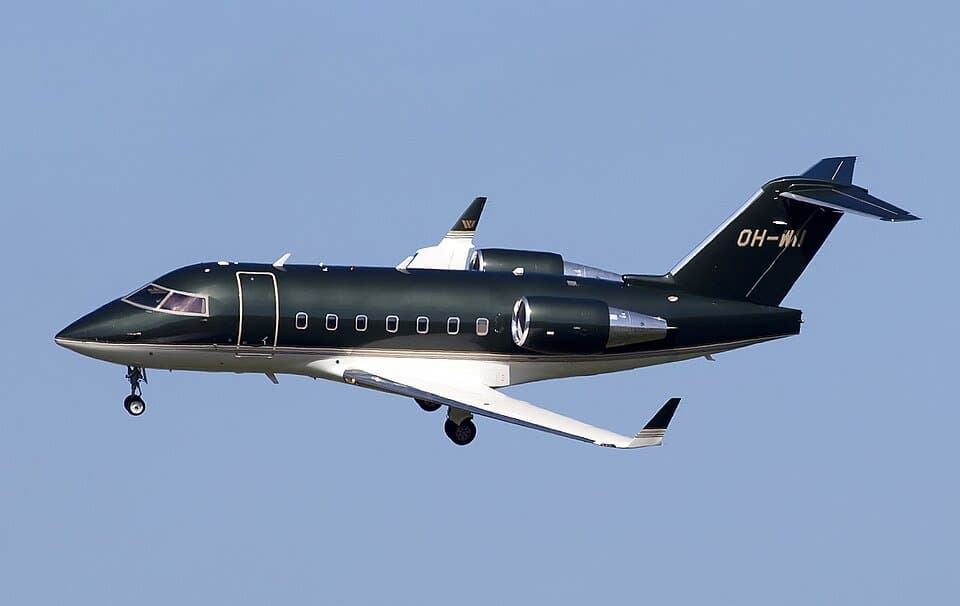

Credit
Maarten Visser from Capelle aan den IJssel, Nederland · CC BY-SA 2.0 · Resized · CC BY-SA 2.0 · Source ↗ · Modified


Preparing your view.

At a glance
Measured figures
Mach 0.85[source]
Cruise; Falcon 20F · at 12,200 m (40,000 ft) (econ. cruise)
Single sourceMaximum; Falcon 20F · at 7,620 m (25,000 ft) (max cruise)
Single source862 km/h (536 mph, 465 kn) at 7,620 m (25,000 ft) (max cruise)[source]
750 km/h (470 mph, 400 kn) at 12,200 m (40,000 ft) (econ. cruise)[source]
Challenger 650 · 2 × General Electric CF34 -3B turbofans thrust each
Single source2 × General Electric CF34 -3B turbofans , 41.0 kN (9,220 lbf) thrust each[source]
Falcon 20F · 2 × General Electric CF700 -2D-2 turbofans thrust each
Single source2 × General Electric CF700 -2D-2 turbofans , 20 kN (4,500 lbf) thrust each[source]
Bars compare reported quantities only. A larger figure does not make a system better; configurations and test conditions differ.
Configuration
| Specification | Bombardier Challenger 600 series | Dassault Falcon 20 |
|---|---|---|
| Type | Business jet[source] | Business jet[source] |
| Manufacturer | Canadair Bombardier Aerospace[source] | Dassault Aviation[source] |
| Status | In production[source] | Out of production, in active service[source] |
| Number built | 1,066 (October 2018)[source] | 512[source] |
| Manufactured | 1980–present[source] | 1965–1991[source] |
| First flight | 8 November 1978[source] | 4 May 1963[source] |
| Developed into | Bombardier CRJ100/200 Bombardier Global Express[source] | Dassault Falcon 10 Dassault Falcon 50[source] |
| Capacity | 2,200 kg (4,850 lb) and up to 19 passengers[source] | 8–14 passengers[source] |
| Aspect ratio | 8.46[source] | 6.4:1[source] |
| Fuel capacity | 9,072 kg (20,000 lb)[source] | 5,200 L (1,100 imp gal; 1,400 US gal)[source] |
| Cabin | 1.83 m (6 ft) high, 2.41 m (7 ft 11 in) wide[source] | — |
| Thrust/weight | 0.38[source] | — |
| Takeoff | 1,720 m (5,640 ft) (SL, ISA, MTOW)[source] | — |
| Landing | 732 m (2,402 ft) (SL, ISA, typical)[source] | — |
| Role | family of business jets[source] | French business jet[source] |
| Source measurement | In April 1976, Canadair acquired the LearStar 600 concept. By then it was 63 ft (19 m) long, and 53.3 ft (16.2 m) wide, and capable of a maximum speed of Mach 0.85 and a range of 7,240 km (3,910 nmi). As an executive jet, it had sufficient capacity for 14 passengers. In a freighter configuration, it had a 3,400 kg (7,500 lb) payload capacity, loaded and unloaded through a forward door. As a commuter airliner , it could seat up to 30 passengers in a 2–1 seating configuration. Canadair developed the design into a large airframe, furnished with a new supercritical wing design, new avionics and engines, as well as for compliance with new FAR part 25 standards. The configuration was frozen in August and a 1/25 model was tested in the National Aeronautical Establishment transonic wind tunnel . Reportedly, in excess of 1,800 hours of wind tunnel testing were performed upon the supercritical wing alone.[source]Bombardier Challenger 600 series · Development / Origins; only the objects and conditions stated in this passage Due to the expansion of the design, the original powerplant configuration became untenable. Engine manufacturer Lycoming proposed developing a new model, the Lycoming ALF 502 L, which Canadair's design team accepted for the enlarged Challenger, and around which drew up its general arrangement. The type's wide cargo door had been designed in response to the needs of FedEx , the type's original launch customer, having placed an order for 25 aircraft. FedEx had experienced problems with the General Electric CF34 engines, and favoured the Lycoming ALF 502D, instead. Those later had delivery troubles and lacked performance. Reportedly, FedEx converted most of its orders into the Challenger's stretched version, intending to carry up to 12,500 lb of freight. FedEx ultimately opted to cancel its orders due to the US Airline Deregulation Act , and the specific aircraft that were already in production were sold to other customers instead.[source]Bombardier Challenger 600 series · Development / Launch; only the objects and conditions stated in this passage By early March 1978, the first prototype was almost finished and the assembly of the two other had debuted. Destined to control handling qualities and test flight performance, it was formally rolled out on 25 May 1978. 116 orders were confirmed 19 months after go-ahead. By this point, production jigs allowing for a production rate of up to seven Challengers per month had been established, ready for quantity production to proceed. Airframe structural testing began in February 1979. Operational test cycling started in December 1979, simulating 72,638 flight hours by February 1985, while its predicted lifetime was 30,000 hours.[source]Bombardier Challenger 600 series · Development / Launch; only the objects and conditions stated in this passage On 8 November 1978, the prototype aircraft took off for its maiden flight from Montreal, Quebec . The flight test and certification program were conducted at Mojave Kern County Airport instead of Canada due to better weather. The second and third prototypes first flew during 1979. A test flight on 3 April 1980 in the Mojave Desert resulted in disaster. The aircraft crashed due to the failure of the release mechanism to detach the recovery chute after a deep stall , killing one of the test pilots. The other test pilot and the flight test engineer parachuted to safety.[source]Bombardier Challenger 600 series · Development / Flight test phase; only the objects and conditions stated in this passage The Challenger's wing has been referred to as being a modified NACA symmetrical aerofoil. Akin to other supercritical wings, it features a rounded leading edge , an inverted camber , a blunt trailing edge and scalloping of the underside. The twin-spar wing box structure spans the entire length of the wing and is compartmentalised to form five internal fuel tanks; these tanks can accommodate up to 14,661 lb of fuel, nearly half the aircraft's empty weight.[source]Bombardier Challenger 600 series · Design; only the objects and conditions stated in this passage The fuselage diameter was designed to accommodate an unobstructed cabin floor, a cabin height of 6 ft 1 in in the centre section, and space for the wing box , underfloor integral fuel tanks, air ducts, and various control cabling. It was also designed to easily accommodate Canadair's early plans to stretch the fuselage, for which equal-length plugs are installed fore and aft of the centre section to greatly increase the Challenger's capacity.[source]Bombardier Challenger 600 series · Design; only the objects and conditions stated in this passage Second prototype, a CL-600-1A11, c/n 1002, was allocated to the RCAF after finishing its test programme. Used at the Aerospace Engineering and Test Establishment (AETE), CFB Cold Lake until retirement in 1993, it is now preserved at the CFB Winnipeg , designated CC-144 in service.[source]Bombardier Challenger 600 series · Variants / Challenger 600 (CL-600-1A11); only the objects and conditions stated in this passage Built from 1996 through 2006, over 360 were delivered. Early ones were selling for $4.0–$4.5 million and late models for less than $8 million in 2016. With 27,000 to 27,100 lb (12,200 to 12,300 kg) operating empty weights , it carries six or seven passengers and full fuel with the increased MTOW . It is able to cruise for 7.5–8.0 hrs at Mach 0.80 and to fly five passengers 4,000 nm at Mach 0.74 up to FL 410.[source]Bombardier Challenger 600 series · Variants / Challenger 604/605/650; only the objects and conditions stated in this passage Thrust lapse as altitude increases, hefty power, and wing loadings affects hot-and-high performance. It takes off in 3,500 to 4,000 ft (1,100 to 1,200 m) for under 800 nmi (1,500 km; 920 mi) missions, in 5,684 ft (1,732 m) at MTOW and sea level. In 9,123 ft (2,781 m) at ISA+20C and 5,000 ft (1,500 m) altitudes, TOW is reduced to 47,535 lb (21,562 kg) to meet climb requirements.[source]Bombardier Challenger 600 series · Variants / Challenger 604/605/650; only the objects and conditions stated in this passage Pro Line 4 avionics include six 7.25 in (18.4 cm) cathode-ray tubes and dual Flight management systems . It burns 3,800 lb (1,700 kg) in the first hour, 3,200 lb (1,500 kg) in the second hour, 2,800 lb (1,300 kg) in the third hour then 2,000 lb (910 kg)/hr. Scheduled maintenance is done every 200 h or six months, and major inspections are made every 96 months, and includes $110,000 landing-gear overhauls, the 8,729 lbf (38.83 kN) CF34-3B turbofans cost $375 per engine per hour.[source]Bombardier Challenger 600 series · Variants / Challenger 604/605/650; only the objects and conditions stated in this passage Following a first flight in 2015, the Challenger 650 was certified and introduced in 2015. Compared to the Challenger 605, it has a redesigned interior cabin, Rockwell Collins Pro Line 21 Advanced avionics, similar to the Challenger 350, Synthetic vision system (SVS) and a 5% increase in takeoff thrust. In 2023, its equipped price was $33M.[source]Bombardier Challenger 600 series · Variants / Challenger 650; only the objects and conditions stated in this passage The 500th unit was rolled out in May 2000. The 1000th, a 650, was delivered to NetJets in December 2015. Including the Challenger 300 and Challenger 850 , the 1,600 Bombardier Challengers in-service had logged 7.3 million hours and over 4.3 million flights by early 2017. As of December 2017, close to 1,100 Challenger 600 Series have been delivered. By October 2018, the global Challenger fleet amounted to 997: of these, 611 were based in North America, 151 in Europe, 93 in Latin America, 78 in Asia-Pacific, 37 in Africa and 23 in Middle East.[source]Bombardier Challenger 600 series · Operators; only the objects and conditions stated in this passage Capacity: 2,200 kg (4,850 lb) and up to 19 passengers[source]Bombardier Challenger 600 series · Specifications (Challenger 650); only the objects and conditions stated in this passage Length: 20.85 m (68 ft 5 in)[source]Bombardier Challenger 600 series · Specifications (Challenger 650); only the objects and conditions stated in this passage Wingspan: 19.61 m (64 ft 4 in)[source]Bombardier Challenger 600 series · Specifications (Challenger 650); only the objects and conditions stated in this passage Height: 6.30 m (20 ft 8 in)[source]Bombardier Challenger 600 series · Specifications (Challenger 650); only the objects and conditions stated in this passage Wing area: 45.4 m 2 (489 sq ft)[source]Bombardier Challenger 600 series · Specifications (Challenger 650); only the objects and conditions stated in this passage Empty weight: 12,315 kg (27,150 lb)[source]Bombardier Challenger 600 series · Specifications (Challenger 650); only the objects and conditions stated in this passage Max takeoff weight: 21,863 kg (48,200 lb)[source]Bombardier Challenger 600 series · Specifications (Challenger 650); only the objects and conditions stated in this passage Fuel capacity: 9,072 kg (20,000 lb)[source]Bombardier Challenger 600 series · Specifications (Challenger 650); only the objects and conditions stated in this passage Cabin: 1.83 m (6 ft) high, 2.41 m (7 ft 11 in) wide[source]Bombardier Challenger 600 series · Specifications (Challenger 650); only the objects and conditions stated in this passage Powerplant: 2 × General Electric CF34 -3B turbofans , 41.0 kN (9,220 lbf) thrust each[source]Bombardier Challenger 600 series · Specifications (Challenger 650); only the objects and conditions stated in this passage Range: 7,400 km (4,600 mi, 4,000 nmi)[source]Bombardier Challenger 600 series · Specifications (Challenger 650); only the objects and conditions stated in this passage Service ceiling: 12,000 m (41,000 ft)[source]Bombardier Challenger 600 series · Specifications (Challenger 650); only the objects and conditions stated in this passage Takeoff: 1,720 m (5,640 ft) (SL, ISA, MTOW)[source]Bombardier Challenger 600 series · Specifications (Challenger 650); only the objects and conditions stated in this passage Landing: 732 m (2,402 ft) (SL, ISA, typical)[source]Bombardier Challenger 600 series · Specifications (Challenger 650); only the objects and conditions stated in this passage | During the 1950s and 1960s, the French government, which had taken a significant interest in the re-establishment and growth of its national aviation industries in the aftermath of the Second World War , developed a detailed request for a combined liaison / trainer aircraft, to be equipped with twin-turbofan engines. Among those companies that took interest in the government request was French aircraft manufacturer Dassault Aviation . In December 1961, French aircraft designer and head of Dassault Aviation, Marcel Dassault , gave the go-ahead to proceed with work towards the production of an eight- to 10-seat executive jet /military liaison aircraft, which was initially named as the Dassault-Breguet Mystère 20 . The emerging design was of a low-wing monoplane, which drew upon the aerodynamics of the transonic Dassault Mystère IV fighter-bomber , and was equipped with a pair of rear-mounted 14.68 kN (3,300 lbf) Pratt & Whitney JT12A-8 turbojet engines.[source]Dassault Falcon 20 · Development / Origins; only the objects and conditions stated in this passage Progress between Dassault and Pan Am was rapid, moving from engineering evaluations of the type to the formation of general agreements between the two companies. In response to feedback received from Pan American, the aircraft was re-engined with a pair of General Electric CF700 engines and several dimensions were increased. Accordingly, Pan American formed an agreement with Dassault to distribute the Mystère 20 in the western hemisphere; the firm placed an initial order for 40 aircraft along with options for a further 120. On 10 July 1964, the re-engined aircraft made its first flight. On 1 January 1965, the first production aircraft performed its maiden flight; in June 1965, both French and American type certifications were awarded. On 10 June 1965, French aviator Jacqueline Auriol achieved the women's world speed record using the first Mystère 20 prototype, having flown at an average recorded speed of 859 km/h over a distance of 1000 km.[source]Dassault Falcon 20 · Development / Origins; only the objects and conditions stated in this passage In 1973, FedEx's Falcons, designation FA-20-DC, cost $1.2 million each and were modified with a 55-by-74.5-inch forward cargo door with independent power supply, higher mtow, reinforced floor, plugged windows, and bigger brakes.[source]Dassault Falcon 20 · Development / Origins; only the objects and conditions stated in this passage An improved model of the aircraft, designated the Falcon 200 , was developed, which featured more advanced jet engines and other major improvements to increase range, capacity, and comfort. The Falcon 200, along with the Falcon 20G and HU-25 models, were powered by a pair of Garrett ATF3 engines. According to the magazine Flying , the Falcon 200 variant was more comparable to the newer Falcon 50 trijet than the original Falcon 20 model.[source]Dassault Falcon 20 · Development / Further development; only the objects and conditions stated in this passage During 2013, the FAA modified 14 CFR part 91 rules to prohibit the operation of jets weighing 75,000 pounds or less that were not Stage 3 noise compliant after 31 December 2015. The Falcon 20 was listed explicitly in Federal Register 78 FR 39576 . Any examples of the type that had not been modified, either by the installation of Stage 3 noise-compliant engines or have had hush kits installed upon noncompliant engines, were no longer permitted to fly anywhere in the contiguous 48 states after 31 December 2015. However, 14 CFR §91.883 Special flight authorizations for jet airplanes weighing 75,000 pounds or less – lists special flight authorizations that may be granted for operation after 31 December 2015.[source]Dassault Falcon 20 · Development / Further development; only the objects and conditions stated in this passage Prototype, one built. F-WLKB, initially powered by two 14.68 kN (3,300 lbf) Pratt & Whitney JT12A-8 turbojet engines. Now stored at Musée Air et Espace Aéroport Paris – Le Bourget.[source]Dassault Falcon 20 · Variants; only the objects and conditions stated in this passage Initial production version, with lengthened fuselage compared to first prototype and with 10–12 seats. Powered by 4,200 lbf (19 kN) CF700-2B engines.[source]Dassault Falcon 20 · Variants; only the objects and conditions stated in this passage Falcon 20CC (s/n 073)[source]Dassault Falcon 20 · Variants; only the objects and conditions stated in this passage Falcon 20G[source]Dassault Falcon 20 · Variants; only the objects and conditions stated in this passage Falcon 20H[source]Dassault Falcon 20 · Variants; only the objects and conditions stated in this passage Improved variant, powered by two 2360-kg (5,200-lb) Garrett ATF3-6A-4C turbofan engines and with more fuel. First flown on 30 April 1980.[source]Dassault Falcon 20 · Variants; only the objects and conditions stated in this passage United States Coast Guard version of the Falcon 20G. 41 built. Equipped with two Garrett AiResearch Garrett ATF3-6-2C turbofan engines.[source]Dassault Falcon 20 · Variants; only the objects and conditions stated in this passage Enlarged, 30-passenger commuter airliner derivative of Falcon 20, powered by two 27.0 kN (6,070 lbf) Lycoming ALF 502 D turbofans. One prototype built, first flying on 11 May 1973. No further production of Falcon 30 or proposed 40-passenger, shorter-range Mystére 40-100 .[source]Dassault Falcon 20 · Variants; only the objects and conditions stated in this passage Pakistan Air Force – 3 in service, including 2 DA-20s in EW , ECM , ESM roles[source]Dassault Falcon 20 · Operators / Current military operators; only the objects and conditions stated in this passage Royal Australian Air Force – Three in service from 1967 to 1989. No. 34 Squadron RAAF[source]Dassault Falcon 20 · Operators / Former military operators; only the objects and conditions stated in this passage Capacity: 8–14 passengers[source]Dassault Falcon 20 · Specifications (Falcon 20F); only the objects and conditions stated in this passage Length: 17.15 m (56 ft 3 in)[source]Dassault Falcon 20 · Specifications (Falcon 20F); only the objects and conditions stated in this passage Wingspan: 16.30 m (53 ft 6 in)[source]Dassault Falcon 20 · Specifications (Falcon 20F); only the objects and conditions stated in this passage Height: 5.32 m (17 ft 5 in)[source]Dassault Falcon 20 · Specifications (Falcon 20F); only the objects and conditions stated in this passage Wing area: 41.00 m 2 (441.3 sq ft)[source]Dassault Falcon 20 · Specifications (Falcon 20F); only the objects and conditions stated in this passage Empty weight: 7,530 kg (16,601 lb)[source]Dassault Falcon 20 · Specifications (Falcon 20F); only the objects and conditions stated in this passage Max takeoff weight: 13,000 kg (28,660 lb)[source]Dassault Falcon 20 · Specifications (Falcon 20F); only the objects and conditions stated in this passage Powerplant: 2 × General Electric CF700 -2D-2 turbofans , 20 kN (4,500 lbf) thrust each[source]Dassault Falcon 20 · Specifications (Falcon 20F); only the objects and conditions stated in this passage Maximum speed: 862 km/h (536 mph, 465 kn) at 7,620 m (25,000 ft) (max cruise)[source]Dassault Falcon 20 · Specifications (Falcon 20F); only the objects and conditions stated in this passage Cruise speed: 750 km/h (470 mph, 400 kn) at 12,200 m (40,000 ft) (econ. cruise)[source]Dassault Falcon 20 · Specifications (Falcon 20F); only the objects and conditions stated in this passage Stall speed: 152 km/h (94 mph, 82 kn)[source]Dassault Falcon 20 · Specifications (Falcon 20F); only the objects and conditions stated in this passage Range: 3,350 km (2,080 mi, 1,810 nmi)[source]Dassault Falcon 20 · Specifications (Falcon 20F); only the objects and conditions stated in this passage Service ceiling: 12,800 m (42,000 ft) (absolute ceiling)[source]Dassault Falcon 20 · Specifications (Falcon 20F); only the objects and conditions stated in this passage |
| Country of origin | Canada[source]Country/countries explicitly given in the equipment row Origin column; not the country operating the row. Challenger 650 | France[source]Inventory Origin column; table 1, row 54, cell 4; revision 1377423821; retrieved 2026-10-02 |
| Primary users | — | Federal Express (formerly) French Navy United States Coast Guard[source] |
| Introduction date | — | 3 June 1965[source] |
| Stall speed | — | 152 km/h (94 mph, 82 kn)[source] |
| National origin | — | France[source] |