
FORCETALLY
Loading the evidence…
Preparing your view.


Preparing your view.
At a glance
Bofors 120 mm Automatic Gun L/46larger figure on 1 of 1
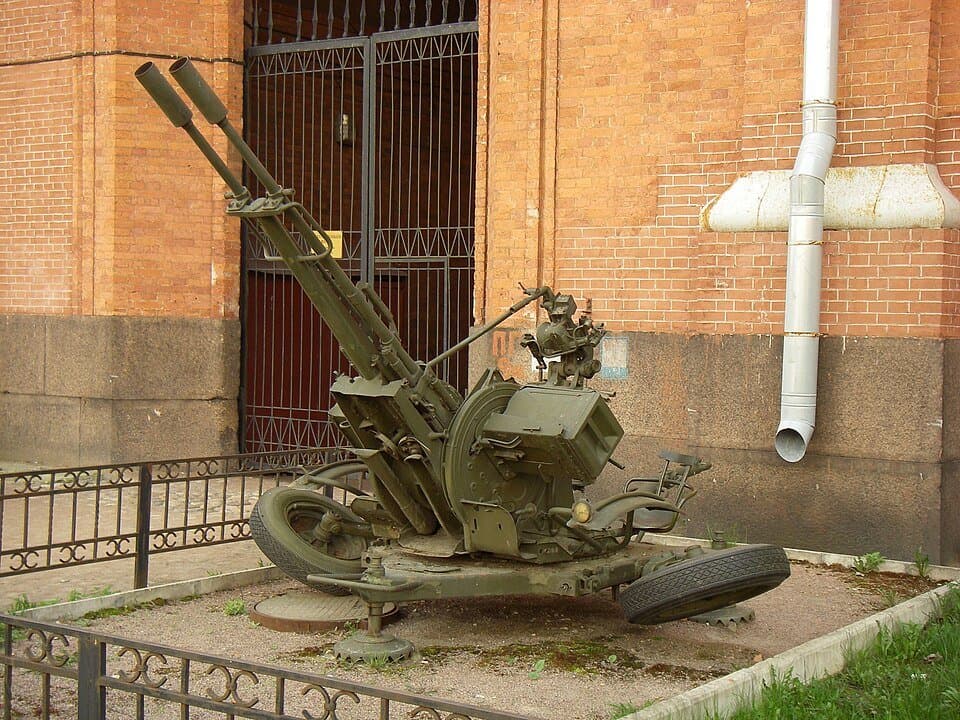
ZU-23-2larger figure on 0 of 1
Counts only measures both sources give with the same scope. A larger figure is not a better system.
Measured figures
Configuration
| Specification | Bofors 120 mm Automatic Gun L/46 | ZU-23-2 |
|---|---|---|
| Type | Anti-aircraft autocannon[source] | Towed 23 mm anti-aircraft twin autocannon[source] |
| Place of origin | Sweden[source] | Soviet Union[source] |
| In service | 1968–present[source] | 1960–present[source] |
| Used by | FAK 120 Swedish Army TAK 120 Finnish Navy Indonesian Navy[source] |
Width
Single source2.88 m (9 ft 5 in)[source]
FAK 120
Single sourceTAK 120
Single sourceFAK 120: 23 t (51,000 lb) TAK 120: 28 t (62,000 lb)[source]
Mass
Single sourceWeight
Single source0.95 tonnes (2,094 lbs)
gunner and commander
Single source2 (gunner and commander)[source]
Muzzle velocity
Single source810 m/s (2,700 ft/s)[source]
Bars compare reported quantities only. A larger figure does not make a system better; configurations and test conditions differ.
See Operators section[source] |
| Designer | AB Bofors[source] | KBP Instrument Design Bureau[source] |
|---|
| Designed | 1963–1967[source] | Late 1950s[source] |
|---|
| Manufacturer | AB Bofors[source] | — |
|---|
| No. built | FAK 120: 1 built TAK 120: 6 built[source] | — |
|---|
| Variants | FAK 120 TAK 120[source] | See Variants and upgrades[source] |
|---|
| Shell | 120 × 615 mm R Bofors[source] | 23x152B[source] |
|---|
| Shell weight | Complete cartridge: 33.7 kg (74 lb) High-Explosive shell: 21 kg (46 lb) Explosive charge: 3.2 kg (7.1 lb) Propellant charge: 5.5 kg (12 lb)[source] | — |
|---|
| Barrels | 1 × liquid-cooled[source] |
|---|
| Recoil | 47 cm (19 in) nominal[source] | — |
|---|
| Elevation | FAK 120: -5°/+85°, 25°/s TAK 120: -10°/+80°, 32°/s, acc 40°/s squared[source] | −10° to +90°[source] |
|---|
| Traverse | FAK 120: 360°, 32°/s TAK 120: 360°, 40°/s, acc 50°/s squared[source] | 360°[source] |
|---|
| Feed system | 52 rounds in feed system[source] | 2x 50 round belt[source] |
|---|
| References | navweaps.com, tdf.chalmers.se, fromtheswedisharchives.wordpress.com[source] | — |
|---|
| Wars | — | Angolan Civil War South African Border War Ethiopian Civil War Lebanese Civil War Soviet–Afghan War Western Sahara War Somali Civil War Iran–Iraq War United States invasion of Grenada Second Sudanese Civil War Siachen conflict Operation Praying Mantis Gulf War Georgian Civil War First Chechen War Second Chechen War War in Afghanistan (2001–2021) South Lebanon conflict (1985–2000) 2006 Lebanon War Russo-Georgian War First Libyan Civil War Sudanese conflict in South Kordofan and Blue Nile Syrian Civil War Northern Mali conflict Russo-Ukrainian War War in Donbas Second Libyan Civil War Yemeni Civil War (2014–present) Tigray War Russo-Ukrainian war War in Amhara Sudanese civil war (2023–present) 2025 India–Pakistan conflict Iran–Israel war 2026 Afghanistan–Pakistan war[source] |
|---|
| Produced | — | 1960–present [1][source] |
|---|
| Action | — | Gas operated[source] |
|---|
| Role | — | Soviet towed 23×152mm anti-aircraft twin-barreled autocannon[source] |
|---|
| Source measurement | — | The ZU-23-2 , also known as ZU-23 , is a Soviet towed 23×152mm anti-aircraft twin-barreled autocannon . ZU stands for Zenitnaya Ustanovka (Russian: Зенитная Установка) – anti-aircraft mount. The GRAU index is 2A13 .[source]ZU-23-2 · Lead; only the objects and conditions stated in this passage The ZU-23-2 was developed in the late 1950s. It was designed to engage low-flying targets at ranges up to 2.5 km as well as armoured vehicles at a range of two kilometres and for direct defence of troops and strategic locations against air assault usually conducted by helicopters and low-flying airplanes. In 1955, KBP presented the single-barrel ZU-1 and the twin-barrel ZU-14 . While the former was eventually dropped, the ZU-14 was selected and, after some modifications, entered series production.[source]ZU-23-2 · Development history; only the objects and conditions stated in this passage The ZU-23-2 (2A13) mounts two 23 mm autocannons on a small trailer which can be converted into a stationary mount for firing the guns. While in this position the wheels are moved aside. The autocannon can be prepared for firing from the march position in 30 seconds and in emergency can be fired from the traveling position. The weapon is aimed and fired manually, with the help of the ZAP-23 optical-mechanical sight which uses manually entered target data to provide limited automatic aiming. It also has a straight-tube telescope T-3 for use against ground targets such as infantry as well as unarmored or lightly armoured vehicles. The ammo is fed by a conveyor belt from two ammunition boxes. Each of the ammunition boxes is located on the side of the twin autocannon and each carries 50 rounds. The fumes created by firing the weapon are partially removed through the side openings in the barrels.[source]ZU-23-2 · Description; only the objects and conditions stated in this passage The cannon carriage is based on the earlier ZPU-2 anti-aircraft twin heavy machine gun, which mounted two KPV 14.5×114mm heavy machine guns . ZU-23-2 can be identified by different placement of the ammunition boxes (at right angles to the gun carriage) and by muzzle flash suppressors. In another similarity to the ZPU series, single-barrel and four-barrel versions of the ZU-23 were also developed. However, these versions never entered service.[source]ZU-23-2 · Description; only the objects and conditions stated in this passage The 23 mm AA gun utilizes the same 23x152B case as the wartime VYa aircraft autocannon. Due to different loadings and primers the ammunition is not interchangeable, however: ammunition of the anti-aircraft cannon can be identified from its steel casings, ammunition for the aircraft cannon having brass cases instead. The following table lists the main characteristics of some of the available 23x152B ammunition used in 23 mm AA guns:[source]ZU-23-2 · Ammunition; only the objects and conditions stated in this passage From 1965 onwards, the Soviet Union began supplying the Democratic Republic of Vietnam with large shipments of weapons. The 23 mm ZU-23-2 was, along with the 37 mm M1939 , the most frequently encountered anti-aircraft gun in Vietnam. Given that 83% of the USAF losses came from ground fire, the ZU-23 was probably responsible for shooting down hundreds of aircraft.[source]ZU-23-2 · Service history; only the objects and conditions stated in this passage On 4 May 2020, ZU-23 was used by Ethiopian troops stationed in Somalia as part of the African Union Mission to Somalia (AMISOM) to mistakenly shoot down an Embraer EMB 120RT Brasilia transporting medical supplies and mosquito nets while on approach to Bardalee, Somalia , killing all six people on board. The confusion arose from the fact the airplane was approaching from the west, instead of the usual easterly landing direction, and overflew the airfield at a low altitude due to animals on or in the vicinity of the runway. Ethiopian soldiers interpreted these facts as indicative of a suicide plane looking to strike targets within the base camp, and responded with fire.[source]ZU-23-2 · Service history; only the objects and conditions stated in this passage ZU-23M – Upgraded variant, designed by the Nudelman Precision Engineering Design Bureau (KB Tochmash). Has new targeting system (which includes laser rangefinder, television channel, optical mechanic device, can be reinforced with thermo location channel and a television system for usage at night) and electromechanic turn system. Optionally, the mount can be fitted with two short-range air-defence missiles, such as the 9M32M "Strela-2M" or the 9M39 "Igla" .[source]ZU-23-2 · Variants and upgrades / Soviet Union/Russian Federation; only the objects and conditions stated in this passage Like the ZU-23M, it has an upgraded fire control system and can optionally be fitted with two launchers for the "Igla" series missile, usually the 9M342 "Igla-S" .[source]ZU-23-2 · Variants and upgrades / Soviet Union/Russian Federation; only the objects and conditions stated in this passage ZUR-23-2S Jod – Polish variant with electro-optical sight GP-1R and twin launcher for Strela-2M missiles, used from 1988.[source]ZU-23-2 · Variants and upgrades / Polish People's Republic / Poland; only the objects and conditions stated in this passage ZUR 23-2KG Jodek-G – Development of ZUR-23-2S with more advanced reflex sight CKE-2 (later CP-1 night-and-day sight with laser rangefinder), electromechanic gun turn system and twin launcher for Grom missiles, produced from 2002.[source]ZU-23-2 · Variants and upgrades / Polish People's Republic / Poland; only the objects and conditions stated in this passage ZUR-23-2KG-I – Improved export version for Indonesia with CKE-2I sight.[source]ZU-23-2 · Variants and upgrades / Polish People's Republic / Poland; only the objects and conditions stated in this passage TR-23-2 – Training simulator version of the ZUR-23-2KG-I.[source]ZU-23-2 · Variants and upgrades / Polish People's Republic / Poland; only the objects and conditions stated in this passage A typical battery consists of up to 6 guns (for example ZUR-23-2 kg), up to 6 Poprad systems, a WD-95 command post and a Radwar MMSR radar.[source]ZU-23-2 · Variants and upgrades / Polish People's Republic / Poland; only the objects and conditions stated in this passage ZU-23-2M Wróbel – Polish naval version of ZU-23-2, hydraulically powered, produced from 1979.[source]ZU-23-2 · Variants and upgrades / Polish People's Republic / Poland; only the objects and conditions stated in this passage ZU-23-2MR Wróbel-II – Polish naval version of ZUR-23-2S, with Strela-2M missiles and water-cooled barrels, produced from 1986[source]ZU-23-2 · Variants and upgrades / Polish People's Republic / Poland; only the objects and conditions stated in this passage ZU-23M – Upgraded version with automatic fire control system, developed by the EVPU company. This version is offered by EVPU and the Punj Lloyd Ltd of India to the Indian army.[source]ZU-23-2 · Variants and upgrades / Slovak Republic; only the objects and conditions stated in this passage ZU 23-M – Licence version of the ZU-23. It is also known as SH-23M and is produced by Abu Zaabal Engineering Industries (Factory 100). Nile 23 – Self-propelled version on the tracked M113 . A system consists of the combat vehicle with ZU 23-M guns and surface-to-air missiles Saqr Eye , and a tracker vehicle, also based on the M113. Sinai 23 – Similar to the Nile 23, with two Zu-23 guns and six Saqr-Eye missiles mounted on a TA-23E turret and fitted with a RA-20S E-band radar. Developed by Dassault and selected by Egypt in preference to Nile 23, entering service by 1992. Instead of the Saqr Eye, FIM-92 Stinger missiles can be used.[source]ZU-23-2 · Variants and upgrades / Egypt; only the objects and conditions stated in this passage Type 85/YW 306 – Reverse-engineered copy of the ZU-23-2, made by NORINCO . Initially it was offered for export as the G-AA-01 . It is referred to as Type 85 gun by some sources. Giant Bow – Also known as Shengong (Deity Bow, 神弓). This is the name of an air-defense system, which consists of up to eight Type 85 guns and a battery command vehicle (BCV). Giant Bow II a.k.a. Shengong-II – This is a more modern version of the Giant Bow and is offered for export since 2005. Apart from the 23 mm guns, it also comprises TY-90 missile launchers and a 3D radar.[source]ZU-23-2 · Variants and upgrades / China; only the objects and conditions stated in this passage Type 87 – Upgraded version with twin 25 mm guns for 25x183B ammunition such as the PG87. After a failed initial design, an improved design was developed in 1979 and ready for evaluation in 1984. The Type 87 gun was accepted for service in 1987. It has the same layout as the original model and consists of two automatic, recoil-operated cannons, a two-wheel cartridge, a Type 86 infrared tracking sight and two 40-round ammunition magazines. The Type 87 fires in either single shot or burst mode, with a cyclic rate of fire of 600~700 rounds/min and has a muzzle velocity of 1,050 m/s. PGZ95 – self-propelled version of the Type 87.[source]ZU-23-2 · Variants and upgrades / China; only the objects and conditions stated in this passage 23mm-2M (alternatively 23-2M ) – an Israeli - Vietnamese co-developed gun turrets solution for the Vietnam Coast Guard patrol vessels . Upgrades include a cabin for the gunner, electromechanic turn system & modern controlling systems as alternatives to the legacy pure-mechanical systems. Ballistic computer & fire-control system are optional. 23mm-2ML (or 23-2ML ) – mostly identical to the above 23-2M except the addition of an optronics sensor and laser rangefinder for better targeting performance & accuracy as well as the potential integration of digital fire-control system .[source]ZU-23-2 · Variants and upgrades / Vietnam; only the objects and conditions stated in this passage Overall dimensions in firing position Length: 4.57 m (15 ft) Width: 2.88 m (9.44 ft) Height: 1.22 m (4 ft)[source]ZU-23-2 · General characteristics; only the objects and conditions stated in this passage Weight: 0.95 tonnes (2,094 lbs)[source]ZU-23-2 · General characteristics; only the objects and conditions stated in this passage Armament: two 2A14 Afanasyev-Yakushev 23x152mm (.90 in) autocannons[source]ZU-23-2 · General characteristics; only the objects and conditions stated in this passage Barrel length: 2 m (6.5 ft)/ 87.3 calibers[source]ZU-23-2 · General characteristics; only the objects and conditions stated in this passage Muzzle velocity: 970 m/s (3,182 ft/s)[source]ZU-23-2 · General characteristics; only the objects and conditions stated in this passage Projectile weight: 186 g (6.27 oz)[source]ZU-23-2 · General characteristics; only the objects and conditions stated in this passage Rate of fire Cyclic: 2,000 rounds per minute Practical: 400 rounds per minute[source]ZU-23-2 · General characteristics; only the objects and conditions stated in this passage Effective range: 2-2.5 km (1.24-1.55 mi)[source]ZU-23-2 · General characteristics; only the objects and conditions stated in this passage Effective altitude: 1,500-2,000 m (4,921-6,562 ft)[source]ZU-23-2 · General characteristics; only the objects and conditions stated in this passage |
|---|
| Country of origin | — | China[source]Inventory Origin column; table 19, row 26, cell 3; revision 1377022818; retrieved 2026-10-02 |
|---|
| Reported operators | — |
|
|---|
Weight: 0.95 tonnes (2,094 lbs)[source]ZU-23-2 · General characteristics · Weight: 0.95 tonnes (2,094 lbs)