



Preparing your view.

At a glance
True scale
Side by side. From every angle. A human reference for perspective.
3.30 MB · Loads when you open it| Model | Length | Width / span | Height |
|---|---|---|---|
| Boeing Vertol CH-46 Sea Knight | ≈ 15.28 m | ≈ 9.83 m (Width) | ≈ 6.42 m |
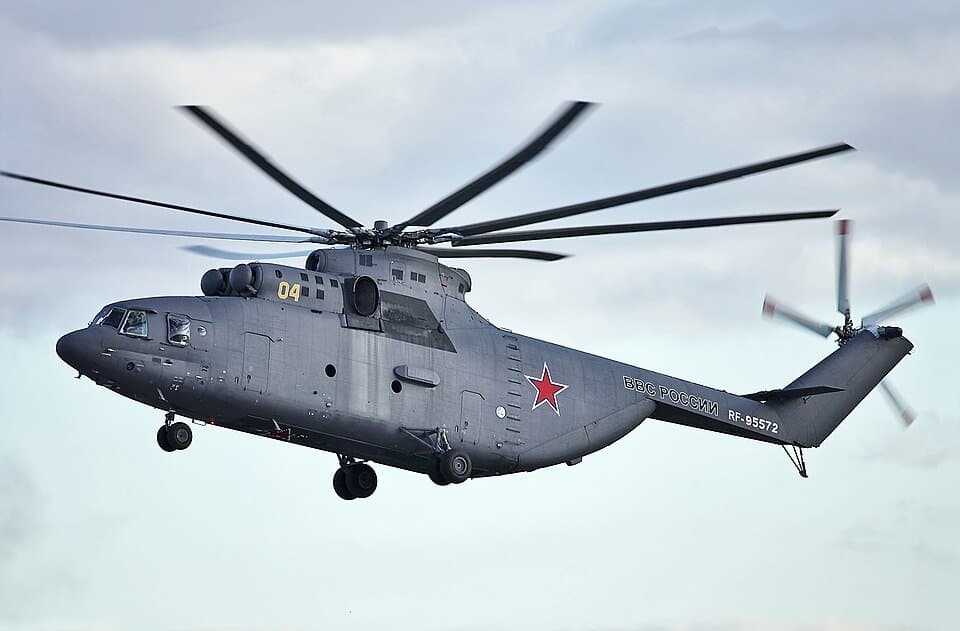
| Mil Mi-26 | ≈ 40.02 m | ≈ 32.11 m (Width) | ≈ 8.15 m |
Scaled uniformly so that the fuselage matches the sourced 13.67 m ch-46e · fuselage length. Not an official model or a measured survey.
ForceTally · All rights reserved
Scaled uniformly to the sourced length of 40.025 m. The height was fitted to the sourced 8.145 m. Not an official model or a measured survey.
ForceTally · All rights reserved
The human reference is a generic 1.75 m figure. Models describe external size, not combat performance.
Measured figures
CH-46E · fuselage
Single source44 ft 10 in (13.67 m) (fuselage)[source]
Configuration
| Specification | Boeing Vertol CH-46 Sea Knight | Mil Mi-26 |
|---|---|---|
| Type | Transport helicopter[source] | Heavy lift transport helicopter[source] |
| National origin | United States[source] | Soviet Union / Russia[source] |
| Manufacturer | Vertol Aircraft Corp. Boeing Vertol[source] | Rostvertol[source] |
| Status | In limited service[source] |
Mi-26 · Length
40.025 m (131 ft 4 in)[source]
Empty; CH-46E · Empty weight
Single sourceGross; CH-46E · Gross weight
Single sourceMaximum take-off; CH-46E · Max takeoff weight
Single source15,537 lb (7,047 kg)[source]
24,300 lb (11,022 kg)[source]
24,300 lb (11,022 kg)[source]
Empty; Mi-26 · Empty weight
Single sourceGross; Mi-26 · Gross weight
Single sourceCruise; CH-46E · maximum at sea level
Single sourceMaximum; CH-46E · at sea level
Single source144 kn (166 mph, 267 km/h) at sea level[source]
143 kn (165 mph, 265 km/h) maximum at sea level[source]
Cruise; Mi-26 · Cruise speed
Single sourceMaximum; Mi-26 · Maximum speed
Single sourceCH-46E · with 2,400 lb (1,100 kg) payload
Single sourceFerry; CH-46E · Ferry range
Single source550 nmi (630 mi, 1,020 km) with 2,400 lb (1,100 kg) payload[source]
600 nmi (690 mi, 1,100 km)[source]
Ferry; Mi-26 · with auxiliary tanks
Single sourceMi-26 · with 7,700 kg (17,000 lb) cargo
Single sourceCH-46E · 2 × General Electric T58-GE-16 turboshaft engines, 1,870 shp ( ) each
Single source2 × General Electric T58-GE-16 turboshaft engines, 1,870 shp (1,390 kW) each[source]
Mi-26 · 2 × ZMKB Progress D-136 turboshaft engines each
Single source2 × ZMKB Progress D-136 turboshaft engines, 8,500 kW (11,400 hp) each[source]
CH-46E · 1,715 ft/min (
Single source1,715 ft/min (8.71 m/s)[source]
Bars compare reported quantities only. A larger figure does not make a system better; configurations and test conditions differ.
In service[source]
| Primary users | United States Marine Corps (historical) United States Navy (historical) Japan Self-Defense Forces (historical)[source] | Russian Aerospace Forces Algerian Air Force Utair Russian Ministry of Emergency Situations[source] |
|---|
| Number built | H-46: 524[source] | Over 300 as of 2026[source] |
|---|
| Manufactured | 1962–1971[source] | 1980–present[source] |
|---|
| Introduction date | 1964[source] | 1983[source] |
|---|
| First flight | 22 April 1958 (V-107)[source] | 14 December 1977[source] |
|---|
| Retired | 2004 (US Navy) 2015 (US Marine Corps)[source] | — |
|---|
| Developed into | Boeing CH-47 Chinook Boeing Model 360[source] | — |
|---|
| Capacity | 24 troops or 15 stretchers and two attendants or 7,000 lb (3,200 kg)[source] | **90 troops or 60 stretchers[source] |
|---|
| Fuel capacity | 350 US gal (290 imp gal; 1,300 L) internal[source] | 12,000 L (3,200 US gal; 2,600 imp gal)[source] |
|---|
| Guns | Two door-mounted 0.5 in (12.7 mm) GAU-15/A machine guns (optional), one ramp-mounted 7.62 mm (0.30 in) M240D machine gun (optional)[source] | — |
|---|
| Main rotor area | 3,926.99 sq ft (364.829 m 2 )[source] | 804.25 m 2 (8,656.9 sq ft)[source] |
|---|
| Rotor blade section | root: Boeing VR-7; tip: Boeing VR-8[source] | — |
|---|
| Hover ceiling IGE | 9,500 ft (2,900 m)[source] | — |
|---|
| Hover ceiling OGE | 5,750 ft (1,750 m)[source] | — |
|---|
| Disk loading | 4.43 lb/sq ft (21.6 kg/m 2 )[source] | — |
|---|
| Power/mass | 0.215 hp/lb (0.353 kW/kg)[source] | — |
|---|
| Designer | — | Mil Moscow Helicopter Plant[source] |
|---|
| Blade section | — | root: TsAGI 12%; tip: TsAGI 9%[source] |
|---|
| Role | — | Soviet / Russian heavy transport helicopter[source] |
|---|
| Source measurement | — | The Mi-26 was designed to replace earlier Mi-6 and Mi-12 heavy lift helicopters and act as a heavy-lift helicopter for military and civil use, having twice the cabin space and payload of the Mi-6, then the world's largest and fastest production helicopter. The primary purpose of the Mi-26 was to transport military equipment such as 13-tonne (29,000 lb) amphibious armored personnel carriers and mobile ballistic missiles to remote locations after delivery by military transport aircraft such as the Antonov An-22 or Ilyushin Il-76 .[source]Mil Mi-26 · Design and development; only the objects and conditions stated in this passage The Mi-26 was the first factory-equipped helicopter with a single, eight-blade main lift rotor . It is capable of flight in the event of power loss by one engine (depending on aircraft mission weight) because of an engine load sharing system. While its empty weight is only slightly higher than the Mi-6's, the Mi-26 has a payload of up to 20 tonnes (44,000 lb). It is the second largest and heaviest helicopter ever constructed, after the experimental Mil V-12. The tail rotor has about the same diameter and thrust as the four-bladed main rotor fitted to the MD Helicopters MD 500 .[source]Mil Mi-26 · Design and development; only the objects and conditions stated in this passage The Mi-26's unique main gearbox is relatively light at 3,639 kg (8,023 lb) but can absorb 14,700 kilowatts (19,725 shp), which was accomplished using a non-planetary, split-torque design with quill shafts for torque equalization. The Mil Design Bureau designed the VR-26 transmission itself, due to Mil's normal gearbox supplier not being able to design such a gearbox. The gearbox housing is stamped aluminum. A split-torque design is also used in the 5,670 kg (12,500 lb) gearbox assembly on the American three-engine Sikorsky CH-53K King Stallion .[source]Mil Mi-26 · Design and development; only the objects and conditions stated in this passage As of 2024 , the Mi-26 still holds the Fédération Aéronautique Internationale world record for the greatest mass lifted by a helicopter to 2,000 metres (6,562 ft) – 56,768.8 kilograms (125,000 lb) on a flight in 1982.[source]Mil Mi-26 · Design and development; only the objects and conditions stated in this passage In July 2010 a proposed Russian-Chinese development of a 33-ton heavy-lift helicopter was announced.[source]Mil Mi-26 · Design and development; only the objects and conditions stated in this passage In October 1999, an Mi-26 was used to transport a 23-tonne (25-short-ton) block of frozen soil encasing a preserved, 23,000-year-old woolly mammoth ( Jarkov Mammoth ) from the Siberian tundra to a lab in Khatanga , Russia . Due to the weight of the load, the Mi-26 had to be returned to the factory afterward to check for airframe and rotor warping caused by the potential of structural over-stressing.[source]Mil Mi-26 · Operational history / Siberian Woolly Mammoth recovery; only the objects and conditions stated in this passage In early 2002, a civilian Mi-26 was leased to recover two U.S. Army MH-47E Chinook helicopters from a mountain in Afghanistan. While the second craft was too badly damaged to recover, the first was determined to be repairable and estimated to weigh 12 tonnes (26,000 lb) with fuel, rotors, and non-essential equipment removed. That weight exceeded the maximum payload of 9.1 tonnes (20,000 lb) at an altitude of 2,600 metres (8,500 ft) of the U.S. military's Sikorsky CH-53E .[source]Mil Mi-26 · Operational history / Afghanistan Chinook recovery; only the objects and conditions stated in this passage The Mi-26 was located through Skylink Aviation in Toronto , which had connections with a Russian company called Sportsflite that operated three civilian Mi-26 versions called "Heavycopters". One of the aircraft, aiding in construction and firefighting work in neighboring Tajikistan, was leased for $300,000; it lifted the Chinook, flew it to Kabul , then later to Bagram Air Base , Afghanistan to ship to Fort Campbell , Kentucky , U.S. for repairs. Six months later, a second U.S. Army CH-47 that had made a hard landing 160 kilometres (100 mi) north of Bagram at an altitude of 1,200 metres (3,900 ft) was recovered by another Sportsflite-operated Mi-26 Heavycopter.[source]Mil Mi-26 · Operational history / Afghanistan Chinook recovery; only the objects and conditions stated in this passage On 14 December 2010, an Indian Air Force Mi-26 crashed seconds after taking off from Jammu Airport , injuring all nine passengers. The aircraft fell from an altitude of about 15 metres (50 ft). The Indian Institute of Flight Safety released an investigation report that stated improper fastening of the truck inside caused an imbalance of the helicopter and led to the crash. The Mi-26 had been carrying machines from Konkan Railway to Jammu–Baramulla line project.[source]Mil Mi-26 · Operational history / Indian Air Force Mi-26 crash; only the objects and conditions stated in this passage Mi-26M[source]Mil Mi-26 · Variants; only the objects and conditions stated in this passage Firefighting version with internal 15,000 litres (4,000 US gal; 3,300 imp gal) fire retardant tank.[source]Mil Mi-26 · Variants; only the objects and conditions stated in this passage Capacity: **90 troops or 60 stretchers 20,000 kg (44,000 lb) cargo[source]Mil Mi-26 · Specifications (Mi-26); only the objects and conditions stated in this passage Length: 40.025 m (131 ft 4 in)[source]Mil Mi-26 · Specifications (Mi-26); only the objects and conditions stated in this passage Height: 8.145 m (26 ft 9 in)[source]Mil Mi-26 · Specifications (Mi-26); only the objects and conditions stated in this passage Empty weight: 28,200 kg (62,170 lb)[source]Mil Mi-26 · Specifications (Mi-26); only the objects and conditions stated in this passage Gross weight: 49,600 kg (109,349 lb)[source]Mil Mi-26 · Specifications (Mi-26); only the objects and conditions stated in this passage Max takeoff weight: 56,000 kg (123,459 lb)[source]Mil Mi-26 · Specifications (Mi-26); only the objects and conditions stated in this passage Powerplant: 2 × ZMKB Progress D-136 turboshaft engines, 8,500 kW (11,400 hp) each[source]Mil Mi-26 · Specifications (Mi-26); only the objects and conditions stated in this passage Main rotor diameter: 32 m (105 ft 0 in)[source]Mil Mi-26 · Specifications (Mi-26); only the objects and conditions stated in this passage Main rotor area: 804.25 m 2 (8,656.9 sq ft)[source]Mil Mi-26 · Specifications (Mi-26); only the objects and conditions stated in this passage Maximum speed: 295 km/h (183 mph, 159 kn)[source]Mil Mi-26 · Specifications (Mi-26); only the objects and conditions stated in this passage Cruise speed: 255 km/h (158 mph, 138 kn)[source]Mil Mi-26 · Specifications (Mi-26); only the objects and conditions stated in this passage Range: 500 km (310 mi, 270 nmi) with 7,700 kg (17,000 lb) cargo[source]Mil Mi-26 · Specifications (Mi-26); only the objects and conditions stated in this passage Ferry range: 1,920 km (1,190 mi, 1,040 nmi) (with auxiliary tanks)[source]Mil Mi-26 · Specifications (Mi-26); only the objects and conditions stated in this passage Service ceiling: 4,600 m (15,100 ft) operational, 1,524 metres (5,000 ft) HOGE at max. gross weight[source]Mil Mi-26 · Specifications (Mi-26); only the objects and conditions stated in this passage |
|---|
Maximum take-off; Mi-26 · Max takeoff weight
Single source