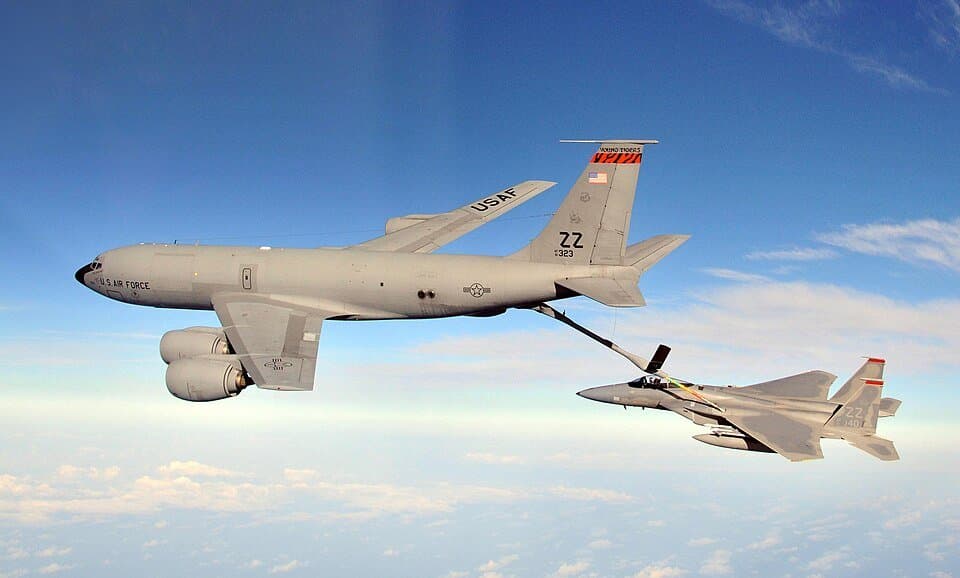

Credit
U.S. Air Force photo/Tech. Sgt. Angelique Perez · Public domain · Resized · Public domain · Source ↗ · Modified


Preparing your view.
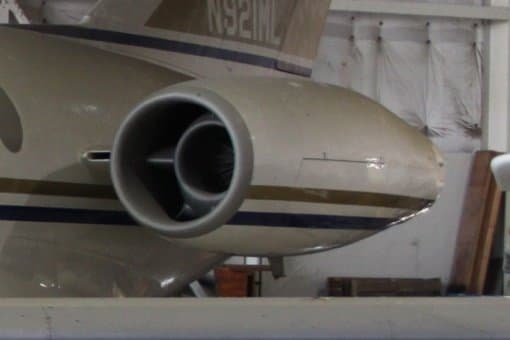

At a glance
Measured figures
KC-135R · Length
Single source136 ft 3 in (41.53 m)[source]
Falcon 20F · Length
Single sourceConfiguration
| Specification | Boeing KC-135 Stratotanker | Dassault Falcon 20 |
|---|---|---|
| Other name | Boeing 717[source] | — |
| Type | Aerial refueling tanker and transport aircraft[source] | Business jet[source] |
| National origin | United States[source] | France[source] |
| Manufacturer | Boeing[source] | Dassault Aviation |
17.15 m (56 ft 3 in)[source]
Empty; KC-135R · Empty weight
Single sourceGross; KC-135R · Gross weight
Single sourceMaximum take-off; KC-135R · Max takeoff weight
Single source98,392 lb (44,630 kg)[source]
297,000 lb (134,717 kg)[source]
322,500 lb (146,284 kg)[source]
Empty; Falcon 20F · Empty weight
Single sourceMaximum take-off; Falcon 20F · Max takeoff weight
Single sourceCruise; KC-135R · at 30,000 ft (9,100 m)
Single sourceMaximum; KC-135R · Maximum speed
Single source504 kn (580 mph, 933 km/h)[source]
460 kn (530 mph, 850 km/h) at 30,000 ft (9,100 m)[source]
Cruise; Falcon 20F · at 12,200 m (40,000 ft) (econ. cruise)
Single sourceMaximum; Falcon 20F · at 7,620 m (25,000 ft) (max cruise)
Single sourceFerry; KC-135R · Ferry range
Single sourceKC-135R · with 150,000 lb (68,039 kg) of transferable fuel
Single source1,300 nmi (1,500 mi, 2,400 km) with 150,000 lb (68,039 kg) of transferable fuel[source]
9,572 nmi (11,015 mi, 17,727 km)[source]
Falcon 20F · Range
Single source3,350 km (2,080 mi, 1,810 nmi)[source]
KC-135R · 4 × CFM International F108-CF-100 turbofan engines thrust each
Single source4 × CFM International F108-CF-100 turbofan engines, 21,600 lbf (96.2 kN) thrust each[source]
Falcon 20F · 2 × General Electric CF700 -2D-2 turbofans thrust each
Single source2 × General Electric CF700 -2D-2 turbofans , 20 kN (4,500 lbf) thrust each[source]
KC-135R · 4,900 ft/min (
Single source4,900 ft/min (25 m/s)[source]
Bars compare reported quantities only. A larger figure does not make a system better; configurations and test conditions differ.
| Status | In service[source] | Out of production, in active service[source] |
|---|
| Primary users | United States Air Force Turkish Air Force Republic of Singapore Air Force (historical)[source] | Federal Express (formerly) French Navy United States Coast Guard[source] |
|---|
| Number built | 803[source] | 512[source] |
|---|
| Manufactured | 1955–1965[source] | 1965–1991[source] |
|---|
| Introduction date | June 1957[source] | 3 June 1965[source] |
|---|
| First flight | 31 August 1956[source] | 4 May 1963[source] |
|---|
| Developed from | Boeing 367-80[source] | — |
|---|
| Variants | Boeing C-135 Stratolifter Boeing NC-135[source] | — |
|---|
| Capacity | up to 80 passengers / 83,000 lb (38,000 kg) or 6 463L pallets[source] | 8–14 passengers[source] |
|---|
| Airfoil | root: BAC 310/311/312; tip: BAC 313[source] | — |
|---|
| Operating empty weight | 124,000 lb (56,245 kg)[source] | — |
|---|
| Fuel capacity | 200,000 lb (90,718 kg) / 29,850 US gal (112,995 L; 24,855 imp gal)[source] | 5,200 L (1,100 imp gal; 1,400 US gal)[source] |
|---|
| Role | American military aerial refueling tanker aircraft[source] | French business jet[source] |
|---|
| Source measurement | In 1950, the USAF operated the world's first production aerial tanker, the Boeing KC-97 Stratofreighter , a gasoline-fueled, piston-engined Boeing Stratocruiser (USAF designation C-97 Stratofreighter ) with a Boeing-developed flying boom and extra kerosene (jet fuel) tanks feeding the boom. The Stratocruiser airliner was developed from the Boeing B-29 Superfortress bomber after World War II . In the KC-97, the mixed gasoline/kerosene fuel system was not desirable, and a jet-powered tanker aircraft obviously would be the next development, having a single type of fuel for both its own engines and for passing to receiver aircraft. The 230 mph (370 km/h) cruise speed of the slower, piston-engined KC-97 was also a serious issue, as using it as an aerial tanker forced the newer, jet-powered military aircraft to slow down to mate with the tanker's boom.[source]Boeing KC-135 Stratotanker · Development / Background; only the objects and conditions stated in this passage Developed in the early 1950s, the basic airframe is characterized by 35°, aft-swept wings and tail , four underwing-mounted engine pods, a horizontal stabilizer mounted on the fuselage near the bottom of the vertical stabilizer with positive dihedral on the two horizontal planes, and a high-frequency radio antenna, which protrudes forward from the top of the vertical fin or stabilizer. These basic features make it strongly resemble the commercial Boeing 707 and 720 aircraft, although it is a different aircraft.[source]Boeing KC-135 Stratotanker · Development / Background; only the objects and conditions stated in this passage All KC-135s were originally equipped with Pratt & Whitney J57-P-59W turbojet engines, which produced 10,000 lbf (44 kN) of thrust dry, and about 13,000 lbf (58 kN) of thrust wet . Wet thrust is achieved through the use of water injection on takeoff, as opposed to "wet thrust" when used to describe an afterburning engine . 670 US gallons (2,500 L) of water are injected into the engines over the course of three minutes. The water is injected into the inlet and the diffuser case in front of the combustion case. The water cools the air in the engine to increase its density; it also reduces the turbine gas temperature, which is a primary limitation on many jet engines. This allows the use of more fuel for proper combustion and creates more thrust for short periods of time, similar in concept to " war emergency power " in a piston-engined aircraft.[source]Boeing KC-135 Stratotanker · Development / Engine retrofits; only the objects and conditions stated in this passage The second modification program retrofitted 500 aircraft with new CFM International CFM56 (military designation: F108) high-bypass turbofan engines produced by General Electric and Safran . The CFM56 engine produces 22,000 lbf (98 kN) of thrust, nearly double compared to the original J57 engine. The modified tanker, designated KC-135R (modified KC-135A or E) or KC-135T (modified KC-135Q), can offload up to 50% more fuel (on a long-duration sortie), is 25% more fuel-efficient, and costs 25% less to operate than with the previous engines. It is also significantly quieter than the KC-135A, with noise levels at takeoff reduced from 126 to 99 decibels . This 27-decibel noise reduction results in a sound pressure level of about 5% of the original level. The KC-135R's operational range is 60% greater than the KC-135E for comparable fuel offloads, providing a wider range of basing options.[source]Boeing KC-135 Stratotanker · Development / Engine retrofits; only the objects and conditions stated in this passage The KC-135R has four turbofan engines, mounted under 35° swept wings, which power it to takeoffs at gross weights up to 322,500 pounds (146,300 kg). Nearly all internal fuel can be pumped through the tanker's flying boom , the KC-135's primary fuel transfer method. A boom operator stationed in the rear of the aircraft controls the boom while lying prone, viewing through a window at the bottom of the tail. Both the flying boom and operator's station are similar to those of the previous KC-97.[source]Boeing KC-135 Stratotanker · Design; only the objects and conditions stated in this passage A special shuttlecock-shaped drogue, attached to and trailing behind the flying boom, may be used to refuel aircraft fitted with probes. This apparatus is significantly more unforgiving of pilot error in the receiving aircraft than conventional trailing hose arrangements; an aircraft so fitted is incapable of refueling by the normal flying-boom method until the attachment is removed. A Cargo deck above the refueling system can hold a mixed load of passengers and cargo. Depending on fuel storage configuration, the KC-135 can carry up to 83,000 pounds (38,000 kg) of cargo.[source]Boeing KC-135 Stratotanker · Design; only the objects and conditions stated in this passage AMC managed 396 Stratotankers, of which the AFR and ANG flew 243 in support of AMC's mission as of May 2018. The KC-135 is one of a few military aircraft types with over 50 years of continuous service with its original operator as of 2009.[source]Boeing KC-135 Stratotanker · Operational history; only the objects and conditions stated in this passage The USAF projected that E and R models have lifetime flying hour limits of 36,000 and 39,000 hours, respectively. Accordingly, only a few KC-135s would reach these limits by 2040, when some aircraft would be about 80 years old. A 2005 USAF study estimated that KC-135Es upgraded to the R standard could remain in use until 2030.[source]Boeing KC-135 Stratotanker · Operational history / Replacements; only the objects and conditions stated in this passage In 2006, the KC-135E fleet was flying an annual average of 350 hours per aircraft. The KC-135R fleet was flying an annual average of 710 hours per aircraft. In March 2009, the Air Force indicated that KC-135s would require additional skin replacement to allow their continued use beyond 2018.[source]Boeing KC-135 Stratotanker · Operational history / Replacements; only the objects and conditions stated in this passage USAF KC-135A, 57-1513 , collided in mid-air with B-52F 57-0036 at 32,000 feet (9,800 m) over Leitchfield , Kentucky, killing all six on board both aircraft.[source]Boeing KC-135 Stratotanker · Accidents; only the objects and conditions stated in this passage USAF KC-135A, 56-3628 , crashed on takeoff in extremely gusty crosswind conditions at Roswell- Walker AFB , New Mexico. The airplane skidded into two other KC-135 tankers (57-1449 and 57–1457) and a hangar and burst into flames. The aircraft was on a training flight, but the instructor pilot was occupying the jump seat instead of one of the pilot seats as directed by the local commander. The destruction of three aircraft, along with the death of all six in the crew plus an additional two deaths on the ground made this a unique mishap.[source]Boeing KC-135 Stratotanker · Accidents; only the objects and conditions stated in this passage USAF KC-135A, 60-0352 on a flight from Ellsworth Air Force Base to Fairchild Air Force Base crashed into a mountain just 20 miles (32 km) northeast of Spokane , Washington. The flight hit fog on approach to the air base and hit Mount Kit Carson , a 5,271 ft (1,607 m) mountain. The crash killed all four crew and 40 passengers on board.[source]Boeing KC-135 Stratotanker · Accidents; only the objects and conditions stated in this passage USAF KC-135A, 61-0322 , collided in mid-air with KC-135A 61-0319 300 miles (480 km) west of Bermuda , killing all 11 on board both aircraft.[source]Boeing KC-135 Stratotanker · Accidents; only the objects and conditions stated in this passage A fatal collision occurred between a B-52G, 58-0256 , and a KC-135A, 61-0273 , flying out of Moron AB , Spain while flying over Palomares , Spain. The B-52G was on an Operation Chrome Dome mission, which required multiple air refuelings. The mishap caused both aircraft to break up in mid-air and killed all four crew members on the KC-135A and three of the seven on the B-52G, while causing radiological contamination, as nuclear weapons had to be recovered from on land and at sea, nearby.[source]Boeing KC-135 Stratotanker · Accidents; only the objects and conditions stated in this passage USAF KC-135A, 56-3613 , crashed into Shadow Mountain, foothill of Mount Spokane (elevation 4,340 ft (1,320 m) MSL) while descending towards Fairchild Air Force Base, killing all nine on board.[source]Boeing KC-135 Stratotanker · Accidents; only the objects and conditions stated in this passage USAF KC-135A, 55-3133 , crashed on landing at Wake Island, Micronesia. Aircraft developed engine problems while en route from Andersen AFB, Guam to Hickam AFB, Hawaii and during landing at Wake Island the aircraft contacted the surface of the water and bounced onto the east end of the runway. There were 11 fatalities out 56 persons on board.[source]Boeing KC-135 Stratotanker · Accidents; only the objects and conditions stated in this passage USAF KC-135A, 61-0296 , crashed while on approach to Wurtsmith Air Force Base, Michigan, killing 15 passengers and flight crew on board. The aircraft was flying a "First Team" mission taking 10 passengers to HQ-Strategic Air Command for briefings and orientation. The crew became distracted by a cabin pressurization problem after an intermediate stop and descended into a wooded area about 12 miles (19 km) southwest of Alpena, Michigan. There was one survivor, reportedly a crew chief who was in the boom operator aft station (boom pod) at the time of the crash.[source]Boeing KC-135 Stratotanker · Accidents; only the objects and conditions stated in this passage Illinois National Guard KC-135A, 58-0031 , exploded in mid-air at 13,700 feet (4,200 m) and crashed at Greenwood, Illinois , due to a possible overheated fuel pump, killing all 27 on board.[source]Boeing KC-135 Stratotanker · Accidents; only the objects and conditions stated in this passage USAF KC-135A, 60-0361 , crashed at Fairchild Air Force Base after encountering wake turbulence from a B-52, while practicing a low-level refueling display. The aircraft rolled 80 degrees to the left, which stalled both left side engines (#1 and #2). The crew was able to recover to wings level, but were too low and impacted the ground in an open area of the base. The accident killed all six on board and one person on the ground.[source]Boeing KC-135 Stratotanker · Accidents; only the objects and conditions stated in this passage USAF KC-135A, 60-0317 , crashed at Wurtsmith Force Base after a hard landing following a steep approach during crosswinds. The airplane went off the side of the runway and broke up. A fire erupted and killed all six crewmembers on board, while 10 passengers were able to jump to safety. Pilot error was determined as the cause of the accident.[source]Boeing KC-135 Stratotanker · Accidents; only the objects and conditions stated in this passage USAF KC-135 suffered a failure of a sighting window next to the sextant port in the cockpit during a trans-Atlantic flight. A boom operator died when he was sucked partway through the 10-inch by 8-inch window opening as the cockpit depressurized. None of the 17 others on board were injured.[source]Boeing KC-135 Stratotanker · Accidents; only the objects and conditions stated in this passage USAF KC-135A, 63-7990 , crashed on takeoff from Dyess AFB , Texas after the water-injection system for the Pratt & Whitney J-57 engines failed and the remaining "dry" thrust was insufficient for flight at the takeoff gross weight. The mission was scheduled as a non-stop flight to Hickam AFB /Honolulu Hawaii with an en route F-16 air refueling mission. 7 crew members and 12 passengers, including military spouses, retired military members and one child, were killed. The aircraft and crew were based at K I Sawyer AFB, Michigan.[source]Boeing KC-135 Stratotanker · Accidents; only the objects and conditions stated in this passage KC-135A, 56-3592 , from en route from Loring Air Force Base crashed into a hill along the west side of Trans-Canada Highway 2 at Carlingford , New Brunswick due to an overheated fuel pump, killing all four crew members. After five accidents involving fuel pump overheating, crews were to keep 3,000 pounds (1,400 kg) of fuel in the tank.[source]Boeing KC-135 Stratotanker · Accidents; only the objects and conditions stated in this passage USAF KC-135R, 63-8886 , was damaged beyond economical repair when it was struck by a Tupolev Tu-154 of Altyn Air , EX-85718 , while stopped on a taxiway after landing at Manas Air Base . As the Tu-154 took off, its right wing struck the fairing of the KC-135R's No. 1 engine. The force of the impact nearly severed the No. 1 engine and destroyed a portion of the left wing. The resulting fire caused extensive damage to the KC-135. The Tu-154 lost about 6 feet (1.8 m) of its right wingtip, but was able to get airborne and return to the airport for an emergency landing. The tanker crew had been directed to use a taxiway which was not usable for night operations and the controller failed to note that they reported "holding short" of that taxiway, rather than "clear of" that point. The crew of the KC-135 evacuated the aircraft without serious injuries.[source]Boeing KC-135 Stratotanker · Accidents; only the objects and conditions stated in this passage USAF KC-135R, 63-8877 , broke up in flight about eight minutes after taking off from Manas Air base in Kyrgyzstan , killing all three crew members. After investigation, it was determined that a rudder power control unit malfunction led to a Dutch roll oscillatory instability. Not recognizing the Dutch roll, the crew used the rudder to stay on course, which exacerbated the instability, leading to an unrecoverable flight condition. The over-stressed tail section detached and the aircraft broke apart soon after. The aircraft was at cruise altitude about 200 km west of Bishkek before it crashed in a mountainous area near the village of Chorgolu, close to the border between Kyrgyzstan and Kazakhstan .[source]Boeing KC-135 Stratotanker · Accidents; only the objects and conditions stated in this passage Capacity: up to 80 passengers / 83,000 lb (38,000 kg) or 6 463L pallets[source]Boeing KC-135 Stratotanker · Specifications (KC-135R); only the objects and conditions stated in this passage Length: 136 ft 3 in (41.53 m)[source]Boeing KC-135 Stratotanker · Specifications (KC-135R); only the objects and conditions stated in this passage Wingspan: 130 ft 10 in (39.88 m)[source]Boeing KC-135 Stratotanker · Specifications (KC-135R); only the objects and conditions stated in this passage Height: 41 ft 8 in (12.70 m)[source]Boeing KC-135 Stratotanker · Specifications (KC-135R); only the objects and conditions stated in this passage Wing area: 2,433 sq ft (226.0 m 2 )[source]Boeing KC-135 Stratotanker · Specifications (KC-135R); only the objects and conditions stated in this passage Empty weight: 98,392 lb (44,630 kg)[source]Boeing KC-135 Stratotanker · Specifications (KC-135R); only the objects and conditions stated in this passage Operating empty weight: 124,000 lb (56,245 kg)[source]Boeing KC-135 Stratotanker · Specifications (KC-135R); only the objects and conditions stated in this passage Gross weight: 297,000 lb (134,717 kg)[source]Boeing KC-135 Stratotanker · Specifications (KC-135R); only the objects and conditions stated in this passage Max takeoff weight: 322,500 lb (146,284 kg)[source]Boeing KC-135 Stratotanker · Specifications (KC-135R); only the objects and conditions stated in this passage Fuel capacity: 200,000 lb (90,718 kg) / 29,850 US gal (112,995 L; 24,855 imp gal)[source]Boeing KC-135 Stratotanker · Specifications (KC-135R); only the objects and conditions stated in this passage Powerplant: 4 × CFM International F108-CF-100 turbofan engines, 21,600 lbf (96.2 kN) thrust each[source]Boeing KC-135 Stratotanker · Specifications (KC-135R); only the objects and conditions stated in this passage Maximum speed: 504 kn (580 mph, 933 km/h)[source]Boeing KC-135 Stratotanker · Specifications (KC-135R); only the objects and conditions stated in this passage Cruise speed: 460 kn (530 mph, 850 km/h) at 30,000 ft (9,100 m)[source]Boeing KC-135 Stratotanker · Specifications (KC-135R); only the objects and conditions stated in this passage Range: 1,300 nmi (1,500 mi, 2,400 km) with 150,000 lb (68,039 kg) of transferable fuel[source]Boeing KC-135 Stratotanker · Specifications (KC-135R); only the objects and conditions stated in this passage Ferry range: 9,572 nmi (11,015 mi, 17,727 km)[source]Boeing KC-135 Stratotanker · Specifications (KC-135R); only the objects and conditions stated in this passage Service ceiling: 50,000 ft (15,000 m)[source]Boeing KC-135 Stratotanker · Specifications (KC-135R); only the objects and conditions stated in this passage Rate of climb: 4,900 ft/min (25 m/s)[source]Boeing KC-135 Stratotanker · Specifications (KC-135R); only the objects and conditions stated in this passage | During the 1950s and 1960s, the French government, which had taken a significant interest in the re-establishment and growth of its national aviation industries in the aftermath of the Second World War , developed a detailed request for a combined liaison / trainer aircraft, to be equipped with twin-turbofan engines. Among those companies that took interest in the government request was French aircraft manufacturer Dassault Aviation . In December 1961, French aircraft designer and head of Dassault Aviation, Marcel Dassault , gave the go-ahead to proceed with work towards the production of an eight- to 10-seat executive jet /military liaison aircraft, which was initially named as the Dassault-Breguet Mystère 20 . The emerging design was of a low-wing monoplane, which drew upon the aerodynamics of the transonic Dassault Mystère IV fighter-bomber , and was equipped with a pair of rear-mounted 14.68 kN (3,300 lbf) Pratt & Whitney JT12A-8 turbojet engines.[source]Dassault Falcon 20 · Development / Origins; only the objects and conditions stated in this passage Progress between Dassault and Pan Am was rapid, moving from engineering evaluations of the type to the formation of general agreements between the two companies. In response to feedback received from Pan American, the aircraft was re-engined with a pair of General Electric CF700 engines and several dimensions were increased. Accordingly, Pan American formed an agreement with Dassault to distribute the Mystère 20 in the western hemisphere; the firm placed an initial order for 40 aircraft along with options for a further 120. On 10 July 1964, the re-engined aircraft made its first flight. On 1 January 1965, the first production aircraft performed its maiden flight; in June 1965, both French and American type certifications were awarded. On 10 June 1965, French aviator Jacqueline Auriol achieved the women's world speed record using the first Mystère 20 prototype, having flown at an average recorded speed of 859 km/h over a distance of 1000 km.[source]Dassault Falcon 20 · Development / Origins; only the objects and conditions stated in this passage In 1973, FedEx's Falcons, designation FA-20-DC, cost $1.2 million each and were modified with a 55-by-74.5-inch forward cargo door with independent power supply, higher mtow, reinforced floor, plugged windows, and bigger brakes.[source] |
|---|
| Developed into | — | Dassault Falcon 10 Dassault Falcon 50[source] |
|---|
| Aspect ratio | — | 6.4:1[source] |
|---|
| Stall speed | — | 152 km/h (94 mph, 82 kn)[source] |
|---|
| Country of origin | — | France[source]Inventory Origin column; table 1, row 54, cell 4; revision 1377423821; retrieved 2026-10-02 |
|---|
862 km/h (536 mph, 465 kn) at 7,620 m (25,000 ft) (max cruise)[source]
750 km/h (470 mph, 400 kn) at 12,200 m (40,000 ft) (econ. cruise)[source]
An improved model of the aircraft, designated the Falcon 200 , was developed, which featured more advanced jet engines and other major improvements to increase range, capacity, and comfort. The Falcon 200, along with the Falcon 20G and HU-25 models, were powered by a pair of Garrett ATF3 engines. According to the magazine Flying , the Falcon 200 variant was more comparable to the newer Falcon 50 trijet than the original Falcon 20 model.[source]Dassault Falcon 20 · Development / Further development; only the objects and conditions stated in this passage
During 2013, the FAA modified 14 CFR part 91 rules to prohibit the operation of jets weighing 75,000 pounds or less that were not Stage 3 noise compliant after 31 December 2015. The Falcon 20 was listed explicitly in Federal Register 78 FR 39576 . Any examples of the type that had not been modified, either by the installation of Stage 3 noise-compliant engines or have had hush kits installed upon noncompliant engines, were no longer permitted to fly anywhere in the contiguous 48 states after 31 December 2015. However, 14 CFR §91.883 Special flight authorizations for jet airplanes weighing 75,000 pounds or less – lists special flight authorizations that may be granted for operation after 31 December 2015.[source]Dassault Falcon 20 · Development / Further development; only the objects and conditions stated in this passage
Prototype, one built. F-WLKB, initially powered by two 14.68 kN (3,300 lbf) Pratt & Whitney JT12A-8 turbojet engines. Now stored at Musée Air et Espace Aéroport Paris – Le Bourget.[source]Dassault Falcon 20 · Variants; only the objects and conditions stated in this passage
Initial production version, with lengthened fuselage compared to first prototype and with 10–12 seats. Powered by 4,200 lbf (19 kN) CF700-2B engines.[source]Dassault Falcon 20 · Variants; only the objects and conditions stated in this passage
Falcon 20CC (s/n 073)[source]Dassault Falcon 20 · Variants; only the objects and conditions stated in this passage
Falcon 20G[source]Dassault Falcon 20 · Variants; only the objects and conditions stated in this passage
Falcon 20H[source]Dassault Falcon 20 · Variants; only the objects and conditions stated in this passage
Improved variant, powered by two 2360-kg (5,200-lb) Garrett ATF3-6A-4C turbofan engines and with more fuel. First flown on 30 April 1980.[source]Dassault Falcon 20 · Variants; only the objects and conditions stated in this passage
United States Coast Guard version of the Falcon 20G. 41 built. Equipped with two Garrett AiResearch Garrett ATF3-6-2C turbofan engines.[source]Dassault Falcon 20 · Variants; only the objects and conditions stated in this passage
Enlarged, 30-passenger commuter airliner derivative of Falcon 20, powered by two 27.0 kN (6,070 lbf) Lycoming ALF 502 D turbofans. One prototype built, first flying on 11 May 1973. No further production of Falcon 30 or proposed 40-passenger, shorter-range Mystére 40-100 .[source]Dassault Falcon 20 · Variants; only the objects and conditions stated in this passage
Pakistan Air Force – 3 in service, including 2 DA-20s in EW , ECM , ESM roles[source]Dassault Falcon 20 · Operators / Current military operators; only the objects and conditions stated in this passage
Royal Australian Air Force – Three in service from 1967 to 1989. No. 34 Squadron RAAF[source]Dassault Falcon 20 · Operators / Former military operators; only the objects and conditions stated in this passage
Capacity: 8–14 passengers[source]Dassault Falcon 20 · Specifications (Falcon 20F); only the objects and conditions stated in this passage
Length: 17.15 m (56 ft 3 in)[source]Dassault Falcon 20 · Specifications (Falcon 20F); only the objects and conditions stated in this passage
Wingspan: 16.30 m (53 ft 6 in)[source]Dassault Falcon 20 · Specifications (Falcon 20F); only the objects and conditions stated in this passage
Height: 5.32 m (17 ft 5 in)[source]Dassault Falcon 20 · Specifications (Falcon 20F); only the objects and conditions stated in this passage
Wing area: 41.00 m 2 (441.3 sq ft)[source]Dassault Falcon 20 · Specifications (Falcon 20F); only the objects and conditions stated in this passage
Empty weight: 7,530 kg (16,601 lb)[source]Dassault Falcon 20 · Specifications (Falcon 20F); only the objects and conditions stated in this passage
Max takeoff weight: 13,000 kg (28,660 lb)[source]Dassault Falcon 20 · Specifications (Falcon 20F); only the objects and conditions stated in this passage
Powerplant: 2 × General Electric CF700 -2D-2 turbofans , 20 kN (4,500 lbf) thrust each[source]Dassault Falcon 20 · Specifications (Falcon 20F); only the objects and conditions stated in this passage
Maximum speed: 862 km/h (536 mph, 465 kn) at 7,620 m (25,000 ft) (max cruise)[source]Dassault Falcon 20 · Specifications (Falcon 20F); only the objects and conditions stated in this passage
Cruise speed: 750 km/h (470 mph, 400 kn) at 12,200 m (40,000 ft) (econ. cruise)[source]Dassault Falcon 20 · Specifications (Falcon 20F); only the objects and conditions stated in this passage
Stall speed: 152 km/h (94 mph, 82 kn)[source]Dassault Falcon 20 · Specifications (Falcon 20F); only the objects and conditions stated in this passage
Range: 3,350 km (2,080 mi, 1,810 nmi)[source]Dassault Falcon 20 · Specifications (Falcon 20F); only the objects and conditions stated in this passage
Service ceiling: 12,800 m (42,000 ft) (absolute ceiling)[source]Dassault Falcon 20 · Specifications (Falcon 20F); only the objects and conditions stated in this passage