

ADrones & UAVs
Boeing Insitu MQ-27 ScanEagle
Small unmanned surveillance and reconnaissance aerial vehicle
Credit
U.S. Navy photo /Released · Public domain · Resized · Public domain · Source ↗ · Modified


Preparing your view.
ADrones & UAVs
Small unmanned surveillance and reconnaissance aerial vehicle

At a glance
Boeing Insitu MQ-27 ScanEaglelarger figure on 1 of 4
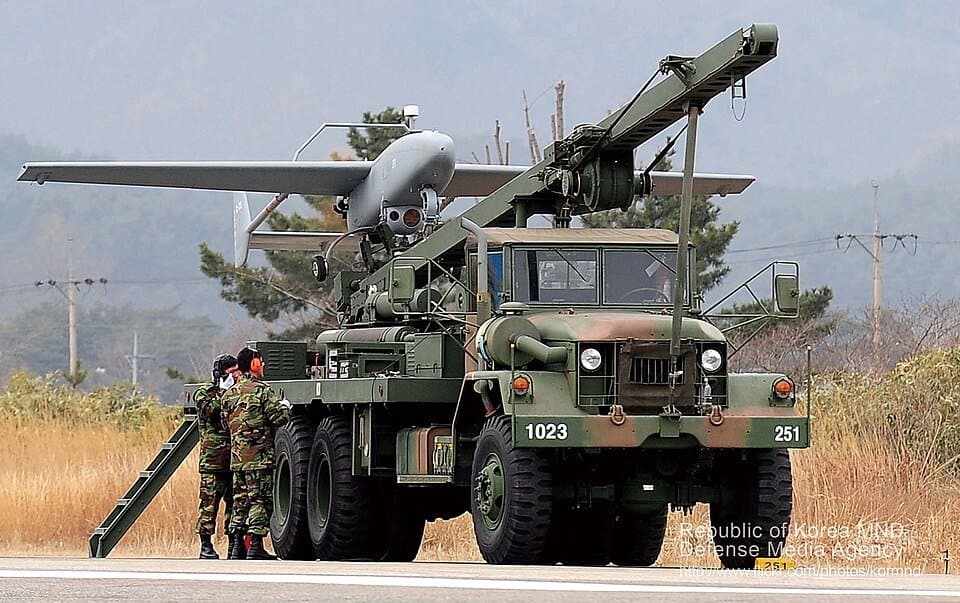
KAI RQ-101 Songgolmaelarger figure on 3 of 4
True scale
Side by side. From every angle. A human reference for perspective.
3.26 MB · Loads when you open it| Model | Length | Width / span | Height |
|---|---|---|---|
| Boeing Insitu MQ-27 ScanEagle | ≈ 1.549 m | ≈ 3.1 m (Width) | ≈ 0.387 m |
| KAI RQ-101 Songgolmae | ≈ 4.7 m | ≈ 5.73 m (Width) | ≈ 1.497 m |
Scaled uniformly to the sourced length of 1.5494 m. The shape was turned square to the axes; the wing panels were fitted to the sourced 3.1 m wingspan. Not an official model or a measured survey.
ForceTally · All rights reserved
Scaled uniformly to the sourced length of 4.7 m. The shape was turned square to the axes. Not an official model or a measured survey.
ForceTally · All rights reserved
The human reference is a generic 1.75 m figure. Models describe external size, not combat performance.
Measured figures
Length · source measurement 1
Single sourceLength · source measurement 2
Single sourceConfiguration
| Specification | Boeing Insitu MQ-27 ScanEagle | KAI RQ-101 Songgolmae |
|---|---|---|
| Crew | none on-board[source] | Unmanned[source] |
| Type | Small unmanned surveillance and reconnaissance aerial vehicle[source] | Unmanned surveillance and reconnaissance aerial vehicle[source] |
| National origin | United States[source] | South Korea[source] |
| Manufacturer | Insitu[source] |
Counts only measures both sources give with the same scope. A larger figure is not a better system.
ScanEagle Specifications · Length
Single sourceLength
Single source4.7 m (15 ft 5 in)[source]
Gross; Gross weight
Single sourceMaximum take-off; Max takeoff weight
Single sourceEmpty; Empty weight
Single sourceMaximum take-off; ScanEagle Specifications · Max takeoff weight
Single source30.90–39.68 lb (14–18 kg)[source]
39.7 lb (18 kg)[source]
58 lb (26.5 kg)[source]
62 lb / 28 kg[source]ScanEagle Specifications
Gross; Gross weight
Single sourceMaximum take-off; Max takeoff weight
Single sourceCruise; Cruise speed
Single sourceMaximum; Maximum speed
Single sourceMaximum; ScanEagle Specifications · Maximum speed
Manufacturer claim80 kn (92 mph, 148 km/h)[source]
60 kn (69 mph, 111 km/h)[source]
80 knots / 41.2 m/s[source]ScanEagle Specifications
Cruise; Cruise speed
Single sourceMaximum; Maximum speed
Single sourceBars compare reported quantities only. A larger figure does not make a system better; configurations and test conditions differ.
Korea Aerospace Industries[source] |
| Primary users | United States Navy United States Marine Corps Royal Australian Navy See Operators section for others[source] | — |
|---|
| Manufactured | 2002–present[source] | 2000–present[source] |
|---|
| Introduction date | 2005 (U.S. Navy)[source] | 2002[source] |
|---|
| First flight | 20 June 2002[source] | 1993[source] |
|---|
| Developed from | Insitu SeaScan[source] | — |
|---|
| Developed into | Boeing Insitu RQ-21 Blackjack[source] | — |
|---|
| Capacity | 11 lb (5 kg)[source] | — |
|---|
| Engine | Heavy fuel (JP-5 or JP 8) or C-10 gasoline engine[source]ScanEagle Specifications | — |
|---|
| Designer | — | Agency for Defense Development Korea Aerospace Industries[source] |
|---|
| Status | — | In service[source] |
|---|
| Primary user | — | Republic of Korea Army[source] |
|---|