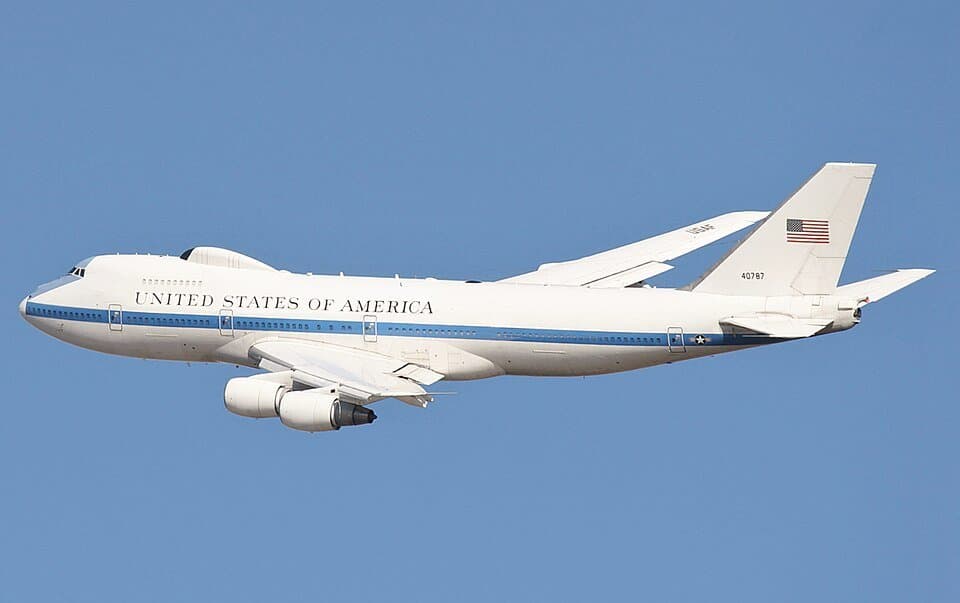

Credit
Masteruploader · Public domain · Resized · Public domain · Source ↗ · Modified


Preparing your view.
At a glance
True scale
Side by side. From every angle. A human reference for perspective.
3.17 MB · Loads when you open it| Model | Length | Width / span | Height |
|---|---|---|---|
| Boeing E-4 | ≈ 70.51 m | ≈ 59.65 m (Width) | ≈ 19.33 m |
| Boeing E-6 Mercury | ≈ 45.82 m | ≈ 45.21 m (Width) | ≈ 12.93 m |
Scaled uniformly to the sourced length of 70.51 m. The shape was turned square to the axes; the height was fitted to the sourced 19.33 m; the width was fitted to the sourced 59.64 m. Not an official model or a measured survey.
ForceTally · All rights reserved
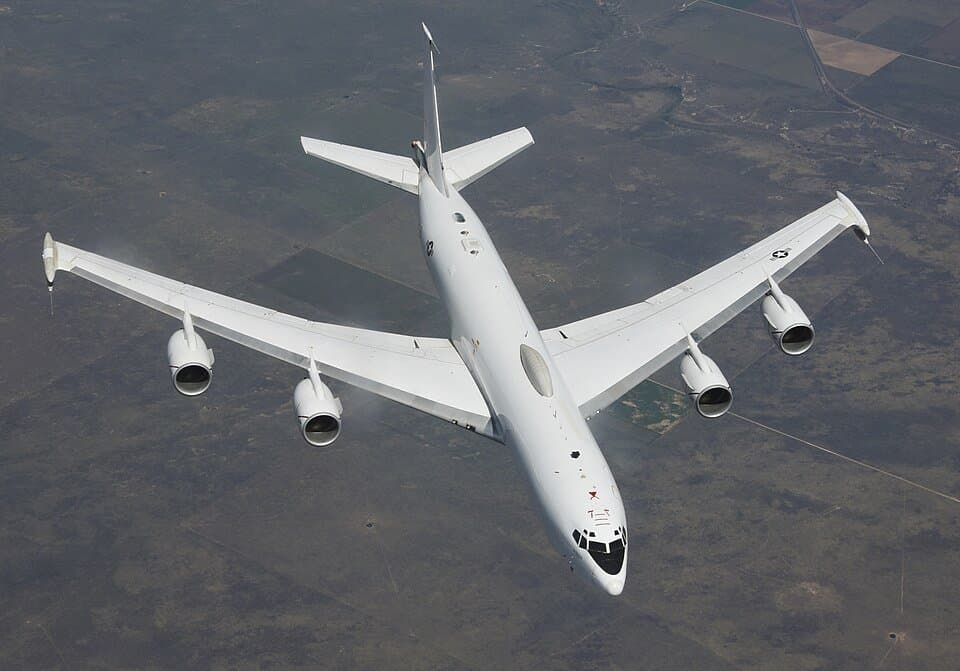
Scaled uniformly to the sourced length of 45.82 m. The shape was turned square to the axes; the height was fitted to the sourced 12.93 m; the width was fitted to the sourced 45.21 m. Not an official model or a measured survey.
ForceTally · All rights reserved
The human reference is a generic 1.75 m figure. Models describe external size, not combat performance.
Measured figures
E-4B · Length
Single source231 ft 4 in (70.51 m)[source]
E-6B · Length
Configuration
| Specification | Boeing E-4 | Boeing E-6 Mercury |
|---|---|---|
| Role | Airborne strategic command and control post[source] | — |
| National origin | United States[source] | — |
| Manufacturer | Boeing[source] | Boeing[source] |
| Status | In service[source] | In service[source] |
| Primary user | United States Air Force[source] |
150 ft 4 in (45.82 m)[source]
Empty; E-4B · Empty weight
Single sourceGross; E-4B · Gross weight
Single sourceMaximum take-off; E-4B · Max takeoff weight
Single source410,000 lb (185,973 kg)[source]
800,000 lb (362,874 kg)[source]
833,000 lb (377,842 kg)[source]
Empty; E-6B · Empty weight
Single sourceMaximum take-off; E-6B · Max takeoff weight
Single sourceE-6B · Combat range
Single source6,350 nmi (7,310 mi, 11,760 km)[source]
E-4B · 4 × General Electric F103 turbofan engines thrust each
Single source4 × General Electric F103 turbofan engines, 52,500 lbf (234 kN) thrust each[source]
150+ hours (with refueling)[source]
E-6B · maximum with multiple refuelings
Single sourceE-6B · on station at 1,000 nmi (1,200 mi; 1,900 km) unrefueled
Single sourceE-6B · with one refueling
Single sourceon station at 1,000 nmi (1,200 mi; 1,900 km) 10 hours 30 minutes unrefueled 28 hours 54 minutes with one refueling 72 hours maximum with multiple refuelings[source]
Bars compare reported quantities only. A larger figure does not make a system better; configurations and test conditions differ.
United States Navy[source] |
| Number built | 16[source] |
|---|
| Introduction date | 1974[source] | August 1989[source] |
|---|
| First flight | 13 June 1973[source] | 19 February 1987[source] |
|---|
| Developed from | Boeing 747-200[source] | Boeing 707[source] |
|---|
| Successors | SNC E-4C Survivable Airborne Operations Center[source] | — |
|---|
| Capacity | up to 108 mission crew[source] | — |
|---|
| Airfoil | root: BAC 463 to BAC 468; tip: BAC 469 to BAC 474[source] | — |
|---|
| Wing loading | 150 lb/sq ft (730 kg/m 2 )[source] | 112.13 lb/sq ft (547.5 kg/m 2 )[source] |
|---|
| Thrust/weight | 0.26[source] | 0.281[source] |
|---|
| Type | — | Airborne command and control[source] |
|---|
| Powerplant | — | 4 × CFM International CFM56-2A-2 turbofan engines[source] |
|---|
| Critical field length | — | 6,700 ft (2,042 m)[source] |
|---|
| Max effort take-off run | — | 5,400 ft (1,646 m)[source] |
|---|
| Landing run at max landing weight | — | 2,600 ft (792 m)[source] |
|---|
| Country of origin | — | Vereinigte Staaten[source]Country of design · Entwurfsland |
|---|