


Preparing your view.
At a glance
Measured figures
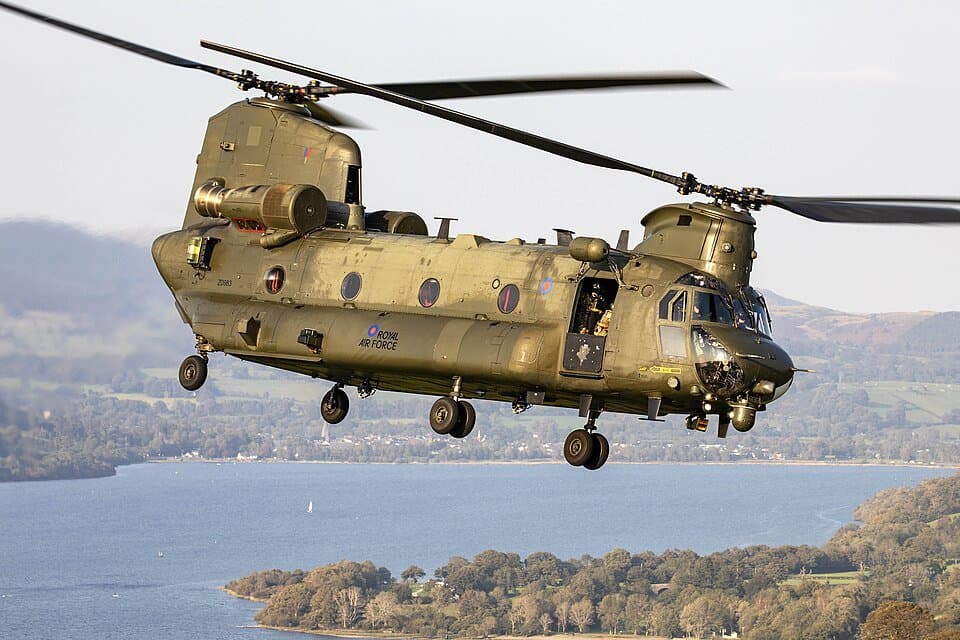
Chinook HC6A · Length
Single sourceChinook / RAF specification (variant not stated) · Length · Length
Single sourceConfiguration
| Specification | Boeing Chinook (UK variants) | Westland Lynx |
|---|---|---|
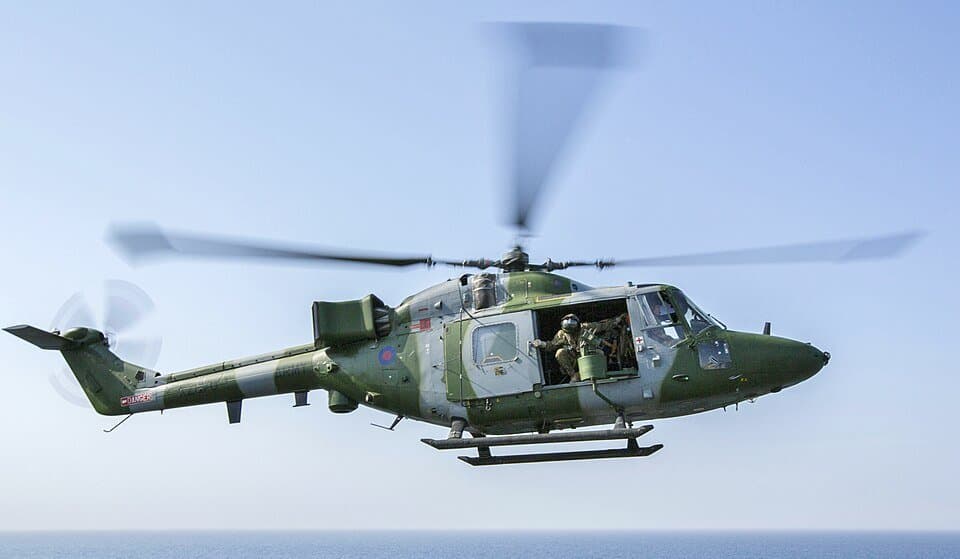
| Type | Transport helicopter[source] | Multi-purpose military helicopter[source] |
| Manufacturer | Boeing Defense, Space & Security[source] | Westland Helicopters AgustaWestland[source] |
| Designer | Boeing-Vertol[source] | — |
| Status | In service[source] | In service[source] |
Super Lynx Series 100 · including tail-rotor
Single source43 ft 9.25 in (13.3414 m) including tail-rotor[source]
Chinook HC6A · 2 ×
Single sourceChinook / RAF specification (variant not stated) · Rotor diameter · Rotor
Single source2 × 60 ft 0 in (18.29 m)[source]
18.29m[source]Chinook / RAF specification (variant not stated) · Rotor
Super Lynx Series 100 · Main rotor diameter
Single source42 ft 0 in (12.80 m)[source]
Chinook HC6A · Height
Single sourceChinook / RAF specification (variant not stated) · Height · Height
Single source18 ft 8 in (5.69 m)[source]
5.77m[source]Chinook / RAF specification (variant not stated) · Height
Super Lynx Series 100 · including tail-rotor
Single source12 ft 0.5 in (3.670 m) including tail-rotor[source]
Empty; Chinook HC6A · Empty weight
Single sourceGross; Chinook HC6A · Gross weight
Single sourceMaximum take-off; Chinook HC6A · Max takeoff weight
Single source22,450 lb (10,183 kg)[source]
26,680 lb (12,102 kg)[source]
50,000 lb (22,680 kg)[source]
Empty; Super Lynx Series 100 · Empty weight
Single sourceMaximum take-off; Super Lynx Series 100 · Max takeoff weight
Single sourceChinook HC6A · pilot, copilot, two weapon system operators/loadmasters
Single source4 (pilot, copilot, two weapon system operators/loadmasters)[source]
2 Pilots, 2 Weapon System Operators[source]Chinook / RAF specification (variant not stated) · AircrewSource text · numeric interpretation needs review
Super Lynx Series 100 · Crew
Single source2-3[source]
Maximum; Chinook HC6A · Maximum speed
Single sourceMaximum; Chinook / RAF specification (variant not stated) · Maximum speed · Maximum speed
Single source160 kn (180 mph, 300 km/h)[source]
160kt[source]Chinook / RAF specification (variant not stated) · Maximum speed
Maximum; Super Lynx Series 100 · Maximum speed
Single source175 kn (201 mph, 324 km/h)[source]
Super Lynx Series 100 · Combat range
Single sourceSuper Lynx Series 100 · with 4x Sea Skua Surveillance 3 hours 50 minutes on station
Single sourceSuper Lynx Series 100 · with auxiliary fuel ASW
Single sourceSuper Lynx Series 100 · with dipping sonar + one torpedo and 2 hours on station Point attack
Single source540 nmi (620 mi, 1,000 km) with auxiliary fuel ASW 20 nmi (23 mi; 37 km) with dipping sonar + one torpedo and 2 hours on station Point attack: 125 nmi (144 mi; 232 km) with 4x Sea Skua Surveillance: 75 nmi (86 mi; 139 km) - 3 hours 50 minutes on station[source]
Chinook HC6A · 2 × Honeywell T55-GA-714A turboshaft free-turbine engines, 3,750 shp ( ) each
Single source2 × Honeywell T55-GA-714A turboshaft free-turbine engines, 3,750 shp (2,800 kW) each[source]
Super Lynx Series 100 · 2 × LHTEC CTS800-4N turboshaft engines, 1,362 shp ( ) each for take-off, 1,267 shp (
Single sourceSuper Lynx Series 100 · ) maximum continuous
Single source2 × LHTEC CTS800-4N turboshaft engines, 1,362 shp (1,016 kW) each for take-off, 1,267 shp (945 kW) maximum continuous[source]
Chinook HC6A · Service ceiling
Single source15,000 ft (4,600 m)[source]
Chinook HC6A · 1,980 ft/min ( )Thrust 2x 4,168shp each engine
Single source1,980 ft/min (10.1 m/s)Thrust 2x 4,168shp each engine[source]
Super Lynx Series 100 · with auxiliary fuel
Single source5 hours 20 minutes with auxiliary fuel[source]
Bars compare reported quantities only. A larger figure does not make a system better; configurations and test conditions differ.
| Primary user | Royal Air Force[source] | — |
|---|
| Number built | 72 (all RAF models)[source] | 450 (as of 2009)[source] |
|---|
| Introduction date | 22 November 1980 (with RAF)[source] | 1978[source] |
|---|
| First flight | 23 March 1980 (HC1)[source] | 21 March 1971[source] |
|---|
| Developed from | Boeing CH-47 Chinook[source] | — |
|---|
| Variants | HC1, HC1B, HC2, HC3, HC4, HC5, HC6, HC6A, HC7[source] | — |
|---|
| Capacity | 55 soldiers and up to 10 tonnes of freight or equipment[source] | 8 troops / 3,000 lb (1,361 kg) maximum underslung load[source] |
|---|
| Guns | 2× M134 Miniguns and 1× M60 machine gun[source] 2 x M134 Miniguns, 1 x M60 Machine Gun[source]Chinook / RAF specification (variant not stated) · Guns | — |
|---|
| Main rotor area | 5,655.2 sq ft (525.39 m 2 )[source] | 1,385.4 sq ft (128.71 m 2 )[source] |
|---|
| Blade section | - root: Boeing VR-7; tip: Boeing VR-8[source] | — |
|---|
| Cockpit Avionics | Glass cockpit with a BAE Systems Digital Advanced Flight Control System (DAFCS), includes automatic modes such as auto-hover and auto-descend to ease pilot workload.[source] | — |
|---|
| Sensors | Electro-Optical Sensor Turret (EOST) with two infrared cameras and a low-light TV function .[source] EOST turret including two infrared cameras and a low-light TV function[source]Chinook / RAF specification (variant not stated) · Electro optics | — |
|---|
| Defensive Aids | Missile Warning Receiver, Infrared Warning Receiver, Radar Warning Receiver, Counter-measure dispensing system (flares).[source] | — |
|---|
| Country of origin | United States[source]Boeing Chinook (UK variants) · origin explicitly stated in the linked current national-inventory row; no inference from operator or shipyard | — |
|---|
| Powerplant | Two Honeywell 55-L-714A Free-Turbine engines[source]Chinook / RAF specification (variant not stated) · Powerplant | — |
|---|
| Reported engine rating | 4,168shp each[source]Chinook / RAF specification (variant not stated) · ThrustSource text · numeric interpretation needs review | — |
|---|
| Flight altitude | 15,000ft[source]Chinook / RAF specification (variant not stated) · Maximum altitude | — |
|---|
| National origin | — | United Kingdom[source] |
|---|
| Primary users | — | British Army (historical) Royal Navy (historical) German Navy See Operators for others[source] |
|---|
| Retired | — | 2011 (Royal Danish Navy) 2012 (Royal Netherlands Navy) 2014 (Royal Norwegian Air Force) 2017 (Royal Navy) 2018 (British Army) 2020 (French Navy)[source] |
|---|
| Developed into | — | Westland 30 AgustaWestland AW159 Wildcat[source] |
|---|
| Fuel capacity | — | 210 imp gal (252 US gal; 955 L) usable internal fuel + optional 75.9 imp gal (91 US gal; 345 L) cabin tank or 2x 97 imp gal (116 US gal; 441 L) ferry tanks[source] |
|---|
| Length overall | — | 50 ft (15.24 m)[source] |
|---|
| Length folded | — | 35 ft 7.25 in (10.85 m)[source] |
|---|
| Width folded | — | 9 ft 7.75 in (2.94 m)[source] |
|---|
| Height folded | — | 10 ft 8 in (3.25 m)[source] |
|---|
| Maximum usable fuel capacity | — | 411 imp gal (494 US gal; 1,868 L)[source] |
|---|
| Blade sections | — | - root: RAE 9648; tip: RAE 9645/9643[source] |
|---|
| Disk loading | — | 41.4 lb/sq ft (202 kg/m 2 ) max[source] |
|---|
| Power/mass | — | 0.1565 shp/lb (0.2573 kW/kg)[source] |
|---|
| Operating weight | — | ASW mission 10,181 lb (4,618 kg) (2x torpedo) ASV mission 9,641 lb (4,373 kg) (2x Sea Skua ) Surveillance and targeting mission 8,174 lb (3,708 kg) SAR mission 8,329 lb (3,778 kg)[source] |
|---|