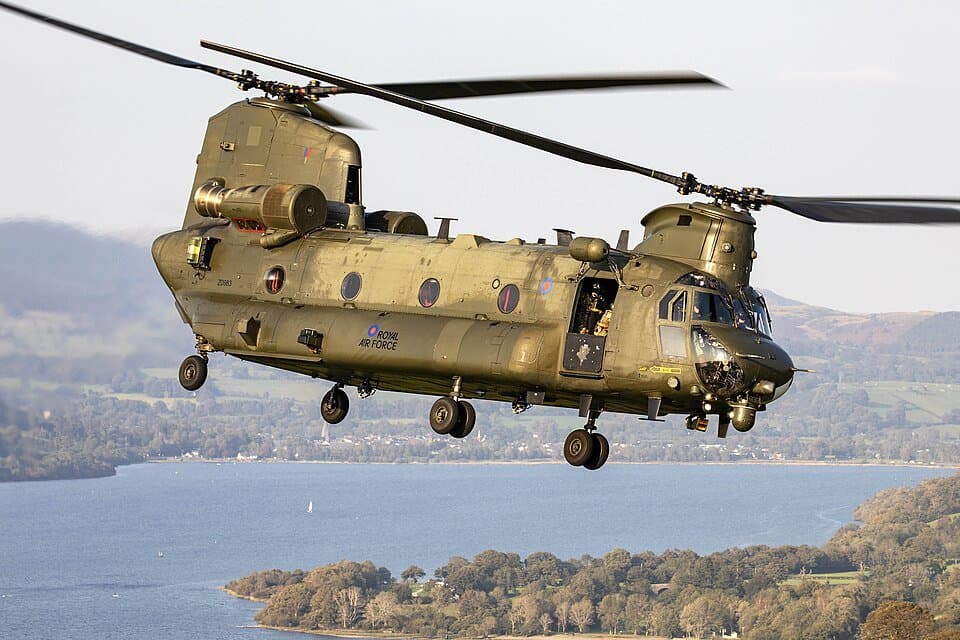



Preparing your view.

At a glance
Measured figures
Chinook HC6A · Length
Single sourceChinook / RAF specification (variant not stated) · Length · Length
Single sourceConfiguration
| Specification | Boeing Chinook (UK variants) | PZL SW-4 Puszczyk |
|---|---|---|
| Type | Transport helicopter[source] | Multipurpose utility helicopter[source] |
| Manufacturer | Boeing Defense, Space & Security[source] | PZL-Świdnik[source] |
| Designer | Boeing-Vertol[source] | — |
| Status | In service[source] | In service[source] |
SW-4 · Length
Single source10.57 m (34 ft 8 in)[source]
Empty; Chinook HC6A · Empty weight
Single sourceGross; Chinook HC6A · Gross weight
Single sourceMaximum take-off; Chinook HC6A · Max takeoff weight
Single source22,450 lb (10,183 kg)[source]
26,680 lb (12,102 kg)[source]
50,000 lb (22,680 kg)[source]
Empty; SW-4 · Empty weight
Single sourceGross; SW-4 · Gross weight
Single sourceChinook HC6A · pilot, copilot, two weapon system operators/loadmasters
Single source4 (pilot, copilot, two weapon system operators/loadmasters)[source]
2 Pilots, 2 Weapon System Operators[source]Chinook / RAF specification (variant not stated) · AircrewSource text · numeric interpretation needs review
SW-4 · Crew
Single sourceMaximum; Chinook HC6A · Maximum speed
Single sourceMaximum; Chinook / RAF specification (variant not stated) · Maximum speed · Maximum speed
Single source160 kn (180 mph, 300 km/h)[source]
160kt[source]Chinook / RAF specification (variant not stated) · Maximum speed
Maximum; SW-4 · Maximum speed
Single source260 km/h (160 mph, 140 kn)[source]
Chinook HC6A · 2 × Honeywell T55-GA-714A turboshaft free-turbine engines, 3,750 shp ( ) each
Single source2 × Honeywell T55-GA-714A turboshaft free-turbine engines, 3,750 shp (2,800 kW) each[source]
SW-4 · 1 × Rolls-Royce 250-C20R/2 turboshaft engine
Single source1 × Rolls-Royce 250-C20R/2 turboshaft engine, 336 kW (451 hp)[source]
Bars compare reported quantities only. A larger figure does not make a system better; configurations and test conditions differ.
| Primary user | Royal Air Force[source] | Polish Armed Forces[source] |
|---|
| Number built | 72 (all RAF models)[source] | 40[source] |
|---|
| Introduction date | 22 November 1980 (with RAF)[source] | 2002[source] |
|---|
| First flight | 23 March 1980 (HC1)[source] | 29 October 1996[source] |
|---|
| Developed from | Boeing CH-47 Chinook[source] | — |
|---|
| Variants | HC1, HC1B, HC2, HC3, HC4, HC5, HC6, HC6A, HC7[source] | — |
|---|
| Capacity | 55 soldiers and up to 10 tonnes of freight or equipment[source] | 4 passengers[source] |
|---|
| Guns | 2× M134 Miniguns and 1× M60 machine gun[source] 2 x M134 Miniguns, 1 x M60 Machine Gun[source]Chinook / RAF specification (variant not stated) · Guns | — |
|---|
| Main rotor area | 5,655.2 sq ft (525.39 m 2 )[source] | 64 m 2 (690 sq ft)[source] |
|---|
| Blade section | - root: Boeing VR-7; tip: Boeing VR-8[source] | — |
|---|
| Cockpit Avionics | Glass cockpit with a BAE Systems Digital Advanced Flight Control System (DAFCS), includes automatic modes such as auto-hover and auto-descend to ease pilot workload.[source] | — |
|---|
| Sensors | Electro-Optical Sensor Turret (EOST) with two infrared cameras and a low-light TV function .[source] EOST turret including two infrared cameras and a low-light TV function[source]Chinook / RAF specification (variant not stated) · Electro optics | — |
|---|
| Defensive Aids | Missile Warning Receiver, Infrared Warning Receiver, Radar Warning Receiver, Counter-measure dispensing system (flares).[source] | — |
|---|
| Country of origin | United States[source]Boeing Chinook (UK variants) · origin explicitly stated in the linked current national-inventory row; no inference from operator or shipyard | — |
|---|
| Powerplant | Two Honeywell 55-L-714A Free-Turbine engines[source]Chinook / RAF specification (variant not stated) · Powerplant | — |
|---|
| Reported engine rating | 4,168shp each[source]Chinook / RAF specification (variant not stated) · ThrustSource text · numeric interpretation needs review | — |
|---|
| Flight altitude | 15,000ft[source]Chinook / RAF specification (variant not stated) · Maximum altitude | — |
|---|
| National origin | — | Poland[source] |
|---|
| Manufactured | — | 1996–present[source] |
|---|
| Disk loading | — | 25 kg/m 2 (5.1 lb/sq ft)[source] |
|---|
| Power/mass | — | 0.21 kW/kg (0.13 hp/lb)[source] |
|---|
| Role | — | Polish light single-engine multipurpose helicopter[source] |
|---|
| Source measurement | — | The original design for the SW-4 called for it to be powered by a 300 kW (400 shp ) PZL Rzeszow GTD350 turboshaft engine, as featured upon the prototype mockup.[source]PZL SW-4 Puszczyk · Development / Origins; only the objects and conditions stated in this passage According to PZL-Swidnik, the early SW-4 could reach the rated top speed of about 240 km/h (130 kn ) and a max range with auxiliary fuel tank about 900 km (485 nmi ).[source]PZL SW-4 Puszczyk · Development / Origins; only the objects and conditions stated in this passage PZL-Świdnik's parent company, AgustaWestland chose to use the SW-4 as the basis for an optionally manned rotorcraft, the PZL-Świdnik SW-4 Solo. In 2011, development of an optionally-manned demonstrator began. The SW-4 Solo was first was shown at the MSPO 2012 in Poland as "SW-4 Solo" RUAS/OPH platform (Rotorcraft Unmanned Air System/Optionally Piloted Helicopter). In 2013, AgustaWestland was given a Royal Navy contract for the SW-4 Solo's development as part of the UK's RWUAS (Rotary Wing Unmanned Air System) Capability Concept Demonstrator (CCD) programme. Development of the SW-4 Solo is also being supported by the Italian Ministry of Defence 's Directorate for Air Armaments under the Italian National Military Research Plan. By September 2015, the SW-4 Solo had performed a total of 26 demonstration flights, which included simulated shipboard integration tests. In November 2015, AgustaWestland stated that the SW-4 Solo was "ready for sale".[source]PZL SW-4 Puszczyk · Development / Further development; only the objects and conditions stated in this passage The SW-4 is powered by a single 335 kW (450 shp ) (283 kW/380 shp max continuous rated) Rolls-Royce Model 250C20R/2 turboshaft engine, which drives the rotorcraft's three-blade main rotor and two-blade tail rotor. An alternative engine is provided in the form of the 460 kW (615 shp) Pratt & Whitney Canada PW200 /9 turboshaft engine. The main rotor is fully articulated and the rotor blades on both the main and tail rotors are composed of composite materials. The SW-4 uses hydraulic flight controls, the rotorcraft has been promoted as possessing excellent flight controls, and can be flown in both day and night visual flight rules conditions.[source]PZL SW-4 Puszczyk · Design; only the objects and conditions stated in this passage The SW-4 is capable of transporting up to five people, including a pilot, in crashworthy seats; passengers are provided with a high level of external visibility and comfort, an optional vibration absorption system is also offered. The main cabin can be rapidly reconfigured between passenger and cargo-carrying configurations and is accessed via two sliding doors on either side of the cabin, a dedicated baggage compartment is also present beneath the main cabin. PZL- Świdnik stated that multi-role operations had been a high priority during the SW-4's development; and that the rotorcraft is well-suited to passenger transport, primary and advanced training, patrol and surveillance missions.[source]PZL SW-4 Puszczyk · Design; only the objects and conditions stated in this passage Various optional equipment can be installed, such as removable co-pilot flight controls, wire strike protection system , a forward looking infrared (FLIR) sensor system, instrument flight rules (IFR) training fittings, radio altimeter, emergency medical system, moving map, external loudspeakers and/or search light, flotation gear, and an external cargo sling. Much of the external equipment is designed to be held on external extension arms; overall, the SW-4 can mount/carry a useful payload of up to nearly 600 kilograms. Both basic and advanced trainer variants of the SW-4 have been developed to conform with NATO standards and military pilot training regulations, it is promoted as possessing a high level of inherent flight stability and safety; the advanced model is compatible with night vision goggles (NVG) and is equipped with an emergency simulation unit.[source]PZL SW-4 Puszczyk · Design; only the objects and conditions stated in this passage Capacity: 4 passengers[source]PZL SW-4 Puszczyk · Specifications (SW-4); only the objects and conditions stated in this passage Length: 10.57 m (34 ft 8 in)[source]PZL SW-4 Puszczyk · Specifications (SW-4); only the objects and conditions stated in this passage Height: 3.05 m (10 ft 0 in)[source]PZL SW-4 Puszczyk · Specifications (SW-4); only the objects and conditions stated in this passage Empty weight: 1,050 kg (2,315 lb)[source]PZL SW-4 Puszczyk · Specifications (SW-4); only the objects and conditions stated in this passage Gross weight: 1,600 kg (3,527 lb)[source]PZL SW-4 Puszczyk · Specifications (SW-4); only the objects and conditions stated in this passage Max takeoff weight: 1,800 kg (3,968 lb)[source]PZL SW-4 Puszczyk · Specifications (SW-4); only the objects and conditions stated in this passage Powerplant: 1 × Rolls-Royce 250-C20R/2 turboshaft engine, 336 kW (451 hp)[source]PZL SW-4 Puszczyk · Specifications (SW-4); only the objects and conditions stated in this passage Main rotor diameter: 9 m (29 ft 6 in)[source]PZL SW-4 Puszczyk · Specifications (SW-4); only the objects and conditions stated in this passage Main rotor area: 64 m 2 (690 sq ft)[source]PZL SW-4 Puszczyk · Specifications (SW-4); only the objects and conditions stated in this passage Maximum speed: 260 km/h (160 mph, 140 kn)[source]PZL SW-4 Puszczyk · Specifications (SW-4); only the objects and conditions stated in this passage Range: 790 km (490 mi, 430 nmi)[source]PZL SW-4 Puszczyk · Specifications (SW-4); only the objects and conditions stated in this passage Service ceiling: 5,200 m (17,100 ft)[source]PZL SW-4 Puszczyk · Specifications (SW-4); only the objects and conditions stated in this passage Rate of climb: 10.3 m/s (2,030 ft/min)[source]PZL SW-4 Puszczyk · Specifications (SW-4); only the objects and conditions stated in this passage |
|---|
Maximum take-off; SW-4 · Max takeoff weight
Single source