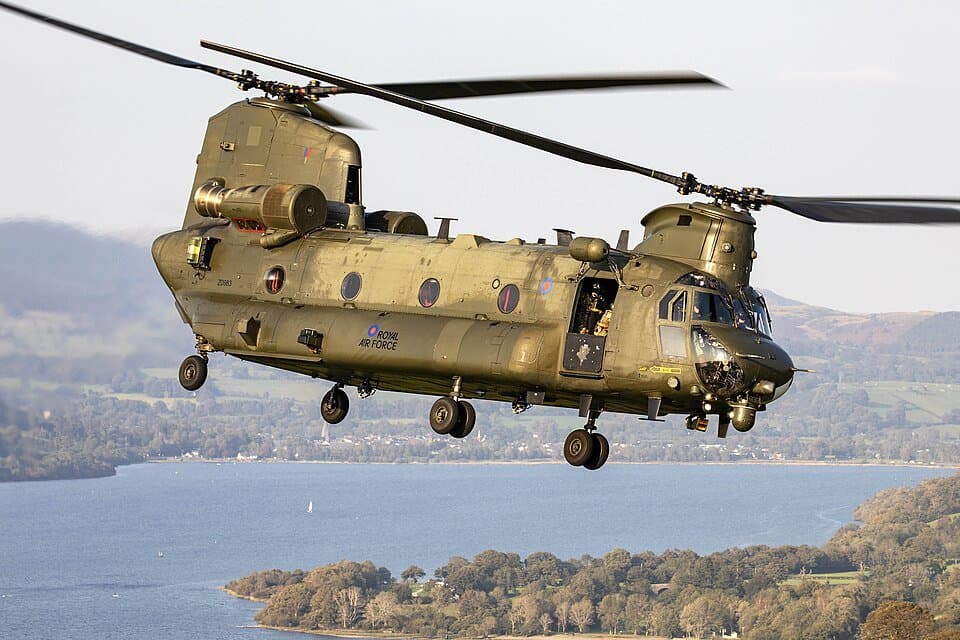



Preparing your view.
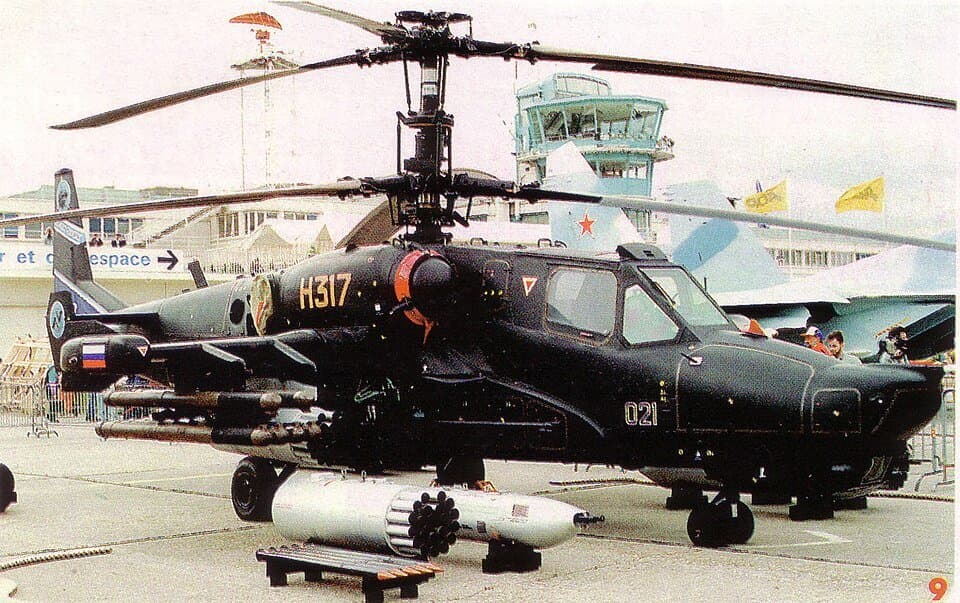
At a glance
Measured figures
Chinook HC6A · Length
Single sourceChinook / RAF specification (variant not stated) · Length · Length
Single sourceConfiguration
| Specification | Boeing Chinook (UK variants) | Kamov Ka-50 |
|---|---|---|
| Type | Transport helicopter[source] | Attack helicopter , scout helicopter[source] |
| Manufacturer | Boeing Defense, Space & Security[source] | Kamov[source] |
| Designer | Boeing-Vertol[source] | — |
| Status | In service[source] | In service[source] |
Ka-50 · Length
Single source16 m (52 ft 6 in)[source]
Empty; Chinook HC6A · Empty weight
Single sourceGross; Chinook HC6A · Gross weight
Single sourceMaximum take-off; Chinook HC6A · Max takeoff weight
Single source22,450 lb (10,183 kg)[source]
26,680 lb (12,102 kg)[source]
50,000 lb (22,680 kg)[source]
Empty; Ka-50 · Empty weight
Single sourceGross; Ka-50 · Gross weight
Single sourceChinook HC6A · pilot, copilot, two weapon system operators/loadmasters
Single source4 (pilot, copilot, two weapon system operators/loadmasters)[source]
2 Pilots, 2 Weapon System Operators[source]Chinook / RAF specification (variant not stated) · AircrewSource text · numeric interpretation needs review
Ka-50 · Crew
Single sourceMaximum; Chinook HC6A · Maximum speed
Single sourceMaximum; Chinook / RAF specification (variant not stated) · Maximum speed · Maximum speed
Single source160 kn (180 mph, 300 km/h)[source]
160kt[source]Chinook / RAF specification (variant not stated) · Maximum speed
Cruise; Ka-50 · Cruise speed
Single sourceMaximum; Ka-50 · Maximum speed
Single sourceKa-50 · Combat range
Single source470 km (290 mi, 250 nmi)[source]
Chinook HC6A · 2 × Honeywell T55-GA-714A turboshaft free-turbine engines, 3,750 shp ( ) each
Single source2 × Honeywell T55-GA-714A turboshaft free-turbine engines, 3,750 shp (2,800 kW) each[source]
Ka-50 · 2 × Klimov VK-2500 turboshaft engines (2,400 shp) each
Single source2 × Klimov VK-2500 turboshaft engines, 1,800 kW (2,400 shp) each[source]
Bars compare reported quantities only. A larger figure does not make a system better; configurations and test conditions differ.
| Primary user | Royal Air Force[source] | — |
|---|
| Number built | 72 (all RAF models)[source] | Ka-50: 18–19 Ka-52: >196[source] |
|---|
| Introduction date | 22 November 1980 (with RAF)[source] | 28 August 1995[source] |
|---|
| First flight | 23 March 1980 (HC1)[source] | Ka-50: 17 June 1982 Ka-52: 25 June 1997 Ka-52M: 9 January 2023[source] |
|---|
| Developed from | Boeing CH-47 Chinook[source] | Kamov V-80[source] |
|---|
| Variants | HC1, HC1B, HC2, HC3, HC4, HC5, HC6, HC6A, HC7[source] | — |
|---|
| Capacity | 55 soldiers and up to 10 tonnes of freight or equipment[source] | — |
|---|
| Guns | 2× M134 Miniguns and 1× M60 machine gun[source] 2 x M134 Miniguns, 1 x M60 Machine Gun[source]Chinook / RAF specification (variant not stated) · Guns | 1 × mobile semi-rigid 30 mm Shipunov 2A42 cannon (460 rounds total, dual feeding AP or HE-Frag )[source] |
|---|
| Main rotor area | 5,655.2 sq ft (525.39 m 2 )[source] | 330.3 m 2 (3,555 sq ft) contra-rotating 3-bladed main rotors[source] |
|---|
| Blade section | - root: Boeing VR-7; tip: Boeing VR-8[source] | — |
|---|
| Cockpit Avionics | Glass cockpit with a BAE Systems Digital Advanced Flight Control System (DAFCS), includes automatic modes such as auto-hover and auto-descend to ease pilot workload.[source] | — |
|---|
| Sensors | Electro-Optical Sensor Turret (EOST) with two infrared cameras and a low-light TV function .[source] EOST turret including two infrared cameras and a low-light TV function[source]Chinook / RAF specification (variant not stated) · Electro optics | — |
|---|
| Defensive Aids | Missile Warning Receiver, Infrared Warning Receiver, Radar Warning Receiver, Counter-measure dispensing system (flares).[source] | — |
|---|
| Country of origin | United States[source]Boeing Chinook (UK variants) · origin explicitly stated in the linked current national-inventory row; no inference from operator or shipyard | — |
|---|
| Powerplant | Two Honeywell 55-L-714A Free-Turbine engines[source]Chinook / RAF specification (variant not stated) · Powerplant | — |
|---|
| Reported engine rating | 4,168shp each[source]Chinook / RAF specification (variant not stated) · ThrustSource text · numeric interpretation needs review | — |
|---|
| Flight altitude | 15,000ft[source]Chinook / RAF specification (variant not stated) · Maximum altitude | — |
|---|
| National origin | — | Soviet Union / Russia[source] |
|---|
| Primary users | — | Russian Aerospace Forces Russian Naval Aviation Egyptian Air Force[source] |
|---|
| Manufactured | — | 1990–present[source] |
|---|
| Never exceed speed | — | 350 km/h (220 mph, 190 kn)[source] |
|---|
| Disk loading | — | 30 kg/m 2 (6.1 lb/sq ft)[source] |
|---|
| Power/mass | — | 0.33 kW/kg (0.20 hp/lb)[source] |
|---|
| Hardpoints | — | 6 × under-wing hardpoints, plus 2 on wingtips for countermeasures or air-to-air missiles with a capacity of 2,000 kg, with provisions to carry combinations of:[source] |
|---|
| Rockets | — | 80 × 80 mm S-8 rockets and 20 × 122 mm S-13 rocket , 4 × Igla air-to-air missiles[source] |
|---|
| Missiles | — | 2 × APU-6 Missile racks, able to accommodate a total of 12 × 9K121 Vikhr anti-tank missiles, 2 × LMUR[source] |
|---|
| Bombs | — | 4 × 250 kg (550 lb) bombs or 2 × 500 kg (1,100 lb) bombs,[source] |
|---|
| Other | — | 23 mm UPK-23-250 gun pods (240 rounds each), 500 L (130 US gal) external fuel tanks.[source] |
|---|
| Role | — | Soviet/Russian single-seat attack helicopter[source] |
|---|
| Source measurement | — | Trials led to two "final" versions: Ka-50N "Night Shark" (Russian: Ночная акула , " velvet belly lanternshark ") and Ka-50Sh (Russian: Ш ар , romanized: Sh ar , "ball"; because of the spherical FLIR turret). The first Ka-50Sh, which was the eighth pre-production aircraft, Bort 018, first flew on 4 March 1997. The Kamov company and Black Shark logos were displayed on the endplate fins and the vertical tail. It featured the Samshit-50 system installed within a 640 mm (25 in) diameter sphere under the nose. Shkval system was moved to the nose cone area. Neither of the Ka-50 night-attack versions has entered full production.[source]Kamov Ka-50 · Development / Ka-50N "Night Shark" and Ka-50Sh; only the objects and conditions stated in this passage The Ka-50-2 is a tandem cockpit variant of the Ka-50. It featured a modern, Israeli-made " glass cockpit " avionics and a turret-mounted folding (for landing clearance) 30 mm cannon instead of the fixed cannon on the Ka-50. It features combat-proven avionics and advanced anti-tank guided missiles for a high level of combat effectiveness. It is equipped with IAI's flexible modular avionics suite, which can be readily tailored to meet the TLF's operational requirements and provides growth potential.[source]Kamov Ka-50 · Development / Ka-50-2 "Erdogan"; only the objects and conditions stated in this passage In comparison to the original Ka-50, the Ka-52 has a new radome with a nose-mounted radar system for targeting, giving the Ka-52 a rounder nose profile. A day-and-night TV/thermal sighting system is fitted in a spherical turret under the nose (some examples have an additional mast radar for aerial targets and a second sighting system above the cockpit). The Ka-52 has the side-mounted cannon of the original Ka-50. It features six wing-mounted hardpoints compared to four on the Ka-50. To keep the weight and performance on par with that of the Ka-50, the armor and the capacity of the cannon magazine/feed were reduced. Also, some flight parameters deteriorated: rate of climb dropped from 10 to 8 m/s and maximum positive load factor became 3.0 g. Most of the problems were solved by installing the new VK-2500 engine. The Ka-52 is approved for day, night and adverse weather conditions.[source]Kamov Ka-50 · Development / Ka-52 "Alligator"; only the objects and conditions stated in this passage The helicopter features the Arbalet-52 dual-band coherent pulse radar, which has an Earth mapping range of 32 km and a detection range of 25 km for ground targets and 15 km for aerial targets.[source]Kamov Ka-50 · Development / Ka-52 "Nile Crocodile"; only the objects and conditions stated in this passage The new version announced by the Russian Ministry of Defence in 2018 eventually crystallized into the Ka-52M; 114 helicopters of this new version are to be acquired. Additionally, older Ka-52s are to be upgraded to Ka-52M standard. The contract for the first 30 Ka-52Ms was signed in August 2021. A new contract was signed in August 2022. Upgrades embodied in the Ka-52M include a modernized GOES-451M electro-optical targeting turret with an increased range, stronger undercarriage wheels, and improved cockpit ergonomics, with better adaptation to the use of night-vision goggles . The LMUR missile is added to the helicopter's armament options. Several new radar types are being considered for the Ka-52M. A new self-protection system will also be fitted to the Ka-52M, replacing the current L370-5 Vitebsk. Lastly, the Ka-52M is adapted to work within a new battlefield command and control system. The Russian military received its first 10 modified Ka-52M helicopters on 9 January 2023. The state defense order for the helicopters was doubled in 2023.[source]Kamov Ka-50 · Development / Ka-52M; only the objects and conditions stated in this passage The hovering ceiling is 4,000 m and vertical rate of climb 10 m/s at an altitude of 2,500 m. Having a coaxial rotor with blades of polymer results in low inertia both relative to vertical and lateral axes, at 50%–75% as compared to a single rotor helicopter with tail rotor. No tail rotor also means it can perform flat turns at all speeds. A maximum vertical load of 3.5 g combined with low inertia makes the Ka-50 highly agile.[source]Kamov Ka-50 · Design / Maneuvering; only the objects and conditions stated in this passage For its own protection, Ka-50 is fitted with a radar warning receiver, electronic warfare system, and chaff and flare dispensers. Aerodynamic cases at wings' ends each contain two dispensers, which in turn have 32 x 26 mm countermeasures each. The whole system works on the principle of evaluated response based on infrared or electronic impulse irradiation. Extensive all-round armour in the cockpit protects the pilot against 12.7 mm armour-piercing bullets and 23 mm projectile fragments. The rotor blades are rated to withstand several hits from ground-based automatic weapons.[source]Kamov Ka-50 · Design / Protection and survivability; only the objects and conditions stated in this passage The aircraft has one Shipunov 2A42 autocannon with selective fire , and a dual-feed, giving it a cyclic rate of fire between 200 and 800 rounds per minute. It is mounted near centre of gravity for accuracy, and carries 460 high-fragmentation, explosive incendiary, or armour-piercing rounds. The type of ammunition is selected by the pilot during flight. The integrated 30 mm cannon is semi-rigidly fixed on the helicopter's side, movable only slightly in elevation and azimuth . Semi-rigid mounting improves the cannon's accuracy, giving the 30 mm a longer practical range and better hit ratio at medium ranges than with a free-turning turret mount.[source]Kamov Ka-50 · Design / Armament; only the objects and conditions stated in this passage Weapons can be carried on four external hardpoints under the stub wings, plus two on the wingtips, a total of more than 2,000 kg (depending on the mix). The pylons can be tilted 10 degrees downward. Fuel tanks may be mounted on a suspension point whenever necessary.[source]Kamov Ka-50 · Design / Armament; only the objects and conditions stated in this passage Anti-tank armament comprises twelve Vikhr laser-guided anti-tank missiles (transl. Vortex or whirlwind), with a maximum range of some 8 km. The laser guidance is reported to be virtually jam-proof, and the system features automatic guidance to target, enabling evasive action immediately after missile launch; alternatively, it can also use Ataka laser-guided anti-tank missiles. Before firing laser-guided missiles, it often must hover a few hundred feet off the ground to direct a laser at a target, leaving itself briefly exposed.[source]Kamov Ka-50 · Design / Armament; only the objects and conditions stated in this passage On 6 February, in the forest-covered mountain area to the south of the village of Tsentoroj, a strike group composed of two Ka-50s and the sole Ka-29 discovered and, from a range of 3 km, destroyed a fortified camp of insurgents using two " 9K121 Vikhr " guided missiles.[source]Kamov Ka-50 · Operational history / Second Chechen War; only the objects and conditions stated in this passage In difficult conditions, pilots found and destroyed eight targets.[source]Kamov Ka-50 · Operational history / Second Chechen War; only the objects and conditions stated in this passage On 4 June, Ukrainian forces of the 128th Mountain Brigade reported the downing of a Russian Ka-52 in the north.[source]Kamov Ka-50 · Operational history / Russo-Ukrainian War; only the objects and conditions stated in this passage Reportedly, a few Ka-52s have suffered from wing vibration under heavy-load attack missions. This was observed months after the invasion. It has been suggested that this may be due to causes such as fatigue, inadequate design, lack of maintenance, and poor management. Ukrainian military intelligence claimed that the Ka-52 can be "disabled with a 7.62mm machine gun" despite a claimed ability to withstand 12.7mm rounds.[source]Kamov Ka-50 · Operational history / Russo-Ukrainian War; only the objects and conditions stated in this passage As of late July 2023, the UK MoD claimed that Russia has lost 40 Ka-52s since the start of the Russian invasion. At the same time the UK MoD said on 27 July 2023: "One of the single most influential Russian weapon systems in the sector is the Ka-52 HOKUM attack helicopter". With the LMUR missile, the Ka-52 has an attack range of 15 km, putting it beyond the range of Ukrainian air defences.[source]Kamov Ka-50 · Operational history / Russo-Ukrainian War; only the objects and conditions stated in this passage On 7 August 2024 during the Ukrainian incursion into Kursk , a Ka-52 was destroyed along with the two-man crew. The Ukrainians are concerned about the ability of the aircraft to carry 9K121 Vikhr air-to-surface missiles, as they are able to penetrate tank armour. The Ka-52 "can carry up to 12 units, allowing it to attack targets from 5 to 11 kilometres."[source]Kamov Ka-50 · Operational history / Russo-Ukrainian War; only the objects and conditions stated in this passage Russia has deployed the Ka-52 against Ukrainian kamikaze drones; downing a number with the Ka-52's 30mm cannon.[source]Kamov Ka-50 · Operational history / Russo-Ukrainian War; only the objects and conditions stated in this passage In June 2015, Sergei Kornev, the head of Rosoboronexport's 's delegation, said that Russia has signed its first contracts on the export of Ka-52 Alligator attack helicopters. "We have the Ka-52 in its export model, and we have contracts for it, and it's already being spun because it has a good, firm future" he said at the airshow outside Paris. Kornev did not specify the volume of contracts or with whom they were signed.[source]Kamov Ka-50 · Operational history / Other; only the objects and conditions stated in this passage Kamov Ka-52M[source]Kamov Ka-50 · Variants; only the objects and conditions stated in this passage Length: 16 m (52 ft 6 in)[source]Kamov Ka-50 · Specifications (Ka-50); only the objects and conditions stated in this passage Height: 4.93 m (16 ft 2 in)[source]Kamov Ka-50 · Specifications (Ka-50); only the objects and conditions stated in this passage Empty weight: 7,700 kg (16,976 lb)[source]Kamov Ka-50 · Specifications (Ka-50); only the objects and conditions stated in this passage Gross weight: 9,800 kg (21,605 lb)[source]Kamov Ka-50 · Specifications (Ka-50); only the objects and conditions stated in this passage Max takeoff weight: 10,800 kg (23,810 lb)[source]Kamov Ka-50 · Specifications (Ka-50); only the objects and conditions stated in this passage Powerplant: 2 × Klimov VK-2500 turboshaft engines, 1,800 kW (2,400 shp) each[source]Kamov Ka-50 · Specifications (Ka-50); only the objects and conditions stated in this passage Main rotor diameter: 2 × 14.5 m (47 ft 7 in)[source]Kamov Ka-50 · Specifications (Ka-50); only the objects and conditions stated in this passage Main rotor area: 330.3 m 2 (3,555 sq ft) contra-rotating 3-bladed main rotors[source]Kamov Ka-50 · Specifications (Ka-50); only the objects and conditions stated in this passage Maximum speed: 315 km/h (196 mph, 170 kn)[source]Kamov Ka-50 · Specifications (Ka-50); only the objects and conditions stated in this passage Cruise speed: 270 km/h (170 mph, 150 kn)[source]Kamov Ka-50 · Specifications (Ka-50); only the objects and conditions stated in this passage Never exceed speed : 350 km/h (220 mph, 190 kn)[source]Kamov Ka-50 · Specifications (Ka-50); only the objects and conditions stated in this passage Range: 545 km (339 mi, 294 nmi)[source]Kamov Ka-50 · Specifications (Ka-50); only the objects and conditions stated in this passage Combat range: 470 km (290 mi, 250 nmi)[source]Kamov Ka-50 · Specifications (Ka-50); only the objects and conditions stated in this passage Ferry range: 1,160 km (720 mi, 630 nmi)[source]Kamov Ka-50 · Specifications (Ka-50); only the objects and conditions stated in this passage Service ceiling: 5,500 m (18,000 ft)[source]Kamov Ka-50 · Specifications (Ka-50); only the objects and conditions stated in this passage Rate of climb: 12 m/s (2,400 ft/min)[source]Kamov Ka-50 · Specifications (Ka-50); only the objects and conditions stated in this passage Guns: 1 × mobile semi-rigid 30 mm Shipunov 2A42 cannon (460 rounds total, dual feeding AP or HE-Frag )[source]Kamov Ka-50 · Specifications (Ka-50); only the objects and conditions stated in this passage Hardpoints: 6 × under-wing hardpoints, plus 2 on wingtips for countermeasures or air-to-air missiles with a capacity of 2,000 kg, with provisions to carry combinations of: Rockets: 80 × 80 mm S-8 rockets and 20 × 122 mm S-13 rocket , 4 × Igla air-to-air missiles Missiles: 2 × APU-6 Missile racks, able to accommodate a total of 12 × 9K121 Vikhr anti-tank missiles, 2 × LMUR Bombs: 4 × 250 kg (550 lb) bombs or 2 × 500 kg (1,100 lb) bombs, Other: 23 mm UPK-23-250 gun pods (240 rounds each), 500 L (130 US gal) external fuel tanks.[source]Kamov Ka-50 · Specifications (Ka-50); only the objects and conditions stated in this passage |
|---|
| Rate of fire | — | rate of fire between 200 and 800 rounds per minute[source]Kamov Ka-50 · Design / Armament · The aircraft has one Shipunov 2A42 autocannon with selective fire , and a dual-feed, giving it a cyclic rate of fire between 200 and 800 rounds per minute. |
|---|
Maximum take-off; Ka-50 · Max takeoff weight
Single source