


Preparing your view.

At a glance
Measured figures
fuselage
Single source3.9 m (12 ft 10 in) (fuselage)[source]
Chinook HC6A · pilot, copilot, two weapon system operators/loadmasters
Single source4 (pilot, copilot, two weapon system operators/loadmasters)[source]
2 Pilots, 2 Weapon System Operators[source]Chinook / RAF specification (variant not stated) · AircrewSource text · numeric interpretation needs review
pilots
Single source2 (pilots)[source]
Maximum; Chinook HC6A · Maximum speed
Single sourceMaximum; Chinook / RAF specification (variant not stated) · Maximum speed · Maximum speed
Single source160 kn (180 mph, 300 km/h)[source]
160kt[source]Chinook / RAF specification (variant not stated) · Maximum speed
Maximum; Maximum speed
Single source243 km/h (151 mph, 131 kn)[source]
Chinook HC6A · 2 × Honeywell T55-GA-714A turboshaft free-turbine engines, 3,750 shp ( ) each
Single source2 × Honeywell T55-GA-714A turboshaft free-turbine engines, 3,750 shp (2,800 kW) each[source]
2 × HAS-Arriel 2L2 turboshaft engines, Take-off Power each
Single source2 × HAS-Arriel 2L2 turboshaft engines, Take-off Power, 770 kW (1,030 hp) each[source]
Bars compare reported quantities only. A larger figure does not make a system better; configurations and test conditions differ.
Configuration
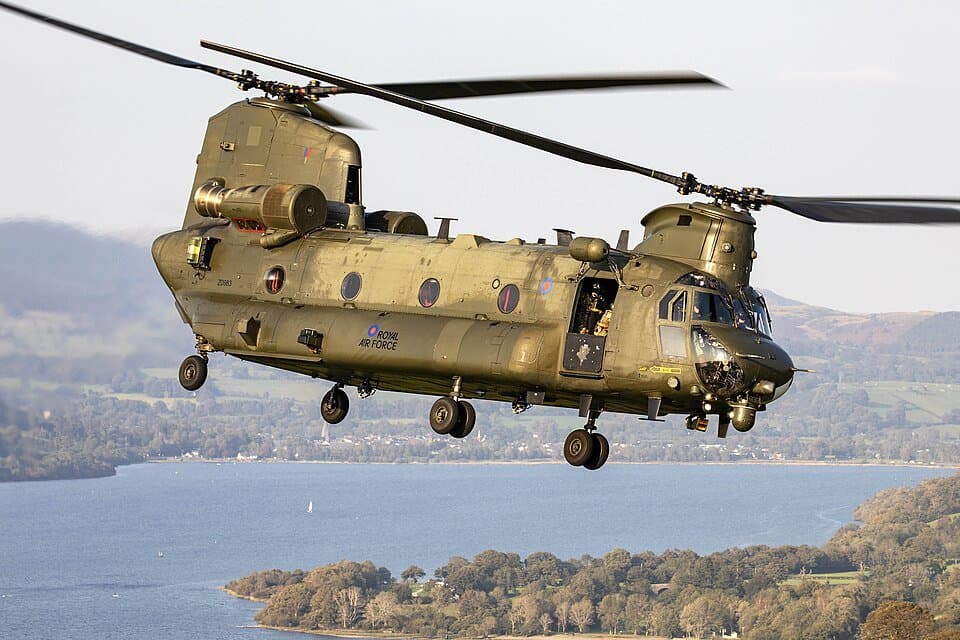
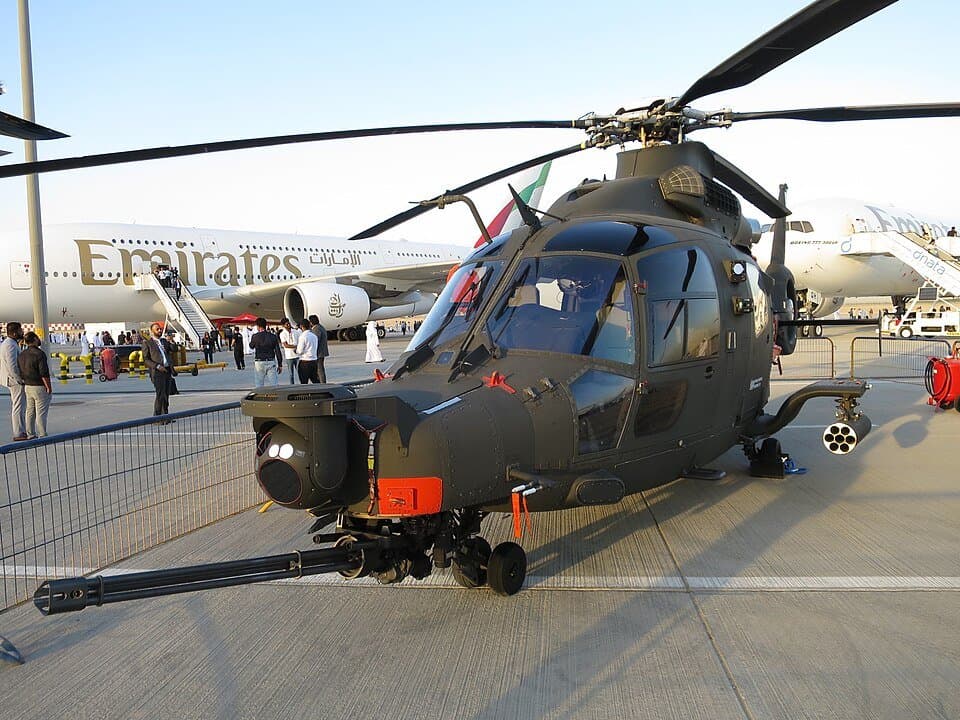
| Specification | Boeing Chinook (UK variants) | KAI LAH-1 Miron |
|---|---|---|
| Type | Transport helicopter[source] | Armed helicopter[source] |
| Manufacturer | Boeing Defense, Space & Security[source] | Korea Aerospace Industries Airbus Helicopters[source] |
| Designer | Boeing-Vertol[source] | Agency for Defense Development[source] |
| Status | In service[source] | In service[source] |
| Primary user | Royal Air Force[source] | Republic of Korea Army[source] |
| Number built | 72 (all RAF models)[source] | |
| Introduction date | 22 November 1980 (with RAF)[source] | — |
| First flight | 23 March 1980 (HC1)[source] | 4 July 2019[source] |
| Developed from | Boeing CH-47 Chinook[source] | Airbus Helicopters H155[source] |
| Variants | HC1, HC1B, HC2, HC3, HC4, HC5, HC6, HC6A, HC7[source] | — |
| Capacity | 55 soldiers and up to 10 tonnes of freight or equipment[source] | 2 x 20mm Magazines (Cabin)[source] |
| Guns | 2× M134 Miniguns and 1× M60 machine gun[source] 2 x M134 Miniguns, 1 x M60 Machine Gun[source]Chinook / RAF specification (variant not stated) · Guns | 1× 20mm M197 electric cannon three-barreled electric Gatling-type rotary cannon[source] |
| Main rotor area | 5,655.2 sq ft (525.39 m 2 )[source] | 124.7 m 2 (1,342 sq ft)[source] |
| Blade section | - root: Boeing VR-7; tip: Boeing VR-8[source] | — |
| Cockpit Avionics | Glass cockpit with a BAE Systems Digital Advanced Flight Control System (DAFCS), includes automatic modes such as auto-hover and auto-descend to ease pilot workload.[source] | — |
| Sensors | Electro-Optical Sensor Turret (EOST) with two infrared cameras and a low-light TV function .[source] EOST turret including two infrared cameras and a low-light TV function[source]Chinook / RAF specification (variant not stated) · Electro optics | — |
| Defensive Aids | Missile Warning Receiver, Infrared Warning Receiver, Radar Warning Receiver, Counter-measure dispensing system (flares).[source] | — |
| Country of origin | United States[source]Boeing Chinook (UK variants) · origin explicitly stated in the linked current national-inventory row; no inference from operator or shipyard | — |
| Powerplant | Two Honeywell 55-L-714A Free-Turbine engines[source]Chinook / RAF specification (variant not stated) · Powerplant | — |
| Reported engine rating | 4,168shp each[source]Chinook / RAF specification (variant not stated) · ThrustSource text · numeric interpretation needs review | — |
| Flight altitude | 15,000ft[source]Chinook / RAF specification (variant not stated) · Maximum altitude | — |
| National origin | — | South Korea[source] |
| Hardpoints | — | 4 , with provisions to carry combinations of:[source] |
| Rockets | — | 2 × seven-shot rocket launcher Hydra 70 (1 launcher on each side)[source] |
| Missiles | — | Air-to-surface missiles: 4 × TAipers Air-to-surface missile (2 on each side)[source] |
| Air-to-surface missiles | — | 4 × TAipers Air-to-surface missile (2 on each side)[source] |
| Role | — | compact twin-engine armed helicopter[source] |
| Source measurement | — | The LAH is armed with a single chin-mounted 20mm three-barreled turret gun and fitted with stub wings for carrying both 70 mm (2.8 in) non-guided rockets and air-to-ground anti-tank missiles .[source]KAI LAH-1 Miron · Development / Design; only the objects and conditions stated in this passage Guided by a dual CCD TV and imaging infrared (IIR) seeker delivering a fire-and-forget capability as well as a fire, observe and update mode using a fiber-optic data-link , it provides an anti-armor capability up to 8 kilometres (5.0 mi) away.[source]KAI LAH-1 Miron · Development / Design; only the objects and conditions stated in this passage Later renamed Cheongeom ( Korean : 천검 ), the missile is 120 mm (4.7 in) in diameter, weighs 16 kg (35 lb), can fly at 200 m/s (720 km/h; 450 mph), and is equipped with a tandem shaped-charge warhead with impact or time delay fuses.[source]KAI LAH-1 Miron · Development / Design; only the objects and conditions stated in this passage On 4 July 2019, the first prototype performed its maiden flight ; on 10 December 2019, it was followed by the second prototype. During December 2020, the LAH was declared to be fit for combat on a provisional basis by DAPA. In April 2021, KAI stated that both the 20mm cannon and 70mm rockets had been integrated with the LAH's target acquisition designation sight, and that testing of the air-to-ground missile would proceed within the year.[source]KAI LAH-1 Miron · Development / Flight test program; only the objects and conditions stated in this passage In September 2022, KAI unveiled a new variant, the Light Utility Helicopter (LUH), which is intended to support operations by special forces ; it is based on the LAH, but has been stripped of non-essential equipment and its troop-carrying capability maximised, not only using the internal cabin but also outboard benches akin to those used on the Boeing MH-6M Little Bird .[source]KAI LAH-1 Miron · Development / Flight test program; only the objects and conditions stated in this passage Capacity: 2 x 20mm Magazines (Cabin)[source]KAI LAH-1 Miron · Specifications; only the objects and conditions stated in this passage Length: 14.3 m (46 ft 11 in)[source]KAI LAH-1 Miron · Specifications; only the objects and conditions stated in this passage Width: 3.9 m (12 ft 10 in) (fuselage)[source]KAI LAH-1 Miron · Specifications; only the objects and conditions stated in this passage Height: 4.3 m (14 ft 1 in)[source]KAI LAH-1 Miron · Specifications; only the objects and conditions stated in this passage Empty weight: 3,400 kg (7,496 lb)[source]KAI LAH-1 Miron · Specifications; only the objects and conditions stated in this passage Gross weight: 4,950 kg (10,913 lb)[source]KAI LAH-1 Miron · Specifications; only the objects and conditions stated in this passage Max takeoff weight: 4,920 kg (10,847 lb)[source]KAI LAH-1 Miron · Specifications; only the objects and conditions stated in this passage Powerplant: 2 × HAS-Arriel 2L2 turboshaft engines, Take-off Power, 770 kW (1,030 hp) each[source]KAI LAH-1 Miron · Specifications; only the objects and conditions stated in this passage Main rotor diameter: 12.6 m (41 ft 4 in)[source]KAI LAH-1 Miron · Specifications; only the objects and conditions stated in this passage Main rotor area: 124.7 m 2 (1,342 sq ft)[source]KAI LAH-1 Miron · Specifications; only the objects and conditions stated in this passage Maximum speed: 243 km/h (151 mph, 131 kn)[source]KAI LAH-1 Miron · Specifications; only the objects and conditions stated in this passage Range: 857 km (533 mi, 463 nmi)[source]KAI LAH-1 Miron · Specifications; only the objects and conditions stated in this passage Ferry range: 985 km (612 mi, 532 nmi)[source]KAI LAH-1 Miron · Specifications; only the objects and conditions stated in this passage Service ceiling: 4,572 m (15,000 ft)[source]KAI LAH-1 Miron · Specifications; only the objects and conditions stated in this passage Rate of climb: 8.9 m/s (1,750 ft/min)[source]KAI LAH-1 Miron · Specifications; only the objects and conditions stated in this passage Guns: 1× 20mm M197 electric cannon three-barreled electric Gatling-type rotary cannon[source]KAI LAH-1 Miron · Specifications; only the objects and conditions stated in this passage |