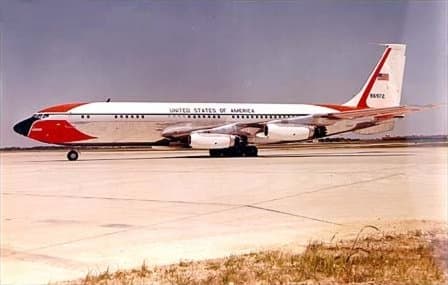

Credit
US Air Force · Public domain · Resized · Public domain · Source ↗ · Modified


Preparing your view.
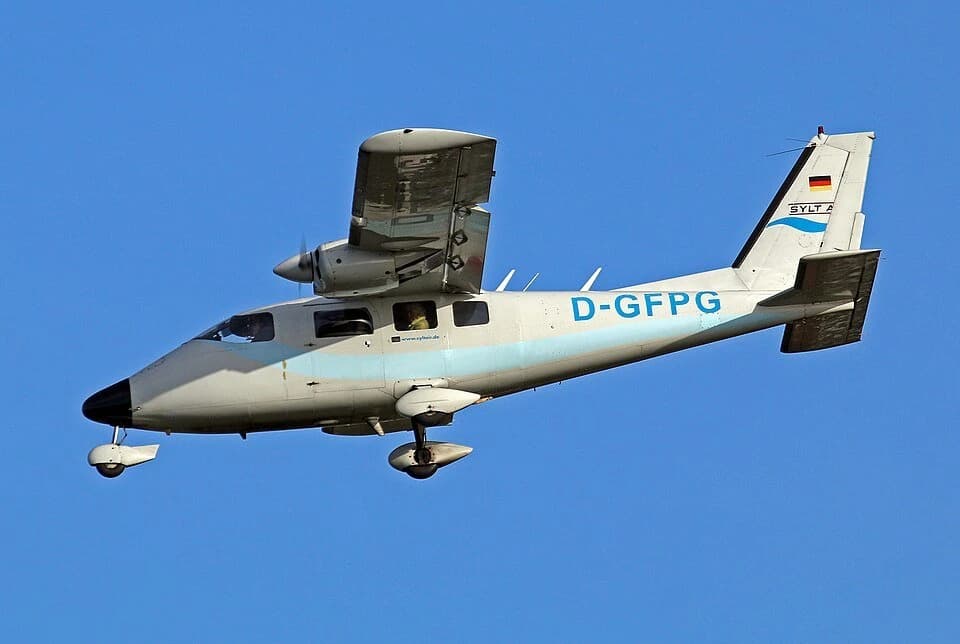

At a glance
Measured figures
VC-137C · Length
Single source152 ft 11 in (46.61 m)[source]
Configuration
| Specification | Boeing C-137 Stratoliner | Partenavia P.68 |
|---|---|---|
| Crew | — | one[source] |
| Type | Passenger/VIP transport[source] | Light transport[source] |
| National origin | United States[source] | — |
| Manufacturer | Boeing[source] | Partenavia Vulcanair[source] |
| Status | Retired |
P.68C · Length
31 ft 0 in (9.55 m)[source]
Empty; VC-137C · Empty weight
Single sourceGross; VC-137C · Gross weight
Single sourceMaximum take-off; VC-137C · Max takeoff weight
Single source98,466 lb (44,663 kg)[source]
297,000 lb (135,000 kg)[source]
327,000 lb (148,325 kg)[source]
Empty; P.68C · Empty weight
Single sourceMaximum take-off; P.68C · Max takeoff weight
Single sourceCruise; VC-137C · Cruise speed
Single sourceMaximum; VC-137C · Maximum speed
Single source627 mph (1,009 km/h, 545 kn)[source]
600 mph (966 km/h, 520 kn)[source]
Cruise; P.68C · at 10,000 ft (3,050 m) (econ cruise)
Single source160 kn (187 mph, 301 km/h) at 10,000 ft (3,050 m) (econ cruise)[source]
P.68C · 2 × Lycoming IO-360 -A1B6 air-cooled horizontally-opposed engine each
Single source2 × Lycoming IO-360 -A1B6 air-cooled horizontally-opposed engine, 200 hp (150 kW) each[source]
VC-137C · 4 × Pratt & Whitney TF33-PW-102 turbofan engines thrust each
Single source4 × Pratt & Whitney TF33-PW-102 turbofan engines , 18,000 lbf (80 kN) thrust each[source]
VC-137C · Wing area
Single source3,010 sq ft (279.63 m 2 )[source]
Bars compare reported quantities only. A larger figure does not make a system better; configurations and test conditions differ.
In service[source] |
| Primary user | United States Air Force[source] | — |
|---|
| Manufactured | 1954–1965[source] | 1970-present[source] |
|---|
| First flight | 31 December 1958[source] | 25 May 1970[source] |
|---|
| Developed from | Boeing 707[source] | — |
|---|
| Variants | Boeing CC-137 VC-137C SAM 26000 VC-137C SAM 27000[source] | — |
|---|
| Role | retired VIP transport aircraft derived[source] | light aircraft[source] |
|---|
| Source measurement | US Air Force procurement of the Boeing 707 was very limited, amounting to three Model 707-153s designated VC-137A. When delivered in 1959 these had four 13,500 lb (6,100 kg) dry thrust Pratt & Whitney J57 (JT3C6) turbojets; when subsequently re-engined with 18,000 lbf (80 kN) dry thrust TF33-P-5 (JT3D) turbofans they were redesignated VC-137B. Only one other variant served with the Air Force: this was the VC-137C Air Force One Presidential transport, the two examples of which were Model 707-320B Intercontinentals with specialized interior furnishings and advanced communications equipment. Two further C-137C aircraft lacking Presidential transport modifications were later added.[source]Boeing C-137 Stratoliner · Development; only the objects and conditions stated in this passage Eight second-hand (former American Airlines ) 707-323Cs bought as crew trainers for the EC-18Bs, four later converted to EC-18B, two converted to EC-18D, one to C-18B; one was not taken into service and was used for spares.[source]Boeing C-137 Stratoliner · Variants / C-18; only the objects and conditions stated in this passage Two second-hand (former Trans World Airlines ) 707-331 aircraft modified for E-3 pilot and crew training.[source]Boeing C-137 Stratoliner · Variants / C-18; only the objects and conditions stated in this passage Two second-hand (former TAP Portugal ) 707-382 aircraft modified for E-6 pilot training.[source]Boeing C-137 Stratoliner · Variants / C-18; only the objects and conditions stated in this passage Length: 152 ft 11 in (46.61 m)[source]Boeing C-137 Stratoliner · Specifications (VC-137C); only the objects and conditions stated in this passage Wingspan: 145 ft 9 in (44.42 m)[source]Boeing C-137 Stratoliner · Specifications (VC-137C); only the objects and conditions stated in this passage Height: 42 ft 5 in (12.93 m)[source]Boeing C-137 Stratoliner · Specifications (VC-137C); only the objects and conditions stated in this passage Wing area: 3,010 sq ft (279.63 m 2 )[source]Boeing C-137 Stratoliner · Specifications (VC-137C); only the objects and conditions stated in this passage Empty weight: 98,466 lb (44,663 kg)[source]Boeing C-137 Stratoliner · Specifications (VC-137C); only the objects and conditions stated in this passage Gross weight: 297,000 lb (135,000 kg)[source]Boeing C-137 Stratoliner · Specifications (VC-137C); only the objects and conditions stated in this passage Max takeoff weight: 327,000 lb (148,325 kg)[source]Boeing C-137 Stratoliner · Specifications (VC-137C); only the objects and conditions stated in this passage Powerplant: 4 × Pratt & Whitney TF33-PW-102 turbofan engines , 18,000 lbf (80 kN) thrust each[source]Boeing C-137 Stratoliner · Specifications (VC-137C); only the objects and conditions stated in this passage Maximum speed: 627 mph (1,009 km/h, 545 kn)[source]Boeing C-137 Stratoliner · Specifications (VC-137C); only the objects and conditions stated in this passage Cruise speed: 600 mph (966 km/h, 520 kn)[source]Boeing C-137 Stratoliner · Specifications (VC-137C); only the objects and conditions stated in this passage Range: 7,610 mi (12,247 km, 6,610 nmi)[source]Boeing C-137 Stratoliner · Specifications (VC-137C); only the objects and conditions stated in this passage Service ceiling: 50,000 ft (15,200 m)[source]Boeing C-137 Stratoliner · Specifications (VC-137C); only the objects and conditions stated in this passage Rate of climb: 4,900 ft/min (25 m/s)[source]Boeing C-137 Stratoliner · Specifications (VC-137C); only the objects and conditions stated in this passage | The type certification for the P.68 Victor , a twin piston engine, high wing monoplane with fixed tricycle landing gear was applied for on 22 January 1969. The Partenavia P.68 was designed as a six-seat light transport and trainer powered by two 200 hp (149 kW) Lycoming IO-360 engines, it made its first flight on 25 May 1970 at Naples . The type certification for the 9.20 m (30.18 ft) long P.68 was granted by the Italian Civil Aviation Authority on 17 November 1971 for an 1860 kg (4100 lb) MTOW . It was approved by the FAA on 7 December 1971. After 300 h of flight tests , production was to start in May 1972 in a new plant at Naples Capodichino Airport at a rate of three aircraft per month. The prototype was built at Arzano , Italy, production began with 14 pre-production aircraft at new facilities in Casoria , Italy.[source]Partenavia P.68 · Development / Partenavia P.68 Victor; only the objects and conditions stated in this passage The longer, 9.35 m (30.68 ft) P.68B Victor certification was applied for on 18 October 1973 and granted on 24 May 1974 for a 1960 kg (4321 lb) MTOW. Its unit cost was US$ 82,000 in 1974 (US$535000 today). Its fuselage was lengthened to create more space in the cockpit.[source]Partenavia P.68 · Development / Partenavia P.68 Victor; only the objects and conditions stated in this passage Both derived from the P.68B and 9.55 m (31.33 ft) long, the P.68R Victor has a retractable landing gear and was certified on 31 July 1978 while the P.68C has a nose allowing a weather radar , larger fuel tanks and increased weights, and was certified on 23 July 1979 with a 1990 kg (4387 lb) MTOW. The P.68C-TC , certified on 29 April 1980, has turbocharged, 210 hp (157 kW) Lycoming TIO-360 -C1A6D engines. In 2021, the equipped price of the P.68C was US$1.25M, US$1.5M for the P.68R and US$1.55M for the P.68C-TC.[source]Partenavia P.68 · Development / Partenavia P.68 Victor; only the objects and conditions stated in this passage The 9.43 m (30.94 ft) long P.68 Observer , derived from the P.68B with a transparent fuselage nose, adapted systems and larger fuel tanks, was certified on 12 June 1980. The observation aircraft for law enforcement were initially conversions of existing aircraft by German Sportavia-Putzer . |
|---|
| Country of origin | United States[source]Inventory Origin column; table 29, row 11, cell 3; revision 1364221460 | Italy[source]Inventory Origin column; table 2, row 6, cell 2; revision 1343823935 |
|---|
| Designer | — | Luigi Pascale[source] |
|---|
| Number built | — | 431+[source] |
|---|
| Capacity | — | plus five passengers[source] |
|---|
| Fuel capacity | — | 177 US gal (147 imp gal; 670 L)[source] |
|---|
| Propellers | — | 2-bladed[source] |
|---|
| Stall speed | — | 57 kn (66 mph, 106 km/h) (flaps down, power off)[source] |
|---|
The 9.15 m (30.02 ft) long P.68TC Observer , a P.68 "Observer" with turbocharged engines, was certified on 18 June 1985.[source]Partenavia P.68 · Development / Partenavia P.68 Observer; only the objects and conditions stated in this passage
The 9.54 m (31.30 ft) long P.68 "Observer 2 is a P.68 "Observer", with increased weights, upturned wing tips and modified systems, and was certified on 30 November 1989 for a 2084 kg (4594 lb) MTOW.[source]Partenavia P.68 · Development / Partenavia P.68 Observer; only the objects and conditions stated in this passage
The 10.89-11.27 m (35.73-36.97 ft) long, retractable gear AP68TP-600 "Viator" , with two 328 hp (245 kW) Allison 250 -B17C turboprops, has a 2850–3000 kg (6283-6614 lb) MTOW and was certified on 16 October 1986. In 2023, its equipped price was $3.5M.[source]Partenavia P.68 · Development / Partenavia AP68TP-600 Viator; only the objects and conditions stated in this passage
The 9.90 m (32.48 ft) long, fixed gear AP68TP-300 Spartacus was certified on 10 December 1983 with two 328 hp (245 kW) Allison 250 -B17C turboprops and a 2600 kg (5732 lb) MTOW . The nine-seater development was helped by Aeritalia . The prototype first flew in 1978 with a retractable undercarriage.[source]Partenavia P.68 · Development / Partenavia AP68TP-300 Spartacus; only the objects and conditions stated in this passage
September 11, 1983: A P.68C, N29561, performing an aerobatic display broke up in flight during an airshow in Plainview, Texas . The NTSB report revealed that analysis of the video showed the aircraft performed a fly-by over the runway, exceeding its Vne (Velocity, never-exceed) speed by 27 knots. The pilot then executed a sharp nose-up pitch change of about 8 degrees, which spiked the aircraft's dynamic load factor to 8.3Gs and caused both wings to fail in the main spar just outside both engine nacelles then separate from the aircraft, which then began rotating, causing the rear fuselage to twist along its length between its cabin and empennage . The aircraft then plummeted 250 feet down just beyond the group of spectators.[source]Partenavia P.68 · Incidents and accidents; only the objects and conditions stated in this passage
Capacity: plus five passengers[source]Partenavia P.68 · Specifications (P.68C); only the objects and conditions stated in this passage
Length: 31 ft 0 in (9.55 m)[source]Partenavia P.68 · Specifications (P.68C); only the objects and conditions stated in this passage
Wingspan: 39 ft 4 in (12 m)[source]Partenavia P.68 · Specifications (P.68C); only the objects and conditions stated in this passage
Height: 12 ft 3 in (3.40 m)[source]Partenavia P.68 · Specifications (P.68C); only the objects and conditions stated in this passage
Empty weight: 3,130 lb (1,420 kg)[source]Partenavia P.68 · Specifications (P.68C); only the objects and conditions stated in this passage
Max takeoff weight: 4,594 lb (2,084 kg)[source]Partenavia P.68 · Specifications (P.68C); only the objects and conditions stated in this passage
Powerplant: 2 × Lycoming IO-360 -A1B6 air-cooled horizontally-opposed engine, 200 hp (150 kW) each[source]Partenavia P.68 · Specifications (P.68C); only the objects and conditions stated in this passage
Cruise speed: 160 kn (187 mph, 301 km/h) at 10,000 ft (3,050 m) (econ cruise)[source]Partenavia P.68 · Specifications (P.68C); only the objects and conditions stated in this passage
Stall speed: 57 kn (66 mph, 106 km/h) (flaps down, power off)[source]Partenavia P.68 · Specifications (P.68C); only the objects and conditions stated in this passage
Range: 1,103 nmi (1,269 mi, 2,043 km) (econ cruise, standard fuel)[source]Partenavia P.68 · Specifications (P.68C); only the objects and conditions stated in this passage
Service ceiling: 18,000 ft (5,490 m)[source]Partenavia P.68 · Specifications (P.68C); only the objects and conditions stated in this passage
Rate of climb: 1,100 ft/min (6.0 m/s)[source]Partenavia P.68 · Specifications (P.68C); only the objects and conditions stated in this passage