
Credit
US Air Force · Public domain · Resized · Public domain · Source ↗ · Modified


Preparing your view.
At a glance
Measured figures
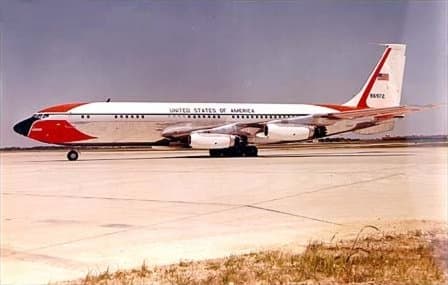
VC-137C · Length
Single source152 ft 11 in (46.61 m)[source]
Configuration
| Specification | Boeing C-137 Stratoliner | Boeing KC-46 Pegasus |
|---|---|---|
| Type | Passenger/VIP transport[source] | Tanker / transport[source] |
| National origin | United States[source] | United States[source] |
| Manufacturer | Boeing[source] | Boeing Defense, Space & Security[source] |
| Status | Retired[source] |
Length
165 ft 6 in (50.5 m)[source]
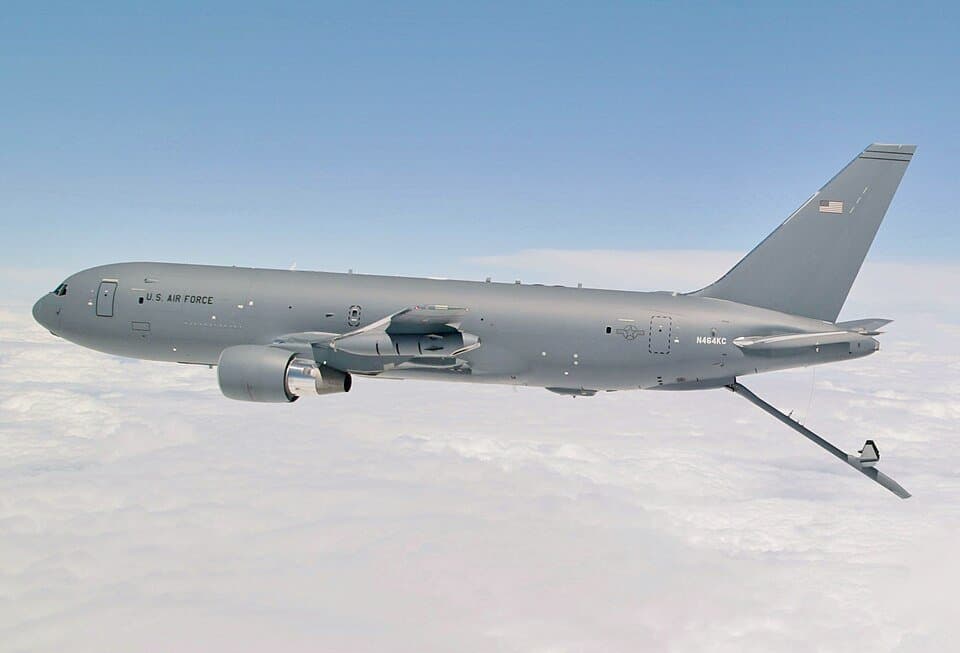
Length: 165 ft[source]Boeing KC-46 Pegasus · Specifications · Length: 165 ft 6 in (50.5 m)
Empty; VC-137C · Empty weight
Single sourceGross; VC-137C · Gross weight
Single sourceMaximum take-off; VC-137C · Max takeoff weight
Single source98,466 lb (44,663 kg)[source]
297,000 lb (135,000 kg)[source]
327,000 lb (148,325 kg)[source]
Empty; Empty weight
Single sourceMaximum take-off; Max takeoff weight
Single source(2 pilots, 1 boom operator ) basic crew; 15 permanent seats for additional crew members, including aeromedical evacuation crew members
Single source3 (2 pilots, 1 boom operator ) basic crew; 15 permanent seats for additional crew members, including aeromedical evacuation crew members[source]
VC-137C · 4 × Pratt & Whitney TF33-PW-102 turbofan engines thrust each
Single source4 × Pratt & Whitney TF33-PW-102 turbofan engines , 18,000 lbf (80 kN) thrust each[source]
2 × Pratt & Whitney PW4062 turbofan thrust each
Single source2 × Pratt & Whitney PW4062 turbofan , 62,000 lbf (280 kN) thrust each[source]
VC-137C · Wing area
Single source3,010 sq ft (279.63 m 2 )[source]
VC-137C · 4,900 ft/min (
Single source4,900 ft/min (25 m/s)[source]
Bars compare reported quantities only. A larger figure does not make a system better; configurations and test conditions differ.
In service[source] |
| Primary user | United States Air Force[source] | — |
|---|
| Manufactured | 1954–1965[source] | 2013–present[source] |
|---|
| First flight | 31 December 1958[source] | 25 September 2015[source] |
|---|
| Developed from | Boeing 707[source] | Boeing KC-767[source] |
|---|
| Variants | Boeing CC-137 VC-137C SAM 26000 VC-137C SAM 27000[source] | — |
|---|
| Role | retired VIP transport aircraft derived[source] | American military aerial refueling and strategic military transport aircraft[source] |
|---|
| Source measurement | US Air Force procurement of the Boeing 707 was very limited, amounting to three Model 707-153s designated VC-137A. When delivered in 1959 these had four 13,500 lb (6,100 kg) dry thrust Pratt & Whitney J57 (JT3C6) turbojets; when subsequently re-engined with 18,000 lbf (80 kN) dry thrust TF33-P-5 (JT3D) turbofans they were redesignated VC-137B. Only one other variant served with the Air Force: this was the VC-137C Air Force One Presidential transport, the two examples of which were Model 707-320B Intercontinentals with specialized interior furnishings and advanced communications equipment. Two further C-137C aircraft lacking Presidential transport modifications were later added.[source]Boeing C-137 Stratoliner · Development; only the objects and conditions stated in this passage Eight second-hand (former American Airlines ) 707-323Cs bought as crew trainers for the EC-18Bs, four later converted to EC-18B, two converted to EC-18D, one to C-18B; one was not taken into service and was used for spares.[source]Boeing C-137 Stratoliner · Variants / C-18; only the objects and conditions stated in this passage Two second-hand (former Trans World Airlines ) 707-331 aircraft modified for E-3 pilot and crew training.[source]Boeing C-137 Stratoliner · Variants / C-18; only the objects and conditions stated in this passage Two second-hand (former TAP Portugal ) 707-382 aircraft modified for E-6 pilot training.[source]Boeing C-137 Stratoliner · Variants / C-18; only the objects and conditions stated in this passage Length: 152 ft 11 in (46.61 m)[source]Boeing C-137 Stratoliner · Specifications (VC-137C); only the objects and conditions stated in this passage Wingspan: 145 ft 9 in (44.42 m)[source]Boeing C-137 Stratoliner · Specifications (VC-137C); only the objects and conditions stated in this passage Height: 42 ft 5 in (12.93 m)[source]Boeing C-137 Stratoliner · Specifications (VC-137C); only the objects and conditions stated in this passage Wing area: 3,010 sq ft (279.63 m 2 )[source]Boeing C-137 Stratoliner · Specifications (VC-137C); only the objects and conditions stated in this passage Empty weight: 98,466 lb (44,663 kg)[source]Boeing C-137 Stratoliner · Specifications (VC-137C); only the objects and conditions stated in this passage Gross weight: 297,000 lb (135,000 kg)[source]Boeing C-137 Stratoliner · Specifications (VC-137C); only the objects and conditions stated in this passage Max takeoff weight: 327,000 lb (148,325 kg)[source]Boeing C-137 Stratoliner · Specifications (VC-137C); only the objects and conditions stated in this passage Powerplant: 4 × Pratt & Whitney TF33-PW-102 turbofan engines , 18,000 lbf (80 kN) thrust each[source]Boeing C-137 Stratoliner · Specifications (VC-137C); only the objects and conditions stated in this passage Maximum speed: 627 mph (1,009 km/h, 545 kn)[source]Boeing C-137 Stratoliner · Specifications (VC-137C); only the objects and conditions stated in this passage Cruise speed: 600 mph (966 km/h, 520 kn)[source]Boeing C-137 Stratoliner · Specifications (VC-137C); only the objects and conditions stated in this passage Range: 7,610 mi (12,247 km, 6,610 nmi)[source]Boeing C-137 Stratoliner · Specifications (VC-137C); only the objects and conditions stated in this passage Service ceiling: 50,000 ft (15,200 m)[source]Boeing C-137 Stratoliner · Specifications (VC-137C); only the objects and conditions stated in this passage Rate of climb: 4,900 ft/min (25 m/s)[source]Boeing C-137 Stratoliner · Specifications (VC-137C); only the objects and conditions stated in this passage | The United States Air Force has taken delivery of 105 KC-46A aircraft and intends to procure 263 in total, a number which has grown with the cancellation of the KC-Y program and may grow further if the Next Generation Air-refueling System (NGAS) program does not develop as planned. Other nations which operate or have purchased the KC-46A include Japan and Israel.[source]Boeing KC-46 Pegasus · Lead; only the objects and conditions stated in this passage In September 2009, the USAF began a new round of bids with clearer criteria, including reducing the number of requirements from 800 to 373 in an attempt to simplify the process and allow more objective decision making. In March 2010, Boeing announced it would bid the KC-767 for the new KC-X round. EADS stated in April 2010 it would submit a bid without Northrop Grumman as a U.S. partner. Boeing submitted its KC-767 "NewGen Tanker" bid, based on the 767-200 with an improved version of the KC-10 's refueling boom , and cockpit displays from the 787, in July 2010. Boeing submitted a revised bid in February 2011.[source]Boeing KC-46 Pegasus · Development / USAF KC-X program; only the objects and conditions stated in this passage In December 2013, Boeing joined the wings and fuselage for the first 767-2C to be adapted into a KC-46A. The first of four 767-2C provision freighters were to complete assembly by the end of January 2014. Once assembled, it would go through ground vibration and instrumentation testing and have body fuel tanks added. The first test flight would occur during summer 2014 and include measuring its rate of climb and descent. The Engineering Manufacturing and Design (EMD) model was to be integrated with the needed systems and technologies to become a military-standard KC-46A by January 2015. Seven low-rate production KC-46s were to be delivered in 2015, 12 in 2016, and 15 delivered annually from 2017 to 2027. The last of four test aircraft began assembly in January 2014.[source]Boeing KC-46 Pegasus · Development / Selection and early development; only the objects and conditions stated in this passage The 767-2C's first flight took place on 28 December 2014. It flew from Paine Field and landed at Boeing Field . In March 2015, a refueling test with a C-17 transport was stopped because of a higher-than-expected boom axial load while delivering fuel. The problem was caused by the turbulent "bow wave effect" generated by two large aircraft flying in line. In January 2016, the KC-46 successfully refueled an F-16 for the first time during a five hour 36 minute sortie. Test refueling of several other military aircraft followed, including a C-17, F/A-18 , A-10 , and AV-8B . In February 2016, a KC-46 refueled an F/A-18, using its probe-and-drogue system for the first time. |
|---|
| Country of origin | United States[source]Inventory Origin column; table 29, row 11, cell 3; revision 1364221460 | — |
|---|
| Primary users | — | U.S. Air Force (USAF) Japan Air Self-Defense Force Israeli Air Force[source] |
|---|
| Number built | — | 113 as of Aug 2026[source] |
|---|
| Introduction date | — | 2019[source] |
|---|
| Capacity | — | 65,000 lb (29,500 kg) payload, configurable as: seating for up to 54 passengers (up to 114 in contingencies), up to 18 463L pallets , or up to 58 patients (24 litters, 34 ambulatory)[source] |
|---|
| Fuel Capacity | — | 212,299 lb (96,297 kg) / 31,220 US gal (118,200 L; 26,000 imp gal)[source] |
|---|
| Maximum Fuel Available for Transfer | — | 207,672 lb (94,198 kg)[source] |
|---|
On 5 July 2016, USAF spokesman Daryl Mayer stated that, despite the testing delays, Milestone C approval was expected in the following month, and that Boeing would add a fifth EMD aircraft to accelerate testing. EMD-1 and EMD-3 primarily conducted flight tests towards FAA airworthiness certificates, while EMD-2 and EMD-4 focused on USAF aerial refueling and mission system testing. An F-16 was successfully refueled on 8 July, and a C-17 on 12 July 2016. Once the hardware fix was verified, a KC-46 with the updated boom underwent regression testing on the F-16, followed by refueling demonstrations with the C-17 and A-10 for the final test for Milestone C approval. On 15 July 2016, the KC-46 successfully refueled an A-10, offloading 1,500 pounds of fuel at 15,000 feet. At the time, more than 900 flight test hours have been completed by the five EMD aircraft. On 12 August 2016, the program received Milestone C approval, indicating production readiness. The issuing of contracts for two lots covering 19 aircraft was expected within 30 days.[source]Boeing KC-46 Pegasus · Development / Flight tests and delays; only the objects and conditions stated in this passage
Ongoing development efforts associated with the KC-46 aim to provide new capabilities and fix problems. In the FY27 budget request, the USAF proposed reallocating funds ($13M as requested) from the Next Generation air-refueling System (NGAS) to a new effort called the Advanced Tanker System (ATS). ATS will develop upgrades for connectivity, electronic warfare , and self-defense capabilities—many of the features associated with NGAS—for the existing tanker fleet. The USAF has clarified that they are not abandoning plans for the future NGAS.[source]Boeing KC-46 Pegasus · Development / Continuing development; only the objects and conditions stated in this passage
The aircraft is FAA-certified to transport up to 58 passengers in the rear fuselage using palletized seating similar to that of the C-17, along with a galley/lavatory pallet and passenger baggage loaded onto a cargo pallet.[source]Boeing KC-46 Pegasus · Design; only the objects and conditions stated in this passage
Boeing states that in contingency operations, the aircraft could accommodate up to 114 passengers.[source]Boeing KC-46 Pegasus · Design; only the objects and conditions stated in this passage
In an all-cargo configuration, the KC-46A can carry up to 65,000 pounds (29,000 kg) of cargo across 18 pallets.[source]Boeing KC-46 Pegasus · Design; only the objects and conditions stated in this passage
The KC-46A can carry 212,299 pounds (96,297 kg) of fuel, 10 percent more than the KC-135.[source]Boeing KC-46 Pegasus · Design; only the objects and conditions stated in this passage
In June 2024 the USAF completed a 45 hour non-stop flight around the globe as part of Project Magellan. The flight, which took off and landed at McConnell Air Force Base, was refueled several times while it refueled other operational aircraft at various places around the world.[source]Boeing KC-46 Pegasus · Operational history / United States; only the objects and conditions stated in this passage
The three tankers were to be fielded around 2020 at a cost of more than ¥20.8 billion, about US$173 million (~$206 million in 2024) per aircraft. An order for a third and fourth KC-46 was placed in October 2020. Japan ordered two additional KC-46s in December 2022, bringing Japan's order total to six. In February 2021, the JASDF conducted its first KC-46 flight. Training of Japanese KC-46 pilots began in June 2021 and Japan received its first KC-46 in November 2021.[source]Boeing KC-46 Pegasus · Operational history / Japan; only the objects and conditions stated in this passage
Capacity: 65,000 lb (29,500 kg) payload, configurable as: seating for up to 54 passengers (up to 114 in contingencies), up to 18 463L pallets , or up to 58 patients (24 litters, 34 ambulatory)[source]Boeing KC-46 Pegasus · Specifications; only the objects and conditions stated in this passage
Length: 165 ft 6 in (50.5 m)[source]Boeing KC-46 Pegasus · Specifications; only the objects and conditions stated in this passage
Wingspan: 157 ft 8 in (48.1 m)[source]Boeing KC-46 Pegasus · Specifications; only the objects and conditions stated in this passage
Height: 52 ft 1 in (15.9 m)[source]Boeing KC-46 Pegasus · Specifications; only the objects and conditions stated in this passage
Empty weight: 181,610 lb (82,377 kg)[source]Boeing KC-46 Pegasus · Specifications; only the objects and conditions stated in this passage
Max takeoff weight: 415,000 lb (188,240 kg)[source]Boeing KC-46 Pegasus · Specifications; only the objects and conditions stated in this passage
Fuel Capacity: 212,299 lb (96,297 kg) / 31,220 US gal (118,200 L; 26,000 imp gal)[source]Boeing KC-46 Pegasus · Specifications; only the objects and conditions stated in this passage
Maximum Fuel Available for Transfer: 207,672 lb (94,198 kg)[source]Boeing KC-46 Pegasus · Specifications; only the objects and conditions stated in this passage
Powerplant: 2 × Pratt & Whitney PW4062 turbofan , 62,000 lbf (280 kN) thrust each[source]Boeing KC-46 Pegasus · Specifications; only the objects and conditions stated in this passage
Maximum speed: 570 mph (914 km/h, 500 kn)[source]Boeing KC-46 Pegasus · Specifications; only the objects and conditions stated in this passage
Cruise speed: 530 mph (851 km/h, 460 kn)[source]Boeing KC-46 Pegasus · Specifications; only the objects and conditions stated in this passage
Range: 7,350 mi (11,830 km, 6,385 nmi) – global with in flight refueling[source]Boeing KC-46 Pegasus · Specifications; only the objects and conditions stated in this passage
Service ceiling: 40,100 ft (12,200 m)[source]Boeing KC-46 Pegasus · Specifications; only the objects and conditions stated in this passage