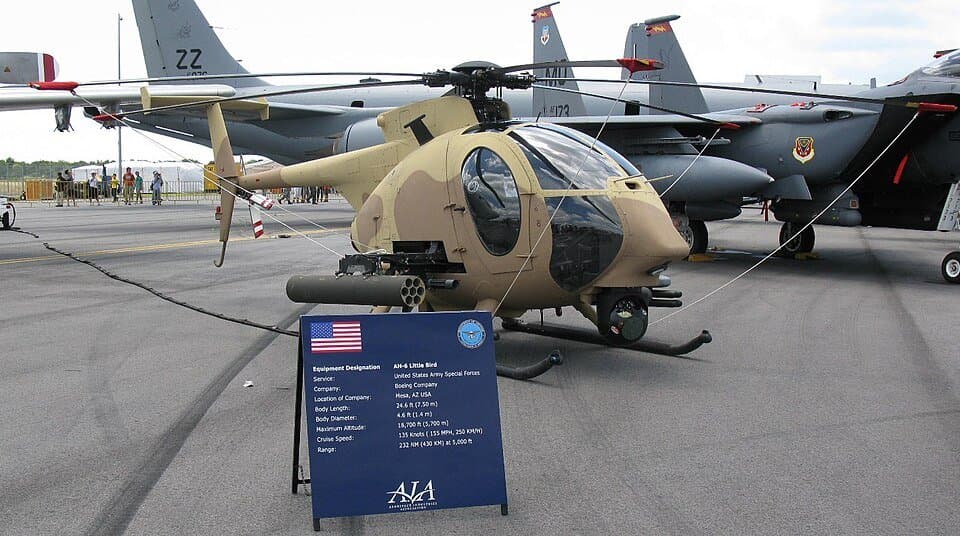

Credit
Dave1185 · CC BY-SA 3.0 · Resized · CC BY-SA 3.0 · Source ↗ · Modified


Preparing your view.

At a glance
Measured figures
ULB/MD530F · Length
Single source32 ft 7 in (9.94 m)[source]
Configuration
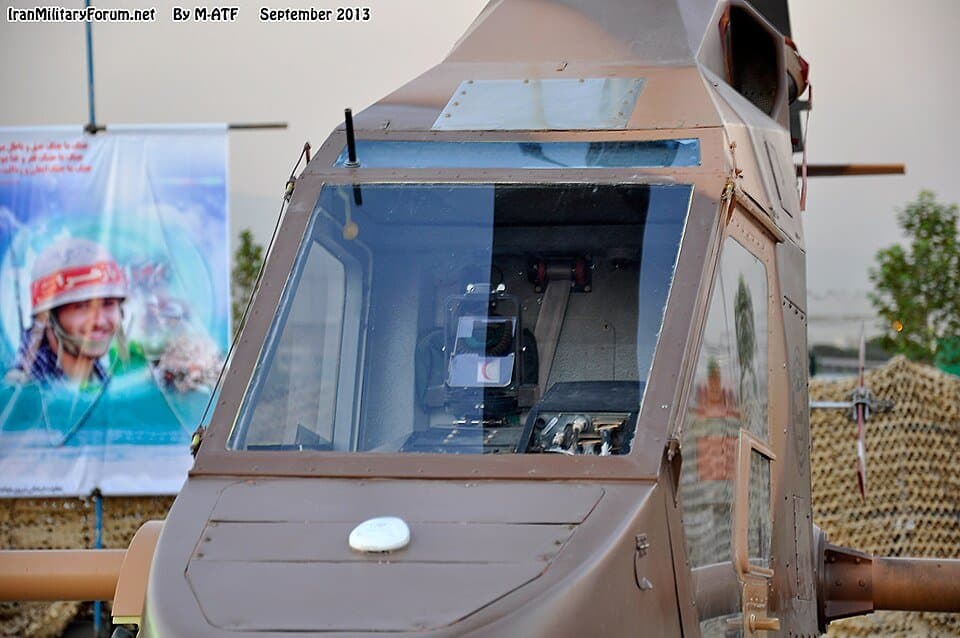
| Specification | Boeing AH-6 | HESA Shahed 285 |
|---|---|---|
| Type | Light attack / reconnaissance helicopter[source] | light attack/reconnaissance helicopter[source] |
| National origin | United States[source] | — |
| Manufacturer | Boeing Rotorcraft Systems[source] | HESA[source] |
| Status | Under development[source] | — |
| First flight | ULB: September 8, 2004 MELB: September 20, 2006[source] |
Shahed 285 / AH-85A · Length
11.84 m (38 ft 10 in)[source]
Shahed 285 / AH-85A · fuselage
Single source2.78 m (9 ft 1 in) (fuselage)[source]
ULB/MD530F · Wingspan
Single source27 ft 4 in (8.33 m)[source]
Empty; ULB/MD530F · Empty weight
Single sourceMaximum take-off; ULB/MD530F · Max takeoff weight
Single source1,591 lb (722 kg)[source]
3,550 lb (1,610 kg)[source]
Empty; Shahed 285 / AH-85A · Empty weight
Single sourceMaximum take-off; Shahed 285 / AH-85A · Max takeoff weight
Single sourceCruise; ULB/MD530F · Cruise speed
Single sourceMaximum; ULB/MD530F · Maximum speed
Single source152 kn (175 mph, 282 km/h)[source]
135 kn (155 mph, 250 km/h)[source]
Cruise; Shahed 285 / AH-85A · Cruise speed
Single sourceMaximum; Shahed 285 / AH-85A · Maximum speed
Single sourceULB/MD530F · 1 × One Allison 250-C30 turboshaft , 425 shp ( ) takeoff power (derated
Single source1 × One Allison 250-C30 turboshaft , 425 shp (317 kW) takeoff power (derated)[source]
Shahed 285 / AH-85A · 1 × Rolls-Royce Model 250-C20J turboshaft 420 shp
Single source1 × Rolls-Royce Model 250-C20J turboshaft , 310 kW (420 shp)[source]
ULB/MD530F · Wing area
Single source587.5 sq ft (54.6 m 2 )[source]
Bars compare reported quantities only. A larger figure does not make a system better; configurations and test conditions differ.
2009[source] |
| Developed from | MD Helicopters MD 500 MD Helicopters MH-6 Little Bird[source] | Bell 206 & Panha Shabaviz 2061[source] |
|---|
| Capacity | 5 total[source] | — |
|---|
| Guns | 2× 12.7 mm (.50 cal) GAU-19 ; or 2× 7.62 mm (.30 cal) M134 Minigun[source] | 1x nose-mounted PKMT light machine gun (early models) 1x nose-mounted NSV machine gun (later models)[source] |
|---|
| Rockets | 2× LAU-68D/A seven-tube rocket pods firing 2.75 in (70 mm) Hydra 70 or APKWS rocket projectiles[source] | 14x 2.75 in (70 mm) rockets[source] |
|---|
| Missiles | Anti-tank guided missile: 2 or 4× AGM-114 Hellfire Anti-air missile: 2 or 4× FIM-92 Stinger ATAS for self-defense[source] | — |
|---|
| Role | series of light helicopter gunships[source] | — |
|---|
| Source measurement | The ULB Demonstrator first flew in the uncrewed mode on June 30, 2006 from the United States Army 's Yuma Proving Ground , flying a pre-programmed 20-minute armed intelligence, surveillance and reconnaissance mission around the facility. All previous flights during the 450 flight hour engineering development phase had a safety pilot on board, although the aircraft was typically flown remotely from the ground.[source]Boeing AH-6 · Design and development; only the objects and conditions stated in this passage With the successes of the ULB, Boeing incorporated its technologies into an A/MH-6, designating it the A/MH-6X. On September 20, 2006, the first A/MH-6X lifted off on its maiden flight from Boeing Rotorcraft Systems' Mesa, Arizona facility with a pilot on board. While the ULB Demonstrator had a payload of 2,400 pounds, the MELB has an additional 1,000 pounds of payload capacity. The A/MH-6X is similar to the A/MH-6M, but includes a prototype glass cockpit and a number of upgrades to the electronics and avionics. The A/MH-6X is an optionally crewed or uncrewed aircraft which is a hybrid of the ULB demonstrator and the A/MH-6M mission-enhanced Little Bird which is used by US Army Special Operations Command.[source]Boeing AH-6 · Design and development; only the objects and conditions stated in this passage In 2009, it was reported that Boeing was working on the "AH-6S Phoenix" for the US Army's restarted ARH program, named Armed Aerial Scout . The AH-6S design is stretched by 15 inches (380 mm) to allow room for other ARH crew shot down in combat to be recovered. The aircraft also would feature an extended aerodynamic nose to house avionics hardware. AH-6S cockpit and main rotor composite blades are to be based the AH-64D Block III. The AH-6S will have an improved tail rotor and a more powerful Rolls-Royce 250-CE30 engine. The Little Bird has an endurance of 12 hours and carries a maximum mission payload of 2,400 lb (1,090 kg).[source]Boeing AH-6 · Design and development; only the objects and conditions stated in this passage In December 2012, Boeing demonstrated the Unmanned Little Bird version of the AH-6 to the South Korean Army . The aircraft flew autonomously for 25 minutes to demonstrate the uncrewed system's capabilities that can be integrated into Army MD 500 Defender helicopters.[source]Boeing AH-6 · Design and development; only the objects and conditions stated in this passage In September 2013, Aurora Flight Sciences and Boeing offered the H-6U Little Bird for the U.S. Marine Corps uncrewed lift intelligence surveillance and reconnaissance capability competition. Boeing, working as a subcontractor, was flying the Little Bird without human input, but with a pilot on board to comply with Federal Aviation Administration regulations during testing near Manassas, Virginia . The H-6U is competing against the uncrewed Kaman K-MAX , which has a usable external payload of 6,000 lb (2,720 kg) and has been used in theater to resupply Marines. Evaluations were to begin in February 2014 at Marine Corps Base Quantico .[source]Boeing AH-6 · Design and development; only the objects and conditions stated in this passage Marines at Quantico announced they had successfully landed an uncrewed Little Bird, as well as a K-MAX, autonomously using a mini- tablet computer in April 2014. The helicopters were equipped with technology called the Autonomous Aerial Cargo/Utility System (AACUS), which combines advanced algorithms with LIDAR and electro-optical/infrared sensors to enable a person holding a tablet to select a point to land the helicopter at an unprepared landing site. Autonomous landing without the need for remote control or tele-operation reduces operator burden and allows them be resupplied or conduct other missions like medical evacuation around the clock. The AACUS weighs 100 lb (45 kg), so it can be easily integrated onto other aircraft like the CH-53E Super Stallion and V-22 Osprey . According to Rear Adm. Matthew Klunder, Chief of Naval Research, operational use of the system could be possible by 2015–2016. The Office of Naval Research selected Aurora Flight Sciences and the Unmanned Little Bird to complete development of the prototype AACUS system over Lockheed and the K-MAX.[source]Boeing AH-6 · Design and development; only the objects and conditions stated in this passage Length: 32 ft 7 in (9.94 m)[source]Boeing AH-6 · Specifications (ULB/MD530F); only the objects and conditions stated in this passage Wingspan: 27 ft 4 in (8.33 m)[source]Boeing AH-6 · Specifications (ULB/MD530F); only the objects and conditions stated in this passage Height: 8 ft 9 in (2.48 m)[source]Boeing AH-6 · Specifications (ULB/MD530F); only the objects and conditions stated in this passage Wing area: 587.5 sq ft (54.6 m 2 )[source]Boeing AH-6 · Specifications (ULB/MD530F); only the objects and conditions stated in this passage Empty weight: 1,591 lb (722 kg)[source]Boeing AH-6 · Specifications (ULB/MD530F); only the objects and conditions stated in this passage Max takeoff weight: 3,550 lb (1,610 kg)[source]Boeing AH-6 · Specifications (ULB/MD530F); only the objects and conditions stated in this passage Powerplant: 1 × One Allison 250-C30 turboshaft , 425 shp (317 kW) takeoff power (derated)[source]Boeing AH-6 · Specifications (ULB/MD530F); only the objects and conditions stated in this passage Maximum speed: 152 kn (175 mph, 282 km/h)[source]Boeing AH-6 · Specifications (ULB/MD530F); only the objects and conditions stated in this passage Cruise speed: 135 kn (155 mph, 250 km/h)[source]Boeing AH-6 · Specifications (ULB/MD530F); only the objects and conditions stated in this passage Range: 232 nmi (267 mi, 430 km)[source]Boeing AH-6 · Specifications (ULB/MD530F); only the objects and conditions stated in this passage Service ceiling: 18,700 ft (5,700 m)[source]Boeing AH-6 · Specifications (ULB/MD530F); only the objects and conditions stated in this passage Rate of climb: 2,070 ft/min (10.5 m/s)[source]Boeing AH-6 · Specifications (ULB/MD530F); only the objects and conditions stated in this passage Guns: 2× 12.7 mm (.50 cal) GAU-19 ; or 2× 7.62 mm (.30 cal) M134 Minigun[source]Boeing AH-6 · Specifications (ULB/MD530F); only the objects and conditions stated in this passage Rockets: 2× LAU-68D/A seven-tube rocket pods firing 2.75 in (70 mm) Hydra 70 or APKWS rocket projectiles[source]Boeing AH-6 · Specifications (ULB/MD530F); only the objects and conditions stated in this passage | — |
|---|
| Designer | — | Shahed Aviation Industries Research Center[source] |
|---|
| Primary user | — | Islamic Republic of Iran Navy[source] |
|---|
| Introduction date | — | Iran[source] |
|---|
| Country of origin | — | Iran[source] |
|---|