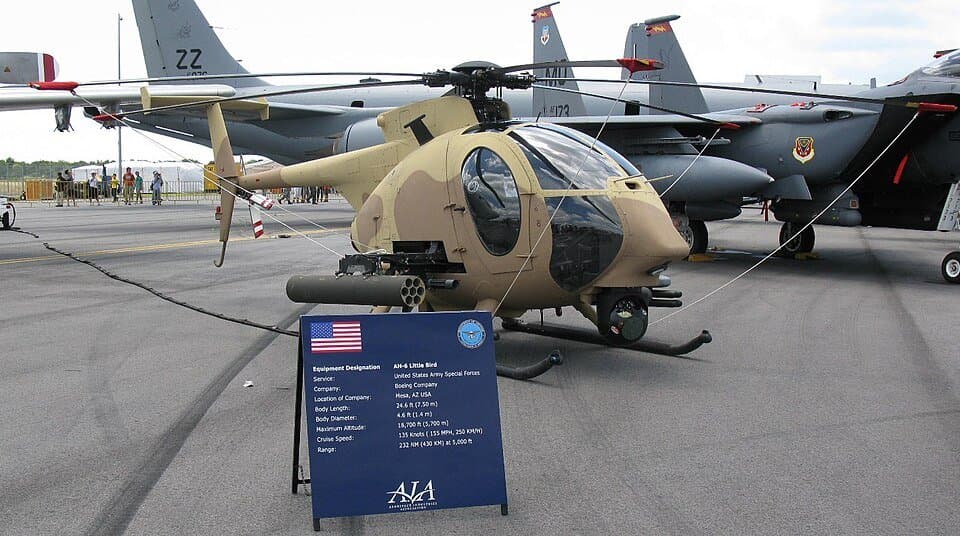

Credit
Dave1185 · CC BY-SA 3.0 · Resized · CC BY-SA 3.0 · Source ↗ · Modified


Preparing your view.

At a glance
Measured figures
ULB/MD530F · Length
Single source32 ft 7 in (9.94 m)[source]
Z-10 · Length
Configuration
| Specification | Boeing AH-6 | Changhe Z-10 |
|---|---|---|
| Type | Light attack / reconnaissance helicopter[source] | Attack helicopter[source] |
| National origin | United States[source] | — |
| Manufacturer | Boeing Rotorcraft Systems[source] | Changhe Aircraft Industries Corporation (CAIC)[source] |
| Status | Under development[source] | In service[source] |
| First flight |
14.2 m (46 ft 7 in)[source]
ULB/MD530F · Wingspan
Single source27 ft 4 in (8.33 m)[source]
ULB/MD530F · Range
Single source232 nmi (267 mi, 430 km)[source]
Z-10 · Combat range
Single source800–1,120 km (500–700 mi, 430–600 nmi)[source]
ULB/MD530F · 1 × One Allison 250-C30 turboshaft , 425 shp ( ) takeoff power (derated
Single source1 × One Allison 250-C30 turboshaft , 425 shp (317 kW) takeoff power (derated)[source]
Z-10 · 2 × WZ-9C turboshaft engines each
Single source2 × WZ-9C turboshaft engines, 1,200 kW (1,600 hp) each[source]
ULB/MD530F · Wing area
Single source587.5 sq ft (54.6 m 2 )[source]
ULB/MD530F · 2,070 ft/min (
Single source2,070 ft/min (10.5 m/s)[source]
Z-10 · (2,400 ft/min) 23 mm PX-10 revolver cannon; WXG1006 electro-optical turret, pilot night vision system, a radar warning receiver (RWR), a missile approach warning system (MAWS) sensor, an IFF antenna, and armor plates can also be seen at the nose section
Single source12 m/s (2,400 ft/min) 23 mm PX-10 revolver cannon; WXG1006 electro-optical turret, pilot night vision system, a radar warning receiver (RWR), a missile approach warning system (MAWS) sensor, an IFF antenna, and armor plates can also be seen at the nose section[source]
Bars compare reported quantities only. A larger figure does not make a system better; configurations and test conditions differ.
ULB: September 8, 2004 MELB: September 20, 2006[source] |
29 April 2003[source] |
| Developed from | MD Helicopters MD 500 MD Helicopters MH-6 Little Bird[source] | — |
|---|
| Capacity | 5 total[source] | — |
|---|
| Guns | 2× 12.7 mm (.50 cal) GAU-19 ; or 2× 7.62 mm (.30 cal) M134 Minigun[source] | 1x 23 mm (0.906 in) PX-10A revolver cannon[source] |
|---|
| Rockets | 2× LAU-68D/A seven-tube rocket pods firing 2.75 in (70 mm) Hydra 70 or APKWS rocket projectiles[source] | on each hard point with 57 mm (2.244 in) rocket pod (19-tube) 70 mm (2.756 in) unguided rocket pod (7-tube) 70 mm (2.756 in) FS70 guided rocket pod (7-tube) with FS70A (GR-5) 70 mm (2.756 in) guided rocket or FS70B 70 mm (2.756 in) air burst fragmentation rocket 70 mm (2.756 in) unguided rocket pod (19-tube) 90 mm (3.543 in) rocket pod (7-tube) with FS90A 90 mm (3.543 in) guided rocket or Tianjian 90 mm (3.543 in) rockets[source] |
|---|
| Missiles | Anti-tank guided missile: 2 or 4× AGM-114 Hellfire Anti-air missile: 2 or 4× FIM-92 Stinger ATAS for self-defense[source] | on each hard point with 4× HJ-8 , HJ-9 laser-guided air-to-surface missiles 4× AKD-10 (BA-7) laser-guided air-to-surface missiles 4× AKD-9 (BA-9) laser-guided air-to-surface missiles 4× AKD-21 (BA-21) millimetre-wave air-to-surface missiles 4× AG-300/M or AG-300/L laser-guided air-to-surface missiles 4× CM-502KG NLOS air-to-surface missiles 2× CM-501GA NLOS air-to-surface missiles 1× CM-501XA loitering munition 4× TY-90 air-to-air missiles[source] |
|---|
| Role | series of light helicopter gunships[source] | — |
|---|
| Source measurement | The ULB Demonstrator first flew in the uncrewed mode on June 30, 2006 from the United States Army 's Yuma Proving Ground , flying a pre-programmed 20-minute armed intelligence, surveillance and reconnaissance mission around the facility. All previous flights during the 450 flight hour engineering development phase had a safety pilot on board, although the aircraft was typically flown remotely from the ground.[source]Boeing AH-6 · Design and development; only the objects and conditions stated in this passage With the successes of the ULB, Boeing incorporated its technologies into an A/MH-6, designating it the A/MH-6X. On September 20, 2006, the first A/MH-6X lifted off on its maiden flight from Boeing Rotorcraft Systems' Mesa, Arizona facility with a pilot on board. While the ULB Demonstrator had a payload of 2,400 pounds, the MELB has an additional 1,000 pounds of payload capacity. The A/MH-6X is similar to the A/MH-6M, but includes a prototype glass cockpit and a number of upgrades to the electronics and avionics. The A/MH-6X is an optionally crewed or uncrewed aircraft which is a hybrid of the ULB demonstrator and the A/MH-6M mission-enhanced Little Bird which is used by US Army Special Operations Command.[source]Boeing AH-6 · Design and development; only the objects and conditions stated in this passage In 2009, it was reported that Boeing was working on the "AH-6S Phoenix" for the US Army's restarted ARH program, named Armed Aerial Scout . The AH-6S design is stretched by 15 inches (380 mm) to allow room for other ARH crew shot down in combat to be recovered. The aircraft also would feature an extended aerodynamic nose to house avionics hardware. AH-6S cockpit and main rotor composite blades are to be based the AH-64D Block III. The AH-6S will have an improved tail rotor and a more powerful Rolls-Royce 250-CE30 engine. The Little Bird has an endurance of 12 hours and carries a maximum mission payload of 2,400 lb (1,090 kg).[source]Boeing AH-6 · Design and development; only the objects and conditions stated in this passage In December 2012, Boeing demonstrated the Unmanned Little Bird version of the AH-6 to the South Korean Army . The aircraft flew autonomously for 25 minutes to demonstrate the uncrewed system's capabilities that can be integrated into Army MD 500 Defender helicopters.[source]Boeing AH-6 · Design and development; only the objects and conditions stated in this passage In September 2013, Aurora Flight Sciences and Boeing offered the H-6U Little Bird for the U.S. Marine Corps uncrewed lift intelligence surveillance and reconnaissance capability competition. Boeing, working as a subcontractor, was flying the Little Bird without human input, but with a pilot on board to comply with Federal Aviation Administration regulations during testing near Manassas, Virginia . The H-6U is competing against the uncrewed Kaman K-MAX , which has a usable external payload of 6,000 lb (2,720 kg) and has been used in theater to resupply Marines. Evaluations were to begin in February 2014 at Marine Corps Base Quantico .[source]Boeing AH-6 · Design and development; only the objects and conditions stated in this passage Marines at Quantico announced they had successfully landed an uncrewed Little Bird, as well as a K-MAX, autonomously using a mini- tablet computer in April 2014. The helicopters were equipped with technology called the Autonomous Aerial Cargo/Utility System (AACUS), which combines advanced algorithms with LIDAR and electro-optical/infrared sensors to enable a person holding a tablet to select a point to land the helicopter at an unprepared landing site. Autonomous landing without the need for remote control or tele-operation reduces operator burden and allows them be resupplied or conduct other missions like medical evacuation around the clock. The AACUS weighs 100 lb (45 kg), so it can be easily integrated onto other aircraft like the CH-53E Super Stallion and V-22 Osprey . According to Rear Adm. Matthew Klunder, Chief of Naval Research, operational use of the system could be possible by 2015–2016. The Office of Naval Research selected Aurora Flight Sciences and the Unmanned Little Bird to complete development of the prototype AACUS system over Lockheed and the K-MAX.[source]Boeing AH-6 · Design and development; only the objects and conditions stated in this passage Length: 32 ft 7 in (9.94 m)[source]Boeing AH-6 · Specifications (ULB/MD530F); only the objects and conditions stated in this passage Wingspan: 27 ft 4 in (8.33 m)[source]Boeing AH-6 · Specifications (ULB/MD530F); only the objects and conditions stated in this passage Height: 8 ft 9 in (2.48 m)[source]Boeing AH-6 · Specifications (ULB/MD530F); only the objects and conditions stated in this passage Wing area: 587.5 sq ft (54.6 m 2 )[source]Boeing AH-6 · Specifications (ULB/MD530F); only the objects and conditions stated in this passage Empty weight: 1,591 lb (722 kg)[source]Boeing AH-6 · Specifications (ULB/MD530F); only the objects and conditions stated in this passage Max takeoff weight: 3,550 lb (1,610 kg)[source]Boeing AH-6 · Specifications (ULB/MD530F); only the objects and conditions stated in this passage Powerplant: 1 × One Allison 250-C30 turboshaft , 425 shp (317 kW) takeoff power (derated)[source]Boeing AH-6 · Specifications (ULB/MD530F); only the objects and conditions stated in this passage Maximum speed: 152 kn (175 mph, 282 km/h)[source]Boeing AH-6 · Specifications (ULB/MD530F); only the objects and conditions stated in this passage Cruise speed: 135 kn (155 mph, 250 km/h)[source]Boeing AH-6 · Specifications (ULB/MD530F); only the objects and conditions stated in this passage Range: 232 nmi (267 mi, 430 km)[source]Boeing AH-6 · Specifications (ULB/MD530F); only the objects and conditions stated in this passage Service ceiling: 18,700 ft (5,700 m)[source]Boeing AH-6 · Specifications (ULB/MD530F); only the objects and conditions stated in this passage Rate of climb: 2,070 ft/min (10.5 m/s)[source]Boeing AH-6 · Specifications (ULB/MD530F); only the objects and conditions stated in this passage Guns: 2× 12.7 mm (.50 cal) GAU-19 ; or 2× 7.62 mm (.30 cal) M134 Minigun[source]Boeing AH-6 · Specifications (ULB/MD530F); only the objects and conditions stated in this passage Rockets: 2× LAU-68D/A seven-tube rocket pods firing 2.75 in (70 mm) Hydra 70 or APKWS rocket projectiles[source]Boeing AH-6 · Specifications (ULB/MD530F); only the objects and conditions stated in this passage | — |
|---|
| Designer | — | 602nd Aircraft Design Institute Kamov Design Bureau[source] |
|---|
| Primary user | — | People's Liberation Army Ground Force Aviation People's Liberation Army Air Force Pakistan Army Aviation Corps[source] |
|---|
| Manufactured | — | 2003-present[source] |
|---|
| Introduction date | — | 2009[source] |
|---|
| Hardpoints | — | 4 with a capacity of 1,500 kg (3,307 lb) useful load , with provisions to carry combinations of: Rockets: on each hard point with 57 mm (2.244 in) rocket pod (19-tube) 70 mm (2.756 in) unguided rocket pod (7-tube) 70 mm (2.756 in) FS70 guided rocket pod (7-tube) with FS70A (GR-5) 70 mm (2.756 in) guided rocket or FS70B 70 mm (2.756 in) air burst fragmentation rocket 70 mm (2.756 in) unguided rocket pod (19-tube) 90 mm (3.543 in) rocket pod (7-tube) with FS90A 90 mm (3.543 in) guided rocket or Tianjian 90 mm (3.543 in) rockets Missiles: on each hard point with 4× HJ-8 , HJ-9 laser-guided air-to-surface missiles 4× AKD-10 (BA-7) laser-guided air-to-surface missiles 4× AKD-9 (BA-9) laser-guided air-to-surface missiles 4× AKD-21 (BA-21) millimetre-wave air-to-surface missiles 4× AG-300/M or AG-300/L laser-guided air-to-surface missiles 4× CM-502KG NLOS air-to-surface missiles 2× CM-501GA NLOS air-to-surface missiles 1× CM-501XA loitering munition 4× TY-90 air-to-air missiles Bombs: GB25 and GB50 guided bombs Other: 280kg drop tank[source] |
|---|
| g limits | — | +3[source] |
|---|
| Bombs | — | GB25 and GB50 guided bombs[source] |
|---|
| Other | — | 280kg drop tank[source] |
|---|
| Country of origin | — | People's Republic of China[source] |
|---|