Credit
One half 3544 · Public domain · Resized · Public domain · Source ↗ · Modified


Preparing your view.
BArmoured vehicles
At a glance
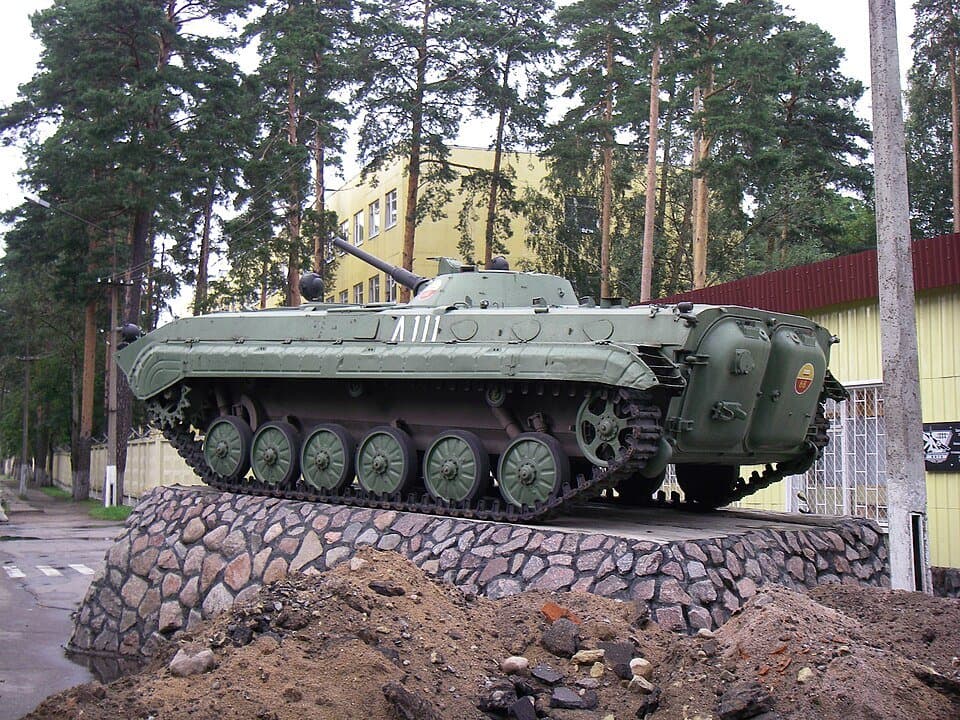
BMP-1larger figure on 3 of 3
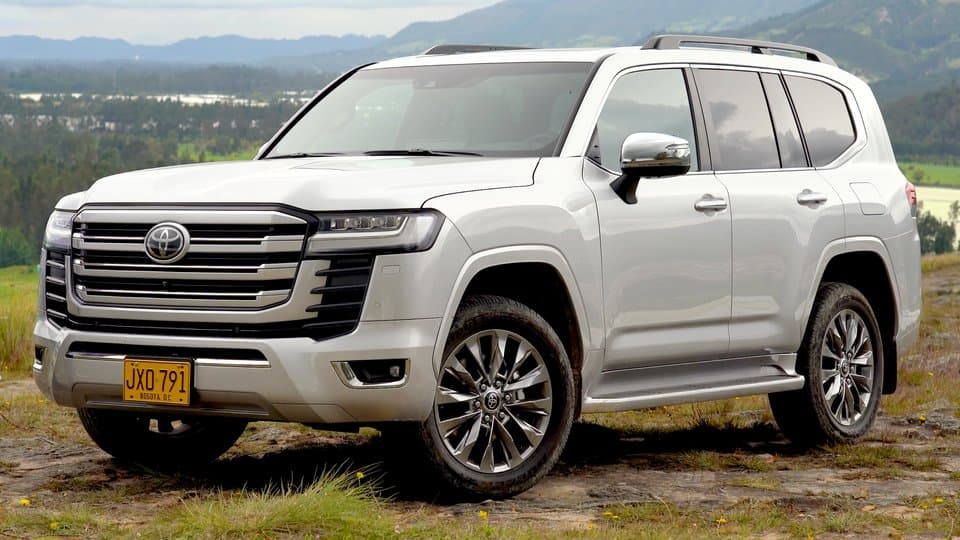
Toyota Land Cruiserlarger figure on 0 of 3
Counts only measures both sources give with the same scope. A larger figure is not a better system.
Measured figures
Length
Single source6.735 m (22 ft 1.2 in)[source]
Length
Single sourceConfiguration
| Specification | BMP-1 | Toyota Land Cruiser |
|---|---|---|
| Type | Infantry fighting vehicle Armoured personnel carrier[source] | — |
| Place of origin | Soviet Union[source] | — |
| In service | 1966–present[source] | — |
| Used by | See Service history[source] | — |
| Wars | See Service history[source] | — |
| Designer | Pavel Isakov (Design Bureau of the ChTZ )[source] |
3,793 mm (149.3 in)[source]
Mass
Single source13.2 tonnes (13.0 long tons; 14.6 short tons)[source]
(commander, driver and gunner) + 8 passengers
Single source3 (commander, driver and gunner) + 8 passengers[source]
Maximum; Off-road
Single sourceMaximum; road
Single sourceMaximum; water
Single source65 km/h (40 mph) road 45 km/h (28 mph) off-road 7–8 km/h (4.3–5.0 mph) water[source]
Operational; Off-road
Single sourceOperational; road
Single source600 km (370 mi) road 500 km (310 mi) off-road[source]
UTD-20 V6 diesel engine at 2,600 rpm
Single sourceUTD-20 V6 diesel engine 300 hp (220 kW) at 2,600 rpm[source]
Bars compare reported quantities only. A larger figure does not make a system better; configurations and test conditions differ.
| — |
| Designed | 1961–1965[source] | — |
|---|
| Manufacturer | Kurganmashzavod (Soviet Union) ZTS Detva (Czechoslovakia) See also Production history section for details.[source] | Toyota[source] |
|---|
| Produced | 1966–(production in the Soviet Union ended in 1982 or 1983) 2026–(production to restart in Slovakia between 2026 and 2027)[source] | — |
|---|
| No. built | More than 20,000 of all variants (Soviet Union) More than 3,000 of all variants (PRC) 18,000 (Czechoslovakia) ≈800 (India)[source] | — |
|---|
| Variants | BMP-1, BMP-2 , MLI-84 , Boragh ; see also BMP-1 variants .[source] | — |
|---|
| Armor | 6–33 mm (0.24–1.30 in) welded rolled steel[source] | — |
|---|
| Main armament | 73 mm 2A28 Grom smoothbore gun (40 rounds) 9M14 Malyutka ATGM (4 rounds)[source] | — |
|---|
| Secondary armament | 7.62 mm PKT coaxial machine gun (2,000 rounds)[source] | — |
|---|
| Power/weight | 22.7 hp/tonne (17.0 kW/tonne)[source] | — |
|---|
| Suspension | torsion bar[source] | — |
|---|
| Ground clearance | 370 mm (15 in)[source] | — |
|---|
| Fuel capacity | 462 L (102 imp gal; 122 US gal)[source] | — |
|---|
| Production | — | 1951–present[source] |
|---|
| Class | — | Off-road vehicle Full-size SUV ( J )[source] |
|---|
| Layout | — | Front-engine, four-wheel-drive[source] |
|---|
| Chassis | — | Body-on-frame[source] |
|---|
| Also called | — | Toyota Jeep BJ (1951–1954)[source] |
|---|
| Assembly | — | Japan: Toyota City ( Arakawa Auto Body )[source] |
|---|
| Body style | — | 2-door softtop[source] |
|---|
| Engine | — | 3.4 L B I6 3.9 L F I6[source] |
|---|
| Transmission | — | 4-speed manual[source] |
|---|
| Wheelbase | — | 2,400 mm (94.5 in)[source] |
|---|
| Curb weight | — | 1,425 kg (3,141.6 lb)[source] |
|---|
| Design and production context | — | In 1936, the Imperial Japanese Army introduced the Kurogane Type 95 Four Wheel Drive reconnaissance car. However, in a separate development, in 1941, the Japanese government asked Toyota to develop a light truck for the military. And after the Empire of Japan occupied the Philippines , then a self-governed American colony, during 1941–1942, a captured Bantam GP (or Willys MB) was sent to Japan for assessment and testing. Japanese military authorities subsequently requested that Toyota produce a similar vehicle, albeit with an altered external appearance.[source] In 1950, the Korean War created demand for a military light utility vehicle. The United States government ordered 100 vehicles with the then-new Willys specifications and tasked Toyota to manufacture them. The Toyota "Jeep" BJ prototype was developed in January 1951. This came from the demand for military-type utility vehicles, much like the British Land Rover Series 1 that was developed in 1948. The Jeep BJ was larger than the original U.S. Jeep and more powerful courtesy of its Type B 3.4-litre six-cylinder OHV Four-stroke petrol engine which generated a power output of 63 kW (84 hp; 85 PS) at 3,600 rpm and 215 N⋅m (159 lb⋅ft) of torque at 1,600 rpm. It had a part-time four-wheel drive system like the Jeep. However, and unlike the Jeep, the Jeep BJ had no low-range transfer case . In July 1951, Toyota's test driver Ichiro Taira drove the next generation of the Jeep BJ prototype up to the sixth stage of Mount Fuji , the first vehicle to climb that height. The test was overseen by the National Police Agency (NPA). Impressed by this feat, the NPA quickly placed an order for 289 of these off-road vehicles, making the Jeep BJ their official patrol car.[source] |
|---|
| Origin reported by inventory | — | Japan[source]Inventory Origin column; table 11, row 6, cell 4; revision 1347912314; retrieved 2026-09-30 Japan[source]Inventory Origin column; table 10, row 5, cell 4; revision 1341802473; retrieved 2026-09-30 Japan[source]Inventory Origin column; table 8, row 22, cell 3; revision 1377004866; retrieved 2026-09-30 Japan[source]Inventory Origin column; table 5, row 67, cell 3; revision 1377737772; retrieved 2026-10-01 Japan[source]Inventory Origin column; table 17, row 19, cell 3; revision 1377658855; retrieved 2026-09-30 Japan[source]Inventory Origin column; table 9, row 3, cell 3; revision 1377597373; retrieved 2026-09-30 Japan[source]Inventory Origin column; table 37, row 28, cell 5; revision 1377394124; retrieved 2026-09-30 Japan[source]Inventory Origin column; table 20, row 5, cell 3; revision 1376302551; retrieved 2026-09-30 Japan[source]Inventory Origin column; table 11, row 12, cell 3; revision 1376486574; retrieved 2026-09-30 Japan[source]Inventory Origin column; table 27, row 3, cell 3; revision 1377271970; retrieved 2026-09-30 Japan[source]Inventory country of origin column; table 2, row 50, cell 2; revision 1371454682; retrieved 2026-10-01 Austria[source]Inventory country of origin column; table 2, row 52, cell 2; revision 1371454682; retrieved 2026-10-01 Japan[source]Inventory Origin column; table 1, row 15, cell 2; revision 1375696849; retrieved 2026-10-01 Japan[source]Inventory Origin column; table 1, row 7, cell 4; revision 1371891576; retrieved 2026-09-30 Japan[source]Inventory Origin column; table 4, row 36, cell 3; revision 1377599444; retrieved 2026-10-01 Japan[source]Inventory Origin column; table 3, row 4, cell 3; revision 1352605490; retrieved 2026-09-30 Japan[source]Inventory Origin column; table 10, row 5, cell 3; revision 1377680091; retrieved 2026-09-30 Japan[source]Inventory Origin column; table 9, row 4, cell 4; revision 1361593065; retrieved 2026-10-01 Japan[source]Inventory Origin column; table 6, row 4, cell 4; revision 1353719247; retrieved 2026-09-30 Japan[source]Inventory Origin column; table 6, row 2, cell 4; revision 1367487973; retrieved 2026-09-30 United Arab Emirates[source]Inventory Origin column; table 2, row 3, cell 2; revision 1370867673; retrieved 2026-10-01 United Arab Emirates[source]Inventory Origin column; table 1, row 27, cell 3; revision 1371936157; retrieved 2026-10-01 |
|---|