Credit
One half 3544 · Public domain · Resized · Public domain · Source ↗ · Modified


Preparing your view.

At a glance
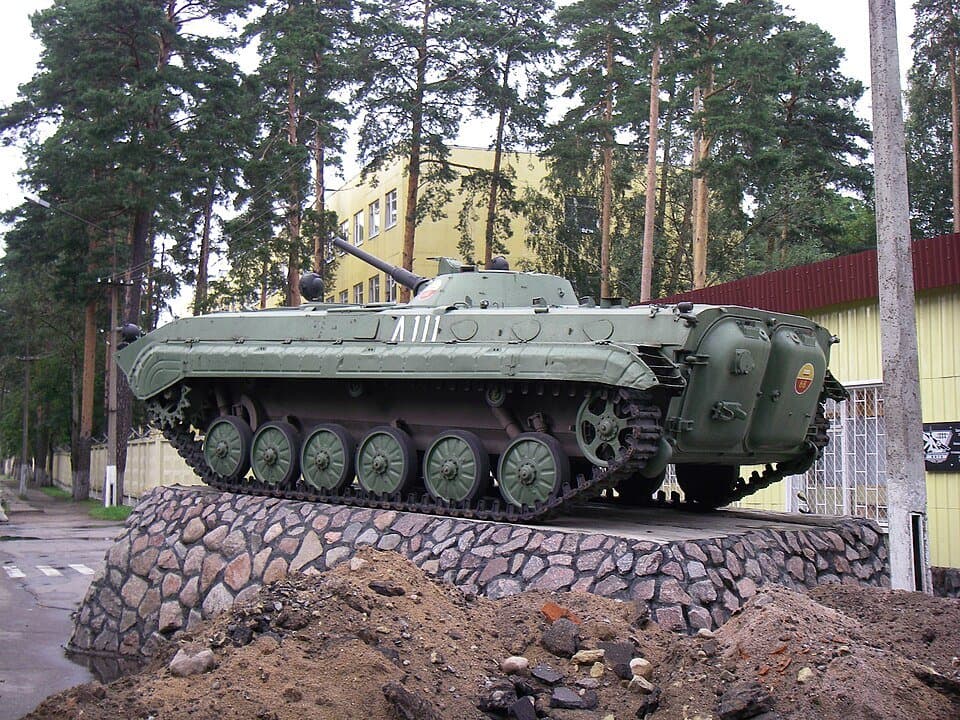
BMP-1larger figure on 1 of 4
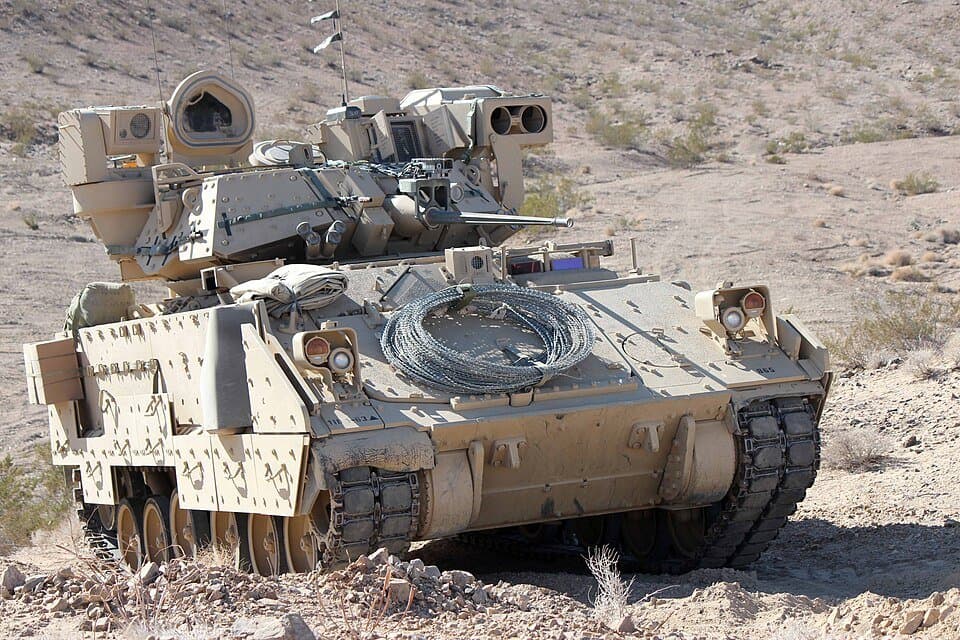
Bradley Fighting Vehiclelarger figure on 3 of 4
Counts only measures both sources give with the same scope. A larger figure is not a better system.
Measured figures
Length
Single source6.735 m (22 ft 1.2 in)[source]
Length
Single sourceConfiguration
| Specification | BMP-1 | Bradley Fighting Vehicle |
|---|---|---|
| Type | Infantry fighting vehicle Armoured personnel carrier[source] | Armored fighting vehicle Infantry fighting vehicle[source] |
| Place of origin | Soviet Union[source] | United States[source] |
| In service | 1966–present[source] | 1981–present[source] |
| Used by | See Service history[source] | § Operators |
21.5 ft (6.55 m)[source]
Bars compare reported quantities only. A larger figure does not make a system better; configurations and test conditions differ.
| Wars | See Service history[source] | Persian Gulf War Waco siege Yugoslav Wars Operation Joint Endeavour Global War on Terrorism War in Afghanistan Iraq War Russo-Ukrainian War Russian invasion of Ukraine[source] |
|---|
| Designer | Pavel Isakov (Design Bureau of the ChTZ )[source] | FMC Corporation[source] |
|---|
| Designed | 1961–1965[source] | 1963–1981[source] |
|---|
| Manufacturer | Kurganmashzavod (Soviet Union) ZTS Detva (Czechoslovakia) See also Production history section for details.[source] | United Defense (1981–1995) BAE Systems Platforms & Services (since 2004)[source] |
|---|
| Produced | 1966–(production in the Soviet Union ended in 1982 or 1983) 2026–(production to restart in Slovakia between 2026 and 2027)[source] | 1981–1995 ( United Defense ) 2004–present ( BAE Systems Platforms & Services )[source] |
|---|
| No. built | More than 20,000 of all variants (Soviet Union) More than 3,000 of all variants (PRC) 18,000 (Czechoslovakia) ≈800 (India)[source] | 6,724[source] |
|---|
| Variants | BMP-1, BMP-2 , MLI-84 , Boragh ; see also BMP-1 variants .[source] | § Variants[source] |
|---|
| Armor | 6–33 mm (0.24–1.30 in) welded rolled steel[source] | Spaced laminate armor: 14.5–30 mm all-around AP protection (depending on variant) Explosive reactive armor for RPG protection[source] |
|---|
| Main armament | 73 mm 2A28 Grom smoothbore gun (40 rounds) 9M14 Malyutka ATGM (4 rounds)[source] | 25 mm M242 Bushmaster chain gun 2× BGM-71 TOW anti-tank missile[source] |
|---|
| Secondary armament | 7.62 mm PKT coaxial machine gun (2,000 rounds)[source] | 7.62 mm M240C machine gun[source] |
|---|
| Power/weight | 22.7 hp/tonne (17.0 kW/tonne)[source] | 19.7 horsepower per short ton (16.2 kW/t)[source] |
|---|
| Suspension | torsion bar[source] | Torsion bar[source] |
|---|
| Ground clearance | 370 mm (15 in)[source] | — |
|---|
| Fuel capacity | 462 L (102 imp gal; 122 US gal)[source] | — |
|---|
| Source measurement | — | The M2/M3's primary armament is a 25 mm chain gun using either 100 or 300 rounds per minute, accurate to 3,000 m. It is armed with a TOW missile launcher capable of carrying two loaded missiles. The missiles, capable of destroying most tanks to a maximum range of 4,000 m (13,000 ft), can only be fired while the vehicle is stationary. The Bradley carries a coaxial 7.62 mm medium machine gun to the right of the chain gun.[source]Bradley Fighting Vehicle · Design / Armament; only the objects and conditions stated in this passage The Bradley is equipped with the 25 mm M242 Bushmaster as its main weapon. The M242 is a single-barrel chain gun with an integrated dual-feed mechanism and remote feed selection. The cannon carries 300 rounds of ammunition in two ready boxes (one of 70 rounds, the other of 230 rounds), with an extra 600 rounds in storage for the M2 Infantry Fighting Vehicle variant or 1,200 stowed rounds for the M3 Cavalry Fighting Vehicle variant. The two ready-boxes allow a selectable mix of rounds, such as the M791 APDS-T (Armor-Piercing Discarding Sabot (with) Tracer) and M792 HEI-T (High Explosive Incendiary (with) Tracer) rounds. The tungsten APDS-T rounds proved effective in Desert Storm , capable of knocking out many Iraqi vehicles, including several T-55 tanks.[source]Bradley Fighting Vehicle · Design / Armament / Primary; only the objects and conditions stated in this passage An M240C medium machine gun is mounted coaxially to the M242 , with 2,200 rounds of 7.62×51mm ammunition. For engaging heavier targets, such as acting as an anti-tank gun, the Bradley carries a TOW missile system . This was modified to fire TOW II missiles from the M2A1 model onward. M2 infantry Bradleys have firing ports for M231 Firing Port Weapons (FPWs), providing a means for the occupants to fire from within the vehicle and replacing the top-side gunners on the M113-based Armored Cavalry Assault Vehicles, although the M231 is rarely employed.[source]Bradley Fighting Vehicle · Design / Armament / Secondary; only the objects and conditions stated in this passage The use of aluminum armor and the storage of large quantities of ammunition in the vehicle initially raised questions about its combat survivability. Spaced laminate belts and high-hardness steel skirts have been added to improve the side protection of later versions, while overall weight was increased to 33 tons.[source]Bradley Fighting Vehicle · Design / Countermeasures; only the objects and conditions stated in this passage The BUSK kit adds 3 tons to the vehicle's weight. Because of this, a major upgrade was planned. Additional upgrades included a stronger, 800 horsepower engine, a larger main gun, lighter armor, improved sensors and cameras to give a 360° view outside, and an improved fire extinguisher system. This system was supposed to enter service in 2012, but the Bradley became too heavy and the kit did not make it survivable enough. A newer BUSK III kit is now available for Bradleys incorporating a blastproof fuel cell, a blast-resistant driver seat, a turret survivability system, and an emergency ramp release. This kit was recently installed on 236 M2A3 Bradleys in South Korea and is scheduled next to be added to Bradleys of the 4th Infantry Division.[source]Bradley Fighting Vehicle · Design / Countermeasures / Bradley Urban Survival Kit; only the objects and conditions stated in this passage The Bradley is highly capable in cross-country open terrain, in accordance with one of the main design objectives of keeping pace with the M1 Abrams main battle tank. The Bradley was initially designed to float by deploying a flotation curtain around the vehicle, allowing it to "swim" at a speed of 4.5 mph (7.2 km/h ). Later armor upgrades have negated this capability.[source]Bradley Fighting Vehicle · Design / Mobility; only the objects and conditions stated in this passage One of the early issues that drove the development of the infantry fighting vehicle (IFV) was the need to have a vehicle that could serve in a high-intensity conflict in Europe, which was feared might include the use of nuclear, biological or chemical (NBC) type weapons . To work in such an environment, an IFV would have to have a life support system that protected from outside contaminants, while allowing the soldiers to fight from inside the vehicle. The earliest specification, from 1958, called for a vehicle of no more than 8 tons, mounting a turret with a 20 mm autocannon and a 7.62 mm machine gun, with sealed firing ports for five infantry gunners.[source]Bradley Fighting Vehicle · History / Development; only the objects and conditions stated in this passage In December 1963, the Army Combat Developments Command studied the concept for a "Post 1965 Infantry Combat Vehicle", later the MICV. In the interim, the Army planned upgrades to the M113 that would bridge the gap to the MICV. One such upgrade was the XM734 which added firing ports. The .50 caliber machine gun was replaced with a twin machine gun cupola or an M139 20 mm autocannon. This test bed saw limited service in Vietnam, from 1967 to 1972, where it received positive feedback from troops.[source]Bradley Fighting Vehicle · History / Development; only the objects and conditions stated in this passage The prototypes had the following characteristics: a weight of 25–27 tons, depending on an aluminum or steel hull; a 425 hp diesel engine; a two-man turret with a 20 mm gun; a crew of three plus nine infantry equipped with firing ports; a built-in toilet; armor that was proof against Soviet 14.5 mm MG fire beyond a certain range; a collective and overpressure CBR system; amphibious. The filtration system provided a shirt-sleeve environment until the passengers dismounted. After that they could not repressurize without fear of contamination, but they could plug their suits into the vehicle's filtration system. The vehicle was 9 ft (2.7 m) high, 20 ft (6.1 m) long, and 10 ft (3.0 m) wide. The rising costs of the Vietnam War left less money to go around in the Pentagon's procurement budget. The XM701 project had several technical shortcomings. It had poor mobility relative to upcoming designs such as the MBT-70, and it could not be carried aboard a C-141 Starlifter . The project was canceled, and new specifications were written in 1965.[source]Bradley Fighting Vehicle · History / Development; only the objects and conditions stated in this passage From 1969 to 1970, the Army looked at two alternate vehicles that could be fielded more quickly. The FMC Corporation had developed the XM765 Armored Infantry Fighting Vehicle , an IFV version of the M113A1. It had a one-man turret mounting a 25 mm gun, a sealed environment, and firing ports. The vehicle weight was 15 tons. The upper sides of the vehicle were sloped and spaced steel armor plates were added to improve protection. Firing ports for the passengers were added and a M139 20 mm cannon was added to the commander's cupola. The U.S. Army rejected it due to limited mobility, which would have prevented it from keeping pace with the proposed MBT-70. The other alternate vehicle was the West German Marder , which mounted a 20 mm autocannon, relatively strong steel armor, and full CBR protection. The U.S. Army rejected it due to it not being amphibious, too large and heavy for air transport, and too expensive.[source]Bradley Fighting Vehicle · History / Development; only the objects and conditions stated in this passage The MICV program continued on, and in 1972, the Army solicited proposals for the MICV. In November 1972, the Army awarded FMC a contract to develop the XM723. This vehicle was similar to the XM765, but had improved armor and speed. It shared components with the LVTP-7 rather than the M113. FMC began construction of the XM723 prototype, which was completed in 1973. The XM723 weighed 21 tons, had spaced aluminum armor proofed against 14.5 mm fire, had a crew of three plus eight infantry, firing ports for the infantry, and a one-man turret with a 20 mm gun. The commander sat inside the hull.[source]Bradley Fighting Vehicle · History / Development; only the objects and conditions stated in this passage To adapt the XM723 to a reconnaissance role, as well as an IFV, the turret was replaced in 1976 with a two-man turret mounting a 25 mm Bushmaster cannon and TOW missiles. This was the TBAT-II (Tow Bushmaster Armored Turret, Two Man) design. A two-man turret design put the commander in a position with a better view of the battlefield. The TOW missiles give the vehicle a strong antiarmor capability. The value of anti-tank missiles had been well established in the 1973 Yom Kippur war . The added political advantage was that the TOW missiles made it an easier sell to Congress, as it was a new capability not possessed by the M113.[source]Bradley Fighting Vehicle · History / Development; only the objects and conditions stated in this passage In October 1976, the Army accepted a number of recommendations put forward by the MICV Task Force formed earlier that year. The Army would combine the roles of scout and IFV, as the previous Armored Reconnaissance Scout Vehicle had been canceled. The Army agreed to make the armor protection comparable to the XM723. The TBAT-II turret with its 25 mm cannon and a TOW-missile launcher in the two-man turret would be used for the both vehicles.[source]Bradley Fighting Vehicle · History / Development; only the objects and conditions stated in this passage On 12 January 2024, video emerged of a pair of Ukrainian M2A2 Bradleys from the 47th Mechanized Brigade engaging and disabling a Russian T-90M tank at close range with their autocannons in Stepove , Ukraine.[source]Bradley Fighting Vehicle · History / Combat history / Russo-Ukrainian War; only the objects and conditions stated in this passage The U.S. Army began the Future Combat Systems (FCS) Manned Ground Vehicles program in 1999. This family of 18-ton lightweight tracked vehicles based on a common chassis. It would consist of eight variants, including infantry carriers, scouting vehicles and main battle tanks. FCS was canceled in 2009 due to budget cuts.[source]Bradley Fighting Vehicle · History / Replacement; only the objects and conditions stated in this passage In 2010, the Army began the Ground Combat Vehicle program to replace the M2 Bradley. Entries from BAE Systems and General Dynamics were selected for evaluation. Concerns grew around the vehicle's proposed weight of around 70 tons. The GCV was cancelled in 2014 due to sequestration budget cuts.[source]Bradley Fighting Vehicle · History / Replacement; only the objects and conditions stated in this passage The M2 Bradley Infantry Fighting Vehicle (IFV) consists of five variants: the M2, M2A1, M2A2, M2A2 ODS (Operation Desert Storm improvements), and M2A3. Their main mission is to provide protected transport of an infantry squad , up to six passengers, to critical points. Aside from carrying mechanized infantry into close contact with the enemy, the M2 can provide overwatching fire to dismounting infantrymen. It is adequately armored to provide protection against small arms fire and artillery, and able to combat any vehicle on the battlefield using its TOW missiles.[source]Bradley Fighting Vehicle · Variants / M2 Bradley; only the objects and conditions stated in this passage The M2 IFV has six external firing ports for the squad M231 Firing Port Weapon on the M2 and M2A1 versions only. Four ports were removed on the sides of the vehicle on the M2A2 and A3 versions, and only two in the ramp remain. These ports allow passengers to engage the enemy from within the protection of the Bradley vehicle. These firing ports are almost always covered by additional armor kits and a Bradley with them operable is rare. The proper use of M231 FPWs was rare in practice.[source]Bradley Fighting Vehicle · Variants / M2 Bradley; only the objects and conditions stated in this passage The M2 Bradley unit cost is $1.11 million (FY 1993 constant dollars) US$1.84M in 2016 (inflation adjusted).[source]Bradley Fighting Vehicle · Variants / M2 Bradley; only the objects and conditions stated in this passage In October 2017, BAE displayed an updated version of the Bradley Linebacker called the M-SHORAD (Mobile Short-Range Air Defense) equipped with a pMHR (portable multi-mission hemispheric radar) search radar mounted around the turret, a fire-control radar, and a jammer on top of the turret to non-kinetically defeat unmanned aerial vehicles (UAVs). The main gun was replaced with an XM914 30 mm autocannon with airburst rounds , and a missile launcher that could accommodate various missiles including the Stinger, AIM-9X Sidewinder , or others.[source]Bradley Fighting Vehicle · Variants / M6 Linebacker; only the objects and conditions stated in this passage |
|---|
| Country of origin | — | United States[source]Inventory Origin column; table 25, row 8, cell 3; revision 1377349156; retrieved 2026-10-02 |
|---|
| Reported operators | — |
|
|---|