
FORCETALLY
Loading the evidence…
Preparing your view.


Preparing your view.

At a glance
Blowpipe (missile)larger figure on 2 of 3
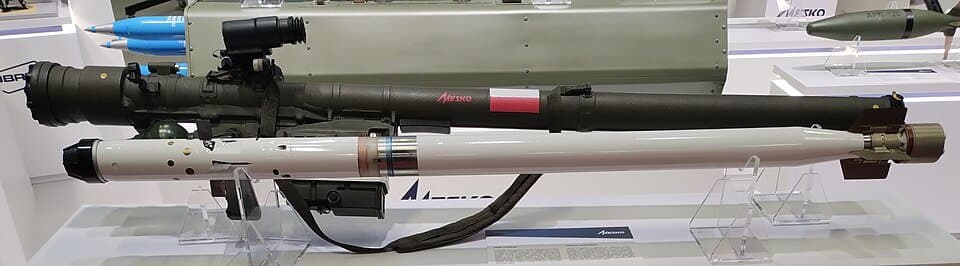
Piorun (missile)larger figure on 1 of 3
Counts only measures both sources give with the same scope. A larger figure is not a better system.
Measured figures
Length
Single source1.35 m (4 ft 5 in)[source]
Length
Single sourceConfiguration
| Specification | Blowpipe (missile) | Piorun (missile) |
|---|---|---|
| Type | Man-portable air-defense systems[source] | Man-portable air-defense system[source] |
| Place of origin | United Kingdom[source] | Poland[source] |
| In service | 1975–present[source] | 2019 ( 2019 ) –present[source] |
| Used by | See Operators[source] | See Operators |
1.596 m (5.24 ft)[source]
complete system
Single sourcelauncher
Single sourcemissile in launch tube
Single source14.5 kg (32 lb) (missile in launch tube) 22 kg (49 lb) (complete system) 6.2 kg (14 lb) (launcher)[source]
missile
Single sourcetotal
Single source16.5 kg (36 lb) total 10.5 kg (23 lb) missile
Bars compare reported quantities only. A larger figure does not make a system better; configurations and test conditions differ.
| Wars | Falklands War Soviet–Afghan War Gulf War Cenepa War[source] | Russian invasion of Ukraine[source] |
|---|
| Designer | Short Brothers[source] | — |
|---|
| Designed | 1975[source] | 2010 ( 2010 ) –2015 ( 2015 )[source] |
|---|
| Manufacturer | Short Brothers[source] | Mesko[source] |
|---|
| Produced | 1975 to 1993[source] | 2016 ( 2016 ) –present[source] |
|---|
| No. built | 34,382[source] | 3,000 (as of early 2025)[source] |
|---|
| Warhead | Shaped charge[source] | HMX with aluminium powder[source] |
|---|
| Engine | Solid rocket motor[source] | Solid-fuel rocket motor[source] |
|---|
| Guidance system | MCLOS system[source] | infrared homing with argon -cooled seeker[source] |
|---|
| Role | man-portable (MANPADS) surface-to-air missile[source] | — |
|---|
| Source measurement | After Blowpipe began to enter service, it was decided it would replace the Bofors 40mm/L70 guns in service with the Territorial Army Volunteer Reserve . The first such unit was formed in July 1978 in Northern Ireland . In February 1980 it was decided to increase the number of such units, and a further £20 million order was placed to equip another 12 units, bringing the total to 48.[source]Blowpipe (missile) · History / Development; only the objects and conditions stated in this passage The Blowpipe's guidance is initially semi-automatic with the missile gathered to the centre of the sight's crosshairs by the infrared optic atop the aiming unit. Two to three seconds after launch, missile guidance is switched to fully MCLOS mode and the operator regains full control of the missile. The operator has to steer the missile all the way to its target manually via a small thumb joystick . The operator can opt not to use auto-gathering when engaging low flying targets such as helicopters but then has to super-elevate the launcher to ensure that the missile does not hit the ground. Four flares in the tail of the missile make it visible in flight, first to the infrared optic, then to the operator. Detonation is either by proximity or contact fuse . In emergencies, the operator can end an engagement by shutting off the power to the transmitter with the system switch, after which the missile will immediately self-destruct. The aiming unit can then be removed from the empty missile container and fitted to a new round.[source]Blowpipe (missile) · Description; only the objects and conditions stated in this passage Blowpipe was used by both sides during the Falklands War in 1982. With targets typically being fast-flying aircraft approaching at low altitude and using the terrain for cover, the Blowpipe operator had about 20 seconds to detect, align, and fire. Brigadier Julian Thompson compared using the weapon to "trying to shoot pheasants with a drainpipe". British forces fired 95 missiles during the conflict, of which approximately half suffered various failures. Only one confirmed kill was attributed to Blowpipe when an Argentine Navy Aermacchi MB-339A (4-A-114) was shot down on 28 May by a missile fired by the Royal Marines Air Defence Troop during the Battle of Goose Green . The pilot, Sub-Lieutenant Miguel, was killed.[source]Blowpipe (missile) · Combat performance; only the objects and conditions stated in this passage Blowpipe was found to be particularly ineffective when used to engage a crossing target or to chase a target moving rapidly away from the operator. Its poor performance led to it being withdrawn from British service. In 1986, some of the mothballed units were sent clandestinely to equip the Mujahideen whom Britain was supporting , fighting the Soviets in Afghanistan . The system again proved ineffective, and was eventually supplanted by the US Stinger missile. While Blowpipe was available on the international arms market and therefore its origins were open to speculation, the Stinger was restricted, which at the time indicated a more open acknowledgement of Western support for the Mujahideen. With the arrival of Stinger, Blowpipe was used primarily as a manually-guided long-range weapon against ground targets. Blowpipe missile systems were still being found in weapon caches as recently as May 2012 in Afghanistan.[source]Blowpipe (missile) · Combat performance; only the objects and conditions stated in this passage | — |
|---|
| Country of origin | United Kingdom[source]Inventory Origin column; table 8, row 4, cell 4; revision 1342029330; retrieved 2026-10-02 | — |
|---|
| Unit cost | — | 1 mill. EUR/launcher+3 missiles[source] |
|---|
| Detonation mechanism | — | impact fuze with a delay mechanism, and a proximity fuze for C-UAS[source] |
|---|
| Flight ceiling | — | 4 km (13,000 ft)[source] |
|---|
| Flight altitude | — | 10 m (33 ft)–4,000 m (13,000 ft)[source] |
|---|
| Launch platform | — | MANPADS[source] |
|---|