


Preparing your view.

At a glance
BIO Hespérideslarger figure on 4 of 5
Measured figures
Length
Single source82.5 m (270 ft 8 in)[source]
Length
Single sourceConfiguration
| Specification | BIO Hespérides | Brazilian research ship Ary Rongel |
|---|---|---|
| Name | Hespérides[source] | Polar Queen[source] |
| Port of registry | Cartagena, Spain[source] | — |
| Builder | Empresa Nacional Bazán , Cartagena[source] | Georg Eide's Sønner[source] |
| Laid down | 14 November 1988[source] | 27 September 1980[source] |
Brazilian research ship Ary Rongellarger figure on 1 of 5
Counts only measures both sources give with the same scope. A larger figure is not a better system.
75.3 m (247 ft 1 in)[source]
standard
Single sourcefull
Single source1,983 t (1,952 long tons ) standard 2,750 t (2,707 long tons) full[source]
standard
Single sourcefull load
Single sourceBars compare reported quantities only. A larger figure does not make a system better; configurations and test conditions differ.
| Launched | 12 March 1990[source] | 22 January 1981[source] |
|---|
| Commissioned | 16 May 1991[source] | 25 April 1994[source] |
|---|
| Refit | 2003–2004[source] | — |
|---|
| Identification | IMO number : 8803563 MMSI number : 224886000 Callsign : EBBW[source] | IMO number : 7922142 MMSI number : 710400000 Callsign : PWAR[source] |
|---|
| Status | Active[source] | in active service[source] |
|---|
| Type | Research vessel[source] | Research ship[source] |
|---|
| Ice class | 1C[source] | Ice-strengthened[source] |
|---|
| Endurance | 120 days[source] | — |
|---|
| Sensors & processing systems | 2 × DGPS 2 radar ARPA ECDIS GMDSS[source] | — |
|---|
| Aircraft carried | 1 × Agusta-Bell 212 helicopter[source] | 2 × Helibrás Esquilo (locally designated as UH-12/13)[source] |
|---|
| Aviation facilities | Hangar[source] | Helipad and hangar[source] |
|---|
| National origin | Spain[source] | — |
|---|
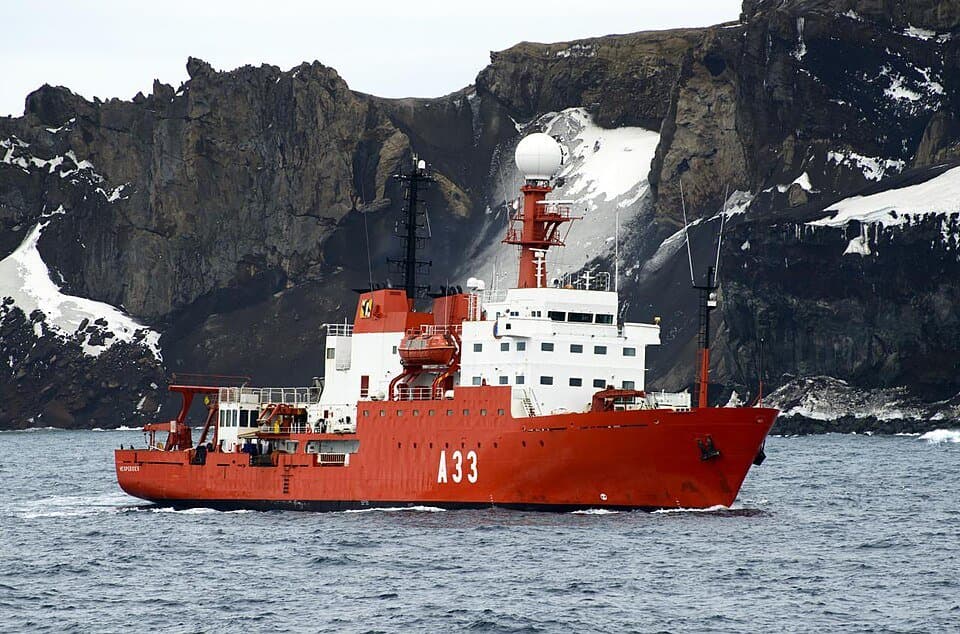
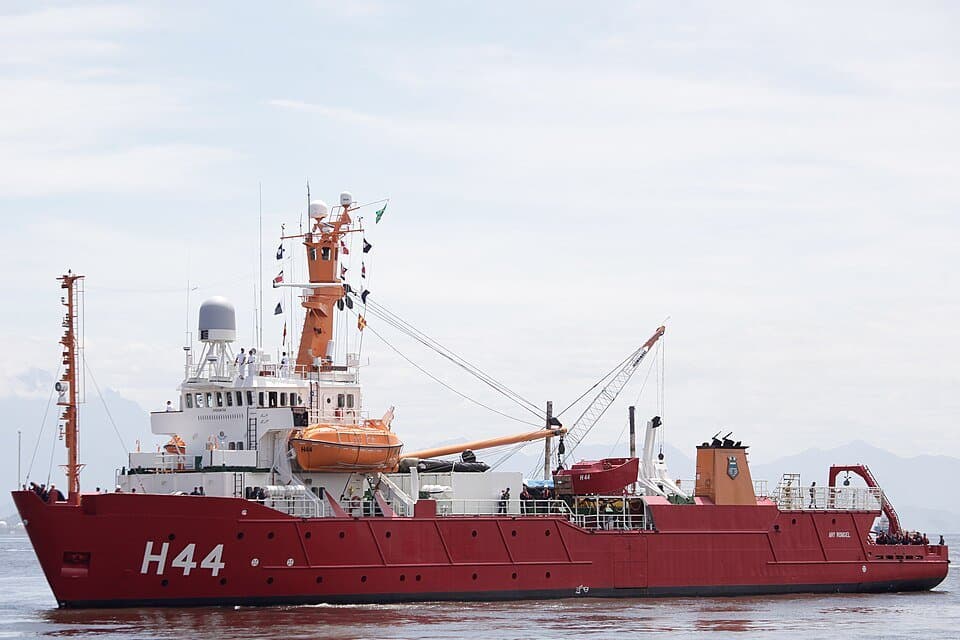
| Source measurement | Hespérides is classified by Lloyd's Register of Shipping with ice class 1C. She can move through up to 0.5 metres (1 ft 8 in) of ice at 5 knots (9.3 km/h; 5.8 mph). Her propulsion system uses a computer-controlled variable-pitch propeller and stern and bow thrusters. The vessel carries one helicopter.[source]BIO Hespérides · Lead; only the objects and conditions stated in this passage In 2003–2004, she was the subject of a thorough renovation, the hull was strengthened even more to break ice, all systems were improved and the habitability of the ship. The vessel is equipped with 11 laboratories, spread over 345 m 2 and located on the main deck and below.[source]BIO Hespérides · History; only the objects and conditions stated in this passage In 2009, the vessel participated in a high-profile rescue of Ocean Nova , a vessel with 106 people in the Antarctic.[source]BIO Hespérides · History; only the objects and conditions stated in this passage | As built, the ship was an ice-strengthened research vessel . The vessel measured 1,496 gross register tons (GRT) and 1,050 tons deadweight (DWT), was 65.1 metres (213 ft 7 in) long overall and 56.0 metres (183 ft 9 in) between perpendiculars with a beam of 13.1 metres (43 ft 0 in). In 1986, the ship was lengthened to 75.3 metres (247 ft 1 in) long overall and 67.4 metres (221 ft 2 in) between perpendiculars. The vessel was remeasured as 1,982 gross tonnage (GT) and 1,100 deadweight.[source]Brazilian research ship Ary Rongel · Description; only the objects and conditions stated in this passage The ship is powered by two MaK 6M-453 diesel engines driving one shaft turning a controllable pitch propeller , one stern thruster and two bow thrusters rated at 4,500 horsepower (3,356 kW). The ship is capable of 14.5 knots (26.9 km/h; 16.7 mph) and has a cruising range of 17,000 nautical miles (31,000 km; 20,000 mi) at 12 knots (22 km/h; 14 mph).[source]Brazilian research ship Ary Rongel · Description; only the objects and conditions stated in this passage In Brazilian naval service, the research ship has a standard displacement of 1,928 long tons (1,959 t) and 3,628 long tons (3,686 t) at full load. The ship is equipped with a helipad and is capable of operating up to two UH-13 Helibrás Esquilo helicopters. The vessel's cargo capacity in naval service is 2,400 m 3 (85,000 cu ft) and the ship has a complement of 70 including 19 officers and space for 22 scientists.[source]Brazilian research ship Ary Rongel · Description; only the objects and conditions stated in this passage |
|---|
| Propulsion | computer-controlled variable-pitch propeller and stern and bow thrusters[source]BIO Hespérides · own ship propulsion arrangement; no numeric engine power inferred | 1 × controllable pitch propeller 1 × stern thruster 2 × bow thrusters[source] |
|---|
| Used by | Spanish Navy[source]BIO Hespérides (A-33) · own named research vessel · present operator; no inventory quantity or dated count inferred | — |
|---|
| Completed | — | March 1981[source] |
|---|
| Fate | — | Acquired by Brazilian Navy , 1994[source] |
|---|
| Namesake | — | Admiral Ary dos Santos Rongel[source] |
|---|
| Acquired | — | 19 April 1994[source] |
|---|
| Home port | — | Rio de Janeiro[source] |
|---|
| Capacity | — | 2,400 m 3 (85,000 cu ft)[source] |
|---|
| Country of origin | — | Norway[source]Inventory Origin column; table 3, row 8, cell 3; revision 1376315831 |
|---|
1,928 long tons (1,959 t) standard 3,628 long tons (3,686 t) full load[source]