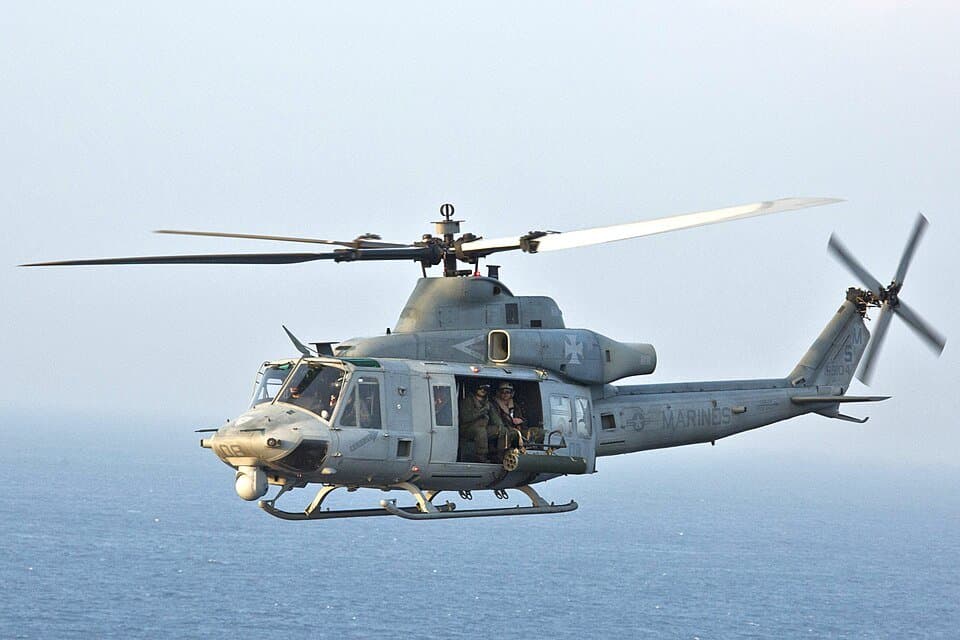

Credit
Cpl. Hailey D. Clay · Public domain · Resized · Public domain · Source ↗ · Modified


Preparing your view.

At a glance
Bell UH-1Y Venomlarger figure on 2 of 2
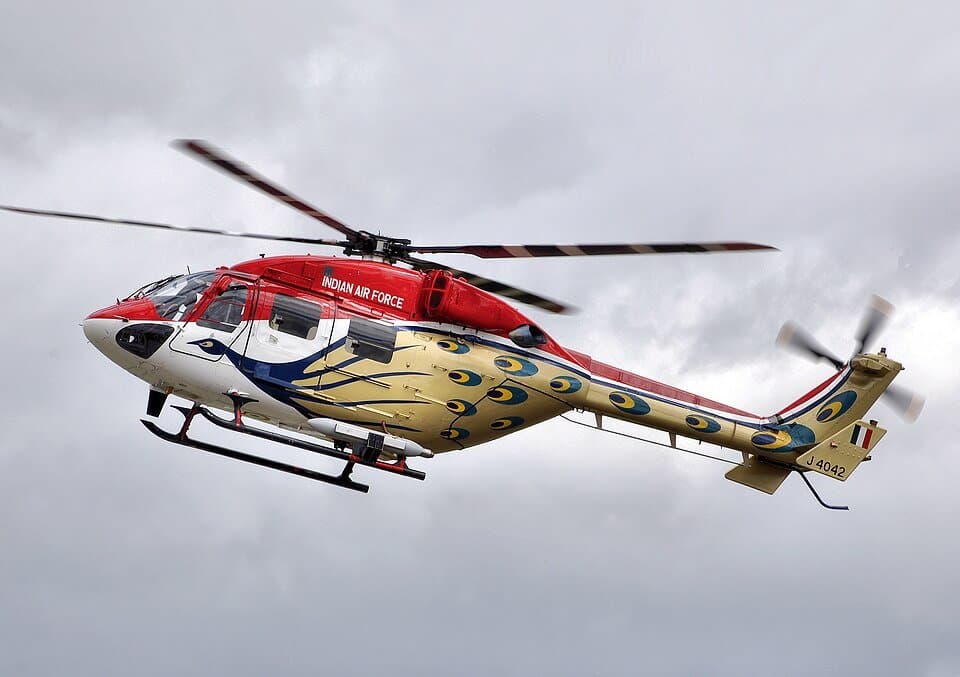
HAL Dhruvlarger figure on 0 of 2
Counts only measures both sources give with the same scope. A larger figure is not a better system.
Measured figures
Length
Single source58 ft 4 in (17.78 m)[source]
Length
Single sourceConfiguration
| Specification | Bell UH-1Y Venom | HAL Dhruv |
|---|---|---|
| Type | Utility helicopter[source] | Utility helicopter[source] |
| National origin | United States[source] | India[source] |
| Manufacturer | Bell Textron[source] | Hindustan Aeronautics Limited[source] |
| Status | In service[source] | In service[source] |
15.87 m (52 ft 1 in)[source]
Empty; Empty weight
Single sourceGross; BELL UH-1Y VENOM / Bell UH-1Y Specifications · Gross weight · Max Gross Weight
Single sourceMaximum take-off; Max takeoff weight
Single source11,840 lb (5,371 kg)[source]
18,500 lb (8,391 kg)[source]
18,500 lbs[source]BELL UH-1Y VENOM / Bell UH-1Y Specifications
Gross; for Mk III with wheels
Single sourceMaximum take-off; for Mk III with skids
Single sourcefor Mk III
Single source630 km (390 mi, 340 nmi) for Mk III[source]
2 × General Electric T700-GE-401C turboshaft , 1,828 shp ( ) each for 2 minutes 30 seconds
Single source2 × General Electric T700-GE-401C turboshaft , 1,828 shp (1,363 kW) each for 2 minutes 30 seconds[source]
2 × Turbomeca TM 333 -2B2 turboshaft (1,082 shp) each (Mk I and II)
Single source2 × Turbomeca TM 333 -2B2 turboshaft , 807 kW (1,082 shp) each (Mk I and II)[source]
underslung (Mk II)
Single source1,500 kg (3,300 lb) underslung (Mk II)[source]
Bars compare reported quantities only. A larger figure does not make a system better; configurations and test conditions differ.
| Primary users | United States Marine Corps Czech Air Force[source] | Indian Army Indian Air Force Indian Navy See Operators[source] |
|---|
| Number built | 160[source] | 400+ (January 2024)[source] |
|---|
| Manufactured | 2001–present[source] | 1992–present[source] |
|---|
| Introduction date | 8 August 2008[source] | March 2002[source] |
|---|
| First flight | 20 December 2001[source] | 20 August 1992[source] |
|---|
| Developed from | Bell UH-1N Twin Huey[source] | — |
|---|
| Capacity | 6,660 lb (3,021 kg) / up to ten crashworthy passenger seats / six litters / equivalent cargo[source] | 12 armed troops or 14 passengers[source] |
|---|
| Main rotor area | 1,808 sq ft (168.0 m 2 )[source] | 136.85 m 2 (1,473.0 sq ft)[source] |
|---|
| Blade section | Narramore[source] | — |
|---|
| Never exceed speed | 198 kn (228 mph, 367 km/h)[source] | 291 km/h (181 mph, 157 kn) for Mk III[source] |
|---|
| Designer | — | Rotary Wing Research and Design Center[source] |
|---|
| Variant | — | HAL Rudra[source] |
|---|
| Developed into | — | HAL Prachand[source] |
|---|
| Fuel capacity | — | 1,055 kg (2,326 lb)[source] |
|---|
| g limits | — | 3.5[source] |
|---|
| Disk loading | — | 40.19 kg/m 2 (8.23 lb/sq ft)[source] |
|---|
| Reported operators | — |
|---|