



Preparing your view.
At a glance
Measured figures
Empty; Empty weight
Single sourceMaximum take-off; external load
Single sourceMaximum take-off; Internal load
Single source2,180 lb (989 kg)[source]
3,680 lb (1,669 kg) (Internal load), 4,475 lb (2,030 kg) (external load)[source]
Empty; H225 · Empty weight
Single sourceGross; H225 · Gross weight
Single sourceH225 · 1,710 ft/min
Single source8.7 m/s (1,710 ft/min)[source]
Bars compare reported quantities only. A larger figure does not make a system better; configurations and test conditions differ.
Configuration
| Specification | Bell 505 Jet Ranger X | Eurocopter EC225 Super Puma |
|---|---|---|
| Type | Light helicopter[source] | Passenger transport helicopter[source] |
| National origin | United States / Canada[source] | Multinational[source] |
| Manufacturer | Bell Textron[source] | Eurocopter Airbus Helicopters[source] |
| Status | In service[source] | — |
| Number built | 505 (November 2023)[source] | 170+ (as of 2016 )[source] |
| Manufactured | 2014–present[source] | 1999–present[source] |
| Introduction date | March 7, 2017[source] | December 2004[source] |
| First flight | November 10, 2014[source] | 27 November 2000[source] |
| Capacity | four passengers[source] | 24 passengers + 1 cabin attendant[source] |
| Useful load | 1,500 lb (680 kg)[source] | — |
| Main rotor area | 1,075 sq ft (99.9 m 2 )[source] | 206.15 m 2 (2,219.0 sq ft)[source] |
| Role | American/Canadian light helicopter[source] | long-range passenger transport helicopter[source] |
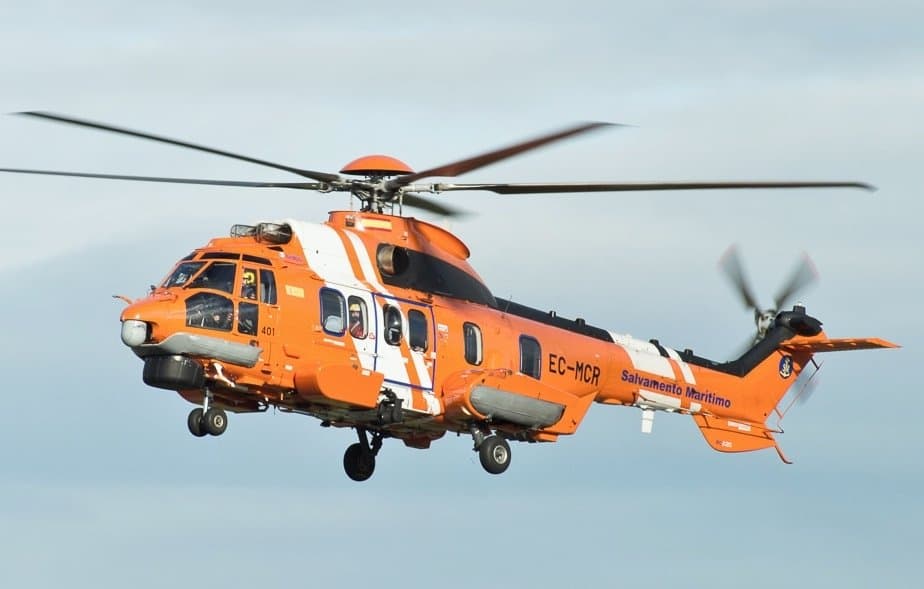
| Source measurement | The helicopter was unveiled at the 2013 Paris Airshow on June 17, 2013, as the Bell SLS (Short Light Single). The model designation was later announced at HAI Heli-Expo 2014 in Anaheim, California on February 25, 2014.[source]Bell 505 Jet Ranger X · Design and development; only the objects and conditions stated in this passage The Bell 505 is a "clean sheet" design, but uses some dynamic components, such as the rotor system, of the Bell 206L-4 . The airframe is constructed of metal and composites, and has a 22-square-foot (2.04 m 2 ) flat floor and an 18-cubic-foot (0.51 m 3 ) luggage bay. The Safran Arrius 2R is used with a dual-channel FADEC and a 3,000-hour Time-between-overhaul . The 505 cockpit is equipped with the Garmin G1000 H glass avionics suite. Various options such as a cargo hook are available.[source]Bell 505 Jet Ranger X · Design and development; only the objects and conditions stated in this passage Main production started in 2016 in an 82,300-square-foot (7,646 m 2 ), $26.3 million hangar facility at Lafayette Regional Airport in Louisiana, but the tooling was created for assembly in different places in the world. Louisiana offered $8 million in support for 250 new jobs, and started construction of the factory in August 2014 which was then leased to Bell. The factory opened in August 2015.[source]Bell 505 Jet Ranger X · Design and development; only the objects and conditions stated in this passage Initial assembly, flight testing and certification started in Canada while the factory was being built in the US. First flight went to 60 knots on November 11, 2014, and the second test aircraft flew in February 2015. Bell said they had 240 letters of intent (LOI) (50 from Europe) for the 505 in October 2014, and in November Chinese tourism operator Reignwood increased their LOI from 10 to 60 of the type. In August 2015, Bell had 350 letters of intent.[source]Bell 505 Jet Ranger X · Design and development; only the objects and conditions stated in this passage The 505 was certified by the Federal Aviation Administration in June 2017 and received high altitude certification (22,500 feet density altitude) in June 2019. Bell delivered the 100th 505 Jet Ranger X in June 2018, and the 200th in August 2019. 360 (March 2022) By November 2023, the 505th Bell 505 was delivered.[source]Bell 505 Jet Ranger X · Sales, production and operations; only the objects and conditions stated in this passage On March 3, 2019, a Bell 505 crashed shortly after taking off from Central Island National Park , Kenya. The pilot and four passengers were killed in the accident. Kyle Forti , an American political consultant, was one of the passengers that died in the crash.[source]Bell 505 Jet Ranger X · Accidents and incidents; only the objects and conditions stated in this passage In 2022 in Queensland, a fan shaft bearing failure led to the failure of the tail shaft. The Australian authorities, working with Bell, could not find a deeper issue, but did note that odd mechanical sounds can be a sign of imminent hardware failure.[source]Bell 505 Jet Ranger X · Accidents and incidents; only the objects and conditions stated in this passage Nautilus Aviation, received 2 in 2018.[source]Bell 505 Jet Ranger X · Operators; only the objects and conditions stated in this passage Royal Jordanian Air Force , received Bell 505 in November 2023.[source]Bell 505 Jet Ranger X · Operators; only the objects and conditions stated in this passage Capacity: four passengers[source]Bell 505 Jet Ranger X · Specifications; only the objects and conditions stated in this passage Length: 42 ft 5 in (12.93 m)[source]Bell 505 Jet Ranger X · Specifications; only the objects and conditions stated in this passage Height: 10 ft 8 in (3.25 m)[source]Bell 505 Jet Ranger X · Specifications; only the objects and conditions stated in this passage Empty weight: 2,180 lb (989 kg)[source]Bell 505 Jet Ranger X · Specifications; only the objects and conditions stated in this passage Max takeoff weight: 3,680 lb (1,669 kg) (Internal load), 4,475 lb (2,030 kg) (external load)[source]Bell 505 Jet Ranger X · Specifications; only the objects and conditions stated in this passage Useful load: 1,500 lb (680 kg)[source]Bell 505 Jet Ranger X · Specifications; only the objects and conditions stated in this passage Powerplant: 1 × Safran Arrius 2R turboshaft , 505 shp (377 kW)[source]Bell 505 Jet Ranger X · Specifications; only the objects and conditions stated in this passage Main rotor diameter: 37 ft 0 in (11.28 m)[source]Bell 505 Jet Ranger X · Specifications; only the objects and conditions stated in this passage Main rotor area: 1,075 sq ft (99.9 m 2 )[source]Bell 505 Jet Ranger X · Specifications; only the objects and conditions stated in this passage Maximum speed: 144 mph (232 km/h, 125 kn) (max cruise)[source]Bell 505 Jet Ranger X · Specifications; only the objects and conditions stated in this passage Range: 383 mi (617 km, 333 nmi) at 4,000 ft (1,200 m)[source]Bell 505 Jet Ranger X · Specifications; only the objects and conditions stated in this passage Service ceiling: 18,610 ft (5,670 m) at 3,680 lb (1,670 kg)[source]Bell 505 Jet Ranger X · Specifications; only the objects and conditions stated in this passage | The Airbus Helicopters H225 (formerly Eurocopter EC225 Super Puma ) is a long-range passenger transport helicopter developed by Eurocopter as the next generation of the civilian Super Puma family. It is a twin-engined aircraft and can carry up to 24 passengers along with two crew and a cabin attendant, dependent on customer configuration. The helicopter is marketed for offshore support and VIP passenger transport duties, as well as public service missions.[source]Eurocopter EC225 Super Puma · Lead; only the objects and conditions stated in this passage In February 2014, Airbus Helicopters announced at Heli-Expo 2014 the development of an improved variant, the EC225e. The EC225e features numerous changes including new avionics systems, such as the TCAS II collision avoidance system, an automatic identification system, and a specialized rig-approach system; it was also intended to feature an improved Turbomeca Makila 2B engine to increase the EC225e's maximum takeoff weight by 550 kg, and an additional fuel tank in the rear baggage compartment to extend its range to 300 nautical miles with up to ten passengers on board. Some, but not all, modifications can be retrofitted onto existing EC225s. In the same announcement, in February 2014, Lease Corporation International said that they had placed a $645 million order for 15 EC225e (along with 6 Airbus Helicopters EC175 ) helicopters as the launch customer. In February 2016, the Makila 2B engine was dropped from the EC225e as a cost reduction measure, development of the other structural and avionics aspects is proceeding.[source]Eurocopter EC225 Super Puma · Development; only the objects and conditions stated in this passage A key safety feature of the aircraft's main gear box (MGB) is an emergency oil spraying sub-system present in the lubrication system; this is designed to exceed the JAR 29 Standard's requirements of a 30-minute running time in the event of the loss of MGB oil pressure, and has demonstrated up to 50-minute running time. The engine also incorporates a "blade shedding" system to ensure engine integrity during an overspeed instance. Energy absorbent self-sealing fuel tanks are contained in the aircraft's sponsons , along with other equipment such as downward-facing illumination and navigation lighting fixtures. The transmission can accommodate more power than the maximum output of the engines; however two aircraft were lost in 2012 due to the cracking of the bevel gear shaft, a gearbox component. In response, the design of the transmission was modified in 2013, and the onboard health and usage monitoring system (HUMS) was upgraded to provide real-time monitoring of the bevel gear shaft against the threat of crack formation. |
| Primary user | — | CHC Helicopter[source] |
| Developed from | — | Eurocopter AS332 Super Puma[source] |
| Variant | — | Eurocopter EC725[source] |
| Never exceed speed | — | 324 km/h (201 mph, 175 kn)[source] |
Maximum take-off; H225 · Max takeoff weight
Single sourceIn terms of cockpit equipment and avionics, the H225 is equipped with a full glass cockpit with active-matrix liquid crystal displays ; these include four 6-inch by 8-inch multi-functional displays as the predominant instrumentation for key flight information, two 4-inch by 5-inch monitors for displaying aircraft parameters, and a 3-inch screen for backup. The advanced helicopter cockpit and avionics system is described as serving to reduce pilot and crew workload, being used to display flight management and sub-systems information and is complete with a four-axis digital autopilot. During a typical flight, the pilot programs the route into the aircraft and then monitors it, as opposed to direct continuous control of the flight; the need for paper charts has been eliminated by these systems. Under autopilot, the automatic flight control system acts to prevent pilot actions from exceeding the established flight envelope; the H225 remains flyable with all automatic systems disabled. From initiating the startup sequence to being ready to takeoff only takes three minutes.[source]Eurocopter EC225 Super Puma · Design; only the objects and conditions stated in this passage
There are currently a total of four principal configurations designed by Airbus Helicopters for the H225. The passenger transport version has a crash-worthy seating arrangement for up to 19 passengers with a high-density seating arrangement accommodating up to 28 passengers available to be fitted. The VIP transport version has a large lounge with seating for up to 12 passengers and a cabin attendant. The emergency medical services (EMS) configuration has medical units for six stretchers and four seats for medical workers. The search and rescue (SAR) configuration allows space for search and rescue equipment with an operator seat, hoistman seat and up to eight rescue seats and three stretchers. While a single pilot is capable of controlling the aircraft under visual meteorical conditions, two pilots are used in a typical crew complement and, dependent on role, a cabin attendant or flight engineer may also be present.[source]Eurocopter EC225 Super Puma · Design; only the objects and conditions stated in this passage
Icelandic Coast Guard — received 2 H225s in 2019 and 1 in 2021.[source]Eurocopter EC225 Super Puma · Operators / Military operators; only the objects and conditions stated in this passage
18 February 2009: G-REDU, an EC225 LP operated by Bond Offshore Helicopters . During a night visual approach to the ETAP platform, the helicopter descended and impacted the surface of the sea. The crew's perception of the helicopter's position and orientation relative to the platform during the final approach was erroneous. All 18 people on board survived the controlled flight into terrain (water) .[source]Eurocopter EC225 Super Puma · Accidents and incidents; only the objects and conditions stated in this passage
10 May 2012: G-REDW, an EC225 LP, carried out a controlled ditching following indications of a failure of the main gearbox (MGB) lubrication system and a subsequent failure indication warning on the emergency lubrication system. An investigation by the Air Accidents Investigation Branch (AAIB) identified a 360° circumferential crack in the bevel gear vertical shaft in the main gearbox, in the vicinity of a manufacturing weld, causing disengagement of the drive to both mechanical oil pumps.[source]Eurocopter EC225 Super Puma · Accidents and incidents; only the objects and conditions stated in this passage
22 October 2012: G-CHCN, an EC225 LP of CHC Scotia, ditched in the North Sea 32 miles south west of Shetland whilst en route from Aberdeen to the West Phoenix drilling rig. All 19 on board were rescued. A special bulletin issued by the Air Accidents Investigation Branch (AAIB) said the main and standby oil pumps were not working; a 360-degree crack found on the bevel gear vertical shaft of the gearbox had prevented the oil pump gears from being driven. A worldwide grounding of the type was initiated in response. In both of the 2012 incidents, although the main gearbox lubrication system had failed, the backup system was working correctly but displaying an erroneous warning light, due to an incorrect specification of a pressure switch, which led to the helicopters being ditched.[source]Eurocopter EC225 Super Puma · Accidents and incidents; only the objects and conditions stated in this passage
29 April 2016: LN-OJF , an EC225 LP of CHC Helikopter Service , crashed at an islet near Turøy in the Bergen archipelago, en route to Bergen Airport, Flesland , from the Gullfaks B platform in the North Sea. The helicopter was carrying 11 passengers and 2 crew members; everyone on board died. Eyewitnesses reported that the main rotor separated from the hull immediately before the crash. Due to the crash, all commercial flights by EC225 helicopters, excluding search and rescue flights, were grounded by both Norwegian and British civil aviation authorities. The subsequent investigation concluded that a gear in the main rotor gearbox had failed due to a fatigue crack that had propagated under-surface, escaping detection. As a result of the incident the German Defence Ministry had also decided to ground 3 AS532 Helicopter in government use which were manufactured by the same company.[source]Eurocopter EC225 Super Puma · Accidents and incidents; only the objects and conditions stated in this passage
18 January 2023: an EC225 carrying the Minister of Internal Affairs of Ukraine , Denys Monastyrsky , his deputy Yevhen Yenin and state secretary Yurii Lubkovych , crashed at a kindergarten in Brovary , a suburb of Kyiv , Ukraine . The crash killed 14 people, including Monastyrsky, Yenin and Lubkovych; a child was also among the fatalities, while 25 others were injured.[source]Eurocopter EC225 Super Puma · Accidents and incidents; only the objects and conditions stated in this passage
Capacity: 24 passengers + 1 cabin attendant[source]Eurocopter EC225 Super Puma · Specifications (H225); only the objects and conditions stated in this passage
Length: 19.5 m (64 ft 0 in)[source]Eurocopter EC225 Super Puma · Specifications (H225); only the objects and conditions stated in this passage
Height: 4.97 m (16 ft 4 in)[source]Eurocopter EC225 Super Puma · Specifications (H225); only the objects and conditions stated in this passage
Empty weight: 5,256 kg (11,587 lb)[source]Eurocopter EC225 Super Puma · Specifications (H225); only the objects and conditions stated in this passage
Gross weight: 11,000 kg (24,251 lb)[source]Eurocopter EC225 Super Puma · Specifications (H225); only the objects and conditions stated in this passage
Max takeoff weight: 11,200 kg (24,692 lb)[source]Eurocopter EC225 Super Puma · Specifications (H225); only the objects and conditions stated in this passage
Powerplant: 2 × Turbomeca Makila 2A1 turboshaft engines, 1,776 kW (2,382 hp) each[source]Eurocopter EC225 Super Puma · Specifications (H225); only the objects and conditions stated in this passage
Main rotor diameter: 16.2 m (53 ft 2 in)[source]Eurocopter EC225 Super Puma · Specifications (H225); only the objects and conditions stated in this passage
Main rotor area: 206.15 m 2 (2,219.0 sq ft)[source]Eurocopter EC225 Super Puma · Specifications (H225); only the objects and conditions stated in this passage
Maximum speed: 275.5 km/h (171.2 mph, 148.8 kn)[source]Eurocopter EC225 Super Puma · Specifications (H225); only the objects and conditions stated in this passage
Cruise speed: 260.5 km/h (161.9 mph, 140.7 kn)[source]Eurocopter EC225 Super Puma · Specifications (H225); only the objects and conditions stated in this passage
Never exceed speed : 324 km/h (201 mph, 175 kn)[source]Eurocopter EC225 Super Puma · Specifications (H225); only the objects and conditions stated in this passage
Range: 857 km (533 mi, 463 nmi)[source]Eurocopter EC225 Super Puma · Specifications (H225); only the objects and conditions stated in this passage
Ferry range: 985 km (612 mi, 532 nmi)[source]Eurocopter EC225 Super Puma · Specifications (H225); only the objects and conditions stated in this passage
Service ceiling: 5,900 m (19,400 ft)[source]Eurocopter EC225 Super Puma · Specifications (H225); only the objects and conditions stated in this passage
Rate of climb: 8.7 m/s (1,710 ft/min)[source]Eurocopter EC225 Super Puma · Specifications (H225); only the objects and conditions stated in this passage