



Preparing your view.
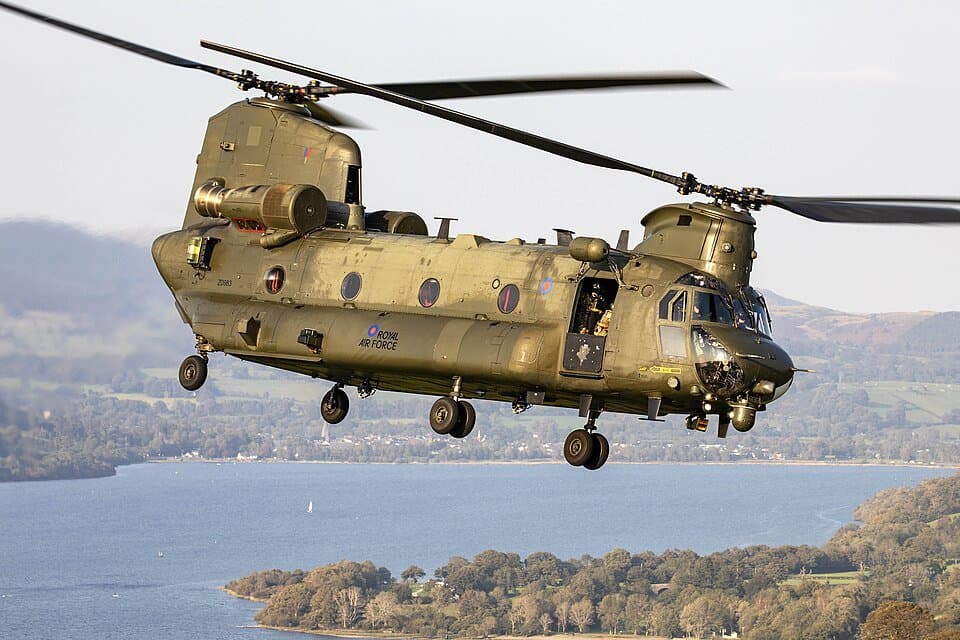
At a glance
Measured figures
Main rotor diameter
Single source37 ft 0 in (11.28 m)[source]
one pilot[source]
Chinook HC6A · pilot, copilot, two weapon system operators/loadmasters
Single source4 (pilot, copilot, two weapon system operators/loadmasters)[source]
2 Pilots, 2 Weapon System Operators[source]Chinook / RAF specification (variant not stated) · AircrewSource text · numeric interpretation needs review
Maximum; max cruise
Single source144 mph (232 km/h, 125 kn) (max cruise)[source]
1 × Safran Arrius 2R turboshaft , 505 shp (
Single source1 × Safran Arrius 2R turboshaft , 505 shp (377 kW)[source]
Chinook HC6A · 2 × Honeywell T55-GA-714A turboshaft free-turbine engines, 3,750 shp ( ) each
Single source2 × Honeywell T55-GA-714A turboshaft free-turbine engines, 3,750 shp (2,800 kW) each[source]
Chinook HC6A · 1,980 ft/min ( )Thrust 2x 4,168shp each engine
Single source1,980 ft/min (10.1 m/s)Thrust 2x 4,168shp each engine[source]
Bars compare reported quantities only. A larger figure does not make a system better; configurations and test conditions differ.
Configuration
| Specification | Bell 505 Jet Ranger X | Boeing Chinook (UK variants) |
|---|---|---|
| Type | Light helicopter[source] | Transport helicopter[source] |
| National origin | United States / Canada[source] | — |
| Manufacturer | Bell Textron[source] | Boeing Defense, Space & Security[source] |
| Status | In service[source] | In service[source] |
| Number built | 505 (November 2023)[source] | 72 (all RAF models)[source] |
| Manufactured | 2014–present[source] | — |
| Introduction date | March 7, 2017[source] | 22 November 1980 (with RAF)[source] |
| First flight | November 10, 2014[source] | 23 March 1980 (HC1)[source] |
| Capacity | four passengers[source] | 55 soldiers and up to 10 tonnes of freight or equipment[source] |
| Useful load | 1,500 lb (680 kg)[source] | — |
| Main rotor area | 1,075 sq ft (99.9 m 2 )[source] | 5,655.2 sq ft (525.39 m 2 )[source] |
| Role | American/Canadian light helicopter[source] | — |
| Source measurement | The helicopter was unveiled at the 2013 Paris Airshow on June 17, 2013, as the Bell SLS (Short Light Single). The model designation was later announced at HAI Heli-Expo 2014 in Anaheim, California on February 25, 2014.[source]Bell 505 Jet Ranger X · Design and development; only the objects and conditions stated in this passage The Bell 505 is a "clean sheet" design, but uses some dynamic components, such as the rotor system, of the Bell 206L-4 . The airframe is constructed of metal and composites, and has a 22-square-foot (2.04 m 2 ) flat floor and an 18-cubic-foot (0.51 m 3 ) luggage bay. The Safran Arrius 2R is used with a dual-channel FADEC and a 3,000-hour Time-between-overhaul . The 505 cockpit is equipped with the Garmin G1000 H glass avionics suite. Various options such as a cargo hook are available.[source]Bell 505 Jet Ranger X · Design and development; only the objects and conditions stated in this passage Main production started in 2016 in an 82,300-square-foot (7,646 m 2 ), $26.3 million hangar facility at Lafayette Regional Airport in Louisiana, but the tooling was created for assembly in different places in the world. Louisiana offered $8 million in support for 250 new jobs, and started construction of the factory in August 2014 which was then leased to Bell. The factory opened in August 2015.[source]Bell 505 Jet Ranger X · Design and development; only the objects and conditions stated in this passage Initial assembly, flight testing and certification started in Canada while the factory was being built in the US. First flight went to 60 knots on November 11, 2014, and the second test aircraft flew in February 2015. Bell said they had 240 letters of intent (LOI) (50 from Europe) for the 505 in October 2014, and in November Chinese tourism operator Reignwood increased their LOI from 10 to 60 of the type. In August 2015, Bell had 350 letters of intent.[source]Bell 505 Jet Ranger X · Design and development; only the objects and conditions stated in this passage The 505 was certified by the Federal Aviation Administration in June 2017 and received high altitude certification (22,500 feet density altitude) in June 2019. Bell delivered the 100th 505 Jet Ranger X in June 2018, and the 200th in August 2019. 360 (March 2022) By November 2023, the 505th Bell 505 was delivered.[source]Bell 505 Jet Ranger X · Sales, production and operations; only the objects and conditions stated in this passage On March 3, 2019, a Bell 505 crashed shortly after taking off from Central Island National Park , Kenya. The pilot and four passengers were killed in the accident. Kyle Forti , an American political consultant, was one of the passengers that died in the crash.[source]Bell 505 Jet Ranger X · Accidents and incidents; only the objects and conditions stated in this passage In 2022 in Queensland, a fan shaft bearing failure led to the failure of the tail shaft. The Australian authorities, working with Bell, could not find a deeper issue, but did note that odd mechanical sounds can be a sign of imminent hardware failure.[source]Bell 505 Jet Ranger X · Accidents and incidents; only the objects and conditions stated in this passage Nautilus Aviation, received 2 in 2018.[source]Bell 505 Jet Ranger X · Operators; only the objects and conditions stated in this passage Royal Jordanian Air Force , received Bell 505 in November 2023.[source]Bell 505 Jet Ranger X · Operators; only the objects and conditions stated in this passage Capacity: four passengers[source]Bell 505 Jet Ranger X · Specifications; only the objects and conditions stated in this passage Length: 42 ft 5 in (12.93 m)[source]Bell 505 Jet Ranger X · Specifications; only the objects and conditions stated in this passage Height: 10 ft 8 in (3.25 m)[source]Bell 505 Jet Ranger X · Specifications; only the objects and conditions stated in this passage Empty weight: 2,180 lb (989 kg)[source]Bell 505 Jet Ranger X · Specifications; only the objects and conditions stated in this passage Max takeoff weight: 3,680 lb (1,669 kg) (Internal load), 4,475 lb (2,030 kg) (external load)[source]Bell 505 Jet Ranger X · Specifications; only the objects and conditions stated in this passage Useful load: 1,500 lb (680 kg)[source]Bell 505 Jet Ranger X · Specifications; only the objects and conditions stated in this passage Powerplant: 1 × Safran Arrius 2R turboshaft , 505 shp (377 kW)[source]Bell 505 Jet Ranger X · Specifications; only the objects and conditions stated in this passage Main rotor diameter: 37 ft 0 in (11.28 m)[source]Bell 505 Jet Ranger X · Specifications; only the objects and conditions stated in this passage Main rotor area: 1,075 sq ft (99.9 m 2 )[source]Bell 505 Jet Ranger X · Specifications; only the objects and conditions stated in this passage Maximum speed: 144 mph (232 km/h, 125 kn) (max cruise)[source]Bell 505 Jet Ranger X · Specifications; only the objects and conditions stated in this passage Range: 383 mi (617 km, 333 nmi) at 4,000 ft (1,200 m)[source]Bell 505 Jet Ranger X · Specifications; only the objects and conditions stated in this passage Service ceiling: 18,610 ft (5,670 m) at 3,680 lb (1,670 kg)[source]Bell 505 Jet Ranger X · Specifications; only the objects and conditions stated in this passage | — |
| Designer | — | Boeing-Vertol[source] |
| Primary user | — | Royal Air Force[source] |
| Developed from | — | Boeing CH-47 Chinook[source] |
| Variants | — | HC1, HC1B, HC2, HC3, HC4, HC5, HC6, HC6A, HC7[source] |
| Guns | — | 2× M134 Miniguns and 1× M60 machine gun[source] 2 x M134 Miniguns, 1 x M60 Machine Gun[source]Chinook / RAF specification (variant not stated) · Guns |
| Blade section | — | - root: Boeing VR-7; tip: Boeing VR-8[source] |
| Cockpit Avionics | — | Glass cockpit with a BAE Systems Digital Advanced Flight Control System (DAFCS), includes automatic modes such as auto-hover and auto-descend to ease pilot workload.[source] |
| Sensors | — | Electro-Optical Sensor Turret (EOST) with two infrared cameras and a low-light TV function .[source] EOST turret including two infrared cameras and a low-light TV function[source]Chinook / RAF specification (variant not stated) · Electro optics |
| Defensive Aids | — | Missile Warning Receiver, Infrared Warning Receiver, Radar Warning Receiver, Counter-measure dispensing system (flares).[source] |
| Country of origin | — | United States[source]Boeing Chinook (UK variants) · origin explicitly stated in the linked current national-inventory row; no inference from operator or shipyard |
| Powerplant | — | Two Honeywell 55-L-714A Free-Turbine engines[source]Chinook / RAF specification (variant not stated) · Powerplant |
| Reported engine rating | — | 4,168shp each[source]Chinook / RAF specification (variant not stated) · ThrustSource text · numeric interpretation needs review |
| Flight altitude | — | 15,000ft[source]Chinook / RAF specification (variant not stated) · Maximum altitude |