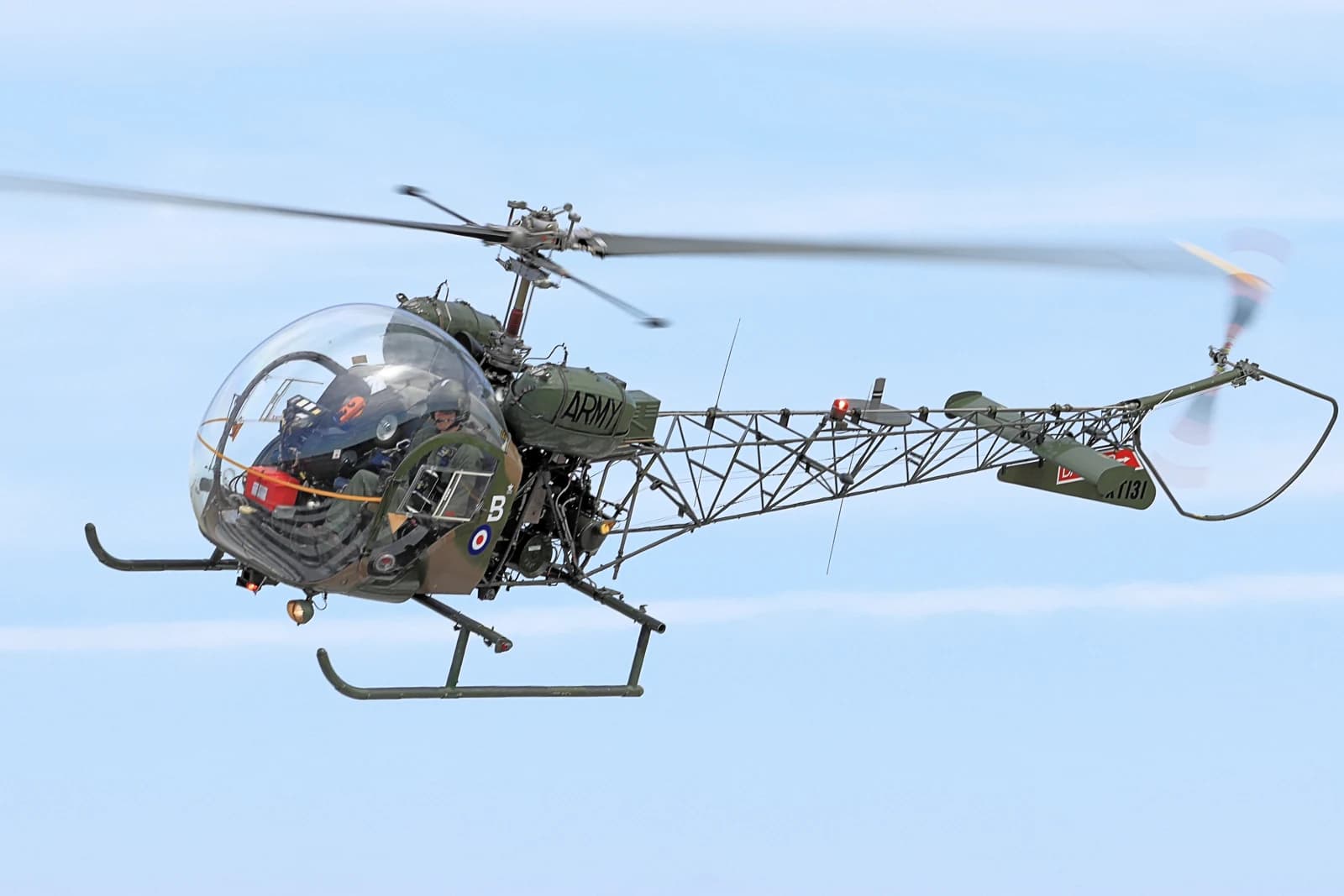

Credit
Airwolfhound from Hertfordshire, UK · CC BY-SA 2.0 · Resized / WebP conversion · CC BY-SA 2.0 · Source ↗ · Modified


Preparing your view.
At a glance
Measured figures
Bell 47G-3B · Length
Single source31 ft 7 in (9.63 m)[source]
Length
Single sourceConfiguration
| Specification | Bell 47 | Hiller OH-23 Raven |
|---|---|---|
| Type | Multipurpose light helicopter[source] | Multipurpose light helicopter[source] |
| National origin | United States[source] | — |
| Manufacturer | Bell Aircraft Bell Helicopter[source] | United Helicopters Hiller Aircraft[source] |
| Designer | Arthur M. Young[source] | — |
| Primary users | United States Army British Army |
8.45 metre[source]Source text · numeric interpretation needs review
8.69 metre[source]Source text · numeric interpretation needs review
8,46 m[source]
8.45 metre[source]Source text · numeric interpretation needs review
8.69 metre[source]Source text · numeric interpretation needs review
8.45 metre[source]Source text · numeric interpretation needs review
8.69 metre[source]Source text · numeric interpretation needs review
8.45 metre[source]Source text · numeric interpretation needs review
8.69 metre[source]Source text · numeric interpretation needs review
8.45 metre[source]Source text · numeric interpretation needs review
8.69 metre[source]Source text · numeric interpretation needs review
Bell 47G-3B · 1 × Lycoming TVO-435-F1A six-cylinder vertically mounted horizontally-opposed air-cooled piston engine
Single source1 × Lycoming TVO-435-F1A six-cylinder vertically mounted horizontally-opposed air-cooled piston engine, 280 hp (210 kW)[source]
H-23D · 1 × Lycoming VO-435-23B 6-cylinder air-cooled horizontally-opposed piston engine
Single source1 × Lycoming VO-435-23B 6-cylinder air-cooled horizontally-opposed piston engine, 250 hp (190 kW)[source]
H-23D · Service ceiling
Single source13,200 ft (4,000 m)[source]
Bars compare reported quantities only. A larger figure does not make a system better; configurations and test conditions differ.
United States Army Colombian Air Force Royal Navy[source] |
| Number built | 5,600[source] | 2,000+[source] |
|---|
| Manufactured | 1946–1974[source] | 1948–1965[source] |
|---|
| Introduction date | 1946[source] | 1948[source] |
|---|
| First flight | December 8, 1945[source] | 1948[source] |
|---|
| Developed from | Bell 30[source] | — |
|---|
| Variants | Bell H-13 Sioux Bell 47J Ranger Kawasaki KH-4[source] | — |
|---|
| Capacity | 1 passenger or 2 litters (1,057 lb (479 kg) payload)[source] | — |
|---|
| Main rotor area | 1,085 sq ft (100.8 m 2 )[source] | 985 sq ft (91.5 m 2 )[source] |
|---|
| Role | single-rotor single-engine light helicopter[source] | two, three, or four-place, military light observation helicopter[source] |
|---|
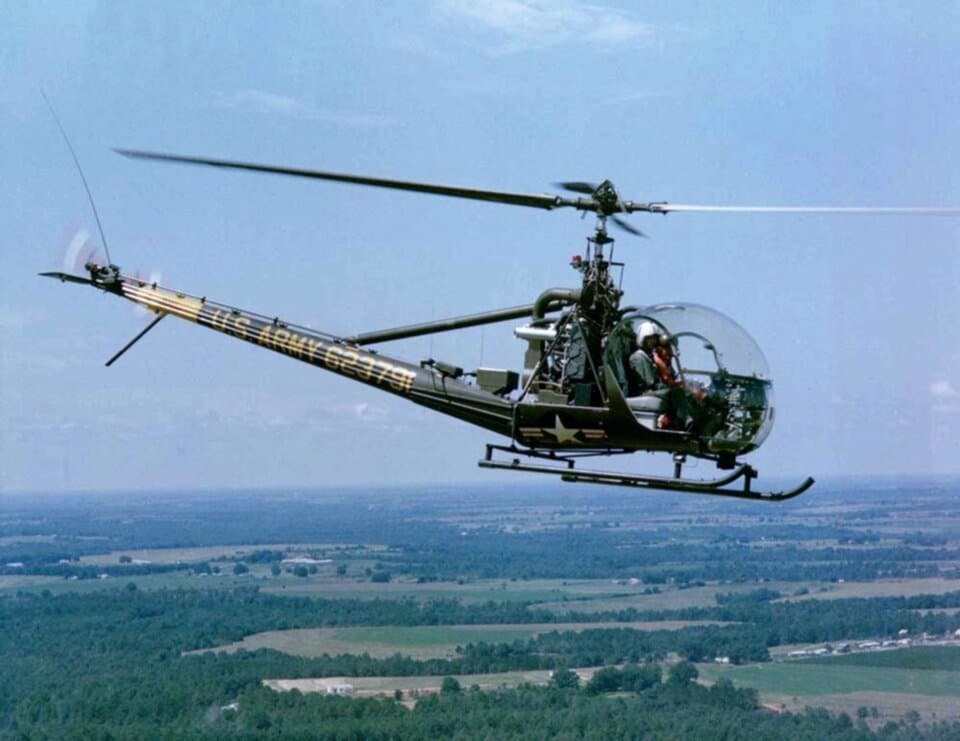
| Source measurement | Early models varied in appearance, with open cockpits or sheet metal cabins, fabric covered or open structures, some with four-wheel landing gear. Later model D and Korean War H-13D and E types settled on a more utilitarian style. The most common model, the 47G introduced in 1953, can be recognized by the full "soap bubble" canopy , exposed welded-tube tail boom, saddle fuel tanks and skid landing gear. The 47G was released as a number of sub-variants and some sub-variants were available in a narrow bubble (55 inches wide) and wide bubble (60 or 63 inches wide).[source]Bell 47 · Design and development; only the objects and conditions stated in this passage The later three-seat 47H had an enclosed cabin with full cowling and monocoque tail boom. It was an attempt to market a "luxury" version of the basic 47G. Relatively few were produced.[source]Bell 47 · Design and development; only the objects and conditions stated in this passage Engines were Franklin or Lycoming vertically mounted piston engines of 175 to 305 HP (130 to 227 kW ). Seating varied from two (early 47s and the later G-5) to four (the J and KH-4).[source]Bell 47 · Design and development; only the objects and conditions stated in this passage In April 2011 there were 1068 registered with the Federal Aviation Administration in the United States and 15 in the United Kingdom.[source]Bell 47 · Design and development; only the objects and conditions stated in this passage The "Telecopter" was a Bell 47 rented by television station KTLA in Los Angeles , California . It was outfitted with a television camera and it made the world ' s first flight by a television news helicopter on July 3, 1958, with its inventor, John D. Silva , aboard. When the television station reported it was receiving no video, Silva exited the helicopter ' s cockpit to climb onto its landing skid while it hovered at 1,500 feet (457 m) so he could investigate the microwave transmitter bolted to its side, where he discovered a vacuum tube had failed due to vibration and hot weather. After Silva fixed the problem overnight, the Telecopter made the world's first successful television news flight on July 4, 1958.[source]Bell 47 · Operational history; only the objects and conditions stated in this passage 13 May 1949, a Bell 47 set an altitude record of 18,550 feet (5,650 m).[source]Bell 47 · Operational history / Records; only the objects and conditions stated in this passage 17 September 1952, Bell pilot Elton J. Smith set a world distance record for piston helicopters of 1,217 miles (1,959 km) by flying nonstop from Hurst, Texas , to Buffalo, New York . As of 2018, this record still stands.[source]Bell 47 · Operational history / Records; only the objects and conditions stated in this passage Pre-production version, powered by a 178 hp (133 kW) Franklin piston engine. Ten pre-production examples built, which varied in appearance.[source]Bell 47 · Variants / Civilian; only the objects and conditions stated in this passage Improved version of the Bell 47, powered by a 175 hp (130 kW) Franklin O-335-1 piston engine.[source]Bell 47 · Variants / Civilian; only the objects and conditions stated in this passage Equivalent to the military YR-13/HTL-1, powered by the 175 hp (130 kW) Franklin O-335-1. 47B-3 Agricultural/utility version with open crew positions. Also, offered in a version to the US Postal Service as the Bell Airmailer .[source]Bell 47 · Variants / Civilian; only the objects and conditions stated in this passage Powered by a 200 hp (150 kW) Franklin 6V4-200-C32 engine.[source]Bell 47 · Variants / Civilian; only the objects and conditions stated in this passage 47G[source]Bell 47 · Variants / Civilian; only the objects and conditions stated in this passage Combines a 200 hp (149 kW) Franklin engine with the three-seat configuration of the 47D-1 and introduced the twin saddle-bag fuel tank configuration. 47G-2 Powered by the Lycoming VO-435 engine. Produced under license by Westland Aircraft as the Sioux for the UK military. 47G-2A Powered by a 240 hp (179 kW) VO-435. 47G-2A-1 Wider cabin, improved rotor blades and increased fuel capacity. Also licence built in Italy by Agusta. 47G-2A-1 Wing Ding An experimental compound helicopter, developed by Bell in 1963. 47G-3 Powered by a supercharged 225 hp (168 kW) Franklin 6VS-335-A. 47G-3B Powered by a turbocharged 280 hp (209 kW) Lycoming TVO-435. 47G-4 Three-seat helicopter powered by an Avco Lycoming VO-540 engine. 47G-5 A three-seat utility version. A two-seat agricultural version was later known as the Ag-5 . The 47G-5 remained in production even after H & J production had ended.[source]Bell 47 · Variants / Civilian; only the objects and conditions stated in this passage 47G-2[source]Bell 47 · Variants / Civilian; only the objects and conditions stated in this passage 47G-2A[source]Bell 47 · Variants / Civilian; only the objects and conditions stated in this passage 47G-2A-1[source]Bell 47 · Variants / Civilian; only the objects and conditions stated in this passage 47G-2A-1 Wing Ding[source]Bell 47 · Variants / Civilian; only the objects and conditions stated in this passage 47G-3[source]Bell 47 · Variants / Civilian; only the objects and conditions stated in this passage 47G-3B[source]Bell 47 · Variants / Civilian; only the objects and conditions stated in this passage 47G-4[source]Bell 47 · Variants / Civilian; only the objects and conditions stated in this passage 47G-5[source]Bell 47 · Variants / Civilian; only the objects and conditions stated in this passage Bell 47H-1[source]Bell 47 · Variants / Civilian; only the objects and conditions stated in this passage Brazilian Navy designation of the Model 47G.[source]Bell 47 · Variants / Military; only the objects and conditions stated in this passage ( Thai : ฮ.ผฑ.๒ ) Royal Thai Armed Forces designation for the Kawasaki-built Model 47G-3B-114.[source]Bell 47 · Variants / Military; only the objects and conditions stated in this passage Carson Super C-4 El Tomcat Mk.II Bell 47G-2 modified extensively for agricultural spraying by Continental Copters Inc. First flew in April 1959, followed by further improved versions.[source]Bell 47 · Variants / Conversions; only the objects and conditions stated in this passage Unknown ID – Bell 47G on static display at the Alberta Aviation Museum in Edmonton , Alberta. It was assembled from parts and represents a Bell 47D.[source]Bell 47 · Aircraft on display; only the objects and conditions stated in this passage CF-NHH – Bell 47G on static display at The Hangar Flight Museum in Calgary, Alberta . It was built by college students from parts and has never flown.[source]Bell 47 · Aircraft on display; only the objects and conditions stated in this passage CF-FZX – Bell 47G-4 on display at the British Columbia Aviation Museum .[source]Bell 47 · Aircraft on display; only the objects and conditions stated in this passage 710 (French Air Force) – Bell 47G on static display at the Musée de l’air et de l’espace in Le Bourget, Île-de-France .[source]Bell 47 · Aircraft on display; only the objects and conditions stated in this passage AS+058 (German Army) – Agusta-Bell 47G-2 on static display at the Deutsches Museum in Munich, Bavaria .[source]Bell 47 · Aircraft on display; only the objects and conditions stated in this passage AS7201 – Bell 47G-2 on static display at the Malta Aviation Museum in Ta'Qali . It was the first aircraft of the Armed Forces of Malta and was donated to the museum on 31 May 2008.[source]Bell 47 · Aircraft on display; only the objects and conditions stated in this passage NZ3705 – Bell 47G-3B-1 on static display at the Air Force Museum of New Zealand in Wigram, Canterbury .[source]Bell 47 · Aircraft on display; only the objects and conditions stated in this passage HE.7B-31 – AB-47G-3B1 on static display at the Museo Aeronáutico de Málaga in Málaga, Andalusia .[source]Bell 47 · Aircraft on display; only the objects and conditions stated in this passage Unknown ID – Bell 47G on static display at the ABBA: The Museum in Stockholm . It had previously been featured on the cover for ABBA 's 1976 album Arrival .[source]Bell 47 · Aircraft on display; only the objects and conditions stated in this passage HB-XAE – Bell 47G-2 on static display at the Swiss Museum of Transport in Lucerne .[source]Bell 47 · Aircraft on display; only the objects and conditions stated in this passage G-AZYB (painted in former SABENA markings as OO-SHW) – Bell 47H on static display at the Helicopter Museum in Weston-super-Mare, Somerset. It supported a scientific expedition in Antarctica.[source]Bell 47 · Aircraft on display; only the objects and conditions stated in this passage N996B – Bell 47H-1 on static display at the Niagara Aerospace Museum in Niagara Falls, New York.[source]Bell 47 · Aircraft on display; only the objects and conditions stated in this passage N8010E – Bell 47H on static display at the American Helicopter Museum & Education Center in West Chester, Pennsylvania.[source]Bell 47 · Aircraft on display; only the objects and conditions stated in this passage OE-XDM – Bell 47 G-3B-1T (a former United States Army TH-13T) airworthy with The Flying Bulls in Salzburg .[source]Bell 47 · Surviving aircraft; only the objects and conditions stated in this passage A1-402 - Bell 47 G former Australian Army 161 Independent Recce Flight on static display at HARS Parkes Aviation Museum[source]Bell 47 · Surviving aircraft; only the objects and conditions stated in this passage N2490B – Bell 47G-2 airworthy at the EAA AirVenture Museum in Oshkosh, Wisconsin .[source]Bell 47 · Surviving aircraft; only the objects and conditions stated in this passage N7576 – Bell 47G-2A airworthy at the Classic Rotors Museum in Ramona, California .[source]Bell 47 · Surviving aircraft; only the objects and conditions stated in this passage N6356X – Continental Copters Bell 47G airworthy at the Mid America Flight Museum in Mount Pleasant, Texas .[source]Bell 47 · Surviving aircraft; only the objects and conditions stated in this passage Capacity: 1 passenger or 2 litters (1,057 lb (479 kg) payload)[source]Bell 47 · Specifications (Bell 47G-3B); only the objects and conditions stated in this passage Length: 31 ft 7 in (9.63 m)[source]Bell 47 · Specifications (Bell 47G-3B); only the objects and conditions stated in this passage Height: 9 ft 3 in (2.82 m)[source]Bell 47 · Specifications (Bell 47G-3B); only the objects and conditions stated in this passage Empty weight: 1,893 lb (859 kg)[source]Bell 47 · Specifications (Bell 47G-3B); only the objects and conditions stated in this passage Max takeoff weight: 2,950 lb (1,338 kg)[source]Bell 47 · Specifications (Bell 47G-3B); only the objects and conditions stated in this passage Powerplant: 1 × Lycoming TVO-435-F1A six-cylinder vertically mounted horizontally-opposed air-cooled piston engine, 280 hp (210 kW)[source]Bell 47 · Specifications (Bell 47G-3B); only the objects and conditions stated in this passage Main rotor diameter: 37 ft 2 in (11.33 m)[source]Bell 47 · Specifications (Bell 47G-3B); only the objects and conditions stated in this passage Main rotor area: 1,085 sq ft (100.8 m 2 )[source]Bell 47 · Specifications (Bell 47G-3B); only the objects and conditions stated in this passage Maximum speed: 91 kn (105 mph, 169 km/h)[source]Bell 47 · Specifications (Bell 47G-3B); only the objects and conditions stated in this passage Cruise speed: 73 kn (84 mph, 135 km/h)[source]Bell 47 · Specifications (Bell 47G-3B); only the objects and conditions stated in this passage Range: 214 nmi (246 mi, 396 km)[source]Bell 47 · Specifications (Bell 47G-3B); only the objects and conditions stated in this passage Rate of climb: 860 ft/min (4.4 m/s)[source]Bell 47 · Specifications (Bell 47G-3B); only the objects and conditions stated in this passage | The Raven used Hiller's "Rotor-Matic" cyclic control system, with two small servo rotor paddles offset 90 degrees to the main rotor blades. The paddles were attached to the control column, so that movement of the column would cause the pitch of the servo paddles to change, loading the main rotor blade so that the desired cyclic changes to the rotor occurred. The OH-23 had a top speed of 97 mph (156 km/h; 84 kn). The Raven had a two-bladed main rotor, a metal two-bladed tail rotor. Both the OH-23B and the OH-23C were powered by one Franklin O-335 -5D engine.[source]Hiller OH-23 Raven · Operational history; only the objects and conditions stated in this passage The OH-23D was a purely military version with a Lycoming O-435-23C engine and a more reliable transmission. Most OH-23Ds were replaced by the OH-23G , the most common version of the Raven, with a more powerful Lycoming O-540 -9A six-cylinder, horizontally opposed, air-cooled 305 hp (227 kW) engine. The OH-23G could seat three. The MEDEVAC version carried two external skid-mounted litters or pods. The Raven saw service as a scout during the early part of the Vietnam War before being replaced by the Hughes OH-6A Cayuse in early 1968. A Raven piloted by Hugh Thompson, Jr. played a crucial role in curtailing the My Lai Massacre . When a Raven of the 59th Aviation Company strayed north of the Korean DMZ in August 1969 it was shot down and the crew were kept prisoner until released on December 2.[source]Hiller OH-23 Raven · Operational history; only the objects and conditions stated in this passage The Raven could be armed with twin M37C .30-caliber machine guns on the XM1 armament subsystem or twin M60C 7.62 mm machine guns on the M2 armament subsystem. The XM76 sighting system was used for aiming the guns.[source]Hiller OH-23 Raven · Operational history; only the objects and conditions stated in this passage One Model UH-12A, modified with two-seat cabin and 178 hp Franklin engine for U.S. Army evaluation.[source] |
|---|
| Status | — | Retired[source] |
|---|
| Blade section | — | NACA 0012[source] |
|---|
| Country of origin | — | United States[source] |
|---|
Initial production version with 178 hp (133 kW) Franklin O-335 -4 piston engine and two-seat cockpit, 100 built for the U.S. Army and 5 for evaluation by the U.S. Air Force.[source]Hiller OH-23 Raven · Variants / Military; only the objects and conditions stated in this passage
H-23A with skid/wheel undercarriage and 200 hp (149 kW) O-335-6 engine (some later re-engined with a 250 hp VO-435-23B), re-designated OH-23B in 1962, 273 built for the U.S. Army and 81 for military export.[source]Hiller OH-23 Raven · Variants / Military; only the objects and conditions stated in this passage
H-23C with new rotor, transmission and 250 hp (187 kW) Lycoming VO-435-23B engine, 348 built for U.S. Army. Re-designated OH-23D in 1962.[source]Hiller OH-23 Raven · Variants / Military; only the objects and conditions stated in this passage
Model UH-12E-4, four-seat model with 25-inch cabin extension and a 305 hp VO-540-A1B engine, redesignated OH-23F in 1962, 22 built for U.S. Army.[source]Hiller OH-23 Raven · Variants / Military; only the objects and conditions stated in this passage
H-23G[source]Hiller OH-23 Raven · Variants / Military; only the objects and conditions stated in this passage
Three-seat dual control version of H-23F, redesignated OH-23G in 1962, 793 built.[source]Hiller OH-23 Raven · Variants / Military; only the objects and conditions stated in this passage
Original production model for the U.S. Army, powered by a six cylinder fan-cooled Franklin 6V4-178-B33 engine with a maximal power of 178hp at 3000 rpm. The main rotor blades (produced by the Parsons Industries Inc.) are of solid wood laminations. The body of the blade is in fact essentially made up of numerous strip and block wooden laminations designed to provide a strong but highly flexible blade. The entire blade surface is covered with fiberglass cloth with the leading edge covered with an additional stainless steel sheet. The tail rotor is of all metal construction.[source]Hiller OH-23 Raven · Variants / Civilian; only the objects and conditions stated in this passage
Four-seat civilian version (pilot in front, with back seat for three passengers). United States Army designation H-23F . VO-540 powered. Conversion kit available for E-12 models.[source]Hiller OH-23 Raven · Variants / Civilian; only the objects and conditions stated in this passage
Height: 9 ft 9.5 in (2.985 m)[source]Hiller OH-23 Raven · Specifications (H-23D); only the objects and conditions stated in this passage
Empty weight: 1,816 lb (824 kg)[source]Hiller OH-23 Raven · Specifications (H-23D); only the objects and conditions stated in this passage
Max takeoff weight: 2,700 lb (1,225 kg)[source]Hiller OH-23 Raven · Specifications (H-23D); only the objects and conditions stated in this passage
Powerplant: 1 × Lycoming VO-435-23B 6-cylinder air-cooled horizontally-opposed piston engine, 250 hp (190 kW)[source]Hiller OH-23 Raven · Specifications (H-23D); only the objects and conditions stated in this passage
Main rotor diameter: 35 ft 5 in (10.80 m)[source]Hiller OH-23 Raven · Specifications (H-23D); only the objects and conditions stated in this passage
Main rotor area: 985 sq ft (91.5 m 2 )[source]Hiller OH-23 Raven · Specifications (H-23D); only the objects and conditions stated in this passage
Maximum speed: 95 mph (153 km/h, 83 kn)[source]Hiller OH-23 Raven · Specifications (H-23D); only the objects and conditions stated in this passage
Cruise speed: 82 mph (132 km/h, 71 kn)[source]Hiller OH-23 Raven · Specifications (H-23D); only the objects and conditions stated in this passage
Range: 197 mi (317 km, 171 nmi)[source]Hiller OH-23 Raven · Specifications (H-23D); only the objects and conditions stated in this passage
Service ceiling: 13,200 ft (4,000 m)[source]Hiller OH-23 Raven · Specifications (H-23D); only the objects and conditions stated in this passage
Rate of climb: 1,050 ft/min (5.3 m/s)[source]Hiller OH-23 Raven · Specifications (H-23D); only the objects and conditions stated in this passage