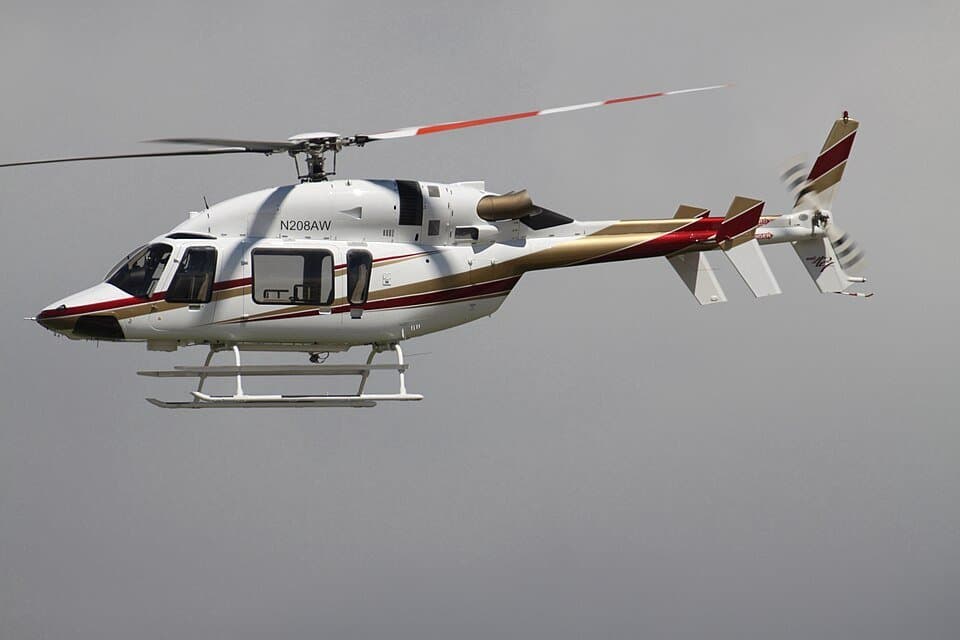


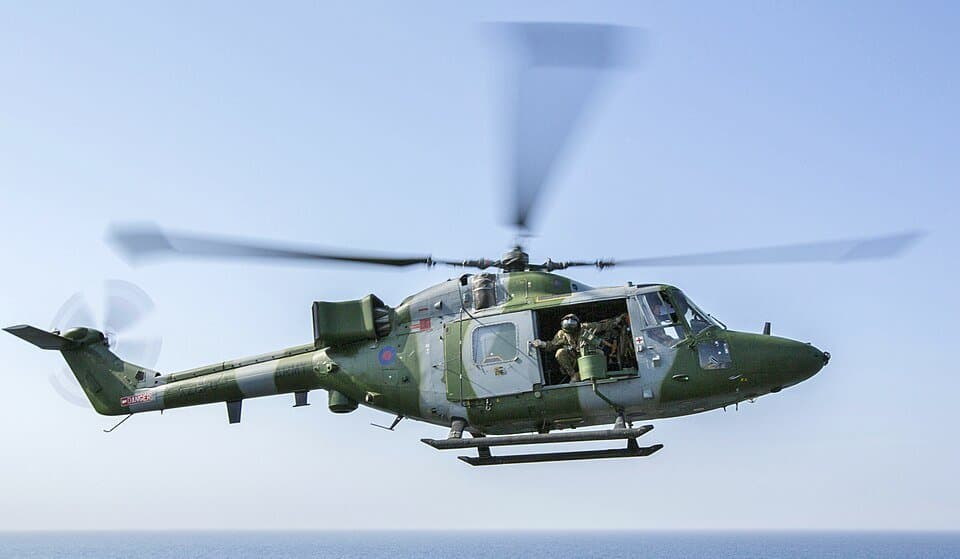
Credit
Aeroprints.com · CC BY-SA 3.0 · Resized · CC BY-SA 3.0 · Source ↗ · Modified


Preparing your view.

At a glance
Measured figures
Bell 427 · Length
Single source37 ft 6 in (11.43 m)[source]
Super Lynx Series 100 · including tail-rotor
Configuration
| Specification | Bell 427 | Westland Lynx |
|---|---|---|
| Type | Multipurpose utility helicopter[source] | Multi-purpose military helicopter[source] |
| National origin | United States/Canada/South Korea[source] | United Kingdom[source] |
| Manufacturer | Bell Helicopter Samsung Aerospace Industries (later part of Korea Aerospace Industries )[source] | Westland Helicopters AgustaWestland[source] |
| Status | In service[source] |
43 ft 9.25 in (13.3414 m) including tail-rotor[source]
Empty; Bell 427 · Empty weight
Single sourceMaximum take-off; Bell 427 · Max takeoff weight
Single source3,881 lb (1,760 kg)[source]
6,550 lb (2,971 kg)[source]
Empty; Super Lynx Series 100 · Empty weight
Single sourceMaximum take-off; Super Lynx Series 100 · Max takeoff weight
Single sourceSuper Lynx Series 100 · Combat range
Single sourceSuper Lynx Series 100 · with 4x Sea Skua Surveillance 3 hours 50 minutes on station
Single sourceSuper Lynx Series 100 · with auxiliary fuel ASW
Single sourceSuper Lynx Series 100 · with dipping sonar + one torpedo and 2 hours on station Point attack
Single source540 nmi (620 mi, 1,000 km) with auxiliary fuel ASW 20 nmi (23 mi; 37 km) with dipping sonar + one torpedo and 2 hours on station Point attack: 125 nmi (144 mi; 232 km) with 4x Sea Skua Surveillance: 75 nmi (86 mi; 139 km) - 3 hours 50 minutes on station[source]
Bell 427 · 2 × Pratt & Whitney Canada PW207D turboshaft engines, 710 shp ( ) each
Single source2 × Pratt & Whitney Canada PW207D turboshaft engines, 710 shp (530 kW) each[source]
Super Lynx Series 100 · 2 × LHTEC CTS800-4N turboshaft engines, 1,362 shp ( ) each for take-off, 1,267 shp (
Single sourceSuper Lynx Series 100 · ) maximum continuous
Single source2 × LHTEC CTS800-4N turboshaft engines, 1,362 shp (1,016 kW) each for take-off, 1,267 shp (945 kW) maximum continuous[source]
Bell 427 · Service ceiling
Single source10,000 ft (3,000 m)[source]
Bell 427 · 2,000 ft/min (
Single source2,000 ft/min (10 m/s)[source]
Super Lynx Series 100 · with auxiliary fuel
Single source5 hours 20 minutes with auxiliary fuel[source]
Bars compare reported quantities only. A larger figure does not make a system better; configurations and test conditions differ.
In service[source]
| Manufactured | 1997–2010[source] | — |
|---|
| Introduction date | 2000[source] | 1978[source] |
|---|
| First flight | 11 December 1997[source] | 21 March 1971[source] |
|---|
| Developed from | Bell 407[source] | — |
|---|
| Developed into | Bell 429 GlobalRanger[source] | Westland 30 AgustaWestland AW159 Wildcat[source] |
|---|
| Capacity | 7 passengers / 2,960 lb (1,343 kg) internal load[source] | 8 troops / 3,000 lb (1,361 kg) maximum underslung load[source] |
|---|
| Main rotor area | 1,075 sq ft (99.9 m 2 )[source] | 1,385.4 sq ft (128.71 m 2 )[source] |
|---|
| Blade section | - root: Boeing VR-7; tip: Narramore 8%[source] | — |
|---|
| Primary users | — | British Army (historical) Royal Navy (historical) German Navy See Operators for others[source] |
|---|
| Number built | — | 450 (as of 2009)[source] |
|---|
| Retired | — | 2011 (Royal Danish Navy) 2012 (Royal Netherlands Navy) 2014 (Royal Norwegian Air Force) 2017 (Royal Navy) 2018 (British Army) 2020 (French Navy)[source] |
|---|
| Fuel capacity | — | 210 imp gal (252 US gal; 955 L) usable internal fuel + optional 75.9 imp gal (91 US gal; 345 L) cabin tank or 2x 97 imp gal (116 US gal; 441 L) ferry tanks[source] |
|---|
| Length overall | — | 50 ft (15.24 m)[source] |
|---|
| Length folded | — | 35 ft 7.25 in (10.85 m)[source] |
|---|
| Width folded | — | 9 ft 7.75 in (2.94 m)[source] |
|---|
| Height folded | — | 10 ft 8 in (3.25 m)[source] |
|---|
| Maximum usable fuel capacity | — | 411 imp gal (494 US gal; 1,868 L)[source] |
|---|
| Blade sections | — | - root: RAE 9648; tip: RAE 9645/9643[source] |
|---|
| Disk loading | — | 41.4 lb/sq ft (202 kg/m 2 ) max[source] |
|---|
| Power/mass | — | 0.1565 shp/lb (0.2573 kW/kg)[source] |
|---|
| Operating weight | — | ASW mission 10,181 lb (4,618 kg) (2x torpedo) ASV mission 9,641 lb (4,373 kg) (2x Sea Skua ) Surveillance and targeting mission 8,174 lb (3,708 kg) SAR mission 8,329 lb (3,778 kg)[source] |
|---|
| Reported operators | — |
|---|