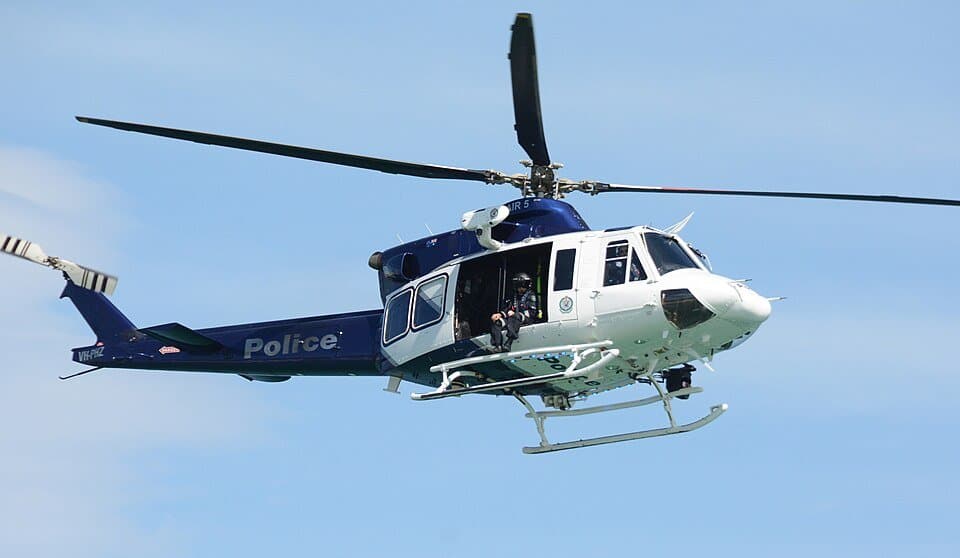


Credit
Sardaka · CC BY-SA 4.0 · Resized · CC BY-SA 4.0 · Source ↗ · Modified


Preparing your view.
At a glance
Measured figures
Bell 412EP · including rotors
Single source56 ft 1 in (17.09 m) including rotors[source]
SH-60B · Length
Configuration
| Specification | Bell 412 | Sikorsky SH-60 Seahawk |
|---|---|---|
| Type | Multipurpose utility helicopter[source] | Utility maritime helicopter[source] |
| National origin | United States / Canada[source] | United States[source] |
| Manufacturer | Bell Helicopter[source] | Sikorsky Aircraft[source] |
| Primary users | Japan Ground Self Defence Force See Operators for others[source] |
64 ft 8 in (19.71 m)[source]
Bell 412EP · 1 × Pratt & Whitney Canada PT6T-3D Twin-Pac or PT6T-3DF Twin-Pac coupled turboshaft engine - each, 1,250 shp (
Single source1 × Pratt & Whitney Canada PT6T-3D Twin-Pac or PT6T-3DF Twin-Pac coupled turboshaft engine - each, 1,250 shp (930 kW)[source]
SH-60B · 2 × General Electric T700-GE-401C turboshaft engines, 1,890 shp ( ) each for take-off
Single source2 × General Electric T700-GE-401C turboshaft engines, 1,890 shp (1,410 kW) each for take-off[source]
Bars compare reported quantities only. A larger figure does not make a system better; configurations and test conditions differ.
United States Navy Royal Australian Navy Turkish Naval Forces Indian Navy[source] |
| Number built | 1,300+[source] | 938[source] |
|---|
| Manufactured | 1979–present[source] | 1979–present[source] |
|---|
| Introduction date | 1981 ( 1981 )[source] | 1984[source] |
|---|
| First flight | August 1979 ( 1979-08 )[source] | 12 December 1979[source] |
|---|
| Developed from | Bell 212[source] | Sikorsky UH-60 Black Hawk[source] |
|---|
| Variant | Bell CH-146 Griffon[source] | — |
|---|
| Capacity | up to 13 passengers, maximum external load of almost 6,614 lb (3,000 kg)[source] | 5 passengers in cabin, slung load of 6,000 lb (2,700 kg) or internal load of 4,100 lb (1,900 kg) for B, F, and H models / 6,684 lb (3,032 kg) payload[source] |
|---|
| Fuselage length | 43 ft (13 m)[source] | — |
|---|
| Blade sections | root: Boeing VR-7; tip: Wortmann FX 71-H-080[source] | — |
|---|
| Main rotor area | 1,662 sq ft (154.4 m 2 )[source] | 2,262.3 sq ft (210.17 m 2 ) * Blade section: root: SC1095/SC1095R8; tip: Sikorsky SC1095[source] |
|---|
| Power/mass | 0.2663 hp/lb (0.4378 kW/kg)[source] | — |
|---|
| Status | — | In service[source] The MH-60S is in production until 2015 and will total a fleet of 275 aircraft, and the MH-60R is in production until 2017 and will total a fleet of 291 aircraft.[source]MH-60S · source-literal variant status |
|---|
| Variants | — | Sikorsky MH-60 Jayhawk Mitsubishi SH-60 Piasecki X-49[source] |
|---|
| Never exceed speed | — | 180 kn (210 mph, 330 km/h)[source] |
|---|
| Role | — | twin turboshaft engine, multi-mission United States Navy helicopter[source] |
|---|
| Source measurement | — | The U.S. Navy acquired H-60 helicopters under the model designations SH-60B , SH-60F , HH-60H , MH-60R , and MH-60S . Able to deploy aboard any air-capable frigate , destroyer , cruiser , fast combat support ship , expeditionary transfer dock , amphibious assault ship , littoral combat ship or aircraft carrier , the Seahawk can handle anti-submarine warfare (ASW), anti-surface warfare (ASUW), naval special warfare (NSW) insertion, search and rescue (SAR), combat search and rescue (CSAR), vertical replenishment (VERTREP), and medical evacuation (MEDEVAC). When entering service, the SH-60B was too large to operate from some of the smaller vessels in service, so it served along with the Kaman SH-2F and SH-2G models until 2001.[source]Sikorsky SH-60 Seahawk · Lead; only the objects and conditions stated in this passage IBM was the prime systems integrator for the Lamps MK III with Sikorsky as the airframe manufacturer. The SH-60B maintained 83% commonality with the UH-60A. The main changes were corrosion protection, more powerful T700 engines, single-stage oleo main landing gear, removal of the left side door, adding two weapon pylons, and shifting the tail landing gear 13 feet (3.96 m) forward to reduce the footprint for shipboard landing. Other changes included larger fuel cells, an electric blade folding system, folding horizontal stabilators for storage, and adding a 25-tube pneumatic sonobuoy launcher on the left side.[source]Sikorsky SH-60 Seahawk · Design and development / SH-60B Seahawk; only the objects and conditions stated in this passage The SH-60B is deployed primarily aboard frigates , destroyers , and cruisers . The primary missions of the SH-60B are surface warfare and anti-submarine warfare. It carries a complex system of sensors, including a towed magnetic anomaly detector (MAD) and air-launched sonobuoys. Other sensors include the APS-124 search radar, ALQ-142 ESM system and optional nose-mounted forward looking infrared (FLIR) turret. Munitions carried include the Mk 46 , Mk 50 , or Mark 54 Lightweight Torpedo , AGM-114 Hellfire missile, and a single cabin-door-mounted M60D / M240 7.62 mm (0.30 in) machine gun, or GAU-16 .50 in (12.7 mm) machine gun.[source]Sikorsky SH-60 Seahawk · Design and development / SH-60B Seahawk; only the objects and conditions stated in this passage After the SH-60B entered service, the Navy conducted a competition to replace the Sikorsky SH-3 Sea King . The competitors were Sikorsky, Kaman and IBM (avionics only). Sikorsky began development of this variant in March 1985. In January 1986, seven SH-60Fs were ordered including two prototypes (BuNos 163282/3). The first example flew on 19 March 1987. The SH-60F was based on the SH-60B airframe, but with upgraded SH-3H avionics.[source]Sikorsky SH-60 Seahawk · Design and development / SH-60F; only the objects and conditions stated in this passage The SH-60F primarily served as the carrier battle group's primary anti-submarine warfare (ASW) aircraft. The helicopter hunted submarines with its AQS-13F dipping sonar , and carried a six-tube sonobuoy launcher. The SH-60F is unofficially named "Oceanhawk". The SH-60F can carry Mk 46 , Mk 50 , or Mk 54 torpedoes for its offensive weapons, and it has a choice of fuselage -mounted machine guns, including the M60D, M240D, and GAU-16 (.50 caliber or 12.7 mm) for self-defense. The standard aircrew is one pilot, one co-pilot, one tactical sensor operator (TSO), and one acoustic sensor operator (ASO). The SH-60F was operated by the U.S. Navy's Helicopter Antisubmarine (HS) squadrons, until they were redesignated Helicopter Sea Combat (HSC) squadrons and transitioned to the MH-60S. The last HS squadron completed its transition in 2016.[source]Sikorsky SH-60 Seahawk · Design and development / SH-60F; only the objects and conditions stated in this passage The HH-60H was developed in conjunction with the US Coast Guard's HH-60J , beginning in September 1986 with a contract for the first five helicopters with Sikorsky as the prime contractor. The variant's first flight occurred on 17 August 1988. Deliveries of the HH-60H began in 1989. The variant earned initial operating capability in April 1990 and was deployed to Desert Storm with HCS-4 and HCS-5 in 1991. The HH-60H's official DoD and Sikorsky name is Seahawk , though it has been called "Rescue Hawk".[source]Sikorsky SH-60 Seahawk · Design and development / HH-60H; only the objects and conditions stated in this passage Based on the SH-60F, the HH-60H is the primary combat search and rescue (CSAR), naval special warfare (NSW) and anti-surface warfare (ASUW) helicopter. It carries various defensive and offensive sensors. These include a FLIR turret with laser designator, and the Aircraft Survival Equipment (ASE) package including the ALQ-144 Infrared Jammer , AVR-2 Laser Detectors, APR-39(V)2 Radar Detectors, AAR-47 Missile Launch Detectors and ALE-47 chaff/flare dispensers. Engine exhaust deflectors provide infrared thermal reduction, reducing the threat of heat-seeking missiles. The HH-60H can carry up to four AGM-114 Hellfire missiles on an extended wing using the M299 launcher, and a variety of mountable guns including M60D, M240, GAU-16 and GAU-17/A machine guns.[source]Sikorsky SH-60 Seahawk · Design and development / HH-60H; only the objects and conditions stated in this passage The HH-60H's standard crew is a pilot, a copilot, an enlisted crew chief, and two door gunners or one rescue swimmer. Originally operated by HCS-5 and HCS-4 (later HSC-84), these two special USNR squadrons were established with the primary mission of Naval Special Warfare and Combat Search and Rescue (CSAR). Due to SOCOM budget issues, the squadrons were deactivated in 2006 and 2016 respectively. The HH-60H was also operated by Helicopter Antisubmarine (HS) squadrons, with a standard dispersal of six F-models and two or three H-models, before the transition of HS squadrons to HSC squadrons equipped with the MH-60S, the last of which completed its transition in 2016. The only squadron equipped with the HH-60H as of 2016 is HSC-85 , one of only two remaining USNR helicopter squadrons, the other being HSM-60 equipped with the MH-60R. In Iraq, HH-60Hs were used by the Navy, assisting the Army, for MEDEVAC purposes and special operations missions.[source]Sikorsky SH-60 Seahawk · Design and development / HH-60H; only the objects and conditions stated in this passage The MH-60R is designed to combine the features of the SH-60B and SH-60F. Its avionics includes dual controls and instead of the complex array of dials and gauges in Bravo and Foxtrot aircraft, 4 fully integrated 8 in × 10 in (200 mm × 250 mm) night vision goggle -compatible and sunlight-readable color multi-function displays , all part of the glass cockpit produced by Owego Helo Systems division of Lockheed Martin . Onboard sensors include: AAR-47 Missile Approach Warning System by ATK, Raytheon AAS-44 electro-optical system that integrates FLIR and laser rangefinder , ALE-39 decoy dispenser and ALQ-144 infrared jammer by BAE Systems , ALQ-210 electronic support measures system by Lockheed Martin, APS-147 multi-mode radar/IFF interrogator, which during a mid-life technology insertion project is replaced by APS-153 Multi-Mode Radar with Automatic Radar Periscope Detection and Discrimination (ARPDD) capability.[source]Sikorsky SH-60 Seahawk · Design and development / MH-60R; only the objects and conditions stated in this passage Both radars were developed by Telephonics , a more advanced AN/AQS-22 advanced airborne low-frequency sonar (ALFS) jointly developed by Raytheon & Thales , an ARC-210 voice radio by Rockwell Collins , an advanced airborne fleet data link SRQ-4 Hawklink with radio terminal set ARQ-59 radio terminal, both by L3Harris , and LN-100G dual-embedded global positioning system and inertial navigation system by Northrop Grumman Litton division. Beginning in 2020, CAE's MAD-XR were fielded on MH-60Rs, providing it with a magnetic anomaly detector.[source]Sikorsky SH-60 Seahawk · Design and development / MH-60R; only the objects and conditions stated in this passage It is the first US Navy helicopter to field a glass cockpit , relaying flight information via four digital monitors. The primary means of defense is door-mounted machine guns such as the M60D, M240D, or GAU-17/A. A "batwing" Armed Helo Kit based on the Army's UH-60L was developed to accommodate Hellfire missiles, Hydra 70 mm (2.75 inch) rockets, or larger guns. The MH-60S can be equipped with a nose-mounted forward looking infrared (FLIR) turret to be used in conjunction with Hellfire missiles. It carries the ALQ-144 Infrared Jammer.[source]Sikorsky SH-60 Seahawk · Design and development / MH-60S; only the objects and conditions stated in this passage The SH-60B Seahawk completed its last active-duty deployment for the U.S. Navy in late April 2015 after a seven-month deployment aboard USS Gary . After 32 years and over 3.6 million hours of service, the SH-60B was formally retired from U.S. Navy service during a ceremony on 11 May 2015 at Naval Air Station North Island . In late November 2015 USS Theodore Roosevelt returned from its deployment, ending the last active-duty operational deployment of both the SH-60F and HH-60H. The models are to be transferred to other squadrons or placed in storage.[source]Sikorsky SH-60 Seahawk · Operational history / U.S. Navy; only the objects and conditions stated in this passage As per Ministry of Defence reports on 26 December 2024, the first nine helicopters were delivered and put into service on the fleet ships. The helicopters took part in exercises like MALABAR , SIMBEX and MILAN 24 in the year.[source]Sikorsky SH-60 Seahawk · Operational history / Indian Navy; only the objects and conditions stated in this passage HH-60H "Rescue Hawk" : Search-and-rescue helicopter for the U.S. Navy; 45 built.[source]Sikorsky SH-60 Seahawk · Variants / U.S. variants; only the objects and conditions stated in this passage HH-60J/MH-60T Jayhawk : U.S. Coast Guard variant. The HH-60J was developed with the HH-60H, the MH-60T is an upgrade to the HH-60J. 42 of the HH-60H were built, all of which were eventually upgraded to MH-60T.[source]Sikorsky SH-60 Seahawk · Variants / U.S. variants; only the objects and conditions stated in this passage S-70B Seahawk : Sikorsky's designation for Seahawk. Designation is often used for exports. S-70B-1 Seahawk: Anti-submarine variant for the Spanish Navy . The Seahawk is configured with the LAMPS (Light Airborne Multipurpose System) S-70B-2 Seahawk: Anti-submarine variant for the Royal Australian Navy , similar to the SH-60B Seahawk in U.S. Navy operation. S-70B-3 Seahawk: Anti-submarine variant for the Japanese Maritime Self-Defense Force. Also known as the SH-60J . The JMSDF ordered 101 units, with deliveries starting in 1991. S-70-4 Seahawk: Sikorsky's designation for the SH-60F Oceanhawk. S-70-5: Sikorsky's designation for the HH-60H Rescue Hawk and HH-60J Jayhawk. S-70B-6 Aegean Hawk: the Greek military variant which is a blend of the SH-60B and F models, based on Republic of China (Taiwan) Navy's S-70C(M)1/2. S-70B-7 Seahawk: Export variant for the Royal Thai Navy . S-70B-28 Seahawk: Export variant for Turkey.[source]Sikorsky SH-60 Seahawk · Variants / Export variants; only the objects and conditions stated in this passage Capacity: 5 passengers in cabin, slung load of 6,000 lb (2,700 kg) or internal load of 4,100 lb (1,900 kg) for B, F, and H models / 6,684 lb (3,032 kg) payload[source]Sikorsky SH-60 Seahawk · Specifications (SH-60B); only the objects and conditions stated in this passage Length: 64 ft 8 in (19.71 m)[source]Sikorsky SH-60 Seahawk · Specifications (SH-60B); only the objects and conditions stated in this passage Height: 17 ft 2 in (5.23 m)[source]Sikorsky SH-60 Seahawk · Specifications (SH-60B); only the objects and conditions stated in this passage Empty weight: 15,200 lb (6,895 kg)[source]Sikorsky SH-60 Seahawk · Specifications (SH-60B); only the objects and conditions stated in this passage Gross weight: 17,758 lb (8,055 kg) for ASW mission[source]Sikorsky SH-60 Seahawk · Specifications (SH-60B); only the objects and conditions stated in this passage Max takeoff weight: 21,884 lb (9,926 kg)[source]Sikorsky SH-60 Seahawk · Specifications (SH-60B); only the objects and conditions stated in this passage Powerplant: 2 × General Electric T700-GE-401C turboshaft engines, 1,890 shp (1,410 kW) each for take-off[source]Sikorsky SH-60 Seahawk · Specifications (SH-60B); only the objects and conditions stated in this passage Main rotor diameter: 53 ft 8 in (16.36 m)[source]Sikorsky SH-60 Seahawk · Specifications (SH-60B); only the objects and conditions stated in this passage Main rotor area: 2,262.3 sq ft (210.17 m 2 ) * Blade section: root: SC1095/SC1095R8; tip: Sikorsky SC1095[source]Sikorsky SH-60 Seahawk · Specifications (SH-60B); only the objects and conditions stated in this passage Maximum speed: 146 kn (168 mph, 270 km/h)[source]Sikorsky SH-60 Seahawk · Specifications (SH-60B); only the objects and conditions stated in this passage Never exceed speed : 180 kn (210 mph, 330 km/h)[source]Sikorsky SH-60 Seahawk · Specifications (SH-60B); only the objects and conditions stated in this passage Range: 450 nmi (520 mi, 830 km)[source]Sikorsky SH-60 Seahawk · Specifications (SH-60B); only the objects and conditions stated in this passage Service ceiling: 12,000 ft (3,700 m)[source]Sikorsky SH-60 Seahawk · Specifications (SH-60B); only the objects and conditions stated in this passage Rate of climb: 1,650 ft/min (8.4 m/s)[source]Sikorsky SH-60 Seahawk · Specifications (SH-60B); only the objects and conditions stated in this passage AGM-114 Hellfire missile , 4 Hellfire missiles for SH-60B and HH-60H and MH-60R, 8 Hellfire missiles for MH-60S Block III.[source]Sikorsky SH-60 Seahawk · Specifications (SH-60B); only the objects and conditions stated in this passage Rapid Airborne Mine Clearance System (RAMICS) using Mk 44 Mod 0 30 mm Cannon[source]Sikorsky SH-60 Seahawk · Specifications (SH-60B); only the objects and conditions stated in this passage |
|---|
| Country of origin | — | United States[source]Inventory Origin column; table 1, row 11, cell 2; revision 1375018706; retrieved 2026-10-02 |
|---|
Maximum take-off; SH-60B · Max takeoff weight
Single source