Credit
Sardaka · CC BY-SA 4.0 · Resized · CC BY-SA 4.0 · Source ↗ · Modified


Preparing your view.
BHelicopters
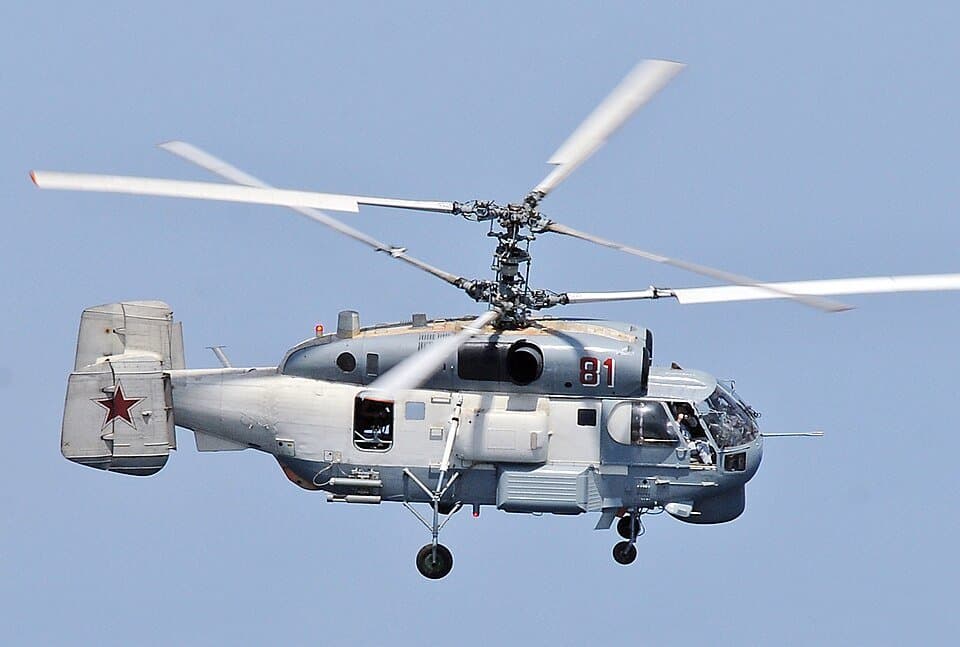
Anti-submarine warfare helicopter (Ka-27/Ka-28) Attack helicopter with transport capabilities (Ka-29) Civilian utility helicopter (Ka-32)
At a glance
Measured figures
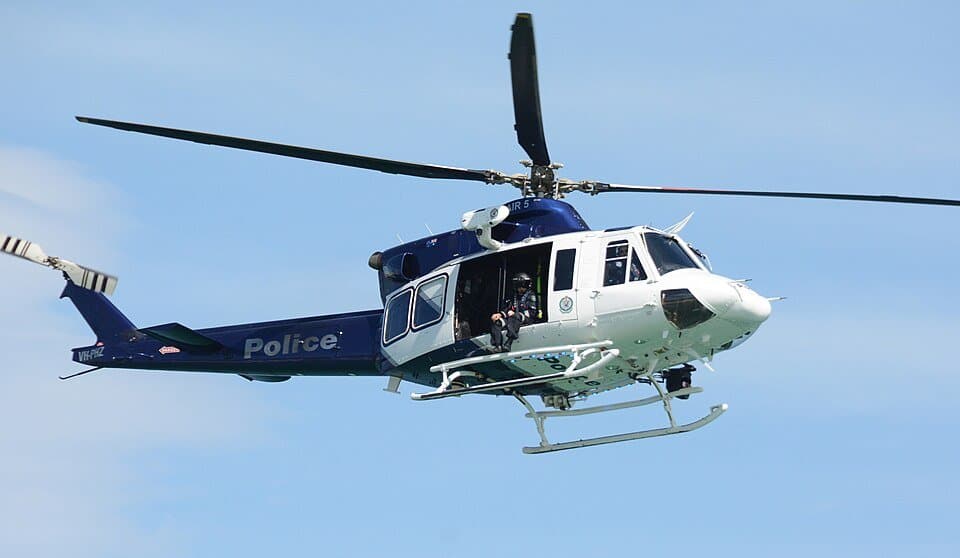
Bell 412EP · including rotors
Single source56 ft 1 in (17.09 m) including rotors[source]
Ka-27 · Length
Single sourceConfiguration
| Specification | Bell 412 | Kamov Ka-27 |
|---|---|---|
| Crew | one-two pilots[source] | one-three, plus two-three specialists (Ka-27)[source] |
| Type | Multipurpose utility helicopter[source] | Anti-submarine warfare helicopter (Ka-27/Ka-28) Attack helicopter with transport capabilities (Ka-29) Civilian utility helicopter (Ka-32)[source] |
| National origin | United States / Canada[source] | Soviet Union / Russia[source] |
| Manufacturer | Bell Helicopter[source] |
11.3 m (37 ft 1 in)[source]
Bell 412EP · 1 × Pratt & Whitney Canada PT6T-3D Twin-Pac or PT6T-3DF Twin-Pac coupled turboshaft engine - each, 1,250 shp (
Single source1 × Pratt & Whitney Canada PT6T-3D Twin-Pac or PT6T-3DF Twin-Pac coupled turboshaft engine - each, 1,250 shp (930 kW)[source]
Ka-27 · 2 × Isotov TV3-117V turboshaft engines each
Single source2 × Isotov TV3-117V turboshaft engines, 1,660 kW (2,230 hp) each[source]
Bell 412EP · 1,350 ft/min (
Single source1,350 ft/min (6.9 m/s)[source]
Bars compare reported quantities only. A larger figure does not make a system better; configurations and test conditions differ.
Kamov[source]
| Primary users | Japan Ground Self Defence Force See Operators for others[source] | Soviet Navy (historical) Russian Navy Ukrainian Navy Indian Navy[source] |
|---|
| Number built | 1,300+[source] | — |
|---|
| Manufactured | 1979–present[source] | 1979–2010[source] |
|---|
| Introduction date | 1981 ( 1981 )[source] | 1982[source] |
|---|
| First flight | August 1979 ( 1979-08 )[source] | 24 December 1973[source] |
|---|
| Developed from | Bell 212[source] | Kamov Ka-25[source] |
|---|
| Variant | Bell CH-146 Griffon[source] | Kamov Ka-31[source] |
|---|
| Capacity | up to 13 passengers, maximum external load of almost 6,614 lb (3,000 kg)[source] | 4,000 kg (8,818 lb) payload (Ka-32), or up to 16 troops (Ka-29).[source] |
|---|
| Fuselage length | 43 ft (13 m)[source] | — |
|---|
| Blade sections | root: Boeing VR-7; tip: Wortmann FX 71-H-080[source] | — |
|---|
| Main rotor area | 1,662 sq ft (154.4 m 2 )[source] | 392.2 m 2 (4,222 sq ft) 3-bladed contra-rotating rotors[source] |
|---|
| Power/mass | 0.2663 hp/lb (0.4378 kW/kg)[source] | — |
|---|
| Status | — | In service[source] |
|---|
| Role | — | military helicopter[source] |
|---|
| Source measurement | — | The Ka-27PS search and rescue helicopter can carry 12 folding seats or four stretchers in its cabin, and is equipped with a 300 kg (660 lb) winch. Its fuel capacity of 3,450 litres (910 US gal; 760 imp gal) is greater than the 2,940-litre (780 US gal; 650 imp gal) capacity of the Ka-27PL.[source]Kamov Ka-27 · Design and development; only the objects and conditions stated in this passage Ka-32 variants, e.g. the Klimov-powered Ka-32A11BC, have been certified for commercial operations throughout the world, notably in Canada and Europe. The Ka-32 has been certified for the newer Klimov VK-2500 PS-02 engine.[source]Kamov Ka-27 · Design and development; only the objects and conditions stated in this passage The Ka-32A11BC features a high power-to-weight ratio and ease of handling, owing to its coaxial rotor design. The rotors' diameters are not restricted by the presence of a tail rotor and associated tail boom; this facilitates maneuvering near obstacles and helps assure exceptional accuracy when hovering in heavy smoke and dust conditions. The Ka-32A11BC may be equipped with the Bambi Bucket suspended fire-fighting system of up to five tons capacity. The service life has been extended to up to 32,000 flight hours.[source]Kamov Ka-27 · Operational history; only the objects and conditions stated in this passage In 2013, Russia tested the new Kamov Ka-27M with an active electronically scanned array radar. The basis of the modernization of the Ka-27M is installed on the helicopter airborne radar with an active phased array antenna FH-A. This radar is part of the command and tactical radar system that combines several other systems: acoustic, magnetometric, signals intelligence and radar. All the information on them is displayed on the display instrumentation.[source]Kamov Ka-27 · Operational history; only the objects and conditions stated in this passage Ka-27PS[source]Kamov Ka-27 · Variants / Military; only the objects and conditions stated in this passage (Helix-D) Search and rescue helicopter, ASW equipment removed and winch fitted. Fitted with 300 kg (660 lb) rescue hoist and hooks under fuselage for loads up to 5,000 kg (11,000 lb).[source]Kamov Ka-27 · Variants / Military; only the objects and conditions stated in this passage Armed version of the Ka-27PS.[source]Kamov Ka-27 · Variants / Military; only the objects and conditions stated in this passage Ka-27M[source]Kamov Ka-27 · Variants / Military; only the objects and conditions stated in this passage The latest modification of the helicopter, equipped with radar and tactical command systems that include the following systems: acoustic sensors, magnetometric sensors, signals intelligence, and FH-A radar with active phased array antenna. The radar is mounted under the fuselage and provides all-around vision in the search and detection of surface, air, and ground targets. Serial upgrading of Ka-27Ms to the level of combatant helicopters was planned to begin in 2014. By the end of 2016, 46 Ka-27PLs had been scheduled for modernization, commissioned by the Russian Navy. The first eight serial Ka-27M were transferred in December 2016. Mass production approved in June 2017 and started in early 2018. A new delivery of 5 helicopters arrived in October 2018. Half of the fleet is modernized as of December 2018. Variant reportely carried on modernized battlecruiser Admiral Nakhimov as of 2026[source]Kamov Ka-27 · Variants / Military; only the objects and conditions stated in this passage (Helix-A) Export version of the Ka-27PL. Max takeoff weight increased to 12,000 kg (26,000 lb), as well max fuel and range also increased.[source]Kamov Ka-27 · Variants / Military; only the objects and conditions stated in this passage (Helix-B) Assault transport armored helicopter, operated from amphibious landing ships or aircraft carriers, with accommodation for two pilots and 16 troops. Equipped with 4 suspensions to carry rockets, guns, bombs and anti-tank missiles. Production began circa 1984 and over 60 were produced. It entered Soviet service in 1987. Other provisions include a single four-barreled 7.62 mm machine gun or 30 mm Shipunov 2A42 . Currently under re-activation and upgrade with changed engines and installed modern arms and electronics, among others.[source]Kamov Ka-27 · Variants / Military; only the objects and conditions stated in this passage Ka-32 Ka-32 pre-production prototype (1985): Exhibited at the 36th Paris Airshow in 1985 . Ka-32C (198x): Little-known custom version. Ka-32T (1987): (Helix-C) Utility transport helicopter, with accommodation for two crew and 16 passengers. Ka-32A (1990): Civil transport helicopter. Initial production version. Ka-32A1 (1994): Fire fighting helicopter, equipped with a helicopter bucket . Ka-32A2 (1994): Police version, equipped with two searchlights and a loudspeaker. Can carry 11 passengers. Ka-32A7 (1994): Armed version of the Ka-27PS. Can carry 13 passengers. Has provisions to carry 2 x GSh-23L 23mm cannons, B-8V-20 rocket pods, 2 x Kh-35 anti-ship missiles or Kh-25 air-to-air missiles. Ka-32A12 (1996): Swiss-registered and approved version. Ka-32A11BC (1997): Canadian, Chinese, European-certified version with Klimov TV3-117MA engines and Glass Cockpit. Used by Pegasus Air Services , Indonesia. Ka-32A11M (2012) Ka-32A4 (1999): Special search and rescue, salvage and evacuation version. Ka-32K (1991): Flying crane helicopter, fitted with a retractable gondola for a second pilot.[source]Kamov Ka-27 · Variants / Civil; only the objects and conditions stated in this passage Ka-32M: Projected development with 1839kW TV3-117VMA-SB3 engines. Probably replaced by the Ka-32-10 project.[source]Kamov Ka-27 · Variants / Civil; only the objects and conditions stated in this passage Korea Forest Service (29 in service)[source]Kamov Ka-27 · Operators / Military and government operators; only the objects and conditions stated in this passage Capacity: 4,000 kg (8,818 lb) payload (Ka-32), or up to 16 troops (Ka-29).[source]Kamov Ka-27 · Specifications (Ka-27); only the objects and conditions stated in this passage Length: 11.3 m (37 ft 1 in)[source]Kamov Ka-27 · Specifications (Ka-27); only the objects and conditions stated in this passage Height: 5.5 m (18 ft 1 in)[source]Kamov Ka-27 · Specifications (Ka-27); only the objects and conditions stated in this passage Empty weight: 6,500 kg (14,330 lb)[source]Kamov Ka-27 · Specifications (Ka-27); only the objects and conditions stated in this passage Gross weight: 11,000 kg (24,251 lb)[source]Kamov Ka-27 · Specifications (Ka-27); only the objects and conditions stated in this passage Max takeoff weight: 12,000 kg (26,455 lb)[source]Kamov Ka-27 · Specifications (Ka-27); only the objects and conditions stated in this passage Powerplant: 2 × Isotov TV3-117V turboshaft engines, 1,660 kW (2,230 hp) each[source]Kamov Ka-27 · Specifications (Ka-27); only the objects and conditions stated in this passage Main rotor diameter: 2 × 15.8 m (51 ft 10 in)[source]Kamov Ka-27 · Specifications (Ka-27); only the objects and conditions stated in this passage Main rotor area: 392.2 m 2 (4,222 sq ft) 3-bladed contra-rotating rotors[source]Kamov Ka-27 · Specifications (Ka-27); only the objects and conditions stated in this passage Maximum speed: 270 km/h (170 mph, 150 kn)[source]Kamov Ka-27 · Specifications (Ka-27); only the objects and conditions stated in this passage Cruise speed: 205 km/h (127 mph, 111 kn)[source]Kamov Ka-27 · Specifications (Ka-27); only the objects and conditions stated in this passage Range: 980 km (610 mi, 530 nmi)[source]Kamov Ka-27 · Specifications (Ka-27); only the objects and conditions stated in this passage Service ceiling: 5,000 m (16,000 ft)[source]Kamov Ka-27 · Specifications (Ka-27); only the objects and conditions stated in this passage 1 × torpedoes ( AT-1M , VTT-1 , UMGT-1 Orlan , APR-2 Yastreb ) or 36 RGB-NM & RGB-NM-1 sonobuoys[source]Kamov Ka-27 · Specifications (Ka-27); only the objects and conditions stated in this passage 1 × 30 mm 2A42 cannon with 250 rounds (flexible semi-rigid mount, optional/removable with ammunition carried in cabin)[source]Kamov Ka-27 · Specifications (Ka-27); only the objects and conditions stated in this passage |
|---|
| Origin reported by inventory | — | Soviet Union[source]Inventory Origin column; table 1, row 8, cell 2; revision 1373626114; retrieved 2026-10-01 |
|---|
Maximum take-off; Ka-27 · Max takeoff weight
Single source